X-Ray Food Inspection Explained and Why It Matters
X-ray food inspection employs advanced technology to see inside packaged goods non-destructively. This process is crucial for modern food production. Its primary function is to identify foreign materials and verify product quality before items ship to consumers.
Physical contaminants like plastic and metal remain a leading cause of food recalls across the US and Europe. Effective x ray detection for food directly addresses this critical safety issue. The global market for this equipment is projected to grow at a Compound Annual Growth Rate (CAGR) of over 7%, highlighting its increasing adoption by manufacturers to protect brand integrity and public health.
How Does X-Ray Inspection Work?
X-ray inspection technology might sound complex, but its operation relies on a straightforward and elegant process. A system passes food products through a controlled X-ray beam, creating an internal view that allows for detailed analysis before the product ever leaves the factory.
The Basic Principle
At its core, an X-ray inspection system functions much like a medical X-ray. It uses density differences to create a picture. The machine directs a beam of low-energy X-rays toward a product moving along a conveyor belt. A detector, or sensor, on the opposite side of the product measures the amount of X-ray energy that passes through.
A typical system integrates several key components to achieve this:
- An X-ray generator to produce the beam
- A highly sensitive detector to capture the image data
- A powerful computer with specialized software to analyze the results
Denser materials absorb more X-ray energy. Contaminants like metal, glass, or stone are much denser than most food products. They block more X-rays, casting a darker "shadow" on the detector.
Note: This principle of differential absorption is the key. The system creates a grayscale image of the food item, where denser, unwanted objects appear as darker areas, making them visible to the machine's software.
From Image to Rejection
Creating the image is only the first step. The system's computer then uses sophisticated software to analyze it in real-time. Advanced algorithms, including AI and deep learning models, process the image. They enhance its contrast, reduce visual noise, and scan for anomalies that deviate from the product's standard profile. This software can identify the unique signatures of contaminants or other quality defects.
Once the software flags a product, it sends an immediate signal to an automated rejection mechanism. This device removes the faulty item from the production line without stopping the flow. The type of mechanism depends on the product.
| Rejection Mechanism | Best For |
|---|---|
| Pneumatic Air Jet | Lightweight or fragile items |
| Pusher Arm | Mid-weight, sturdy packaged goods |
| Retracting Conveyor | Bulk or heavy products |
This entire process, from scan to potential rejection, happens in a fraction of a second, ensuring both safety and production efficiency.
The Importance of X-Ray Detection for Food
X-ray inspection provides a powerful layer of protection in the food supply chain. Its ability to identify hazards invisible to the human eye makes it an essential tool for brand protection and consumer safety. The technology's value extends far beyond simple metal detection, offering a more comprehensive view of product safety.
What Contaminants Can It Find?
An X-ray system's primary strength is its ability to detect contaminants based on density. Any foreign object denser than the food product it is in will appear on the X-ray image, allowing the system to identify it. This makes x ray detection for food exceptionally effective at finding a wide range of physical hazards.
Modern systems can detect incredibly small foreign bodies. The minimum detectable size varies by the contaminant's material and density.
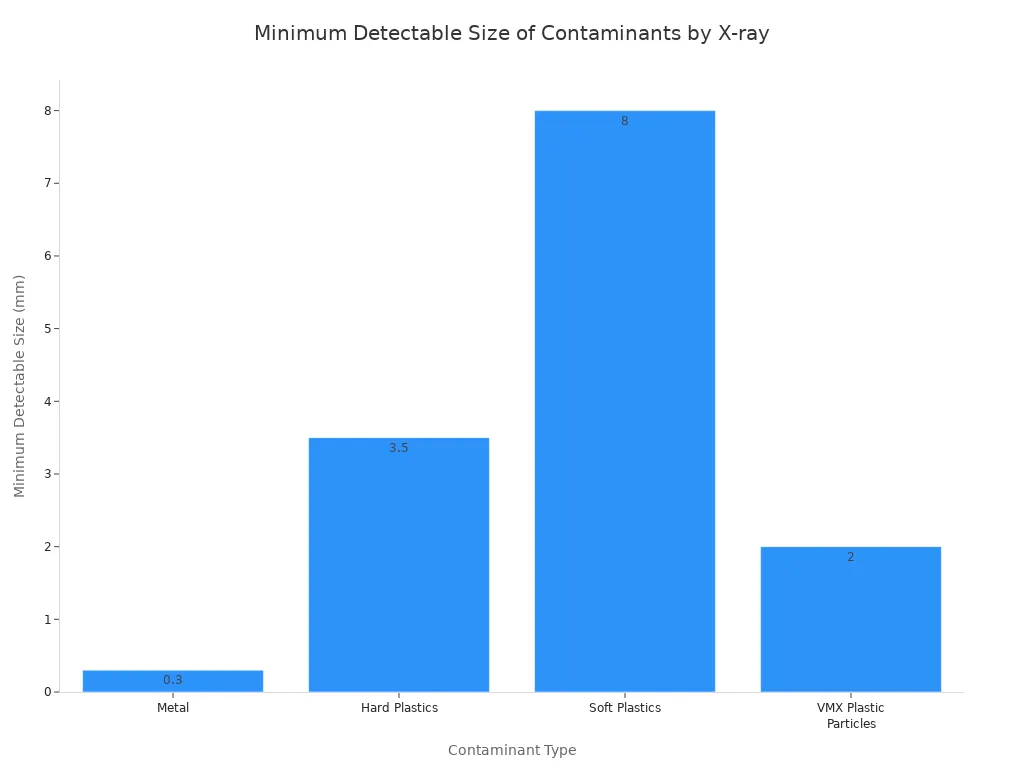
Beyond these common materials, X-ray inspection excels at finding other high-density contaminants, including:
- Mineral Stone: Systems can identify stones in bulk products like potatoes or pumped goods like soups and jams.
- Glass Fragments: X-ray machines are highly efficient at detecting glass shards, a critical safety concern.
- High-Density Rubber and Plastic: Dense rubber or plastic compounds from processing equipment can be found in products ranging from ground meat to hash browns.
In the meat and poultry industry, bone fragment detection is a major application. X-ray systems can identify various types of calcified bone that pose a risk to consumers. Detectable fragments include:
- Calcified bones as small as 1.0mm
- Poultry remnants like wishbones, fan bones, and rib bones (often 2.0mm)
- Other small, hard, or low-calcified bone fragments
What Contaminants Can It Not Find?
X-ray inspection technology is powerful, but it has limitations. The system's reliance on density means it cannot reliably detect contaminants that have a similar or lower density than the food product itself. These low-density materials absorb very little X-ray energy and do not create a distinct shadow on the detector.
Common contaminants that are difficult or impossible for X-ray systems to find include:
- Hair and insects
- Wood splinters and cardboard
- Low-density plastics
- Cartilage
It is important to note that many of these low-density items, such as wood, plastic, hair, and insects, are frequently reported as sources of contamination by consumers. This underscores the need for manufacturers to use X-ray inspection as part of a comprehensive food safety program that includes other controls.
Advantages Over Metal Detectors
Many food processing plants have traditionally relied on metal detectors. While useful, metal detectors have significant limitations that X-ray systems overcome. This makes x ray detection for food a superior solution in many modern production environments.
One major advantage is the elimination of "product effect." Products with high salt or moisture content (like meats, cheeses, and sauces) are conductive. This conductivity can trigger false alarms in a metal detector. To prevent this, operators often must decrease the detector's sensitivity, which increases the risk of missing a real metal contaminant. X-ray systems are completely unaffected by a product's temperature, salt, or moisture levels, ensuring consistent and reliable detection without false rejects.
Another key benefit relates to packaging. Metal detectors cannot inspect products packaged in aluminum foil or metallized film, as the packaging itself triggers the detector. X-ray systems see right through this type of packaging to inspect the contents inside.
| Scenario | Metal Detector Capability | X-ray Detector Capability |
|---|---|---|
| Metal in Foil Packaging | Cannot detect (foil is seen as a contaminant) | Can detect (sees through packaging) |
| Aluminum Contaminants | Good detection (high conductivity) | Less effective (low density) |
| Stainless Steel | Good detection | Excellent detection (high density) |
Finally, X-ray systems offer a broader range of detection. While metal detectors are limited to finding metal, X-ray machines can identify metals (both ferrous and non-ferrous), glass, stone, calcified bone, and high-density plastics. This provides a far more comprehensive safety check in a single inspection step.
More Than Just Contaminant Detection
Modern X-ray systems offer far more than just finding foreign objects. They serve as powerful quality control tools that inspect multiple product attributes simultaneously, protecting brand reputation and ensuring consumer satisfaction.
Ensuring Product Integrity
Product integrity involves ensuring the item is in its intended form. Advanced X-ray technology helps maintain this standard. For example, in powdered products like flour or spices, the system can differentiate between harmless ingredient clumps and actual contaminants. It also inspects for packaging defects. An X-ray machine can identify issues that compromise the product, such as:
- Damaged packaging
- Improperly sealed products
This capability prevents spoiled or compromised goods from ever reaching store shelves.
Verifying Fill Levels and Mass
Accurate portioning is essential for regulatory compliance and customer trust. X-ray systems excel at this task with remarkable precision. They verify liquid fill levels in cans and bottles, often with an accuracy of +/- 0.75 mm. This ensures every container meets its stated volume.
For solid products, the technology performs mass estimation.
In the dairy industry, an X-ray system can inspect cheese blocks for internal voids or pockets of liquid. This check guarantees that customers receive the correct weight and a high-quality product. This function makes x ray detection for food a comprehensive quality assurance tool.
Identifying Missing or Broken Items
X-ray inspection sees what the human eye cannot, even through sealed packaging. This allows manufacturers to identify damaged goods before they ship. One cracker company, for instance, used X-ray technology to solve customer complaints about broken crackers inside sealed packages.
The technology also verifies that all components are present. A system can count items within a package to confirm a multi-pack is complete. It can also check for the presence of promotional items, like a toy in a cereal box or an instruction leaflet, ensuring the final product is exactly as intended.
Is X-Ray Food Inspection Safe?
The word "radiation" often raises concerns, but when it comes to X-ray food inspection, the process is overwhelmingly safe for both the food products and the machine operators. Decades of scientific research and robust engineering have created a technology that is both effective and harmless. The safety measures are comprehensive, addressing every aspect of the system’s operation.
Safety for the Food
A primary question for consumers and manufacturers is whether X-ray inspection affects the food itself. The answer is a definitive no. Food that passes through an X-ray inspection system is just as safe, wholesome, and nutritious as it was before.
The key reason is the extremely low level of radiation used. The dose is minimal and the exposure time lasts for only a fraction of a second. The energy passes through the food without being retained, meaning the food does not become radioactive.
To put this in perspective, it is helpful to compare inspection with food irradiation, a separate process that uses much higher energy levels to pasteurize food and kill bacteria. Even this high-dose process is approved and regulated by global health bodies.
The U.S. Food and Drug Administration (FDA) and the European Food Safety Authority (EFSA) have established clear regulations for food irradiation. The FDA permits its use on a wide range of products to control pathogens and extend shelf life.
| Food Product | Irradiation Application | Irradiation dose limitation (kGy) |
|---|---|---|
| Fresh, non-heated processed pork | Pathogen control | 0.3-1.0 |
| Fresh/frozen uncooked poultry products | Pathogen control | 3 |
| Refrigerated, uncooked meat products | Pathogen control | 4.5 |
| Fresh/frozen molluscan shellfish | Pathogen control | 5.5 |
| Seeds for sprouting | Pathogen control | 8 |
| Dry or dehydrated spices and food seasonings | Microbial disinfection | 30 |
| Pet food, animal feed | Pathogen control | 50 |
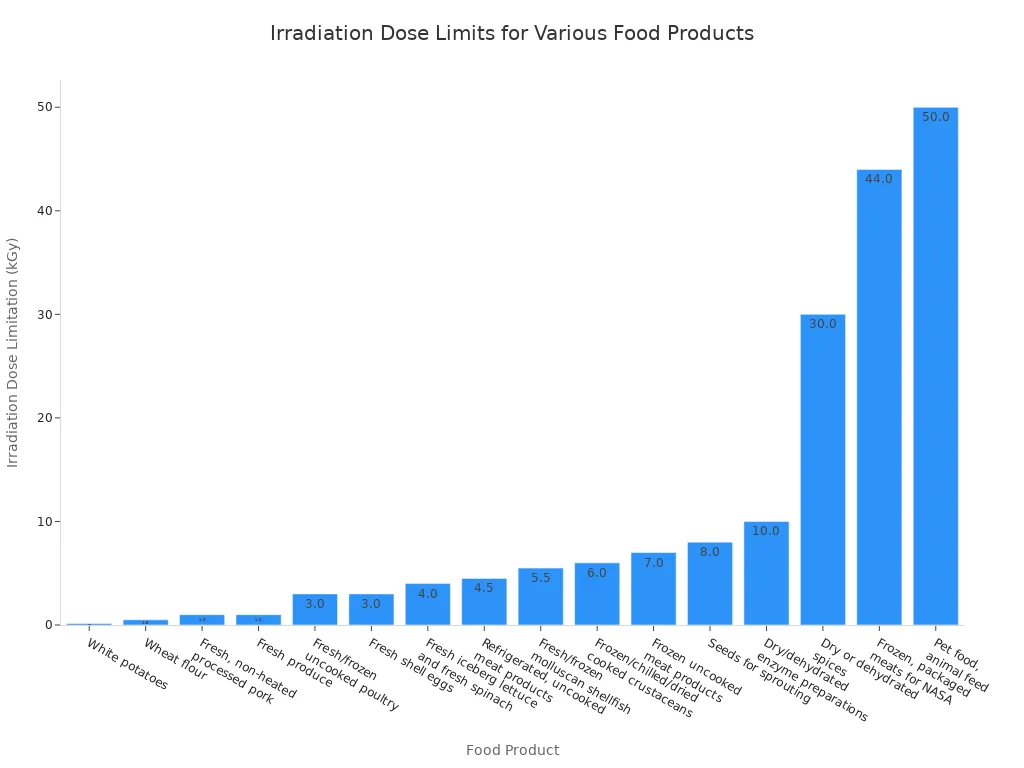
The radiation dose from an inspection system is millions of times lower than these approved irradiation levels. A joint study by the World Health Organization (WHO), FAO, and IAEA confirmed that food remains safe and nutritionally unchanged even at doses far exceeding those used for irradiation. The WHO concluded that foods irradiated at any dose appropriate to achieve the intended technological objective are both safe to consume and nutritionally adequate. This makes the negligible dose from x ray detection for food completely safe.
Safety for the Operators
Protecting the health of employees is a top priority for manufacturers. X-ray inspection systems are designed with multiple layers of redundant safety features to ensure operators are not exposed to harmful radiation. These systems must comply with rigorous international and national standards.
Regulatory bodies provide comprehensive oversight for workplace radiation safety. In the United States, the Occupational Safety and Health Administration (OSHA) sets the standards for protecting workers from ionizing radiation sources like X-ray equipment.
Key regulatory and advisory bodies include:
- International: International Atomic Energy Agency (IAEA) and International Commission on Radiological Protection (ICRP).
- National (U.S.): Occupational Safety and Health Administration (OSHA), National Council on Radiation Protection and Measurements (NCRP), and the Environmental Protection Agency (EPA).
These organizations all operate under the guiding principle of ALARA, which stands for "As Low As Reasonably Achievable." This philosophy ensures that radiation exposure is kept to an absolute minimum. Modern X-ray systems are engineered to produce virtually zero leakage, keeping operators safe at all times.
This high level of safety is achieved through robust machine design and shielding.
- Shielding Materials: Systems are built within thick, dense materials like stainless steel. High-density materials like lead and dense concrete are used to line cabinets and block X-rays from escaping.
- Design Features: Machines include leaded curtains at the entrance and exit tunnels to contain the X-ray beam. They are also equipped with interlock systems, which automatically shut off the X-ray generator if an access panel is opened, preventing any accidental exposure.
The radiation dose an operator might receive while standing next to a properly functioning machine for a full year is often less than the background radiation a person absorbs during a single cross-country flight. This makes x ray detection for food one of the safest technologies on the production floor.
X-ray inspection stands as a critical technology for protecting consumers from harmful physical contaminants. It plays a vital role in modern food production, enhancing both food safety and overall product quality to prevent costly recalls and legal consequences. As innovations like AI continue to advance the field, x ray detection for food becomes an even more indispensable and effective tool. Its implementation ensures the food reaching our shelves is safe to eat.
FAQ
Does X-ray inspection make food radioactive?
No. The energy levels are extremely low. They pass through the food without being absorbed or retained. The food remains completely safe and does not become radioactive. Its nutritional value, taste, and texture are unchanged.
Are X-ray inspection systems expensive?
The initial investment can be significant. However, these systems protect brand reputation and prevent costly recalls. The long-term return on investment from enhanced safety and quality control often justifies the expense for manufacturers.
How is X-ray inspection different from food irradiation?
X-ray inspection uses a very low energy dose to create an image for analysis. Food irradiation uses a much higher dose to kill bacteria and extend shelf life. The two processes have entirely different purposes and energy levels.
Can X-ray systems find all types of plastic?
No. X-ray systems detect contaminants based on density. They can find high-density plastics but cannot reliably detect low-density plastics. Low-density materials have a density too similar to the food product itself for detection.
See Also
Leading Chinese Suppliers for Acquiring X-Ray Inspection Equipment
Understanding Pharmaceutical Checkweighers: Key Features and Functions Explained
Essential Industrial Checkweighers: Three Must-Have Models for Food Facilities
Capsule Checkweighers: Top Choices for Purchasers to Evaluate in 2025
Tablet Sampling Machines: A Comprehensive Laboratory Selection Guide Explained