Understanding Automatic Tablet Press Machines A Beginner's Guide
An automatic tablet press machine is a mechanical device that compresses powder into uniform tablets. It enables high-speed, continuous production for vital industries like pharmaceuticals, nutraceuticals, and chemicals. The significance of this equipment is clear from its substantial market growth.
The global market for these machines was valued at approximately USD 1.2 billion in 2023. Projections show it reaching USD 2.4 billion by 2032, demonstrating strong demand.
This expansion highlights the essential role the automatic tablet press machine plays in modern, large-scale manufacturing.
How Does an Automatic Tablet Press Machine Work?
An automatic tablet press machine operates on a continuous, cyclical principle to transform powder into finished tablets. This sophisticated process breaks down into three fundamental stages: filling, compression, and ejection. Each step is precisely controlled to ensure every tablet meets strict quality standards for uniformity and integrity.
Step 1: Filling
The process begins with the filling stage. A specially formulated powder or granular mixture flows from a large container, called a hopper, into a feed frame. The feed frame then distributes the powder across the surface of a rotating turret. As the turret spins, it moves a series of die cavities underneath the feed frame. Gravity and feeder mechanisms guide the powder into these dies, filling them to a specific volume.
Note: Achieving a uniform fill is critical for consistent tablet weight, but several factors can interfere with smooth powder flow.
Machine designers and formulation scientists must account for these challenges:
- Cohesive Forces: Fine particles can attract one another, forming clumps that resist flowing smoothly into the die.
- Mechanical Friction: Irregularly shaped particles may interlock, creating temporary blockages that disrupt the filling process.
- Permeability: The powder must allow trapped air to escape from the die cavity as it fills. A low-permeability powder can trap air, leading to incomplete or inconsistent filling.
Step 2: Compression
Once the die is filled, the turret rotates to move it into the compression zone. Here, two steel punches—an upper and a lower punch—converge to compact the powder. This happens in two distinct phases:
- Pre-compression: The punches apply an initial, lighter force. This first squeeze gently compacts the powder, removes excess air trapped within the granules, and helps prevent defects in the final tablet.
- Main Compression: Immediately following pre-compression, the punches apply a much greater force. This main compression event fuses the powder particles together, forming a solid, hard tablet.
The forces applied are significant and precisely calibrated. The required force depends on the tablet size and formulation.
| Compression Type | Typical Force Range (kN) | Typical Pressure Range (MPa) |
|---|---|---|
| Pre-compression | 0–20 kN | 0–400 MPa |
| Main Compression | Up to 100 kN | Up to 420+ MPa |
The duration for which this force is applied is known as dwell time. A sufficient dwell time is crucial; it allows particles to deform and bond securely, which increases tablet strength and prevents issues like lamination (splitting) or capping (top of the tablet breaking off).
Step 3: Ejection
After main compression, the turret continues to rotate, moving the newly formed tablet toward the ejection station. Here, the upper punch retracts upward, away from the die. Simultaneously, the lower punch rises within the die, pushing the finished tablet up and out of the die cavity. A take-off blade or scraper then guides the tablet off the press and into a collection chute.
This final step must be smooth to avoid damaging the tablet. However, technical issues can arise, most commonly sticking and picking.
- Sticking: Occurs when formulation material adheres to the flat face of the punch.
- Picking: A specific type of sticking where material gets trapped in embossed details, like letters or logos, on the punch tip.
These problems can stem from a variety of factors, including high moisture content in the powder, insufficient lubricant in the formula, improper machine settings, or worn-out tooling. Addressing them requires a comprehensive approach to ensure a high-quality final product.
Exploring the Key Components
An automatic tablet press machine integrates several critical parts to function. Each component plays a specific role in transforming powder into a finished tablet. Understanding these parts clarifies how the machine achieves its precision and speed.
Hopper
The process begins at the hopper. This large, funnel-shaped container holds the raw powder or granular material before it enters the machine. Its design ensures a consistent and controlled gravity-fed flow of material into the feeder system, which is the first step toward creating uniform tablets.
Dies and Punches
Dies and punches are the heart of the tablet formation process. They are collectively known as the tooling.
- Dies: These are the molds that define the final shape and diameter of the tablet.
- Punches: These are steel tools that press the powder within the die to form the tablet. There is an upper punch and a lower punch for each die.
Tooling comes in standardized types, most commonly B and D types, which differ in size and strength. D-tooling is physically larger and more robust, making it suitable for producing larger tablets that require higher compression forces.
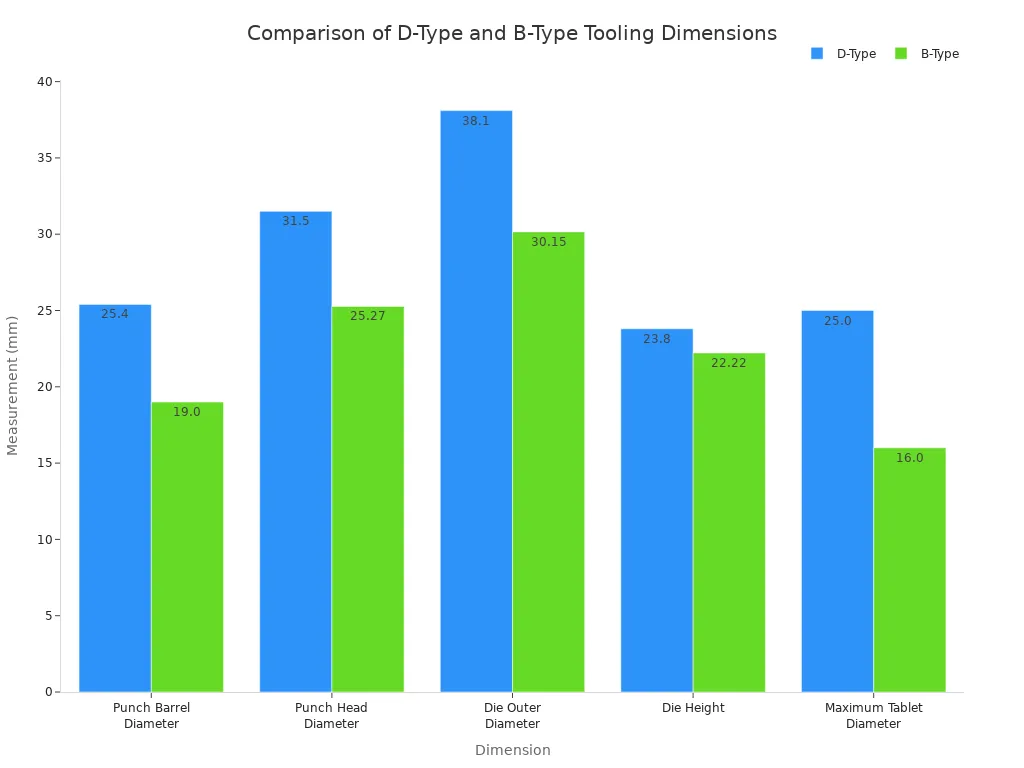
To combat sticking issues, manufacturers often apply specialized coatings to the punch faces. These create a smoother, less reactive surface. Common options include:
- Hard Chrome (Cr)
- Chromium Nitride (CrN)
Turret (or Turntable)
The turret is a heavy, rotating steel disc that houses the dies. It spins at high speeds, typically between 10 and 80 RPM, to move the dies through each stage of the tablet-making cycle. The number of "stations" (die and punch sets) on the turret directly determines the machine's production output. A press with more stations produces more tablets per single rotation, significantly boosting overall productivity.
Control System
The control system is the brain of the automatic tablet press. It is a sophisticated electronic interface that allows operators to manage, monitor, and automate every aspect of the tablet production process. This central command hub ensures precision, consistency, and operational safety from start to finish. Modern systems often feature a user-friendly kiosk or touchscreen with a Windows-based software interface, simplifying complex operations for the user.
Operators use the control system to set critical parameters. These include turret speed, powder fill depth, and the pre-compression and main compression forces. The system provides real-time feedback on these settings, allowing for immediate adjustments to maintain tablet quality. It also monitors for potential errors, such as incorrect tablet weight or hardness, and can trigger alerts or shut down the machine to prevent waste.
In regulated industries like pharmaceuticals, control systems must comply with strict standards. The U.S. FDA's 21 CFR Part 11 regulation, for example, governs electronic records and signatures to ensure data is trustworthy and secure.
A compliant system integrates several key security and data integrity features:
- Access Control: It uses role-based user accounts with password protection. This ensures only authorized personnel can operate the machine or change its settings.
- Electronic Signatures: The system binds actions to specific users through secure logins. It records the user, date, and time for critical operations, creating a verifiable digital signature.
- Audit Trails: It automatically generates an immutable log of all activities. This trail records every change, including the user, timestamp, and details of the modification, providing a complete history of the production batch.
- Data Integrity: It saves all production data in unalterable formats, like PDF files, to prevent tampering and ensure the reliability of electronic records.
These intelligent features make the control system essential for achieving efficiency, precision, and regulatory compliance in modern tablet manufacturing.
Why These Machines Are Essential Across Industries
The automatic tablet press machine is a cornerstone of modern manufacturing, providing unmatched efficiency and precision across several key sectors. Its ability to convert powders into uniform solid doses makes it indispensable for producing a wide range of consumer and industrial goods.
Pharmaceuticals
In the pharmaceutical industry, precision is paramount. Tablet presses are fundamental for manufacturing medications with exact dosages. They ensure every tablet contains the precise amount of active pharmaceutical ingredient (API), which is critical for patient safety and therapeutic effectiveness. These machines enable the mass production of consistent, high-quality medicines that meet strict regulatory standards for weight, hardness, and dissolution.
Nutraceuticals
The nutraceutical market, which includes vitamins, minerals, and dietary supplements, relies heavily on tablet presses. These machines allow manufacturers to create convenient, easy-to-swallow tablets with standardized doses of nutrients. This consistency helps build consumer trust and brand loyalty. The high-speed production capabilities support the industry's rapid growth by meeting consumer demand for health and wellness products.
Chemicals
Beyond medicine and supplements, tablet presses serve specialized roles in the chemical industry. They create solid, easy-to-handle forms of various chemical compounds, improving safety and convenience. For example, some cleaning agents are compacted into tablet form.
Example: Detergent Tablets Alconox Alcotabs are effervescent detergent tablets used for cleaning laboratory equipment. Their tablet form offers several advantages:
- A slow-release bubble action for thorough cleaning.
- Free-rinsing properties that leave no interfering residues.
- A pre-measured dose for reliable and repeatable results.
Handling chemical powders often requires enhanced safety protocols. Facilities use specialized equipment with dust control systems, ventilation, and explosion-proof components. Machine operators also rely on safety interlocks and personal protective equipment (PPE) to minimize exposure to potentially hazardous materials.
Food & Confectionery
The food and confectionery industry utilizes automatic tablet presses to produce a variety of popular items. These machines create compressed confections by compacting dry ingredients into a solid, convenient form. Foundational ingredients for sugar-based candies often include sucrose or dextrose crystals. Sugar-free versions commonly use alternatives like maltitol and sorbitol. This process is ideal for manufacturing products such as:
- Candy
- Big milk tablets
Maintaining food safety is a top priority when manufacturing edible goods. The machinery requires specialized food-grade lubricants to operate smoothly and prevent contamination. These lubricants must meet strict safety standards set by regulatory bodies like the FDA and NSF.
Key Lubricant Standards ⚙️ Lubricants used in food production machinery fall under specific classifications. NSF H1 lubricants are approved for applications with potential incidental food contact. This means they are safe if trace amounts accidentally touch the product. These lubricants must comply with FDA regulation 21 CFR 178.3570, which mandates that they contain only approved, non-toxic ingredients.
Manufacturers must use lubricants formulated without intentionally added heavy metals, carcinogens, or other harmful compounds. This ensures the final product remains pure and safe for consumption. The use of compliant, high-performance tablet presses allows the food industry to produce consistent, high-quality confections efficiently while adhering to critical safety protocols.
Single-Punch vs. Rotary Tablet Press: What's the Difference?

Tablet presses are available in two primary configurations: single-punch and rotary. Each design serves distinct manufacturing needs, from small-scale research to high-volume industrial production. Understanding their differences is key to selecting the right equipment for a specific application.
Single-Punch Press
A single-punch press, also known as a single-station press, is the simplest type of tablet machine. It uses one set of tooling—a single die and a pair of punches—to compress powder into one tablet per cycle. This design is characterized by its straightforward operation and minimal setup time.
Its production output is relatively low, typically ranging from 1,000 to 3,000 tablets per hour.
Due to its precision and low material consumption, the single-punch press is ideal for specific, small-scale applications.
| Use Case | Primary Benefit | Ideal For |
|---|---|---|
| R&D & Formulation Testing | Precision & minimal material use | Confirming powder compressibility |
| Small-Batch Production | Cost-effective for limited quantities | Clinical trials, pilot programs |
| Feasibility Studies | Simple operation & high consistency | Early-stage product development |
Rotary Tablet Press
A rotary tablet press is a high-speed, complex industrial machine designed for mass production. It features a rotating turret that holds multiple sets of dies and punches. As the turret spins, each station moves continuously through the filling, compression, and ejection stages, producing thousands of tablets per minute.
Advanced rotary presses offer enhanced versatility, such as the ability to produce bi-layer tablets. This feature allows manufacturers to:
- Combine incompatible active ingredients in a single dose.
- Create tablets with different release profiles.
- Improve patient adherence by reducing the number of pills required.
Key Distinctions
The primary differences between single-punch and rotary presses relate to their output, complexity, and cost. A rotary automatic tablet press machine provides significant economies of scale for high-volume runs, whereas a single-punch press is more cost-effective for smaller projects. The initial investment for a rotary press is substantial, but its operating efficiency justifies the cost for large-scale manufacturing. In contrast, single-punch presses have a lower initial cost, simpler tooling, and require less operator expertise, making them the preferred choice for labs and pilot programs.
An automatic tablet press machine transforms powder into uniform tablets through a continuous fill-compress-eject cycle. This equipment is a cornerstone of modern manufacturing, crucial for mass-producing consistent products like medicines, vitamins, and cleaning tablets with precision. Understanding its basic function demystifies how many everyday products are made. Future advancements, including the integration of AI and smart sensors, will continue to enhance its efficiency and capabilities in production.
FAQ
What is the main function of an automatic tablet press?
An automatic tablet press machine transforms powder into uniform tablets. It automates a continuous cycle of filling, compressing, and ejecting material. This process enables high-speed, large-scale production for various industries, ensuring product consistency and efficiency.
What is tablet press tooling?
Tooling refers to the core components that form the tablet. It consists of dies and punches.
- Dies are the molds that define the tablet's shape and size.
- Punches (upper and lower) compress the powder within the die to create a solid tablet.
How does a rotary press differ from a single-punch press?
A rotary press uses multiple tooling stations on a spinning turret for high-volume manufacturing. A single-punch press has only one station.
This makes rotary presses ideal for mass production, while single-punch presses suit research, development, and small-batch projects where precision is key.
Why is pre-compression important in tablet making?
Pre-compression applies a light initial force to the powder. This step removes trapped air before the main compression event. It improves tablet hardness and helps prevent common defects like lamination or capping, ensuring a high-quality final product.
See Also
Understanding Tablet Sampling Machines: A Comprehensive Laboratory Selection Guide
Frame Plate Kits for Auto Reinforcement: An Essential Beginner's Introduction
Versatile Nozzle Solutions: Catering to Gardeners, Bioprinters, and Lubrication Needs
Top 5 Applications for Single Stage Rotary Vane Vacuum Pump Sets
Automatic UV Coating Machines: Indispensable for Achieving High-Speed Printing Excellence