What Is a Pellet Mill Ring Die A Complete Guide
A pellet mill ring die is a critical circular component inside a pellet mill. It works with rollers to compress raw materials through precisely drilled holes, forming dense, uniform pellets. The condition of this single part directly determines production efficiency and operational costs.
The die can account for over 60% of the total cost of mechanical consumables in a feed mill.
This component is central to the rapidly growing biomass pellet industry.
| Metric | 2024 | 2034 | CAGR (2025-2034) |
|---|---|---|---|
| Global Biomass Pellets Market Size | USD 12.3 billion | USD 24.7 billion | 7.2% |
Key Takeaways
- A pellet mill ring die is a key part of a pellet mill. It helps make dense, uniform pellets from raw materials.
- The design of the die, like hole size and pattern, changes how good the pellets are and how much can be made. The compression ratio is also very important.
- Using the right materials and taking good care of the die makes it last longer. This helps save money over time.
How a Pellet Mill Ring Die Works
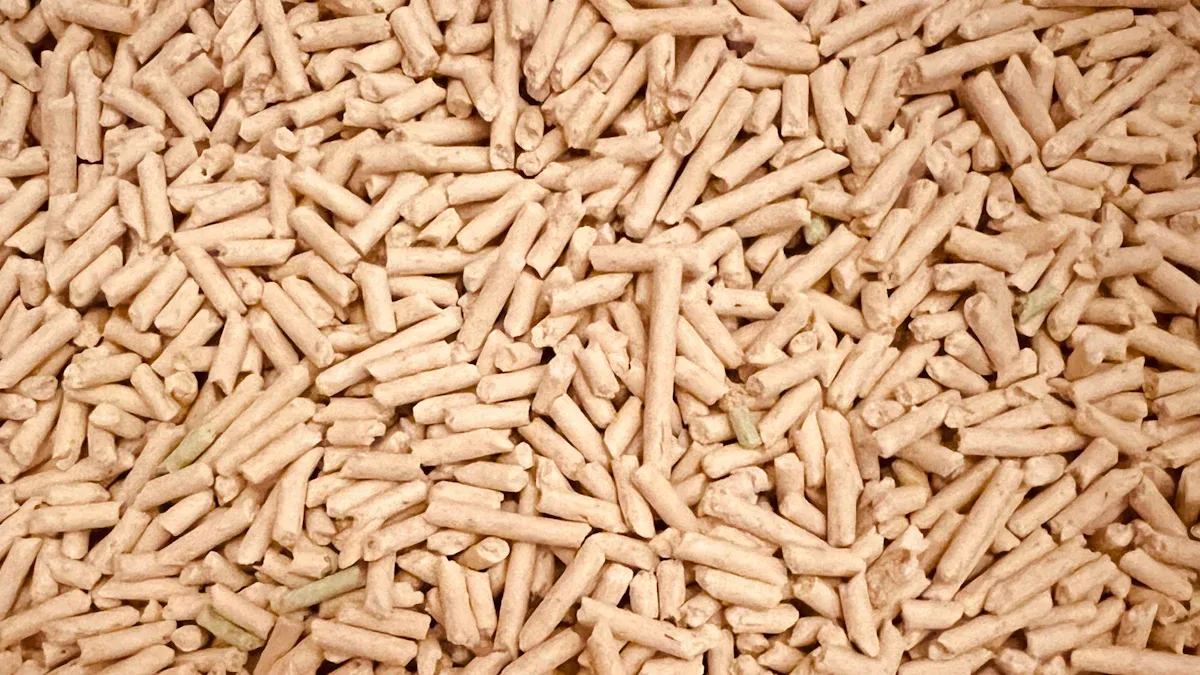
Understanding the mechanics of a pellet mill ring die reveals its central role in production. The die transforms loose, low-density raw materials into a uniform, high-value product through a precise process of compression and extrusion.
The Pelletizing Process
The pelletizing process begins when conditioned raw material enters the pelleting chamber. Inside, a rotating ring die works in conjunction with one or more stationary rollers. The ring die itself provides the primary driving power for the system.
This interaction generates a powerful dual-force mechanism.
- The rollers apply immense compressive force to the raw material, pressing it against the inner surface of the rotating die.
- Simultaneously, the die exerts a resistive radial force as it spins, forcing the compressed material into and through hundreds of precisely drilled holes.
This interplay of compressive and resistive forces is the fundamental action that molds and extrudes the material, forming dense, solid pellets. As the compacted material exits the outer side of the die, fixed knives cut the pellets to a predetermined length.
Key Die Specifications
The design specifications of a die directly influence pellet quality and production efficiency. Key parameters include the hole diameter, which determines the final pellet size, and the hole pattern.
Manufacturers drill holes in several distinct patterns, each suited for different applications:
- Diagonal Drilling (Standard Pattern): This is the most common pattern. It ensures a strong die with uniform stress distribution, making it suitable for nearly all product types.
- Parallel Drilling (Optimized Pattern): This design features more rows with fewer holes per row. It allows material to pass through more quickly, which can increase throughput, reduce wear, and lower energy consumption by 3-10%.
- Close Pattern: This high-density hole pattern is ideal for easy-to-process feeds. It increases throughput and promotes even wear across the die face.
- Heavy Pattern: A less dense pattern used for hard-running, high-fiber materials that require very high pressure to pelletize.
Compression Ratio Explained
The compression ratio is one of the most critical specifications of a pellet mill ring die. It defines the amount of pressure and friction the raw material experiences inside the die hole. Operators calculate this ratio with a simple formula:
Compression Ratio (L/d) = Effective Hole Length (L) / Hole Diameter (d)
- Effective Hole Length (L): This is the portion of the hole where compression occurs. For a simple straight hole, L is the full thickness of the die. For dies with a pressure relief (a wider section of the hole), the effective length is the total thickness minus the length of the relief.
- Hole Diameter (d): This is the diameter of the straight part of the hole, which sets the final pellet diameter.
For example, a die with a 6 mm hole diameter and a 45 mm effective length has a compression ratio of 45 / 6, or 7.5:1. A higher ratio means more resistance and compaction, which is necessary for materials like hardwoods. A lower ratio is used for softer materials that require less pressure.
Common Die Materials
The material used to construct a ring die determines its durability, corrosion resistance, and lifespan. While basic carbon steels were once used, modern dies are made from advanced alloy steels to withstand intense operational stress.
| Property | Carbon Steel | Alloy Steel |
|---|---|---|
| Wear Resistance | Poor | Good to Excellent |
| Corrosion Resistance | Very Poor (requires coating) | Good to Excellent (with high chrome) |
| Strength & Toughness | Lower | Superior |
| Hardness (Post-Treatment) | HRC 45-50 | HRC 50+ |
| Cost | Lower initial cost | Higher initial cost, lower cost per ton |
High-chrome stainless alloy steels, such as X46Cr13, are the industry standard for high-performance applications. These materials offer an exceptional combination of properties achieved through advanced manufacturing.
Pro Tip: Investing in a high-quality alloy steel pellet mill ring die results in a lower cost per ton of produced pellets due to longer life and fewer replacements.
To achieve these characteristics, the die undergoes a multi-stage heat treatment process after drilling. An overall quenching process, often performed in a vacuum furnace, is critical. This vacuum hardening heats the steel above its transition temperature and then rapidly cools it with gas. This method offers several key benefits:
- It prevents oxidation, keeping the die holes perfectly smooth for better material flow.
- It minimizes deformation, ensuring dimensional accuracy.
- It creates a uniform and exceptional hardness, often reaching 53-55 HRc, for maximum wear resistance.
- The high chromium content provides excellent corrosion resistance against acidic or moist raw materials.
This meticulous manufacturing process ensures every die delivers reliable performance and a long operational life.
Optimizing Die Performance and Lifespan
Maximizing the efficiency and service life of a pellet mill ring die requires careful management of materials, machine settings, and maintenance routines. Proactive measures can significantly reduce operational costs and prevent unexpected downtime.
Impact of Raw Materials
The characteristics of the raw material directly influence die performance. An optimal moisture content, typically between 10-15%, is essential.
- High Moisture: Leads to soft pellets and can cause material to clog the die holes.
- Low Moisture: Increases friction and stress on the die and rollers.
Particle size is also a factor. A mix of fine and medium-sized particles facilitates strong inter-particle bonding. An excess of very fine particles can negatively impact pellet quality.
Critical Operational Settings
Operators must precisely control machine settings to protect the die. The gap between the rollers and the die is a critical adjustment, generally set between 0.3mm and 0.5mm. An incorrect gap can cause premature wear or prevent material from being properly compressed. Rotational speed also affects throughput and energy use. While higher speeds can increase output, operators must balance this with pellet quality requirements.
Common Wear and Failure Issues
Dies are subject to intense operational stress. Catastrophic failure, such as cracking, often results from a loss of material toughness or design flaws like sharp corners that create high-stress points. Another common issue is die hole blockage, or "glazing." This occurs when material carbonizes and hardens inside the holes, often during startup or shutdown, restricting flow and increasing pressure.
Essential Maintenance Practices
Consistent maintenance is key to a long die life.
Pro Tip: New dies should be "broken in" by running an oily, abrasive mixture through them for 10-20 minutes to polish the hole surfaces.
Regular cleaning with compressed air or soft brushes removes residue. For storage, dies should be thoroughly cleaned, dried, and kept in a well-ventilated area away from moisture. Applying a protective coating provides an effective barrier against corrosion.
The pellet mill ring die is the heart of any pelleting operation, directly shaping product quality and profitability. Selecting the correct die specifications for a specific application is a critical decision. Proper operation and consistent maintenance are essential for maximizing production output and the die's service life.
A well-maintained, high-quality die can achieve a lifespan of 800 to 1,200 operating hours, reducing long-term costs.
FAQ
How does an operator select the best die material?
Operators choose a material based on the raw material. High-fiber inputs demand maximum wear resistance, while corrosive materials require high-chrome steel for protection against rust.
What signs indicate a die needs replacement?
Key indicators signal the need for a replacement. Operators should watch for:
- A significant drop in production output (a drop)
- Consistently poor or uneven pellet quality
- Visible cracks or excessive wear on the die surface
Why is breaking in a new die necessary?
This process polishes the inner surfaces of the die holes. A smoother surface reduces initial friction, improves material flow, and ensures consistent pellet production from the start.
See Also
Understanding Nozzle Technology: A Guide for Diverse Professional Applications
Demystifying Plate Heat Exchangers: An Illustrated Operational Walkthrough
Frame Plate Kits: Essential Reinforcement for Automotive Structural Integrity
Optimizing Heat Exchange: The Proven Efficacy of Specialized Steel Processing
Tablet Sampling Machines: A Comprehensive Laboratory Equipment Selection Handbook