Vulcanizing Agent GMF (1,4‑Benzoquinone dioxime) What You Need to Know
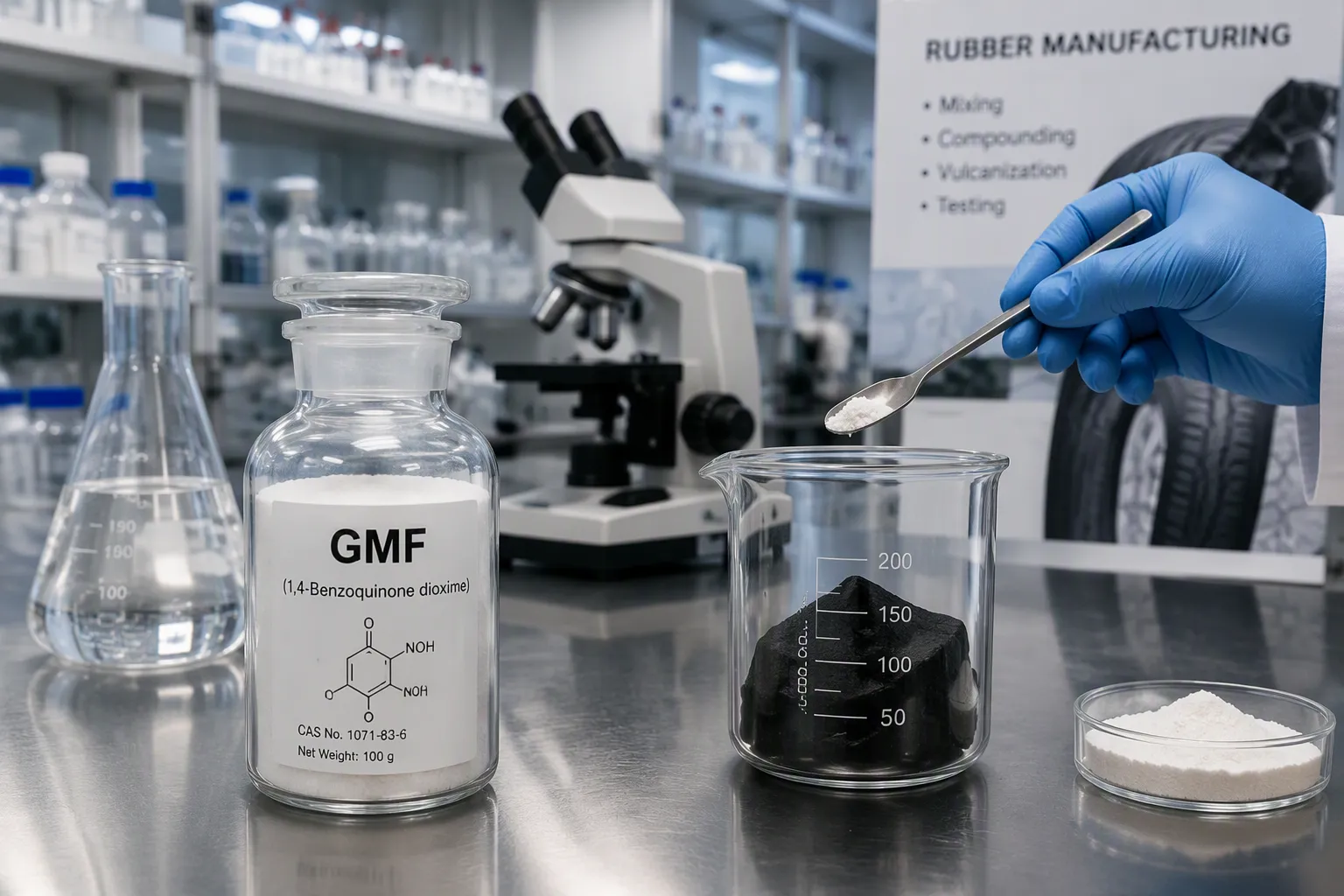
Vulcanizing Agent GMF (1,4-Benzoquinone dioxime) is a quinone dioxime compound with CAS No. 105-11-3. This chemical enables sulfur-free cross-linking of rubber. It significantly improves heat resistance and reversion stability in finished products. Manufacturers value Vulcanizing Agent GMF (1,4-Benzoquinone dioxime) as an alternative to sulfur systems, especially for butyl rubber, natural rubber, EPDM, and styrene butadiene rubber.
Key Takeaways
- GMF creates strong carbon-carbon bonds in rubber without sulfur. These bonds resist heat well and stop reversion. This makes rubber last longer in hot conditions.
- GMF works best for thick rubber items like tire bladders and hoses. It spreads evenly through the rubber. This gives consistent quality in large products.
- GMF is a safer choice than sulfur systems. It does not produce harmful nitrosamines. This helps manufacturers meet modern safety and environmental rules.
Chemical and Physical Properties of GMF
Molecular Structure and Identity
Vulcanizing Agent GMF (1,4‑Benzoquinone dioxime) carries the molecular formula C₆H₆N₂O₂. The compound belongs to the quinone dioxime family. Its structure features a central quinone ring. Two oxime groups (=N–OH) attach at the 1 and 4 positions. This specific arrangement creates the chemical's unique reactivity. The numerical identifier CAS 105-11-3 allows manufacturers and researchers to track the substance accurately. The molecular weight measures 138.12 g/mol. These properties define how the compound behaves during rubber processing.
Appearance and Solubility
The material appears as a dark brown to reddish-brown crystalline powder. Manufacturers supply this solid form for easy handling and measurement. The compound shows low solubility in water. It dissolves readily in organic solvents such as ethanol, acetone, and ethyl acetate. This solubility profile helps the chemical disperse evenly throughout rubber compounds during mixing. Uniform dispersion leads to consistent cross-linking in the final product. The bulk density typically ranges from 0.5 to 0.7 g/cm³.
Stability and Reactivity
The compound remains stable under normal storage conditions. It does not decompose easily at room temperature. The oxime groups provide the reactive sites needed for vulcanization. These groups form cross-links between rubber polymer chains when heated with an activator. The material reacts with strong oxidizing agents and should not contact them. Vulcanizing Agent GMF (1,4‑Benzoquinone dioxime) begins to decompose above its melting point of 215–220 °C. Manufacturers must control processing temperatures carefully. The compound also reacts with metal oxides, which often serve as activators in the curing system.
Vulcanization Performance and Mechanism
Role in Rubber Cross-Linking
Vulcanizing Agent GMF (1,4‑Benzoquinone dioxime) creates cross-links between rubber polymer chains without sulfur. The oxime groups react with the rubber molecules when heated. This reaction forms stable carbon-carbon bonds between adjacent chains. These bonds hold the polymer network together. The resulting structure gives rubber its strength and elasticity. Metal oxides, such as lead dioxide or red lead, activate the reaction. These activators speed up the cross-linking process significantly.
Curing Conditions and Dosage
Manufacturers typically use 1 to 6 parts of GMF per 100 parts of rubber. The exact amount depends on the rubber type and desired hardness. Butyl rubber requires lower dosages than natural rubber or EPDM. Curing temperatures range from 140°C to 180°C. Processing time varies from 10 to 60 minutes. Thicker articles need longer curing times for complete penetration. The compound disperses evenly through the rubber matrix during mixing. This uniform distribution ensures consistent cross-link density throughout the product.
Key Benefits Over Conventional Systems
GMF offers several advantages compared to traditional sulfur curing. The carbon-carbon bonds formed by GMF resist heat better than sulfur bonds. Products maintain their properties at elevated temperatures. Reversion, a common problem with sulfur systems, does not occur with GMF. This means the rubber does not soften or lose strength during prolonged exposure to heat. The compound also penetrates thick articles more uniformly. This property makes it ideal for large rubber components. Vulcanizing Agent GMF (1,4‑Benzoquinone dioxime) produces no nitrosamine byproducts, unlike some sulfur donors. This feature addresses modern safety and environmental concerns in rubber manufacturing.
Applications and Safety Considerations
Common Industrial Applications
Vulcanizing Agent GMF (1,4‑Benzoquinone dioxime) serves critical roles in several rubber manufacturing sectors. The compound's sulfur-free cross-linking mechanism makes it ideal for tire curing bladders. These bladders require exceptional heat resistance and reversion stability. The material withstands repeated exposure to high temperatures during tire production. Heat-resistant hoses represent another major application. These hoses operate in engine compartments and industrial machinery where sulfur-cured rubber would fail. The rubber industry uses GMF for thick rubber products like rollers and seals. The compound penetrates these items uniformly, creating consistent properties throughout the cross-section.
The market for non-sulfur vulcanizing agents continues to grow rapidly. Global green vulcanization chemicals usage exceeded 620,000 metric tons in 2024, an increase of 18% from 2023. Peroxide-cured rubber, a related non-sulfur technology, accounts for 9.3% of medical-grade production, representing over 48,000 metric tons. This shift reflects tightening environmental regulations and consumer demand for sustainable products. Manufacturers are investing approximately 35% of recent capital into sustainable vulcanization chemicals. Producers have launched more than 17 new peroxide-cured rubber grades, with a 21% increase in peroxide blend sales for medical and food applications.
The table below shows current market distribution for vulcanization methods:
| Metric | Value (2024) | Trend |
|---|---|---|
| Sulfur vulcanization market share | ~67% | Declining due to regulations |
| Peroxide vulcanization market share | ~21% | Growing, especially in medical/food-grade |
| Other methods market share | ~12% | Emerging segment |
| Thermal stability improvement (peroxide vs. sulfur) | +18% | Better performance |
| Elongation improvement (peroxide vs. sulfur) | +9% | Better flexibility |
Several factors drive this market transition:
- Regulatory pressure from EU REACH and U.S. EPA is phasing out traditional sulfur-based accelerators linked to nitrosamine formation
- Rising ESG pressure encourages bio-based processing oils and plasticizers, with early-stage research into biogenic accelerators
- Manufacturers develop hybrid additive systems combining functionality for next-generation tires, improving performance and sustainability
Toxicity and Handling Precautions
Vulcanizing Agent GMF (1,4‑Benzoquinone dioxime) requires careful handling procedures. The compound can irritate skin and eyes upon contact. Inhalation of dust particles may cause respiratory irritation. Workers must wear appropriate personal protective equipment. This equipment includes safety goggles, chemical-resistant gloves, and dust masks. Facilities should install local exhaust ventilation to remove airborne particles. The compound should not contact strong oxidizing agents, as this can cause dangerous reactions.
Manufacturers must follow material safety data sheet (MSDS) guidelines. Spills require immediate cleanup using approved methods. Workers should avoid generating dust clouds during handling. Training programs should educate employees about proper handling procedures. The compound does not produce nitrosamine byproducts, which addresses a key safety concern associated with sulfur-based accelerators. This feature makes GMF a safer alternative for rubber manufacturers.
Storage and Shelf Life
Proper storage conditions maintain the quality of Vulcanizing Agent GMF. The compound should remain in a cool, dry, well-ventilated area. Storage temperatures should stay below 40°C (104°F). The material must remain in its original sealed container. Containers should stay away from direct sunlight and heat sources. The compound should not contact moisture, as this can reduce its effectiveness.
The shelf life of GMF typically extends for 12 months from the date of manufacture under proper storage conditions. Manufacturers should test the material after this period to confirm its activity. The compound maintains its reactivity when stored correctly. Regular inventory rotation helps ensure fresh material usage. Facilities should label containers clearly with the receipt date and expiration date. This practice prevents accidental use of expired material.
Vulcanizing Agent GMF (1,4-Benzoquinone dioxime) delivers exceptional heat resistance and reversion stability. Its uniform penetration makes it ideal for thick rubber products. Tire curing bladders and heat-resistant hoses benefit greatly from this compound. Manufacturers should evaluate GMF for their vulcanization needs while following proper safety protocols.
FAQ
What makes GMF different from sulfur-based curing systems?
GMF creates carbon-carbon bonds instead of sulfur bonds. These bonds resist heat better and prevent reversion. Products maintain strength during prolonged high-temperature exposure.
Can manufacturers use GMF with all rubber types?
GMF works effectively with butyl rubber, natural rubber, EPDM, and styrene butadiene rubber. Each rubber type requires specific dosage adjustments for optimal cross-linking results.
How should facilities store Vulcanizing Agent GMF?
Facilities must keep GMF in sealed containers below 40°C. The storage area needs cool, dry conditions away from sunlight. Proper storage maintains effectiveness for 12 months.
See Also
Understanding Molybdenum Furnaces: Their Role and Construction
The Uses and Properties of 60% Nitric Acid Solution
How Aminoguanidine Bicarbonate Is Made and Its Main Uses
Indicators of High-Quality Bovine Gelatin Powder to Recognize
Key Facts About WT20 Thoriated Tungsten for Improved TIG Welding