VAE Emulsion White Latex Your Go-To for Strong Wood Glue
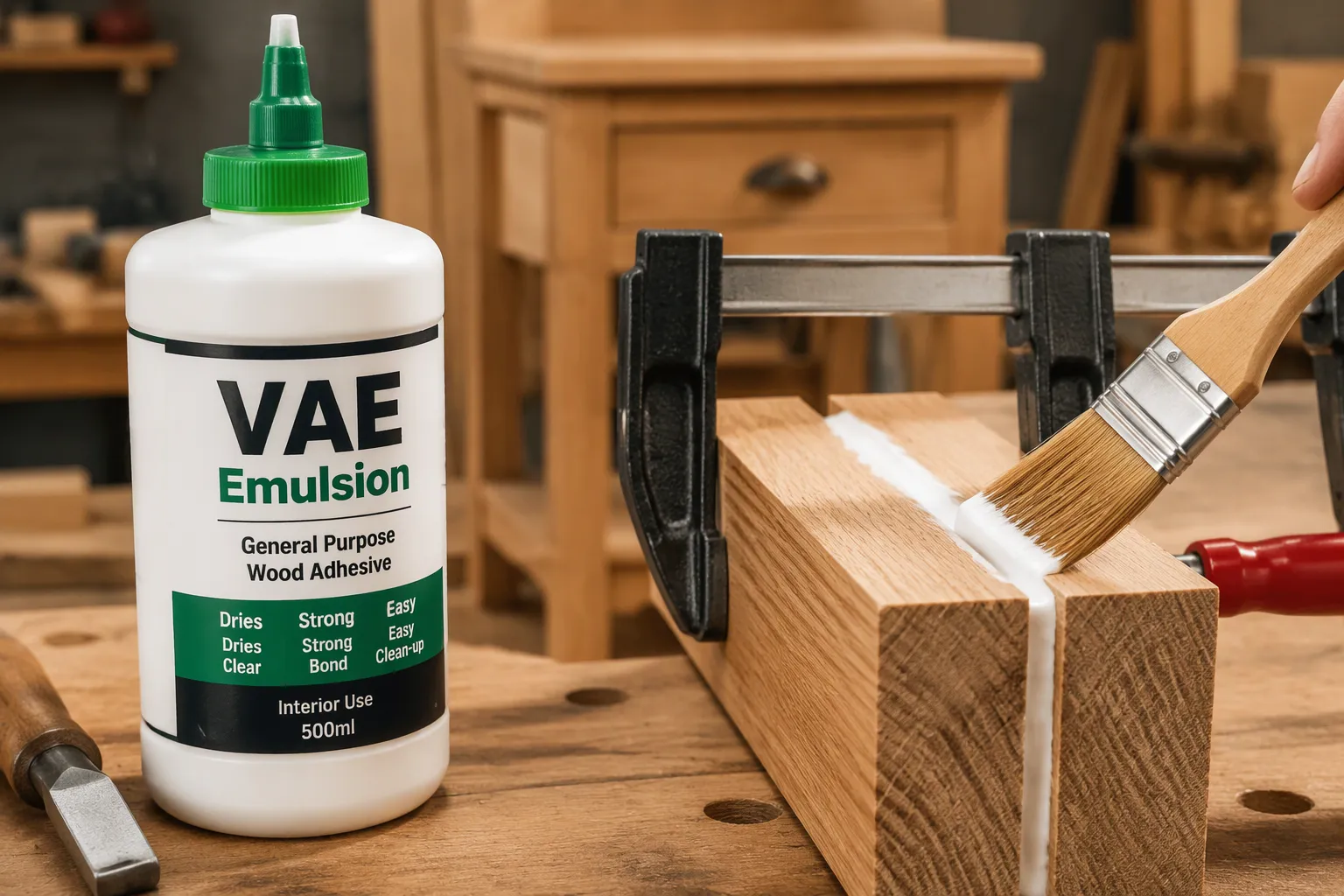
Vinyl Acetate-ethylene Copolymer Emulsion VAE Emulsion White Latex earns its go-to status for strong, reliable wood glue. You get powerful bonds, easy cleanup, and safe use in one product. It suits DIY projects and professional woodworking alike. This emulsion balances strength, flexibility, and value better than many alternatives. BioResources testing shows tensile shear strength climbing toward 13 to 14 MPa after seven days of curing.
Key Takeaways
- VAE emulsion white latex creates strong, flexible bonds that handle wood movement and everyday stress.
- You can apply it easily and clean up with just water, making it safe and simple for indoor projects.
- It costs less than many specialty glues and works well for furniture, cabinets, and general woodworking.
Vinyl Acetate-ethylene Copolymer Emulsion VAE Emulsion White Latex: What It Is and Why It Bonds Strong

You may wonder what makes this white glue so dependable. The answer starts with its chemistry. Vinyl Acetate-ethylene Copolymer Emulsion VAE Emulsion White Latex is a milky white latex. Manufacturers make it through emulsion polymerization. Vinyl acetate monomer and ethylene monomer react together under pressure. Wikipedia describes this reaction as chain-growth polymerization. The process runs through four stages: chain initiation, chain growth, chain transfer, and chain termination. Chain growth controls the degree of polymerization and the average molecular weight. Chain transfer controls the dispersity. Gantrade confirms that VAE copolymer dispersions come from emulsion polymerization of these two monomers.
The recipe has a few key parts. Vinyl acetate builds the basic structure and delivers strong adhesion and film-forming power. Ethylene adds flexibility and fine-tunes the emulsion. Manufacturers adjust the ratio of vinyl acetate to ethylene to tailor the product for specific jobs. Initiators trigger the reaction. Surfactants keep the emulsion stable. Other additives fine-tune viscosity, temperature resistance, and shelf life. Precise control of temperature, pressure, and agitation keeps quality consistent. A final stabilization step adds protective colloids and surfactants. This step prevents coagulation and ensures durable storage.
A Mildew-Free, Milky White Emulsion Built for Adhesion
The milky white color tells you something useful. The emulsion disperses polymer particles in water, not in a solvent. This water-based design resists mildew growth and keeps the product odorless and non-toxic. Zoran produces this emulsion under the GW-705 specification. That grade delivers a solid content of at least 54.4% and a pH between 4.0 and 6.0. Viscosity runs from 1500 to 2500 mPa·s at 25°C. Residual vinyl acetate monomer stays at or below 0.5%. Particle size reaches up to 2 micrometers. The minimum film-forming temperature sits at 0°C. These numbers matter for you. A low film-forming temperature means the glue forms a solid film at room temperature. You get a reliable bond without special heating equipment.
Adhesion starts at the molecular level. Vinyl acetate units are polar. They form hydrogen bonds and dipole interactions with the hydroxyl groups on wood surfaces. PatSnap reports that VAE films show excellent adhesion to polar substrates, including wood, concrete, gypsum, and cellulosic materials. The particles also have a smart structure. Ethylene-rich cores sit inside vinyl acetate-rich shells. This design balances initial tack with ultimate cohesive strength. You get a glue that grabs quickly and holds firmly over time.
Bond Strength That Holds Under Load
Strong wood glue must survive real loads. VAE emulsion delivers on this front. PatSnap lists a peel strength of 1.5 to 4.0 N/mm on wood substrates in a 180° peel test. Tensile strength ranges from 8 to 15 MPa under ASTM D882. Elongation at break reaches 400% to 800%. These figures show a bond that stretches before it fails. That behavior protects the joint from sudden shock.
Shear strength tells an even clearer story. The table below collects typical values for VAE bonds on wood.
| Condition | Substrate | Shear Strength | Standard or Notes |
|---|---|---|---|
| Type-II interior woodworking adhesive, durability class D2, dry, 23°C and 50% RH | Beechwood | Above 10 MPa | Per DIN EN 205; wood failure above 80% |
| Wood adhesive per EN 204 class D2, dry | Beech | 10–15 N/mm² | Under EN 205 |
| Mortise and tenon joints | Wood | About 12.3 MPa | Roughly 22% better than EPI products; similar to polyurethane glues |
| Bond line thickness | Wood | 0.08 mm | Versus 0.12 mm for standard PU options |
High wood failure percentages deserve your attention. When the wood itself breaks before the glue line, the adhesive has done its job. A bond line of just 0.08 mm also keeps joints tight and clean. Thin glue lines mean less squeeze-out and a neater finished piece.
Flexibility for Real-World Wood Movement
Wood moves. Humidity rises and falls. Boards expand and contract. A rigid glue line can crack under that stress. VAE emulsion handles movement well. Its molecular structure pairs a vinyl acetate backbone with ethylene units. The vinyl acetate provides adhesion. The ethylene segments act as internal plasticizers. They reduce brittleness and add give. MWPVA notes that vinyl acetate typically makes up 60% to 95% of the copolymer. A higher vinyl acetate content improves bonding to cellulose-rich wood surfaces. More ethylene adds flexibility.
This dual-phase architecture keeps bonds intact during humidity swings. MWPVA reports that VAE adhesives retain about 98% of original strength after 500 humidity cycles per ASTM D1183. That result means your furniture, cabinets, and frames stay tight through seasonal changes. The Young's modulus of VAE films ranges from 0.1 to 2.0 GPa, according to PatSnap. That range depends on the ratio of ethylene-rich to vinyl acetate-rich segments and on crystallinity. You get a tunable balance of stiffness and spring. A chair joint needs some give. A cabinet panel needs firm support. Vinyl Acetate-ethylene Copolymer Emulsion VAE Emulsion White Latex meets both demands.
Performance You Can Count On

A wood glue only proves itself when conditions turn tough. You need a bond that survives a damp basement, a hot garage, or a spilled glass of water. Vinyl Acetate-ethylene Copolymer Emulsion VAE Emulsion White Latex passes these everyday tests with room to spare. The data below shows how it holds up under water, heat, and indoor use.
Water and Heat Resistance for Everyday Conditions
Water is the enemy of many adhesives. VAE emulsion fights back with a crosslinked polymer network. Test results from polyvinyl-alcohol-supplier.com show how the glue performs under stress:
- A direct-tensile adhesion test on concrete substrates per EN 14891/A1:2022 reaches 1.4 MPa after a 28-day standard cure. The bond fails inside the concrete itself, not at the glue line.
- After 7 days of water immersion plus 6 hours of boiling, adhesion retention stays above 0.9 MPa.
Those numbers tell you the bond keeps working even after severe water exposure. Heat resistance follows the same pattern. The medium-Tg backbone keeps the glass transition temperature above the 60°C softening threshold. Many high-ethylene VAE grades fall below that line and lose their grip in hot conditions. This grade holds its shape.
Durability classifications confirm the point. Polyvinyl-alcohol-supplier.com benchmarks the emulsion against EN 204/D3 and D4 standards. D3 testing requires a shear strength retention of at least 2.0 N/mm² after a 4-day cold-water soak at 23°C. D4 adds a 6-hour boiling-water cycle followed by 2 hours of cold-water immersion. A glue that clears D4 can handle kitchen counters, bathroom cabinets, and outdoor-adjacent furniture.
You can boost water resistance further with a simple additive. The carboxylation level in a comparable medium-Tg VAE grade, expressed as an acid number of 2.0–4.0 mg KOH/g dry polymer, allows targeted crosslinking with polyvalent cations. Adding 0.3–0.5 wt% ammonium zirconium carbonate (AZC) on wet emulsion weight, with pH adjusted to 8.0–8.5 using ammonia, raises the gel content of the dried film from below 10% to above 70% after a 24-hour ambient cure. Polyvinyl-alcohol-supplier.com measured this result by extraction in boiling methyl ethyl ketone per ASTM D2765-16, Method B. The higher gel fraction cuts water whitening time from 4 hours to less than 2 hours in deionized water at 23°C. You get a clearer, stronger glue line in damp settings.
Safe for Indoor Projects
Indoor woodworking puts you close to your materials. You sand, cut, and clamp for hours. A glue that off-gasses harsh fumes makes that work unpleasant. VAE emulsion avoids the problem. It disperses polymer particles in water rather than in a solvent. The product carries no toxic warning and produces no strong odor. Zoran manufactures the GW-705 grade with a residual vinyl acetate monomer content at or below 0.5%. That low residual level keeps indoor air clean during application and cure.
The water-based chemistry also resists mildew growth. You can glue up a bathroom vanity or a basement shelf without worrying about mold feeding on the adhesive. Cleanup takes only warm water and a rag while the glue stays wet. These traits make the emulsion a comfortable choice for schools, home workshops, and small studios. You work with it safely in a closed room with normal ventilation.
Meeting Regulatory Standards
Wood glue sold in the United States and Europe must clear a web of rules. VAE emulsion meets the major frameworks for its application sectors. The table below maps each sector to its primary regulation.
| Application Sector | Primary Regulatory Framework | Key Standard or Clause Reference | Substance Category |
|---|---|---|---|
| VAE/PVAc Emulsion Polymerization | US EPA, EU REACH | 40 CFR Part 63 Subpart FFFF; REACH EC 1907/2006 | Polymerization Protective Colloid |
| Solid Glue Stick | EU Toy Safety, US LHAMA | EN 71-3; ASTM D4236 | Binder / Structural Matrix |
| Wood Lamination Adhesive | EN Durability Classification | EN 204 (D2); EN 12765 (C3 exclusion) | Rheology Modifier / Water Retention Agent |
These rules cover manufacturing emissions, toy safety, and bond durability. Polyvinyl-alcohol-supplier.com notes how the rules connect:
Regulatory compliance intersects with US EPA 40 CFR Part 63 HAPs emission controls for miscellaneous organic chemical manufacturing and the comprehensive REACH registration dossiers mandated within the EU. Emulsions formulated for durability class D3 per EN 204 must reflect a stable dispersion architecture where grafting density prevents phase separation under load.
The EPA framework matters for producers. Under FIFRA, manufacturing use product labeling must reflect all current agency regulations and policy notices. Zoran builds compliance into the production process from the start. The emulsion also qualifies as a government-recommended green material. You get a glue that satisfies inspectors, specifiers, and safety officers without extra paperwork on your end.
Using VAE Emulsion White Latex with Confidence
Easy Application and Cleanup
You can apply Vinyl Acetate-ethylene Copolymer Emulsion VAE Emulsion White Latex with a brush, a roller, or a simple spreader. The glue flows smoothly and spreads evenly across wood surfaces. Clamp your pieces together and let the bond cure. Most joints reach handling strength within an hour. Cleanup takes only warm water and a cloth while the glue stays wet. Dried squeeze-out rubs off with light sanding. You avoid harsh solvents and complicated cleanup routines.
Cost-Effective Compared to Alternatives
Budget matters for any workshop. This emulsion delivers strong bonds at a lower cost per square foot than many specialty adhesives. You buy one product for multiple jobs. It handles wood, paper, and packaging without extra purchases. The water-based formula also reduces waste. You dilute it when needed and store it for months without spoilage. That combination of performance and price gives you solid value on every project.
Where It Fits Best Among Wood Glue Options
Every wood glue has a sweet spot. Polyurethane glues suit outdoor projects that face constant moisture. Epoxy works well for gap filling and structural repairs. Hide glue shines in instrument making and antique restoration. Vinyl Acetate-ethylene Copolymer Emulsion VAE Emulsion White Latex fits best in interior furniture, cabinets, shelving, and general assembly. You get strong, flexible bonds with easy cleanup and safe indoor use. For everyday woodworking, this emulsion earns a permanent spot on your bench.
Vinyl Acetate-ethylene Copolymer Emulsion VAE Emulsion White Latex gives you strong, flexible bonds with simple application and water cleanup. It stays safe indoors and costs less than many specialty glues. Hobbyists and pros both win here. Make this emulsion your default choice for every wood gluing project.
FAQ
How long does VAE emulsion white latex take to cure?
Most joints reach handling strength within one hour. Full cure takes longer. Keep pieces clamped overnight for the strongest bond.
Can you clean up VAE emulsion white latex with water?
Yes. Warm water and a cloth remove wet glue easily. Dried squeeze-out rubs off with light sanding. You avoid harsh solvents entirely.
Does VAE emulsion white latex work on all wood types?
It bonds well to most interior woods, including furniture, cabinets, and shelving. The flexible glue line handles natural wood movement through seasonal humidity changes.
See Also
Silicone Sealant For Construction And Decoration: Modern Homes' Secret Glue
Protecting Doors And Hinges From Wildfire And Flood Damage
Key WT20 Thoriated Tungsten Electrode Facts For Improved TIG Welding
Genuine User Feedback On Popular Wooden And Bamboo Storage Boxes
Data-Driven Methods To Enhance 2 5-Furandicarboxylic Acid Sustainability