Urea Ammonium Nitrate Solution UAN The Plant’s Power Drink
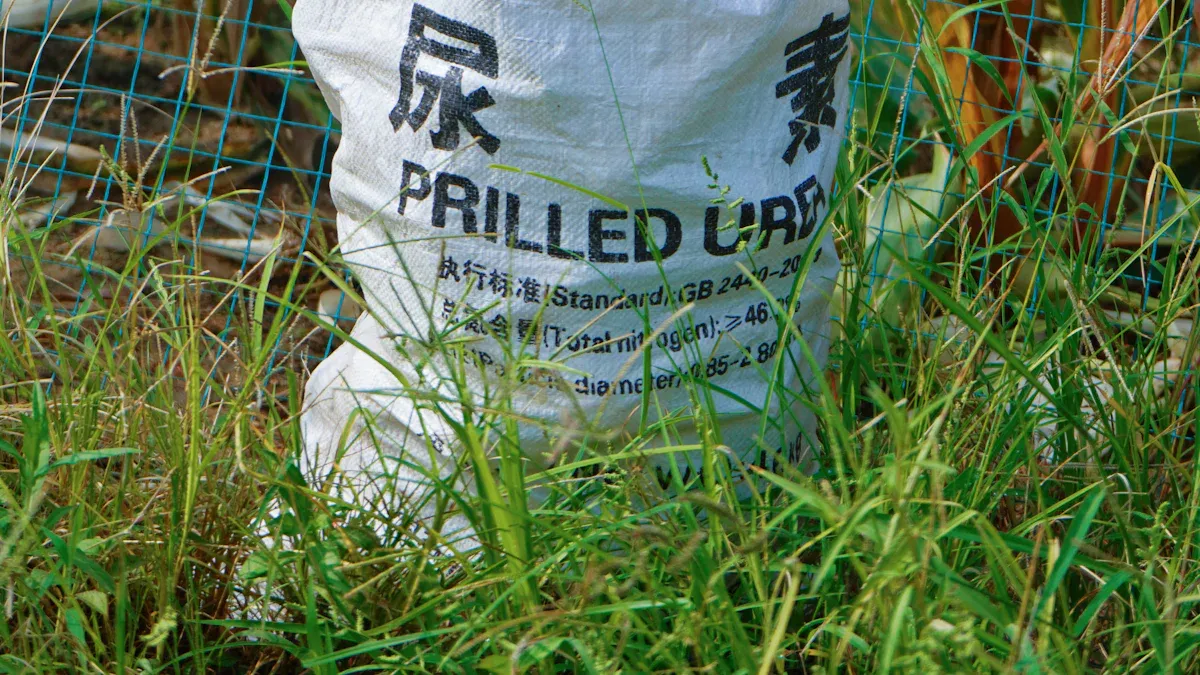
You can boost your crops with Urea Ammonium Nitrate Solution (UAN), a liquid fertilizer that stands out for its high nitrogen content and easy application. Check out some key features:
| Characteristic | Description |
|---|---|
| Nitrogen Content | 28% to 32% |
| Handling | Simple to use and apply |
| Application | Works with irrigation or foliar sprays |
Urea Ammonium Nitrate Solution (UAN): Composition and Formulation
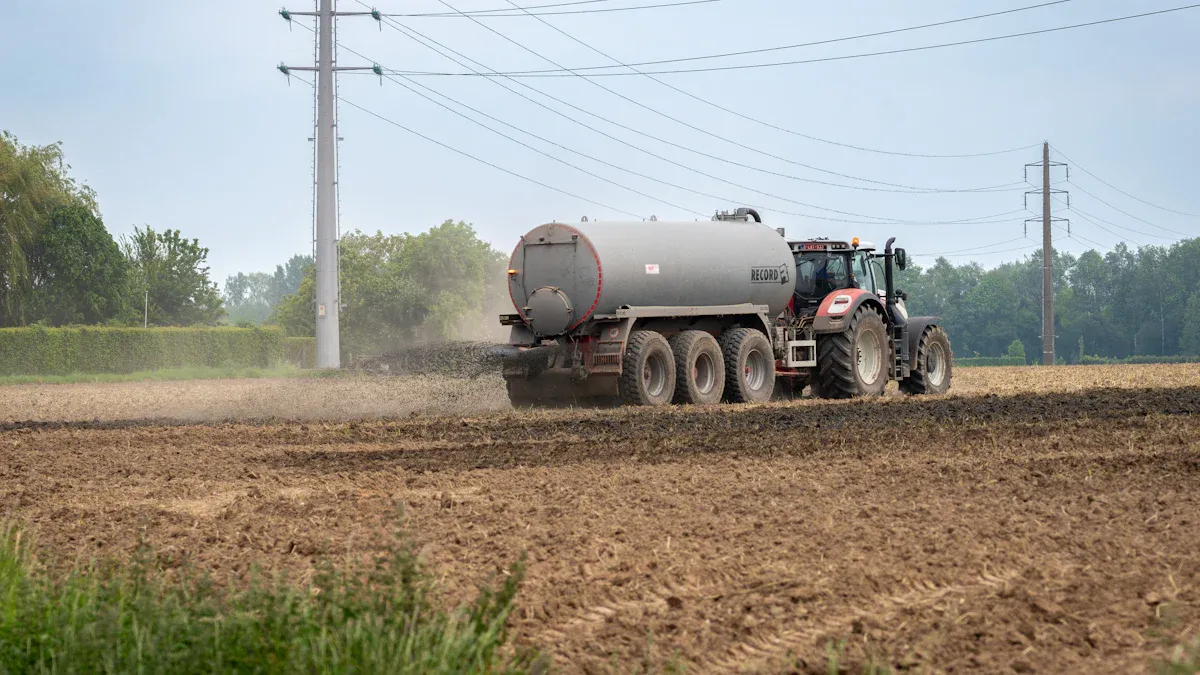
Chemical Makeup and Nitrogen Forms
When you use Urea Ammonium Nitrate Solution (UAN), you give your plants a mix of important nutrients. This fertilizer contains three main ingredients: urea, ammonium nitrate, and water. Each ingredient plays a special role in feeding your crops.
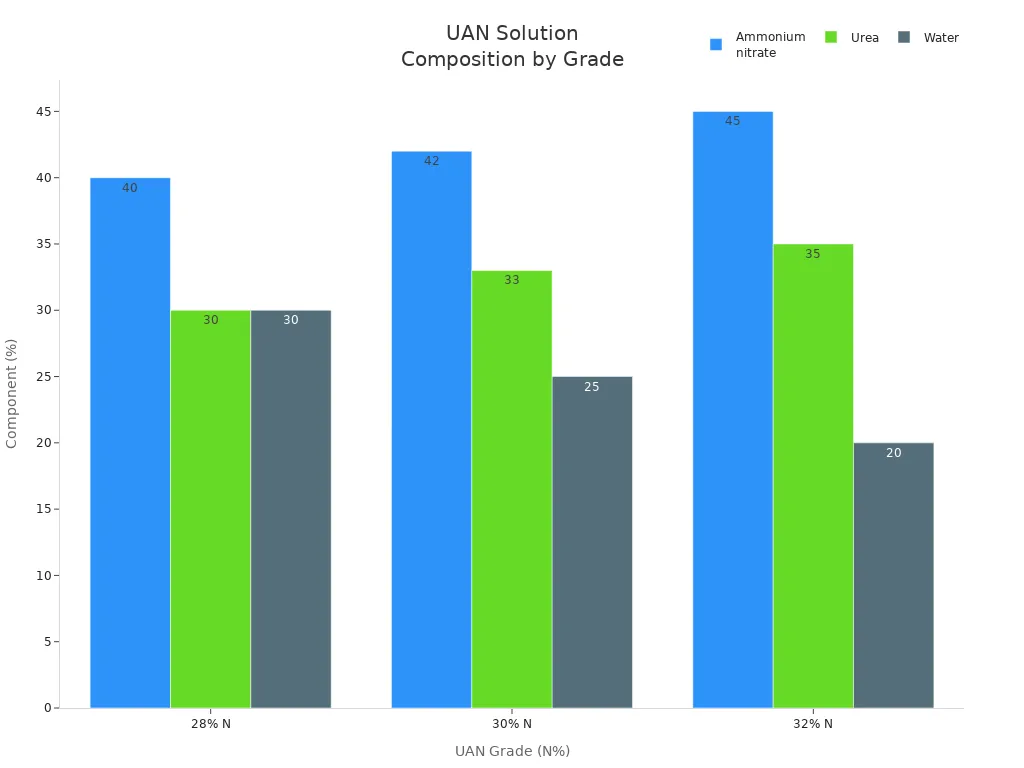
Here is a table showing the typical composition of UAN at different nitrogen grades:
| Grade, N% | 28 | 30 | 32 |
|---|---|---|---|
| Ammonium nitrate (%) | 40 | 42 | 45 |
| Urea (%) | 30 | 33 | 35 |
| Water (%) | 30 | 25 | 20 |
You will find three forms of nitrogen in UAN:
- Nitrate nitrogen (NO₃-N)
- Ammonium nitrogen (NH₄⁺-N)
- Amide nitrogen
Each form helps your plants in a different way. Nitrate nitrogen works fast and is ready for plant roots to absorb. Ammonium nitrogen stays in the soil longer and feeds plants over time. Amide nitrogen, found in urea, changes into ammonium and then nitrate, giving a steady supply of nitrogen.
Tip: The blend of these three nitrogen forms in UAN helps your crops use nitrogen more efficiently. Studies show that UAN can increase grain yield by 9.1% compared to using only urea. It also improves nitrogen use efficiency and reduces harmful gas emissions.
| Evidence Type | Description |
|---|---|
| Nitrogen Forms | UAN integrates three nitrogen forms: nitrate nitrogen, ammonium nitrogen, and amide nitrogen, enhancing nitrogen use efficiency (NUE). |
| Crop Yield | UAN application increased grain yield by 9.1% compared to urea treatment. |
| Nitrogen Efficiency | The agronomic use efficiency and recovery rate of nitrogen for UAN treatment increased by 19.8% and 31.2%, respectively, compared to urea. |
| N2O Emissions | UAN reduced N2O emissions, with the N2O warming potential being 39.3% lower than that of urea treatment. |
Physical Properties and Solubility
Urea Ammonium Nitrate Solution (UAN) is a clear liquid. You can mix it easily with water, which makes it simple to apply in many ways. The solution stays stable at different temperatures, but you should know about its "salt out" temperature. This is the point where the fertilizer starts to form crystals if it gets too cold.
| UAN Concentration | Salt Out Temperature (°C) | Salt Out Temperature (°F) |
|---|---|---|
| 28-0-0 | -18 | 0 |
| 32-0-0 | -2 | 32 |
You can use UAN in several ways on your farm:
| Application Method | Description | Benefits |
|---|---|---|
| Foliar Spraying | Direct application to plant leaves. | Quick nutrient uptake and effective for addressing immediate deficiencies. |
| Fertigation | Application through irrigation systems. | Efficient nutrient delivery and reduced leaching losses. |
| Soil Drenching | Direct application to the soil around the plant roots. | Ensures deep nutrient penetration and availability during critical growth stages. |
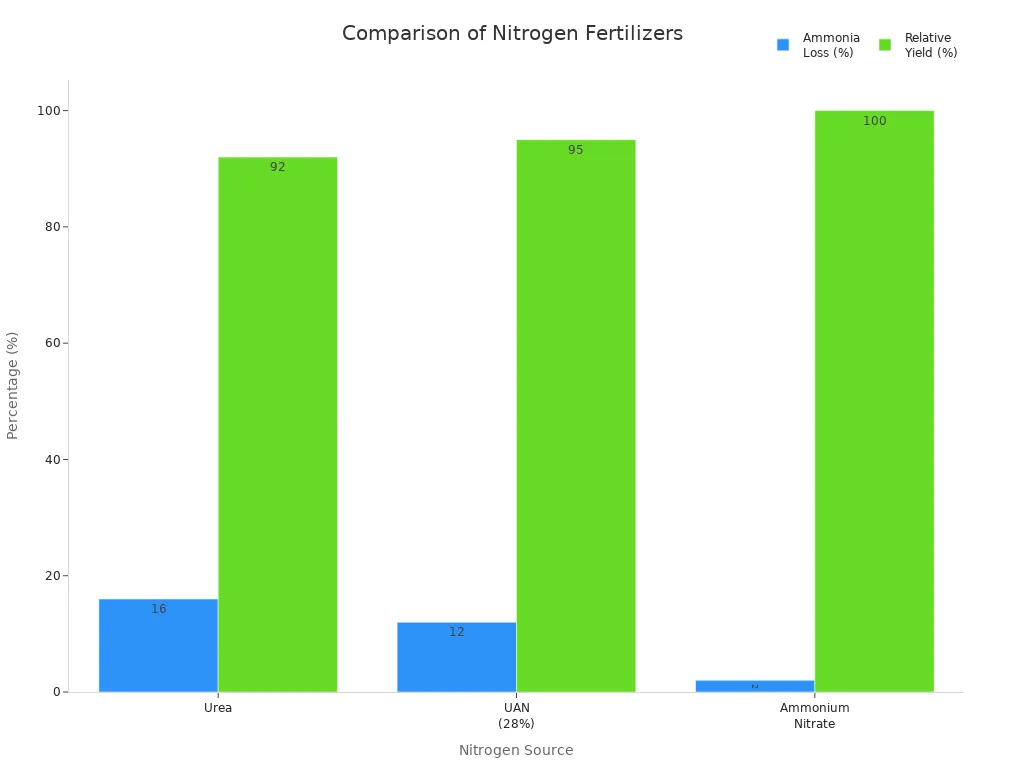
You will notice that UAN has lower ammonia loss than urea and gives a higher relative yield. This means you get more value from each application.
Note: Always store UAN in a cool, dry place away from sunlight. Wear gloves and goggles when handling it to protect your skin and eyes. Make sure the storage area is well-ventilated and check containers for leaks.
Chemical Properties of Urea Ammonium Nitrate Solution (UAN)
Nitrogen Content and Availability
You can count on Urea Ammonium Nitrate Solution (UAN) to deliver a strong dose of nitrogen to your crops. This fertilizer contains a high percentage of nitrogen, which helps plants grow fast and healthy. The total nitrogen content in UAN usually ranges from 28% to 32%. Here is a table that shows the typical nitrogen content in different UAN formulations:
| Formulation | Total Nitrogen Content |
|---|---|
| UAN-32 | 32% |
| Other UAN | 28% - 32% |
You will find that UAN stands out because it provides nitrogen in three forms: nitrate, ammonium, and amide. About 25% of the nitrogen in UAN is in the nitrate form. Plants can absorb this form quickly, which means you see results sooner. The ammonium and amide forms release nitrogen more slowly, giving your crops a steady supply over time.
When you compare UAN to other fertilizers, you notice some differences:
- UAN is a liquid fertilizer with 28-32% nitrogen.
- ESN is a granular fertilizer with 44% nitrogen.
- UAN’s nitrate form can move through the soil easily, but it may also be lost if the soil gets too wet.
Tip: You should apply UAN when your crops need nitrogen the most. This helps your plants use the fertilizer efficiently and reduces waste.
Stability, pH, and Reactivity
Urea Ammonium Nitrate Solution (UAN) stays stable under normal storage conditions. The solution remains clear and does not settle if you keep it at the right temperature. The pH of UAN usually falls between 6.0 and 7.0, which is close to neutral. This pH level makes it safe for most crops and soils.
You need to know that UAN can react with some other chemicals. If you mix UAN with certain fertilizers or acids, you may see crystals form. This is called precipitation, and it can clog your equipment. Here is a table that shows which substances can cause problems when mixed with UAN:
| Incompatible Substances | Potential Reactions |
|---|---|
| Ammonium nitrate (34-0-0) | Precipitation risk |
| Calcium nitrate | Precipitation risk |
| Diammonium phosphate | Precipitation risk |
| Monoammonium phosphate | Precipitation risk |
| Urea-sulfuric acid | Precipitation risk |
| Nitric acid | Precipitation risk |
| Phosphoric acid | Precipitation risk |
| Potassium chloride | Precipitation risk |
| Sulfuric acid | Precipitation risk |
| Ammonium phosphate | Compatible with precautions |
| Ammonium polysulfide | Compatible with precautions |
| Aqua-sulfur solution | Compatible with precautions |
Note: Always check for compatibility before mixing UAN with other products. This helps you avoid problems with your equipment and ensures your crops get the nutrients they need.
Compatibility with Other Fertilizers
You can mix Urea Ammonium Nitrate Solution (UAN) with some other fertilizers, but you must follow the right steps. Not all fertilizers work well with UAN. Some can cause the solution to become cloudy or form solids. This can block your sprayer or irrigation system.
Here are some important tips for mixing UAN with other fertilizers:
- Always contact the manufacturer and do a jar test before mixing.
- Stir the tank well, especially if it has been sitting for a while.
- If you use ammonium thiosulfate (ATS), add it last and keep it below 10% of the total mix.
Ammonium thiosulfate can cause more mixing problems than UAN. If you add too much ATS, you may see solids form in your tank. This can make it hard to apply the fertilizer evenly.
Alert: Mixing UAN with the wrong products can lead to clogged equipment and wasted fertilizer. Always follow best practices to keep your system running smoothly.
Urea Ammonium Nitrate Solution (UAN) and Plant Nutrition

How Plants Use Each Nitrogen Form
You give your crops a powerful boost when you apply Urea Ammonium Nitrate Solution (UAN). This fertilizer supplies three types of nitrogen: nitrate, ammonium, and amide. Each form enters the plant in a unique way.
- Nitrate nitrogen moves quickly into roots and supports fast growth.
- Ammonium nitrogen stays in the soil longer and feeds plants over time.
- Amide nitrogen, found in urea, changes into ammonium and then nitrate, providing a steady supply.
Plants use nitrate for immediate energy and leaf development. Ammonium helps build proteins and supports root growth. Amide nitrogen keeps feeding your crops as it transforms in the soil. You see stronger stems and greener leaves when all three forms work together.
Tip: Timing matters. If you apply UAN as a subsurface band or after crop emergence, you help plants use nitrogen more efficiently. Delayed applications can match nitrogen supply with crop demand, leading to better yields.
| Application Method | Benefit |
|---|---|
| Subsurface banded | Higher grain yield and nitrogen efficiency |
| Delayed application | Greater leaf nitrogen and grain yield |
Advantages for Plant Growth
You notice many benefits when you use Urea Ammonium Nitrate Solution (UAN) in your fields.
- Nitrogen stabilization keeps more nitrogen in the soil, so your crops get what they need.
- Using a stabilizer like TRIBUNE™ lowers nitrate loss and boosts fertilizer efficiency.
- Field trials show corn yields can increase by 16 bushels per acre with treated UAN.
- Foliar UAN applications improve root and shoot growth, even at reduced rates.
- You see better nitrogen use efficiency and improved crop quality, including higher glutenins-to-gliadins ratios in grains.
- UAN helps maintain productivity with less nitrogen input, which is important in tough growing conditions.
For corn, you should apply 30 to 45 pounds of nitrogen at planting and the rest at the V6 to V8 stage. This approach supports high yields and healthy plants.
Note: UAN works well for corn, wheat, and soybeans. You can adjust rates and timing to match your crop’s needs and maximize results.
You give your crops a real boost with Urea Ammonium Nitrate Solution (UAN). Its balanced nitrogen forms and high concentration support strong, healthy growth. Farmers choose UAN for cost-effectiveness, quick action, and sustainability.
| Nitrogen Concentration | Type | Common Use |
|---|---|---|
| 28%–32% N | UAN | Fruit crops |
FAQ
What crops can you use UAN on?
You can use UAN for corn, wheat, soybeans, and fruit crops. UAN works well for many field and specialty crops.
Tip: Always check your crop’s nitrogen needs before applying UAN.
How do you store UAN safely?
You should keep UAN in a cool, dry place. Use sealed containers. Wear gloves and goggles when handling. Make sure the area has good ventilation.
| Safety Item | Purpose |
|---|---|
| Gloves | Protect your hands |
| Goggles | Shield your eyes |
| Ventilation | Prevent fumes buildup |
Can you mix UAN with other fertilizers?
You can mix UAN with some fertilizers. Always do a jar test first. Avoid mixing with acids or phosphates to prevent clogging.
- Mix slowly and stir well.
- Check for solids before spraying.
See Also
Innovative Techniques for Aminoguanidine Bicarbonate Production Today
Essential Insights on Aminoguanidine Bicarbonate Pricing Trends 2023
Understanding Aminoguanidine Bicarbonate Production and Its Uses
Research-Driven Strategies to Enhance 2 5-Furandicarboxylic Acid Sustainability