Top-Rated Siomai Machine Distributors in the Philippines
Philippine food businesses seek reliable equipment for growth. This guide identifies top-rated siomai machine distributors. Each company earns its place through proven product quality, excellent customer support, and strong market reliability. The list includes premier local manufacturers and leading international suppliers. These international companies maintain a significant operational presence within the country.
Note: A quality siomai machine is a crucial investment. It directly impacts production efficiency and product consistency for any food enterprise.
Key Takeaways
- Choose between local or international distributors. Local distributors offer fast support. International distributors provide advanced technology.
- Evaluate distributors carefully. Check for certifications, client references, and good performance. This ensures a reliable partner.
- Match the machine's capacity to your daily needs. Calculate how many siomai you need to make. This prevents production problems.
- Consider the total cost. Look beyond the price tag. Include shipping, taxes, and installation costs.
- Prioritize good after-sales support. A strong warranty, available spare parts, and training are important. They keep your machine running well.
Top Local Siomai Machine Distributors
Local distributors offer distinct advantages for Philippine businesses. They provide accessible customer service, faster technical support, and a deep understanding of the domestic market. Their proximity often translates to lower shipping costs and quicker parts availability.
BNE Food Machinery
BNE Food Machinery stands out as a premier local provider of food processing equipment. The company has built a strong reputation for supplying reliable machinery tailored to the needs of Filipino food entrepreneurs. BNE is known for its hands-on approach, offering direct support and practical solutions for businesses of all sizes.
Key strengths of BNE Food Machinery include:
- Local Expertise: The company understands the specific production challenges and opportunities within the Philippine food industry.
- Accessible Support: Clients benefit from readily available technical assistance and on-site service options.
- Product Focus: BNE specializes in equipment that meets local production standards and consumer demand.
A flagship product in their lineup is the AUTOMATIC DOUBLE LINE SIOMAI MACHINE (Model: HSM-600). This high-capacity siomai machine is engineered for efficiency and consistency, making it an excellent choice for businesses scaling up their operations.
Pro Tip 💡: A double-line machine like the HSM-600 can significantly boost output without doubling the labor, offering a strong return on investment for high-volume producers.
The specifications for the HSM-600 model highlight its robust capabilities for commercial production:
| Model | Length | Width | Height | Power | Weight of Product | Thickness of Wrapper | Capacity | Net Weight |
|---|---|---|---|---|---|---|---|---|
| HSM-600 | 1450 mm | 1100 mm | 2000 mm | 220V / 3Kw / 1PH | 14 – 25 g | 0.4 – 0.5mm | 5,000 – 6,000 pcs/hr | 700 kgs |
BNE Food Machinery provides a dependable option for businesses prioritizing local service and robust, high-volume equipment.
Top International Siomai Machine Distributors
International distributors provide access to cutting-edge technology and machinery built for high-volume, global-scale production. These companies often lead in innovation, offering advanced automation and compliance with stringent international safety standards. For Philippine businesses aiming for export or large-scale market dominance, an international partner can be a strategic asset.
SFT Machinery
SFT Machinery is recognized for its highly versatile food processing equipment. The company designs machines that extend beyond a single function, offering businesses a multi-purpose solution. This adaptability is a significant advantage for producers looking to diversify their product lines without investing in multiple single-purpose machines.
An SFT machine demonstrates remarkable flexibility. It can produce various filled products by equipping different molds and mechanisms. Key capabilities include:
- Product Versatility: The equipment can produce traditional siomai, wontons, and even specialized products like lace-style gyoza.
- Cooking Method Adaptability: Resulting products are suitable for various cooking methods, including steaming, boiling, and frying.
- Customization: The machinery accommodates different stuffing types and production requests, making it a flexible asset for creative food businesses.
ANKO Food Machine Co., Ltd.
ANKO Food Machine Co., Ltd. is a world-renowned leader in automated food machine manufacturing. The company has a strong global presence and is known for its engineering excellence and commitment to food safety. ANKO machines adhere to major international standards, giving businesses confidence in their operational safety and quality.
Compliance and Safety 🛡️ ANKO equipment complies with rigorous design and food safety protocols. Key certifications include:
- CE certification for European market standards.
- ISO certification for quality management systems.
- HACCP principles for food safety hazard control.
ANKO offers several models tailored to different production scales. The HSM series is particularly popular for siomai production, providing options for growing businesses and large-scale enterprises.
| Model No. | Key Feature | Capacity | Product Weight |
|---|---|---|---|
| HSM-900 | Triple-line for maximum output | 9,000 pcs/hr | 14–35 g/pc |
| HSM-600 | Double-line for high efficiency | 5,000–6,000 pcs/hr | 14–30 g/pc |
The Automatic Shumai Machine (Model: HSM-600) is a powerful double-line siomai machine that balances high capacity with uniform product quality. Its technical specifications underscore its suitability for serious commercial operations.
- Type: Double Line
- Power: 3.3 kW
- Capacity: 5,000–6,000 pcs/hr
- Product Weight: 14–30 g/pc
- Dough Belt Thickness: 0.3–0.5 mm
- Net Weight: 760 kg
Shanghai Papa Industrial Co., Ltd.
Shanghai Papa Industrial Co., Ltd. specializes in highly automated food encrusting and forming machines. The company's unique selling proposition is its focus on creating "set it and forget it" systems that minimize labor requirements while maximizing output and consistency. Their machines are engineered for stable, continuous performance.
The P720 model is a prime example of their engineering philosophy. It integrates multiple processes into one seamless operation. Once operators load the dough and stuffing hoppers, the machine manages the rest.
Key features of their equipment include:
- High Automation: The system automatically handles dough pressing, cutting, filling, and molding.
- Duplex Production: It makes two rows of siomai simultaneously at an adjustable high speed, with the P720 model producing up to 6,000 pieces per hour.
- Adjustable Parameters: Users can modify stuffing amounts, dough thickness, and filling ratios to meet precise product specifications.
- Quality Materials: All contact parts are made from high-quality SUS304 stainless steel, ensuring food safety and simplifying maintenance.
The advanced control system is a standout feature. It uses a PLC control panel with a touch screen for intuitive operation. A magnetic clutch device further ensures stable and reliable performance during long production runs.
How to Choose the Right Distributor
Selecting the right distributor is a strategic decision that shapes a business's production capabilities and long-term success. The choice between a local or international partner involves different trade-offs in service, technology, and cost. A thorough evaluation process helps businesses secure a reliable partner.
Local vs. International Suppliers
Local distributors offer the advantage of proximity. This closeness often leads to faster technical support, accessible on-site service, and a better understanding of the domestic market. Businesses benefit from quicker parts availability and potentially lower shipping costs. International suppliers, on the other hand, provide access to cutting-edge technology and machinery built to global standards. They are ideal for large-scale operations or businesses aiming for export, offering advanced automation and compliance with international safety protocols like CE and ISO.
Essential Evaluation Factors
Businesses must verify a distributor's market reputation and reliability. A comprehensive evaluation provides confidence in the investment. Key factors include:
- Certifications and Compliance: Prioritize distributors whose machines hold ISO 9001 (quality management) and CE (safety) certifications. This ensures adherence to international standards.
- Third-Party Verification: Request third-party test reports for output consistency and hygiene compliance. Validate material specifications, such as the use of food-grade SUS304 stainless steel.
- Client References: Contact a distributor’s existing clients. Inquire about their satisfaction with machine performance and, most importantly, after-sales service.
- Performance Metrics: Look for suppliers with strong delivery performance, ideally with on-time delivery rates above 95%. A high reorder rate also signals customer satisfaction and product reliability.
Matching Production Needs
A business must align its equipment choice with its specific production targets. The first step is to determine the daily quantity of siomai needed to meet market demand. The chosen machine's capacity should comfortably meet or exceed this daily goal.
Capacity Calculation ⚙️ A mismatch between machine capacity and production demand creates operational problems. Businesses should carefully calculate their needs to avoid costly errors.
The following table illustrates the importance of matching capacity to demand:
| Metric | Standard/Recommendation | Potential Issues |
|---|---|---|
| Production Capacity | Match to daily demand (e.g., 300–600 pcs/hr) | Overcapacity (idle time) or Under-capacity (backlog) |
For example, a business targeting 4,000 pieces per day during an eight-hour shift needs a siomai machine capable of producing at least 500 pieces per hour. This simple calculation prevents production bottlenecks and ensures the equipment provides a strong return on investment.
Budgeting and Total Cost
A comprehensive budget considers more than just the initial purchase price. Businesses must evaluate the total cost of ownership to make a financially sound investment. This approach accounts for both upfront expenses and long-term operational costs, providing a clearer picture of the machine's true financial impact.
The initial investment varies significantly based on the machine's automation level and capacity. Entry-level, semi-automatic models designed for smaller businesses generally cost between $1,600 and $3,500. Some reliable options are available for under $2,000. In contrast, fully-automatic, high-capacity machines demand a higher initial investment. This premium price reflects their advanced production speed and reduced labor requirements, which can deliver greater long-term value.
Financial Planning Note 📝 Overlooking ancillary costs can strain a budget. Businesses should account for all potential expenses to avoid unexpected financial pressure during acquisition and setup.
Beyond the sticker price, several other costs contribute to the total budget. Entrepreneurs must factor these into their calculations:
- Shipping and Delivery: Some suppliers offer free shipping, but this may be limited. For instance, a promotion might cap free shipping at $20 for a first order, with additional fees for larger or subsequent shipments.
- Taxes and Import Duties: International purchases are subject to additional charges. These taxes and import fees are typically calculated and added during the final checkout process.
- Installation and Setup: Certain complex machines may require professional installation, which can be an added service fee.
- Operator Training: Ensuring staff can operate the new siomai machine efficiently may involve training costs, either from the distributor or a third-party expert.
Considering these factors helps a business create a realistic budget and select a distributor that aligns with its financial strategy.
Key Features of a Quality Siomai Machine
Evaluating the key features of a siomai machine helps businesses make an informed purchasing decision. The right equipment balances performance, durability, and operational simplicity, ensuring a strong return on investment.
Machine Capacity and Speed
Production capacity is a primary factor in selecting a machine. Businesses must match the machine's output, measured in pieces per hour, to their daily production targets. A small cafe may only need a machine producing 1,800 pieces per hour, while a large-scale commercial kitchen requires a much higher output. For instance, the ANKO HSM-600 model produces between 5,000 and 6,000 pieces per hour, suiting high-volume operations.
The market offers a wide range of capacities to fit different business scales.
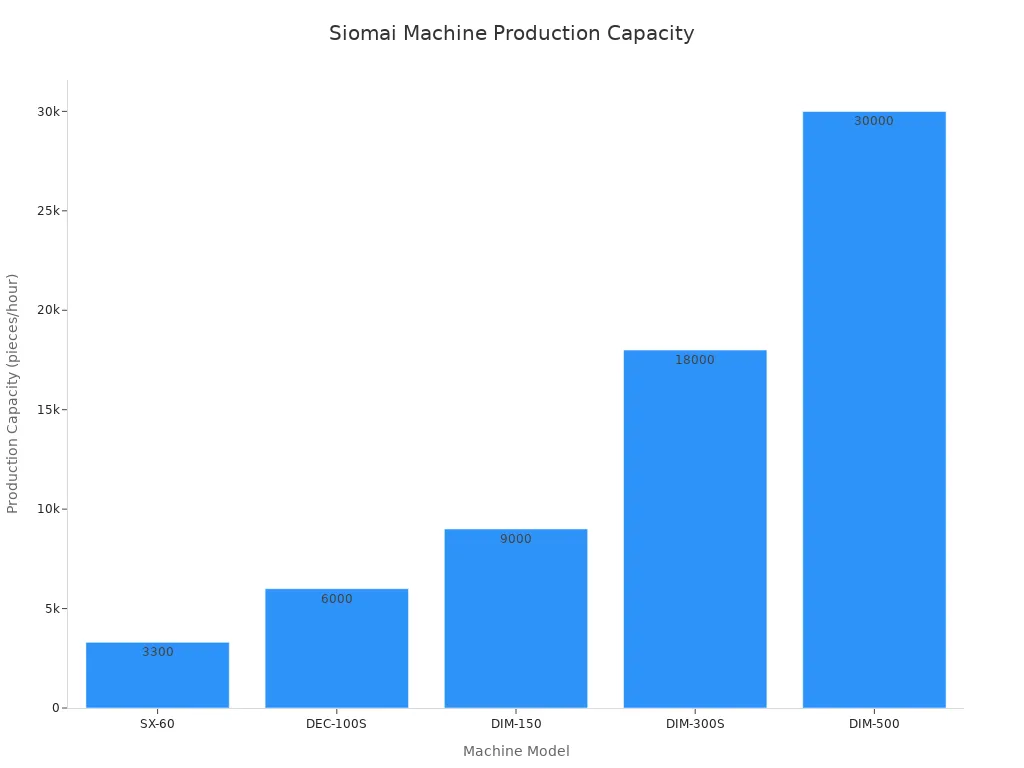
Choosing a machine with appropriate speed prevents production bottlenecks and ensures customer demand is met efficiently.
Material and Build Quality
The construction material directly impacts a machine's durability and food safety. High-quality stainless steel is the industry standard for food processing equipment. The two most common grades are SS304 and SS316.
| Feature | SS304 (Stainless Steel 304) | SS316 (Stainless Steel 316) |
|---|---|---|
| Corrosion Resistance | Good for general food processing. | Superior, especially against salts and acids. |
| Best For | Kitchen appliances, general use. | High-salt or acidic food environments. |
| Cost | Less expensive. | More expensive due to added molybdenum. |
A robust build quality ensures the machine withstands the demands of continuous daily operation, minimizing downtime and repair costs.
Ease of Use and Cleaning
An effective machine should be simple to operate and maintain. Intuitive controls and straightforward processes reduce the need for extensive operator training. More importantly, easy cleaning is essential for maintaining food hygiene standards.
Hygiene First 🧼: A machine that is difficult to clean poses a significant food safety risk. Prioritize designs that promote simple and thorough sanitation.
Look for equipment with the following features:
- The machine is designed for easy disassembly and reassembly.
- All parts that contact food are made from food-grade stainless steel.
- Components are easily accessible for quick cleaning and maintenance.
These design elements simplify daily upkeep and ensure the equipment complies with food safety regulations.
Power Consumption
A machine's power consumption is a critical factor that directly influences long-term operational costs. Businesses must evaluate this metric to understand the full financial impact of their equipment. The power rating, typically measured in kilowatts (kW), determines how much electricity the machine uses per hour of operation. Higher consumption leads to larger utility bills, affecting overall profitability.
Different models have varying energy needs based on their size, speed, and features. For example, an automatic siomai maker like the QD-880 model has a power consumption of 2.9 kW. This figure is a useful benchmark for a high-capacity commercial unit. Smaller, semi-automatic machines generally consume less power, while larger, multi-line systems may require more.
Electrical Compatibility Check ⚡ Before purchasing, businesses must confirm the machine's electrical requirements. Key specifications to verify include:
- Voltage: Ensure the machine's voltage (e.g., 220V) matches the facility's power supply.
- Phase: Determine if the machine needs a single-phase or three-phase connection.
- Frequency: Check that the machine's frequency (e.g., 60Hz) aligns with the local standard.
A mismatch in electrical specifications can lead to performance issues or require costly modifications to the building's wiring. The table below provides a general overview of power consumption relative to machine capacity.
| Machine Scale | Typical Capacity (pcs/hr) | Estimated Power Range (kW) |
|---|---|---|
| Small | 1,500 – 2,500 | 1.0 – 1.8 kW |
| Medium | 3,000 – 6,000 | 2.0 – 3.5 kW |
| Large | 7,000 – 10,000+ | 3.5 – 5.0+ kW |
Ultimately, selecting a machine with an appropriate power rating helps manage expenses effectively. Entrepreneurs should calculate projected energy costs as part of their total cost of ownership analysis to make a financially sound investment.
After-Sales Support and Maintenance
Reliable after-sales support is a critical component of a long-term equipment partnership. A distributor's commitment to maintenance, parts, and technical assistance directly impacts a business's operational uptime and profitability. Strong support minimizes downtime and protects the initial investment.
Warranty and Service Agreements
A comprehensive warranty provides a safety net against manufacturing defects and premature failures. Businesses should carefully review the terms of any warranty or service agreement before purchase. Standard warranties for commercial food equipment typically span from one to two years. For example, distributors like Henan Gelgoog Machinery and Luohe Siyu Machinery offer a 1-year warranty on their commercial models, reflecting a common industry benchmark.
Pro Tip 💡: Always clarify what the warranty covers. Key details include coverage for parts, labor, and on-site service. Understanding these terms prevents unexpected costs during a breakdown.
Spare Parts Availability
Continuous operation depends on the quick availability of spare parts. A machine shutdown due to a minor part failure can halt production and lead to significant revenue loss. Reputable distributors maintain a ready inventory of essential components.
Businesses should inquire about a distributor's parts policy:
- Local Stock: Does the distributor keep common wear-and-tear parts in a local warehouse?
- Lead Time: How long does it take to source and deliver non-stocked or specialized parts?
- Cost: Are the prices for spare parts reasonable and transparent?
A distributor with a robust supply chain ensures that repairs happen swiftly, keeping production lines moving.
Technical Support Options
Effective technical support helps businesses resolve issues efficiently. Top distributors offer multiple channels for assistance, catering to different needs and urgency levels. This ensures clients receive help for installation, troubleshooting, and maintenance.
Modern support services often include:
- Remote Assistance: Product specialists provide help through 24/7 online portals, live chat, and phone calls.
- On-Site Support: Technicians visit the facility for complex repairs or hands-on maintenance.
- Virtual Support: Advanced services may use Augmented Reality (AR), allowing experts to see the issue in real-time and guide on-site staff through repairs with visual instructions.
This multi-faceted approach empowers businesses to resolve technical challenges quickly and maintain peak operational performance.
Operator Training and Guidance
Effective operator training is essential for maximizing the value of a new food production machine. A distributor's commitment to guidance ensures that a business can leverage its equipment to its full potential. Proper training goes beyond basic operation. It empowers staff to run the equipment efficiently, safely, and with minimal downtime. This knowledge directly protects the business's investment and supports consistent production quality.
Top distributors provide comprehensive training programs covering critical operational and maintenance procedures. These sessions equip operators with the skills needed for daily success. Key topics often include:
- Responding to alarms or error messages
- Safe shutdown and disassembly procedures for cleaning
- Identifying early signs of component wear or damage
- Recording all tasks and observations in the maintenance log
This level of instruction helps operators troubleshoot minor issues independently. It also fosters a proactive maintenance culture within the team. Well-trained staff can prevent small problems from escalating into costly repairs, ensuring the siomai machine operates reliably.
Knowledge Retention Tip 🎓 Businesses should document all training procedures and create internal checklists. This practice helps standardize operations and simplifies the process of training new employees, ensuring valuable knowledge stays within the company.
Ultimately, a distributor that invests in thorough operator training provides more than just a machine. They deliver a complete production solution. Businesses should prioritize partners who offer detailed manuals, hands-on demonstrations, and accessible support. This focus on education ensures a smooth transition and long-term operational excellence. A well-guided team is a productive team, capable of meeting production targets while upholding the highest standards of safety and quality.
Selecting the right siomai machine distributor is a critical investment. A business must align its choice with its production scale, budget, and support preferences. A local distributor like BNE offers hands-on service. An international supplier like ANKO provides advanced technology and proven solutions, once helping a client resolve dough wrapper issues after an installation. Entrepreneurs can use this guide to confidently assess their options. This helps them contact the right partners and secure a reliable machine for their food business.
FAQ
What is the typical price range for a siomai machine?
The cost of a siomai machine varies by type. Semi-automatic models for small businesses generally range from $1,600 to $3,500. Fully-automatic, high-capacity machines for large-scale production represent a higher investment, reflecting their advanced speed and automation features.
How much maintenance does a siomai machine require?
Proper maintenance ensures machine longevity and food safety. Operators should perform key tasks regularly.
- Daily cleaning of all food-contact parts.
- Periodic inspection for wear on components like belts and molds.
- Scheduled lubrication of moving parts as per the manufacturer's guide.
Can one machine make different types of siomai?
Many modern siomai machines offer excellent versatility. By equipping different molds and mechanisms, a single unit can produce various products. These include traditional siomai, wontons, and even specialized items like lace-style gyoza, accommodating diverse production needs.
Note 📝: Businesses should confirm a specific model's capabilities with the distributor to ensure it aligns with their product diversification goals.
What is the average production capacity of a commercial siomai machine?
Production capacity differs significantly across models. Small-scale machines may produce around 1,500 pieces per hour. High-volume commercial units, such as double or triple-line models, can achieve outputs from 5,000 to over 9,000 pieces per hour, suiting large food enterprises.
See Also
Top Chinese Manufacturers for High-Quality X-Ray Inspection Equipment Purchases
Essential Industrial Vacuum Cleaners: Six Must-Have Options for Businesses
Innovative Folder Gluer Technologies Shaping 2025 Carton Production Lines
Identifying the Foremost Nameplate Suppliers: Key Qualities for 2025 Success
Comparing Leading Ampoule Filling Production Line Manufacturers: A Comprehensive Analysis