The Surprising Role of AI in the Food Industry's Purity
Artificial intelligence is now an essential tool for ensuring food safety. The technology provides unmatched speed, accuracy, and predictive power for detecting contaminants.
The use of ai in food industry surpasses human limitations. It enables real-time monitoring and rapid responses across the entire supply chain, ensuring product consistency and purity.
How AI Detects Contaminants and Guarantees Quality
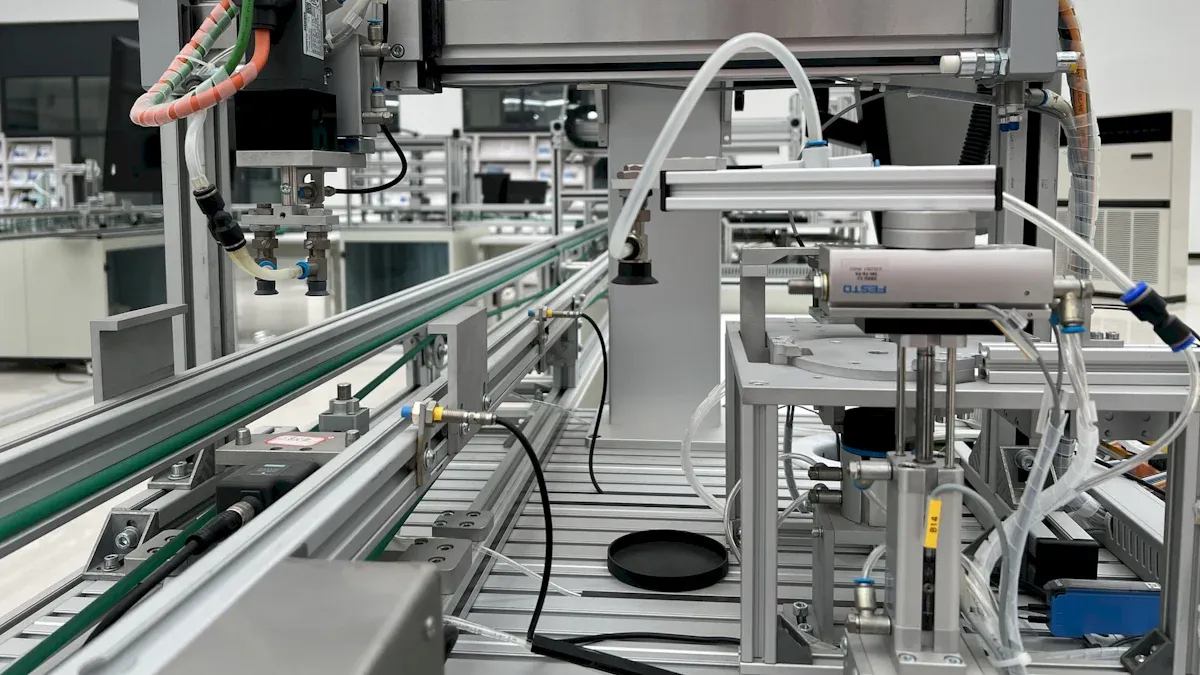
Artificial intelligence moves beyond simple automation. It provides a sophisticated set of tools that see, smell, and taste with superhuman precision. These systems work tirelessly to identify threats and ensure every product meets exacting standards.
AI Vision for Spotting Physical and Microbial Threats
AI-powered computer vision gives food producers an unprecedented ability to see the unseen. These systems identify physical contaminants on fast-moving production lines through a process called anomaly detection. High-speed cameras, often integrated with X-ray or spectroscopy technologies, capture detailed images of products. Deep learning models then analyze these images, having been trained on vast datasets to distinguish between a product's natural variations and foreign materials. This allows them to spot and flag contaminants like:
- Metal shards
- Glass fragments
- Stones
- Plastic pieces
This technology also extends into the microscopic world. Advanced systems use hyperspectral imaging (HSI) to analyze light across the visible and infrared spectrums. This allows the AI to detect subtle chemical changes on a food's surface that signal microbial growth or spoilage before they are visible to the human eye. Specific algorithms like YOLOv4 can even perform real-time detection and classification of harmful bacteria. For example, this model successfully identifies E. coli contamination on romaine lettuce, distinguishing it from other bacteria like Salmonella and Listeria.
The performance leap is significant. While human inspectors can achieve around 80-85% accuracy, AI-powered inspection systems consistently reach over 99% detection rates. They process items in seconds, not minutes, enabling 100% product inspection rather than relying on statistical sampling. This application of ai in food industry dramatically reduces the risk of contaminated products reaching consumers.
AI Sensors for "Smelling" and "Tasting" Spoilage
Beyond vision, AI leverages advanced sensors to mimic the human senses of smell and taste, detecting spoilage at a chemical level.
Electronic noses, or "e-noses," identify food decay by detecting Volatile Organic Compounds (VOCs). As food spoils, it releases specific gases, and e-noses are designed to recognize their unique chemical fingerprints. The process works in a few key ways:
- Sensors with specialized coatings or nanoparticle layers react to VOCs in the air.
- This interaction generates a unique electrical signal or a measurable color change.
- Machine learning algorithms process these signals, comparing them against a database to identify the specific VOCs and, by extension, the type of spoilage or bacterial strain present.
Similarly, electronic tongues, or "e-tongues," assess a liquid's quality and freshness. These devices use an array of sensors, such as ion-sensitive field-effect transistors (ISFETs), that generate electrical signals based on the liquid's chemical composition. An AI model then interprets this data to classify beverages, detect dilution, or confirm freshness. This technology provides an objective and highly consistent measure of taste profiles that is immune to environmental factors like temperature changes. The use of ai in food industry for sensory analysis is creating a new standard for quality control.
Automated Grading for Perfect Consistency
Maintaining consistent quality is a major challenge in the food sector, especially with natural products like fruits, vegetables, and meat. AI-driven automated grading replaces subjective human judgment with objective, data-driven analysis.
AI systems analyze products for a wide range of quality attributes, including size, shape, color, firmness, and surface blemishes. Self-learning models continuously improve their accuracy by training on new data from different seasons and growing conditions, ensuring the grading standards remain consistent over time.
This technology also plays a crucial role in reducing food waste. Instead of simply discarding imperfect items, AI can sort them for different purposes. For instance, Walmart's "Eden" system inspects produce to predict shelf life, saving the company an estimated $2 billion by optimizing inventory and reducing spoilage. Bruised apples or soft peppers that might be rejected by a retailer can be automatically diverted to be used in juice, sauces, or frozen meals.
To ensure objectivity, these systems rely on precise performance metrics. The choice of metric depends on the specific grading task.
| Metric Type | Examples |
|---|---|
| Classification (e.g., good/bad) | Accuracy, Precision, F1-Score, False-Reject Rate |
| Regression (e.g., predicting ripeness) | Mean Absolute Error (MAE), Root Mean Square Error (RMSE) |
| Segmentation (e.g., identifying a bruise) | Mean Intersection-over-Union (mIoU) |
By automating these complex grading tasks, the ai in food industry not only enhances product consistency but also delivers a significant return on investment through increased efficiency, reduced waste, and improved scalability.
The Future of Prevention: Predictive Analytics and the Role of AI in Food Industry
AI’s role extends beyond detection to proactively prevent safety issues before they arise. Predictive analytics transforms food safety from a reactive process into a forward-looking strategy, anticipating problems and neutralizing them at the source.
Predicting Spoilage and Outbreak Hotspots
AI models forecast spoilage and contamination by analyzing complex datasets. These systems process multiple variables to predict when and where a problem might occur. Key data points include:
- Temperature and humidity levels
- Gas emissions from food
- Approximate storage life
- Historical compliance records
A food manufacturer in California, for example, used a predictive model to analyze its lettuce supply chain. The system flagged a high-risk growing region due to unusual weather patterns weeks before traditional testing would have. This allowed the company to switch suppliers, preventing a potential contamination event. This application of ai in food industry empowers managers to take targeted, proactive measures.
AI and Blockchain for Flawless Traceability
Combining AI with blockchain technology creates an unparalleled system for food traceability. Blockchain provides a secure, unchangeable digital ledger that records every step of a product's journey. AI then analyzes this data to spot inconsistencies or verify authenticity. This synergy is revolutionizing food recalls.
Walmart, using an AI-boosted blockchain platform, reduced the time to trace a package of mangoes from nearly seven days to just 2.2 seconds. This speed allows for precise removal of affected products, protecting consumers and minimizing waste.
Optimizing Production for Safer Outcomes
AI optimizes the production environment itself to build safety into the process. It uses data from IoT sensors to manage critical factors like temperature and airflow in storage facilities, ensuring conditions remain optimal. Algorithms also enable predictive maintenance, analyzing equipment performance to schedule repairs before a failure can cause contamination. The use of ai in food industry even extends to formulation, where models identify high-risk ingredient combinations or suggest substitutions to enhance shelf life and safety, creating a fundamentally more resilient food supply.
AI strengthens food purity through three core capabilities: superior contaminant detection, unwavering quality consistency, and proactive risk prevention. These systems use predictive analytics and advanced sensors to avert safety incidents before they happen.
Far from a future concept, AI is a vital tool currently safeguarding our food supply. It elevates the quality of what we consume daily while reducing operational costs.
FAQ
Is AI replacing human workers in food safety?
AI systems augment human capabilities, not replace them. They handle high-speed, repetitive inspection tasks. This allows human experts to focus on complex quality control and system management.
How does AI "see" contaminants on a production line?
AI uses high-speed cameras and deep learning models. The system analyzes product images in real time, identifying foreign objects like metal or plastic by spotting visual anomalies.
Is this technology only for large corporations?
Initial investment can be significant. However, the technology's return on investment from reduced waste and fewer recalls makes it increasingly accessible and valuable for businesses of all sizes.
See Also
Essential Industrial Checkweighers: Top Three for Every Food Processing Plant
Comprehensive Nozzle Solutions: A Guide for Diverse Industry Professionals
Unveiling Designer Creativity: Insights from the Architecture of Computer Chips
Ampoule Filling Production Lines: A Comparative Analysis of Leading Manufacturers
Hygienic Design Innovations: Industry Leaders Convene at the 3-A SSI Summit