A comparison of mucosal incisions made by surgical CO2 lasers vs electrosurgery
Surgeons carefully evaluate soft tissue cutting technologies to optimize clinical outcomes. Selecting the ideal modality for mucosal incisions directly impacts tissue recovery and surgical accuracy. A surgical CO2 laser delivers superior precision, reduced collateral damage, and accelerated wound healing compared to electrosurgery. While electrosurgery remains effective for rapid bulk removal, focused light energy offers unmatched thermal control and minimal necrosis. Clinical studies by Strauss et al and Deppe et al report that the recovery process after laser surgery is faster and less painful than after thermal cautery. Consequently, precise energy delivery minimizes collateral tissue inflammation and significantly elevates post-operative patient comfort.
Precision Mechanisms of Surgical CO2 Laser vs Electrosurgery
Chromophore Absorption in Soft Tissue Treatments
A surgical CO2 laser relies on targeted light absorption rather than physical contact. The 10,600nm wavelength specifically targets intracellular water in mucosal soft tissue treatments. Because moist oral and veterinary tissues contain abundant water, the laser energy absorbs within an absorption depth of approximately 15 µm. This photo-thermal process converts light into heat, causing rapid vaporization of intracellular and extracellular fluid. Surgeons achieve clean incisions without pressing an instrument against vulnerable anatomical structures.
The most efficient heating of the irradiated tissue takes place when laser pulse energy is high and its duration is much shorter than the Thermal Relaxation Time (TR ≈ 1.5 msec for 10,600 nm). This SuperPulse mode minimizes the depth of coagulation, ensuring that the laser energy is confined to the target tissue, thereby achieving precise ablation without damaging adjacent structures.
When exploring various types of lasers in surgery, the CO2 wavelength offers unique absorption features:
Primary mechanism: Intracellular water absorbs the 10,600nm wave directly.
Shallow penetration: Energy dissipates within 0.1 mm, protecting deep bone tissue.
Ablation efficiency: Water absorption provides over 1,000 times superior efficiency compared to ~1,000 nm wavelengths.
Electrical Current Density and Thermal Spread
An electrosurgery unit operates through continuous thermal resistance. Electrical current flows directly through target tissue, generating heat as the cells resist current flow. Moist mucosal environments alter electrical resistance, causing unpredictable thermal spread into adjacent collagen and muscle layers.
Current intensity depends on contact area: smaller knife → higher current density → better cutting; larger surface area → dispersed current → weaker cut and broader thermal injury.
Clinicians evaluate key performance metrics when comparing these two surgical tools during delicate treatment applications:
Feature | CO2 Laser (10,600 nm) | Electrosurgery |
|---|---|---|
Energy delivery | Photo-thermal absorption by water | Electrical current resistance |
Contact requirement | Non-contact cutting | Requires physical tissue contact |
Thermal damage zone | Minimal; coagulation depth ~50 µm | Excessive heat; wider zone of necrosis |
Appliance safety | No risk near metal | Risk with metal orthodontic appliances |
The CO2 laser provides superior margin precision during surgery because its non-contact beam eliminates physical drag and delivers consistent focal density.
Thermal Damage and Healing Rates of CO2 Energy
Lateral Necrosis and Tissue Scarring
Surgical energy sources interact differently with oral and veterinary mucosa. Electrosurgery devices pass high-frequency electrical current directly through biological tissue layers. Resistance to electrical current creates significant heat within moist soft tissues. This uncontrolled electrical resistance creates broad zones of thermal damage beyond the intended surgical line. High continuous heat destabilizes cellular membranes across wide collateral areas.
In contrast, coherent light beams interact specifically with intracellular water molecules within moist biological target tissues. Water absorbs light energy instantly within micro-thin surface layers. Consequently, localized light absorption limits peripheral energy dissipation during targeted mucosal incisions. Clinical researchers have systematically evaluated lateral heat damage boundaries across different energy modalities.
Surgical Method | Zone of Thermal Necrosis | Zone of Reversible Thermal Change |
|---|---|---|
CO2 Laser (Pogrel et al.) | < 100 µm | 100 µm to 500 µm (adjacent to necrosis zone) |
Flexible Fiber CO2 Laser (Wilder-Smith et al.) | < 50 µm (coagulation zone) | N/A |
Narrow thermal damage boundaries preserve adjacent vascular and cellular structures during delicate soft tissue surgery. Continuous research confirms that controlled CO2 energy delivery minimizes lateral thermal spread during delicate ablations.
"...Pogrel and colleagues concluded that the relatively narrow width of thermal tissue necrosis makes the CO2 laser excision superior for histologic examination of excised specimens than those created by electrosurgery."
This documented lack of tissue injury preserves intact mucosal margins for accurate pathology analysis. Pathologists easily evaluate cell structures without thermal distortion artifacts. Smaller thermal injury zones also limit myofibroblast activity during early wound healing phases. Reduced myofibroblast proliferation minimizes contracture forces across surgical borders. Therefore, delicate mucosal tissues retain natural elasticity and avoid dense scar formation.
Post-Operative Pain and Re-Epithelialization
Thermal injury depth directly controls post-operative tissue recovery timelines and patient comfort levels. High thermal energy from electrosurgery strips protective mucosal surfaces across broad margins. Broad tissue destruction delays cell recruitment and triggers intense inflammatory responses. In contrast, focused optical energy seals small nerve endings and capillary vessels instantly during cutting. Sealed nerve fibers block nociceptive pain signals to the central nervous system. Sealed micro-lymphatic channels prevent inflammatory fluid leakage into interstitial tissue spaces. Clinical studies confirm that every patient reports significantly less pain after optical cuts than after electrosurgical cautery. Rapid relief speeds up return to normal eating, speaking, and daily activities.
Furthermore, minimal collateral heat preserves critical collagen scaffolds, native extracellular matrix components, and intact basement membrane proteins. Preserved underlying tissue structures enhance inherent wound healing properties across mucosal surfaces. Basal keratinocytes migrate swiftly across intact extracellular matrices to restore protective epithelial covers. Early re-epithelialization seals target surgical wounds quickly against oral pathogens, thermal changes, and mechanical friction.
Advanced laser systems incorporate innovative thermal management features to optimize soft tissue recovery. Modern laser platforms utilize specialized scanning mechanisms like Random Operate Mode during procedures. The device emits consecutive micro-beams in alternating spatial patterns across target sites. Alternating beam delivery allows surrounding micro-zones to cool rapidly between successive pulses. Effective cooling prevents continuous heat accumulation, deep thermal spread, and secondary tissue swelling. Clinicians choose custom parameters for each soft tissue treatment. Controlled thermal management elevates overall patient outcomes while maintaining superior surgical accuracy.
Intraoperative Hemostasis with CO2 Laser Technology
Microvascular Sealing Capabilities
Surgical tools must control tissue hemorrhage effectively during soft tissue operations. The direct thermal energy from a co2 laser provides exceptional hemostatic control across oral and veterinary mucosal surfaces. Light energy rapidly seals small blood vessels and lymphatic channels during active cutting. Specifically, photo-thermal light absorption targets intracellular water inside soft vascular structures. The laser energy generates localized thermal coagulation inside mucosal capillaries.
Aspect | CO2 Laser vs Electrosurgery |
|---|---|
Healing & Pain | CO2 laser surgery offers enhanced healing and less pain compared to electrosurgery. |
Hemostatic Mechanism | CO2 laser coagulation depth (sub-100 µm) closely matches capillary diameters (20-40 µm), enabling efficient sealing of small vessels, whereas electrosurgery lacks this precise depth matching. |
Electrosurgery relies on broader electrical resistance to scorch bleeding soft tissue zones. Electrical current passes through moist structures unpredictably and damages peripheral vascular walls. In contrast, co2 light beams target microvascular networks directly without deep thermal destruction. The controlled thermal depth preserves sub-mucosal structures and limits post-operative tissue inflammation. Consequently, practitioners observe a minimal amount of bleeding during complex operative procedures. Clinicians maintain optimal clear vision across the active target zone throughout the operation.
Cutting Speed and Surgical Margin Clarity
Clear surgical field visibility enhances overall operator performance and procedural accuracy. Electrosurgery generates considerable tissue charring, thick eschar layers, and heavy surgical smoke. Charred tissue obscures anatomical boundaries during delicate operative maneuvers. Furthermore, electrical current resistance pulls or tears fragile mucosal edges during manual passes. These physical distortions compromise margin precision and complicate histological tissue evaluation.
In contrast, non-contact optical energy dramatically improves surgical margin clarity and efficiency. The laser beam vaporizes targeted soft tissue instantly along designated pathways. Focused light leaves clean, non-charred mucosal margins across all executed incisions. Pathologists easily distinguish healthy cellular structures from pathological tissue samples due to minimal edge distortion.
Optical precision eliminates physical drag on delicate mucosal membranes while sealing micro-vessels simultaneously.
The speed of incisions plays an important role in total operative duration and patient anesthesia exposure. Continuous high energy delivery accelerates linear cutting throughput without sacrificing surgical precision. The following operational advantages highlight how high-powered light ablation improves modern clinical workflows:
Focused energy delivery maintains rapid tissue vaporization along mucosal pathways.
Simultaneous vessel coagulation eliminates frequent surgical pauses for manual blotting.
Clear visual fields allow surgeons to execute steady, continuous cutting motions.
Higher overall efficiency allows clinicians to complete complex soft tissue procedures swiftly. Reduced treatment times decrease total patient stress and minimize operative complications. Patients experience smooth post-operative recovery due to clean cuts and preserved surrounding tissue layers.
Clinical Integration and System Features
Safety Protocols and Smoke Evacuation
Operating rooms require strict safety protocols during energy-based soft tissue surgery. Both thermal modalities generate biohazardous plume and surgical smoke. Local exhaust ventilation systems extract dangerous airborne particulates and protect clinical staff from inhalation risks. Operating room staff must maintain positive air pressure and at least 15 air exchanges per hour.
Component / Practice | Protocol Standard | Rationale |
|---|---|---|
System Type | Portable evacuators or room suction | Provides local exhaust ventilation |
Nozzle Placement | Within 2 inches of surgical site | Captures localized smoke effectively |
System Activation | Active status during plume presence | Prevents particulate dispersal |
Filtration | High-efficiency micron filters | Captures ~99.9% of 0.12-micron particles |
Surgical teams activate evacuators continuously during active tissue vaporization. An electrosurgery unit releases toxic smoke, while a surgical co2 laser creates light-based steam. Integrated electrocautery pencils or dedicated laser nozzles capture hazardous plume directly at the incision site. High-efficiency filters capture ~99.9% of 0.12-micron particles to maintain a sterile clinical environment.
Apolomed CO2 Laser HS-411 Capabilities
Modern surgical platforms enhance clinical versatility across soft tissue applications. The Apolomed CO2 Laser HS-411 serves as a 3-in-1 medical-grade solution. Clinicians select 50mm or 100mm Normal Cutting Handles for precision mucosal soft tissue surgery. Adjustable power outputs of 35W, 55W, and 100W deliver consistent system performance. This surgical co2 laser delivers stable 10,600nm energy directly into moist mucosal tissue.
Modern platforms combine advanced controls with high optical power to elevate treatment precision.
The system operates on an intuitive A9 Android interface. Practitioners draw custom treatment shapes directly on the screen with touch precision. The platform features international certifications from ISO 13485, CE 0197, and the US FDA. Clinicians appreciate this laser system for its exceptional combination of ease of use and cutting accuracy. The co2 laser technology streamlines daily clinical workflow during soft tissue routines. Pure co2 energy penetrates superficial mucosal layers effectively. This co2 platform improves practitioner ease during complex mucosa operations. Surgeons optimize daily unit use with minimal setup delays. Overall, the HS-411 laser platform elevates modern optical surgery.
Clinical Selection Criteria for Surgical Procedures
Anatomical Location and Tissue Vascularity
Biological tissue vascularity heavily influences energy selection during oral surgery. Clinicians prefer light-based ablation when operating on highly vascular soft tissue structures. Laser light coagulates microvascular networks efficiently, maintaining exceptionally clear visibility throughout active dissection.
Vascularity influence: Focused light energy coagulates small blood vessels instantly, enabling safe treatment for patients taking systemic anticoagulants without severe intraoperative bleeding.
Anatomical location influence: Superficial lip hemangiomas require precise non-contact cutting to prevent mechanical trauma, avoid deep tissue distortion, and ensure superior esthetic outcomes.
Penetration depth context: Deep Nd:YAG energy penetrates 7-10 mm into tissue, which renders this wavelength inappropriate for delicate superficial lip lesions.
Conversely, an electrosurgery unit creates excessive thermal necrosis across soft vascular mucosal layers. Uncontrolled electrical resistance generates substantial lateral heat spread, causing post-operative tissue depigmentation and prominent hypertrophic scarring in cosmetically sensitive facial locations. Clinicians avoid intense electrical heating on delicate mucosal margins to protect critical anatomical structures and preserve natural post-operative appearance.
Case Complexity and Equipment Selection
Surgical teams choose specific energy tools based on case complexity, target anatomical depth, and overall operational efficiency. The primary advantages of electrosurgery include rapid execution during bulk tissue removal and fast debulking procedures. However, precise mucosal incisions demand higher thermal control than standard resistance devices provide. Practitioners carefully evaluate overall system versatility when selecting modern surgical tools for routine soft tissue applications.
Modern surgical platforms enhance overall ease of use while expanding total clinical capabilities across diverse surgical disciplines. High system efficiency accelerates routine soft tissue cutting without increasing collateral thermal damage in adjacent tissue beds. In complex clinical scenarios, surgeons may combine electrosurgery and laser surgery to balance swift bulk debulking with fine marginal coagulation. This balanced technique simplifies multi-step operative procedures and accelerates overall tissue healing during routine mucosal surgery procedures. Clinicians value operational ease while delivering consistent, high-quality patient care.
Clinical evidence confirms that a surgical co2 laser creates minimal thermal necrosis during soft tissue procedures. This light-based technology seals capillary networks cleanly to control intraoperative bleeding during mucosal incisions. Clinical studies report lower median pain scores for laser treatment compared to conventional electrosurgery at 4 hours (1.8 vs 3.7), 24 hours (1.2 vs 2.9), and 7 days (0.4 vs 1.6).
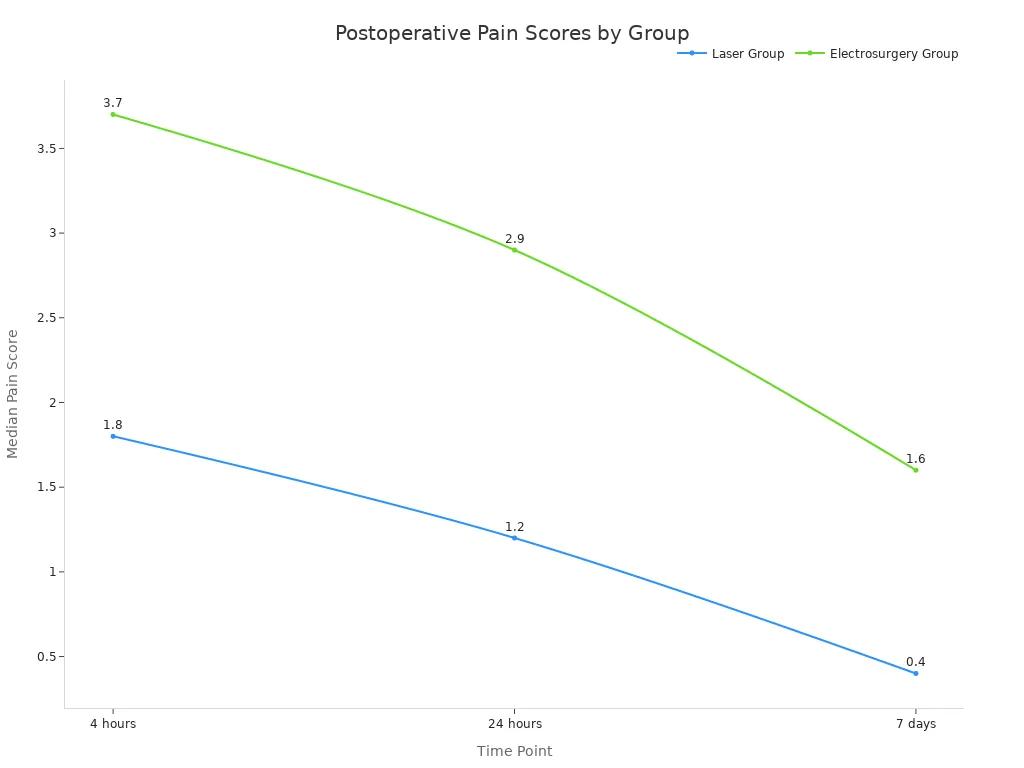
Reduced heat transmission minimizes tissue edema while improving patient comfort during post-operative healing. Advanced platforms, such as the Apolomed CO2 HS-411, provide optimal thermal control for delicate soft tissue mucosal interventions. Practitioners select this modern system to elevate patient outcomes through consistent energy delivery and superior collateral thermal preservation.
FAQ
Why do CO2 lasers cause less lateral thermal damage than electrosurgery?
Target intracellular water absorbs the 10,600nm laser wavelength within a shallow depth. This micro-precise absorption limits heat spread to adjacent tissues. In contrast, electrical current resistance during electrosurgery generates continuous heat spread, which creates a wider zone of lateral thermal necrosis in moist mucosal tissue.
How does patient post-operative pain compare between these energy modalities?
Patients report significantly lower pain scores following CO2 laser procedures. Light energy seals micro-vessels and nerve endings immediately during cutting. Conversely, electrosurgery creates deeper thermal destruction, which triggers intense inflammation and increases pain during the post-operative healing phase.
What features enhance clinician operational control during soft tissue laser procedures?
Modern laser platforms incorporate intuitive interfaces and customizable handpieces. Features like the A9 Android system screen enable custom hand-draw functionality for high treatment accuracy. These design innovations improve operational ease of use and streamline daily clinical workflows during mucosal surgery procedures.
Why is proper smoke evacuation necessary during thermal soft tissue treatments?
Both light energy and electrosurgery produce hazardous airborne particulates and tissue plume. Operating rooms must use dedicated evacuation units with high-efficiency filters. Active smoke capture protects medical staff from inhalation risks and maintains a safe clinical environment during device operation.
How do CO2 lasers preserve clear tissue margins for biopsy samples?
Non-contact optical energy vaporizes mucosal soft tissue without physical contact or tissue drag. The localized light beam creates narrow thermal damage borders under 100 µm. Pathologists easily evaluate cellular structures because clean incision lines lack the heavy charring and edge distortion associated with electrosurgery.