Enhance Your Doors with the Power of Steel Hinges
Steel hinges give doors greater strength and security in homes and businesses. They prevent problems such as squeaking, loose or rusty hinges, misaligned doors, and broken hardware. Homeowners and business owners see lasting value in steel hinges because these parts resist corrosion and support smooth, reliable movement every day.
Why Choose Steel Hinges
What Makes Steel Hinges Unique
Steel hinges stand out because they combine strength and durability with practical features for everyday use. Stainless steel hinges offer exceptional resistance to corrosion and wear, especially in humid or coastal environments. Many homeowners and businesses choose steel hinges for their long lifespan and minimal maintenance needs. These hinges maintain their shine and performance even in challenging conditions, outperforming zinc-coated or brass alternatives.
Stainless steel hinges resist rust and corrosion in damp areas.
Steel hinges require less maintenance than other materials.
Stainless steel hinges remain strong and attractive in coastal regions.
Steel hinges may cost more at first, but their durability leads to lower repair and replacement costs over time.
Stainless steel hinges last longer and need less upkeep.
Manufacturers use advanced processes to create steel hinges with precise dimensions and smooth finishes. The table below shows how these processes contribute to the unique qualities of steel hinges:
Manufacturing Process | Contribution to Characteristics |
|---|---|
Investment Casting | Provides excellent dimensional accuracy and near-net-shape hinges. |
Machining | Ensures precision fit for critical hinge features like pin bores and mounting holes. |
Surface Finishing | Enhances performance and appearance through polishing, electropolishing, and passivation. |
Secondary Treatments | Includes PVD coatings and lubrication channels for added durability and aesthetic appeal. |
Material Strength and Load-Bearing
Steel hinges deliver impressive load-bearing capacity. Heavy-duty stainless steel hinges can support over 120 kg per pair, making them ideal for commercial doors and gates. The strength and durability of steel hinges ensure proper alignment and reliable function, even with frequent use. Ball-bearing designs and thicker materials further increase their ability to handle heavy loads.
The table below compares steel hinges to brass and aluminum hinges:
Material | Advantages | Disadvantages | Best Uses |
|---|---|---|---|
Steel | High strength and durability | Prone to rust and corrosion | Heavy-duty doors in commercial spaces |
Brass | Elegant appearance | Softer than steel, may wear out quickly | Interior doors or high aesthetic value doors |
Aluminum | Lightweight | Weaker than steel | Lightweight or exterior doors |
Heavy-duty hinges made from steel withstand significant stress without deforming. This feature is essential for maintaining door alignment and function in demanding environments.
Temperature and Weather Resistance
Steel hinges perform well in extreme temperatures and harsh weather. Stainless steel hinges maintain flexibility and durability in sub-zero conditions, preventing cracks and ensuring smooth operation in cold storage or freezer units. In high-temperature settings, steel hinges retain their structural integrity, making them suitable for industrial ovens and furnace doors.
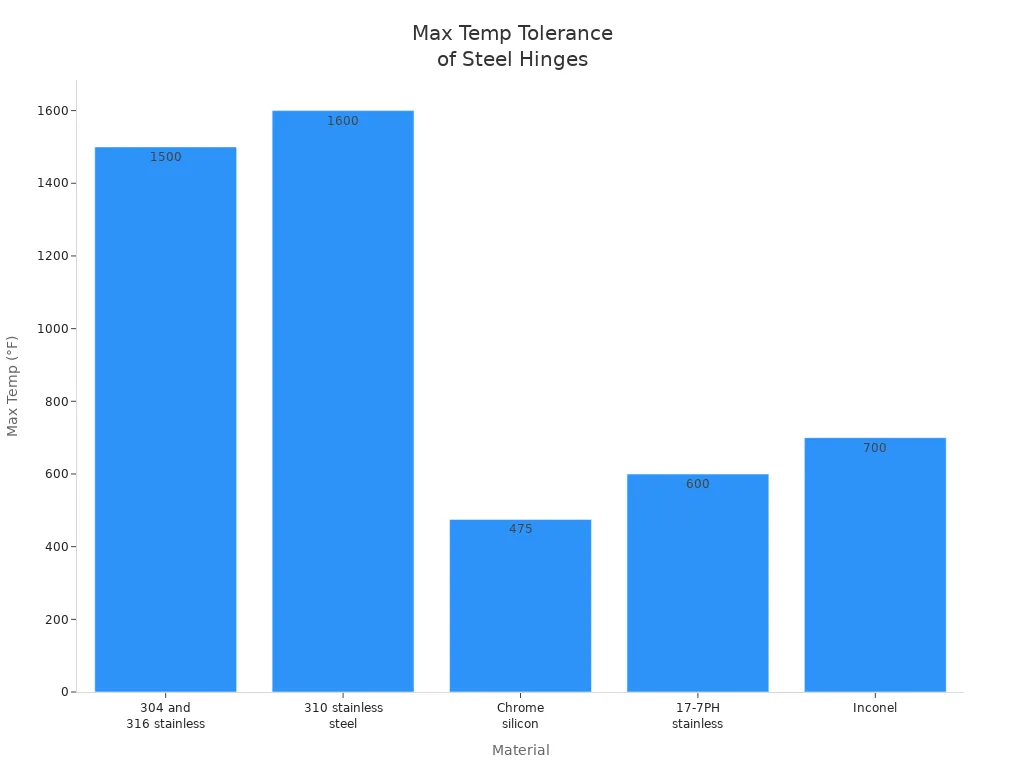
Stainless steel hinges resist corrosion due to chromium, which forms a protective layer. They remain rust-free in damp or coastal environments, unlike ordinary steel hinges. Their high seawater resistance and ability to withstand pitting and crevice corrosion ensure long-lasting performance in wet conditions.
Tip: Choosing steel hinges for exterior doors, gates, and high-traffic areas helps prevent common problems like rust, misalignment, and frequent repairs.
Benefits of Steel Hinges
Durability and Longevity
Steel hinges offer outstanding durability for both residential and commercial doors. They can withstand repeated opening and closing without bending or breaking. Many electrical-cabinet manufacturers report that steel hinges show almost no frame distortion after one million actuations. This level of durability means doors stay aligned and function well for years.
Evidence Type | Description |
|---|---|
Finite-element results | Stress peaks on a 1 m door drop by 60% compared to individual hinges. |
Field trials | Electrical-cabinet OEMs report hinge-side frame distortion falling to near zero after one million actuations. |
Steel hinges resist bending and warping, even under heavy loads. They last longer than brass or aluminum hinges, which often wear out faster. This durability reduces the need for frequent replacements and repairs, saving time and money for homeowners and businesses.
Note: Choosing steel hinges for high-traffic areas ensures reliable performance and long service life.
Corrosion Resistance
Corrosion resistance is a key advantage of steel hinges, especially those made from stainless steel. These hinges contain chromium, which forms a protective layer that prevents rust and corrosion. This feature is important in humid environments, such as bathrooms, kitchens, or coastal areas.
Grade | Corrosion Resistance Characteristics |
|---|---|
304 | Good for mild conditions, but less resistant to chloride corrosion. |
316 | Superior resistance to salt and chemicals, ideal for marine environments. |
304 stainless steel hinges maintain their strength and appearance longer than zinc-coated or brass hinges in damp conditions.
They endure heavy daily use without losing structural integrity.
316 stainless steel hinges provide extra protection in salty or chemical-rich environments.
Steel hinges with high corrosion resistance help prevent common problems like rust stains, squeaky movement, and stuck doors. This quality supports smooth operation and keeps doors looking new.
Smooth Operation and Security
Steel hinges deliver smooth operation for all types of doors. Ball bearing designs reduce friction, making doors open and close quietly and easily. This feature is especially useful for heavy doors in schools, hospitals, and offices.
Feature | Steel Hinges (Ball Bearing) | Other Hinge Types |
|---|---|---|
Friction Reduction | Yes | No |
Smooth Operation | Yes | Varies |
Durability | High | Moderate to Low |
Maintenance | Low | Higher |
Ideal for Heavy Doors | Yes | No |
Ball bearing steel hinges support heavier doors and require less maintenance.
They ensure smooth operation even after years of use.
Their low maintenance design means fewer adjustments and less noise over time.
Steel hinges also provide enhanced security for entry doors. Features like interlocking tabs, heavy-duty construction, non-removable pins, and nested hinges make it difficult for intruders to tamper with or remove the door.
Feature | Description |
|---|---|
Interlocking Tabs | Engage when the door is closed, preventing removal even if hinge pins are taken out. |
Heavy-Duty Construction | Made from reinforced materials, these hinges can withstand significant force and wear. |
Non-Removable Pins | Prevent unauthorized entry by keeping the door attached to the frame, even if someone tries to break the hinge. |
Nested Hinges | Sit within the frame of the door, shielding them from external tampering or removal. |
Security Pins | Make it challenging for anyone to remove the hinges, enhancing the overall security of the entry point. |
These features help protect homes and businesses from forced entry, adding peace of mind for property owners.
Cost-Effectiveness and Sustainability
Steel hinges provide excellent cost-effectiveness over their lifetime. Their durability and low maintenance needs reduce repair and replacement costs. Homeowners and businesses save money by choosing hinges that last longer and perform better.
Steel hinges also support sustainability in building projects. Steel is the most recycled material in the world and is 100% recyclable at the end of its useful life. Using steel hinges helps reduce demolition waste and supports a circular economy.
Evidence | Description |
|---|---|
Steel recyclability | Steel is the most recycled material on the planet and is 100% recyclable at the end of its useful life. |
Circular economy | The high recyclability of steel contributes to a circular economy, minimizing waste and reducing the need for virgin materials. |
Demolition waste | Using steel in construction helps minimize demolition waste, as it can be easily and responsibly recycled. |
Annual recycling | In the U.S., 60 to 80 million tons of steel scrap are recycled per year into new steel products. |
Tip: Choosing steel hinges means investing in a product that benefits both your property and the environment.
The benefits of steel hinges include long-lasting performance, corrosion resistance, smooth operation, and environmental responsibility. These qualities make them a smart choice for anyone looking to improve door function and value.
Stainless Steel Hinges in Action
Residential Applications
Stainless steel hinges play a vital role in homes. They provide reliable performance in areas exposed to moisture and frequent use. Many homeowners choose stainless steel hinges for bathrooms, kitchens, and laundry rooms. These spaces often face steam, water, and cleaning chemicals. Stainless steel hinges resist rust and keep doors moving smoothly.
Bathrooms: Stainless steel hinges prevent rust from steam and water.
Kitchens: They withstand moisture and cleaning products, keeping doors clean and functional.
Laundry rooms: Stainless steel hinges handle frequent use and damp conditions.
Exterior doors also benefit from stainless steel hinges. The table below shows how these hinges improve door performance outdoors:
Feature | Description |
|---|---|
Corrosion Resistance | Stainless steel hinges made from 304 and 316 grades provide superior resistance to corrosion, making them ideal for outdoor use. |
Durability | These hinges are designed to withstand harsh weather and chemical exposure, ensuring longevity and reliability. |
Performance in Rugged Environments | Stainless steel hinges perform well in challenging conditions, such as seaside environments, due to their robust construction. |
Stainless steel hinges offer a sleek, polished look. They fit modern and traditional homes. Homeowners can choose from concealed or decorative designs to match any style.
Commercial and Industrial Uses
Stainless steel hinges excel in high-traffic commercial and industrial settings. Many businesses use stainless steel hinges in commercial kitchens, hospitals, and schools. These hinges resist grease, moisture, and frequent cleaning. Heavy-duty stainless steel hinges, often made from 316 stainless steel, stand up to harsh environments and constant use.
Stainless steel hinges are essential in commercial kitchens, resisting grease and moisture.
Made from 316 stainless steel, these hinges offer excellent rust and corrosion resistance.
Heavy-duty hinges crafted from stainless steel withstand environmental challenges.
Stainless steel hinges adapt to many architectural styles. They suit industrial spaces, minimalist offices, and traditional buildings. Builders and designers value their flexibility, as stainless steel hinges come in many sizes and configurations. These hinges provide both function and style, making them a top choice for many applications of steel hinges.
Stainless steel hinges enhance the appearance of any space. Their polished finish adds sophistication to modern and classic environments.
Stainless steel hinges remain a leading solution for the most demanding applications of steel hinges. Their durability, versatility, and visual appeal make them essential for both homes and businesses.
Steel hinges deliver superior performance, durability, and appearance. Their high strength and corrosion resistance support heavy doors and reduce maintenance. People should check for rust or loose hardware and consider upgrading to quality hinges. Investing in quality steel hinges improves security and ensures long-term value for homes and businesses.
FAQ
What are the main advantages of steel hinges?
They provide strength, durability, and resistance to rust. These features help doors last longer and operate smoothly in many environments.
How often should someone replace steel hinges?
Most steel hinges last for many years. Replacement becomes necessary only if they show signs of wear, damage, or persistent noise.
Can steel hinges be used outdoors?
Yes. Steel hinges work well on exterior doors. They resist weather and corrosion, making them a reliable choice for outdoor use.