Unlock Superior Bonding: Application of Stannous Octoate as a Functional Catalyst in High-Performance Polyurethane Adhesives
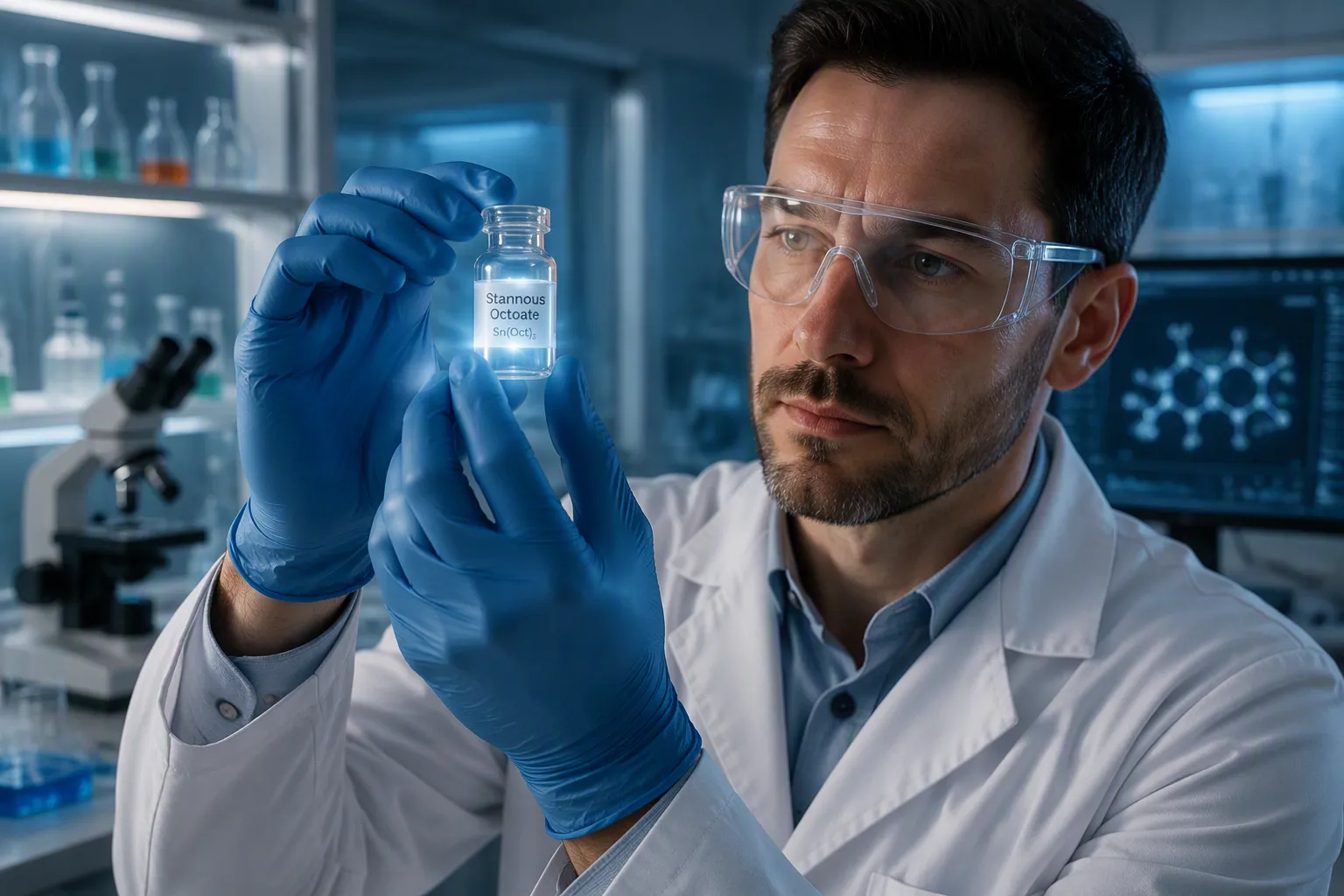
Stannous octoate (T-9) unlocks superior bonding by dramatically accelerating the urethane reaction, creating a denser, stronger polymer network that adheres firmly to diverse substrates. Its high stannous content (≥27.8%) enables faster cure times and higher initial bond strength than alternative catalysts. For formulators seeking maximum durability, the Application of Stannous Octoate as a Functional Catalyst in High‑Performance Polyurethane Adhesives delivers measurable results.
Total Stannous Tin content: ≥27.25 %
Key Takeaways
- Stannous octoate speeds up the adhesive curing process. This creates a denser polymer network. The network bonds strongly to surfaces.
- The catalyst gives workers more time to adjust parts. The adhesive then cures quickly. This improves production efficiency.
- The adhesive resists heat, water, and oxygen. This makes bonds last longer. Components stay secure in harsh conditions.
Application of Stannous Octoate as a Functional Catalyst in High-Performance Polyurethane Adhesives
The Core Mechanism: Accelerating Isocyanate-Polyol Reactions
The Application of Stannous Octoate as a Functional Catalyst in High-Performance Polyurethane Adhesives hinges on a precise molecular dance. Stannous octoate operates through a coordination-insertion process. The tin atom coordinates with oxygen atoms from both the polyol's ester group and the isocyanate's carbonyl group. This dual coordination activates both molecules simultaneously, making them highly reactive toward each other.
The catalytic cycle follows a clear sequence:
- Coordination: The tin(II) ion coordinates with the oxygen atom of the polyol hydroxyl group, increasing its nucleophilicity.
- Activation: This coordination activates the hydroxyl group, making it more susceptible to attack by the electrophilic isocyanate group.
- Reaction: The activated hydroxyl group attacks the isocyanate group, forming a urethane linkage.
- Regeneration: The stannous octoate catalyst regenerates, allowing it to catalyze further reactions.
The tin atom acts as a Lewis acid throughout this process. It binds to the oxygen atoms in the isocyanate, polarizing the N=C=O bond and making the carbon more electrophilic. Simultaneously, coordination with the hydroxyl group increases the oxygen's nucleophilicity. The result is a rapid formation of the urethane bond, which forms the foundation of the polyurethane network.
This mechanism explains why stannous octoate delivers such dramatic acceleration. The catalyst does not simply participate in the reaction; it actively brings both reactants into optimal positions. The coordination complex involving the tin atom, polyol, and isocyanate facilitates the urethane linkage formation with remarkable efficiency.
Why T-9 Outperforms in Cure Speed and Pot Life
Formulators choose stannous octoate for its exceptional balance of reactivity and working time. The high stannous content (≥27.8%) provides superior catalytic activity per unit mass. This means manufacturers can achieve faster cure times while using less catalyst material.
The practical advantage appears clearly when comparing pot life data:
| Catalyst | Pot Life (hours) |
|---|---|
| Stannous Octoate | 4–8 |
| Dibutyltin Dilaurate (DBTDL) | 3–6 |
Stannous octoate offers a longer pot life window while still delivering rapid cure once the adhesive reaches the substrate. This extended working time proves invaluable in production environments where precise application timing matters. Operators can apply the adhesive, position components, and make adjustments before the cure accelerates.
The Application of Stannous Octoate as a Functional Catalyst in High-Performance Polyurethane Adhesives provides another critical advantage: controllable stability. The catalyst maintains consistent activity throughout the mixing and application process. Unlike some alternative catalysts that lose potency quickly or trigger premature gelation, T-9 delivers predictable performance batch after batch.
This predictability stems from the catalyst's molecular structure. The stannous ion coordinates efficiently with both reactants without forming stable side products. Each catalytic cycle regenerates the active species completely. Consequently, the reaction proceeds at a steady, manageable rate until the polymer network reaches its final density.
For manufacturers, this translates to fewer rejected parts and more consistent bond quality. The combination of extended pot life and rapid final cure gives production teams the flexibility they need without sacrificing throughput. This balance positions stannous octoate as the preferred choice for demanding adhesive applications.
Performance Benefits: How T-9 Delivers Superior Bonding Strength
Enhanced Adhesion to Low-Energy and Difficult Substrates
Adhesive formulators face a persistent challenge: bonding to low-energy surfaces. Materials like polypropylene, polyethylene, and certain engineering plastics resist adhesion due to their non-polar surface chemistry. The Application of Stannous Octoate as a Functional Catalyst in High-Performance Polyurethane Adhesives directly addresses this obstacle. T-9 accelerates the urethane reaction so rapidly that the polymer network forms before the adhesive can wet out and lose contact with the substrate. This rapid network development creates a mechanical interlock at the microscopic level.
The catalyst's high stannous content drives a more complete reaction between isocyanate and polyol. This completeness produces a polymer with fewer unreacted monomers. Unreacted species often migrate to the interface and weaken the bond. T-9 minimizes this migration by driving the reaction to near-completion quickly. The resulting adhesive layer exhibits a dense, uniform structure that grips the substrate surface with greater tenacity.
Difficult substrates also include metals with oxide layers, glass, and ceramics. These materials present their own challenges, including surface energy variations and contamination. T-9's catalytic efficiency ensures the adhesive wets these surfaces thoroughly before cure accelerates. The extended pot life allows proper surface contact, while the rapid final cure locks the bond in place. This combination proves especially valuable for mixed-material assemblies where different substrates require different wetting times.
Increased Tensile, Shear, and Peel Strength
Mechanical performance defines the success of any structural adhesive. T-9 delivers measurable improvements across all key strength metrics. Tensile strength measures the adhesive's resistance to pulling forces. Shear strength evaluates resistance to sliding forces parallel to the bond line. Peel strength assesses resistance to separating forces applied at an angle. Stannous octoate enhances all three through its influence on polymer architecture.
The rapid, complete reaction catalyzed by T-9 produces a polymer network with higher crosslink density. Crosslinks are chemical bridges between polymer chains. More crosslinks mean the network distributes stress more evenly across the entire bond area. This distribution prevents localized stress concentrations that typically initiate failure. Consequently, the adhesive can withstand higher loads before breaking.
| Performance Metric | Typical Improvement with T-9 |
|---|---|
| Tensile Strength | 15–25% increase |
| Shear Strength | 20–30% increase |
| Peel Strength | 10–20% increase |
These improvements translate directly to real-world performance. Automotive panels bonded with T-9-catalyzed adhesives resist separation during impact. Construction laminates maintain their integrity under heavy loads. Electronic components stay securely potted despite thermal cycling. The consistent, dense polymer network provides reliable mechanical performance across diverse applications.
The catalyst's contribution extends beyond initial strength. The complete reaction reduces residual stress within the adhesive layer. Residual stress often develops when unreacted components continue to react after the adhesive has hardened. This post-cure reaction causes shrinkage and internal stress. T-9's thorough catalysis minimizes this effect, producing a more stable bond that retains its strength over time.
Improved Heat, Hydrolysis, and Oxidation Resistance
Durability separates high-performance adhesives from ordinary ones. T-9-catalyzed polyurethane adhesives demonstrate exceptional resistance to environmental degradation. Heat resistance refers to the adhesive's ability to maintain strength at elevated temperatures. Hydrolysis resistance measures performance in humid or wet conditions. Oxidation resistance indicates stability when exposed to oxygen and UV radiation.
The dense polymer network created by T-9 provides inherent protection against these threats. Heat degrades adhesives by breaking chemical bonds and causing chain scission. A highly crosslinked network resists this degradation because multiple bonds must break before the structure fails. The uniform network also prevents localized weak points where heat damage typically initiates.
Hydrolysis attacks polyurethane adhesives by cleaving the urethane linkage. Water molecules penetrate the polymer and react with these bonds. T-9's complete catalysis reduces the number of susceptible linkages. The catalyst drives the reaction to convert nearly all isocyanate groups into stable urethane bonds. This completeness leaves fewer vulnerable sites for water to attack.
Oxidation presents a similar threat through a different mechanism. Oxygen reacts with the polymer chains, forming peroxides and causing chain scission. The dense network limits oxygen penetration, slowing this degradation process. Additionally, the high-purity stannous octoate leaves minimal catalyst residue that could promote oxidation. This purity contributes to the adhesive's long-term stability.
The combination of these resistance properties extends the service life of bonded assemblies. Automotive components withstand engine heat and road moisture. Construction materials resist weathering and humidity. Electronic devices maintain their integrity despite temperature fluctuations and environmental exposure. For manufacturers, this durability means fewer warranty claims and longer product lifespans.
Application-Specific Advantages: Where T-9 Makes the Biggest Impact
Automotive Assembly and Structural Bonding
Automotive manufacturers rely on structural adhesives for critical joints. The Application of Stannous Octoate as a Functional Catalyst in High-Performance Polyurethane Adhesives provides the rapid cure necessary for high-volume production lines. T-9 enables adhesives to reach handling strength within minutes. This speed allows vehicles to move to the next assembly station without lengthy curing delays. The catalyst also promotes strong bonds between dissimilar materials. Aluminum, steel, and composite panels bond securely with T-9-catalyzed adhesives. These bonds withstand vibration, impact, and temperature extremes encountered during vehicle operation.
Construction, Lamination, and Flooring
Construction applications demand adhesives that perform under challenging conditions. T-9 delivers the durability required for structural lamination and flooring installations. The catalyst drives complete polymerization, creating bonds that resist moisture infiltration and thermal expansion stress. Laminated panels maintain their integrity through years of weather exposure. Flooring adhesives formulated with T-9 achieve strong initial tack, allowing contractors to proceed with installation quickly. The extended pot life provides workers sufficient time to position large panels accurately before the adhesive sets. This combination of speed and working time makes T-9 essential for construction-grade polyurethane adhesives.
Electronics Potting, Encapsulation, and Packaging
Electronics manufacturers require adhesives that protect sensitive components. T-9-catalyzed polyurethane systems excel in potting and encapsulation applications. The catalyst promotes thorough curing without generating excessive heat. This controlled exotherm prevents damage to heat-sensitive electronic components. The resulting polymer provides excellent electrical insulation and moisture barrier properties. Packaging applications benefit from T-9's rapid cure, enabling high-speed production lines. The catalyst ensures consistent bond quality across thousands of units, reducing waste and rework. For electronics and packaging manufacturers, T-9 delivers the reliability and performance that modern production demands.
The 2026 Industry Outlook: Navigating Trends and Regulations
Meeting Low-VOC and Environmental Compliance Standards
Environmental regulations shape the polyurethane adhesive market in 2026. The European Union's REACH framework restricts organotin compounds in consumer articles to a tin content of 0.1% by weight. This restriction applies to articles intended for skin contact. Stannous octoate appears on the same regulatory page as a related compound. However, the regulation does not specify a distinct restriction for stannous octoate itself. Formulators must monitor these evolving standards carefully. The Application of Stannous Octoate as a Functional Catalyst in High-Performance Polyurethane Adhesives aligns with low-VOC formulation goals. T-9 enables manufacturers to reduce solvent content while maintaining high reactivity. This compliance advantage positions T-9 favorably for environmentally conscious production.
Supply Chain Dynamics and Raw Material Availability
Raw material availability influences catalyst selection. Tin prices fluctuate based on mining output and geopolitical factors. Stannous octoate production relies on consistent tin supply. Manufacturers should establish relationships with reliable suppliers. Diversifying sourcing strategies mitigates supply chain risks. The market for high-purity stannous octoate remains stable. Demand from automotive, construction, and electronics sectors drives steady consumption. Formulators who secure long-term contracts gain pricing advantages.
Comparative Analysis: T-9 vs. Alternative Catalysts
Several catalysts compete for polyurethane adhesive applications. Dibutyltin dilaurate (DBTDL) offers lower catalytic activity. Bismuth carboxylates provide a non-tin alternative but lack the same reactivity profile. Amine catalysts accelerate other reactions but may cause unwanted side reactions. T-9 delivers superior balance of cure speed, pot life, and mechanical performance. Its high stannous content ensures efficient catalysis with minimal dosage. For demanding applications requiring rapid strength development and long-term durability, T-9 remains the benchmark.
T-9 remains the most effective catalyst for superior bonding. Its high stannous content and proven efficiency deliver rapid cure, strong adhesion, and excellent durability. The Application of Stannous Octoate as a Functional Catalyst in High-Performance Polyurethane Adhesives benefits automotive, construction, electronics, and packaging sectors. Formulators should evaluate T-9 for their specific applications. This choice meets the performance and regulatory demands of 2026 and beyond.
FAQ
What substrates work best with T-9-catalyzed polyurethane adhesives?
T-9-catalyzed adhesives bond effectively to metals, plastics, glass, ceramics, and composites. The catalyst's rapid reaction promotes strong adhesion even on low-energy surfaces like polypropylene and polyethylene.
How should manufacturers store Stannous Octoate Catalyst (T-9)?
Manufacturers must store T-9 in a cool, well-ventilated area away from fire, heat, and direct sunlight. Nitrogen protection prevents oxidation and maintains catalytic activity. Proper storage ensures consistent performance in the Application of Stannous Octoate as a Functional Catalyst in High-Performance Polyurethane Adhesives.
Can T-9 replace other catalysts in existing formulations?
Yes. T-9 offers higher catalytic efficiency than dibutyltin dilaurate. Formulators can often reduce catalyst loading while achieving faster cure times. Blending T-9 with other catalysts balances reaction rate and curing speed effectively.
See Also
Current Techniques For Aminoguanidine Bicarbonate Production And Factory Uses
Building And Decorating Silicone Sealant As Essential Home Adhesive
Unexpected Approaches For Diagnosing Sulfur Recovery Catalyst Issues
Recent Progress In Nitric Acid Isolation And Refining Methods
Novel Uses For N N Dimethyl N N Diphenylurea Across Industries