Understanding the Synergy Between SQUID and X-ray Technology in Modern Labs
Modern laboratories rely on advanced tools for precise analysis. The combination of a squid and X-ray machine creates powerful solutions for scientists and industry experts. A squid detects tiny magnetic signals, while X-ray systems reveal hidden structures. When labs use a squid x ray machine, they gain unmatched sensitivity. Food safety teams trust squid for finding contaminants in products. Material scientists depend on squid to study metals and new materials. The squid offers rapid feedback, which leads to better decisions. Many labs now use squid to ensure quality and safety. Squid technology supports innovation in many fields. Researchers value squid for its detailed data. Squid improves results in both research and industry.
What Is a Superconducting Quantum Interference Device
SQUID Technology Overview
A superconducting quantum interference device, often called a squid, stands as one of the most sensitive tools for detecting magnetic signals. Scientists use squid to measure extremely small changes in magnetic flux. The device operates at very low temperature, where superconducting materials show zero electrical resistance. The core of a squid includes a superconducting loop with Josephson junctions. These junctions allow quantum interference to occur, which makes the device highly sensitive.
The table below explains the main aspects of a superconducting quantum interference device:
Aspect | Description |
|---|---|
Operating Principle | Quantum interference of superconducting currents in a loop with Josephson junctions. |
Sensitivity Mechanism | Detection of small changes in magnetic flux due to the periodic function of critical current. |
Typical Sensitivity Range | 1-10 fT/Hz√Hz, making squid the most sensitive magnetometers available. |
Noise Sources | Thermal noise from junctions, shunt resistors, and environmental noise affecting sensitivity. |
Characterization | Spectral density of equivalent flux noise, SΦ(f), expressed in units of Φ0²/Hz. |
A squid works best at cryogenic temperature, often near absolute zero. The superconducting state allows quantum effects to dominate. This leads to precise interference patterns. The device can detect changes that are impossible for other sensors. Microwave squid readout technology has advanced integration with X-ray systems, especially for quantum astrophysics missions.
SQUID Applications in Labs
Laboratories use squid for many tasks. Researchers rely on squid to study magnetic properties of materials at low temperature. Medical teams use squid in magnetoencephalography (MEG) to map brain activity. In one study, MEG with squid gave extra information in 32% of cases with focal onset seizures. This helped doctors diagnose drug-resistant epilepsy.
Material scientists use squid to analyze superconducting samples and quantum devices. Squid helps them understand interference effects and magnetic behavior. Quantum researchers use squid to explore new phenomena at low temperature. Superconductor development depends on squid for accurate measurements. Food safety labs use squid to find contaminants in products. Squid technology supports innovation in many fields, including quantum computing and neuromorphic devices.
Tip: Squid works best when the temperature stays low and the environment remains stable. This ensures the superconducting state and reliable quantum interference.
X-ray Machine Fundamentals
X-ray Imaging and Spectroscopy
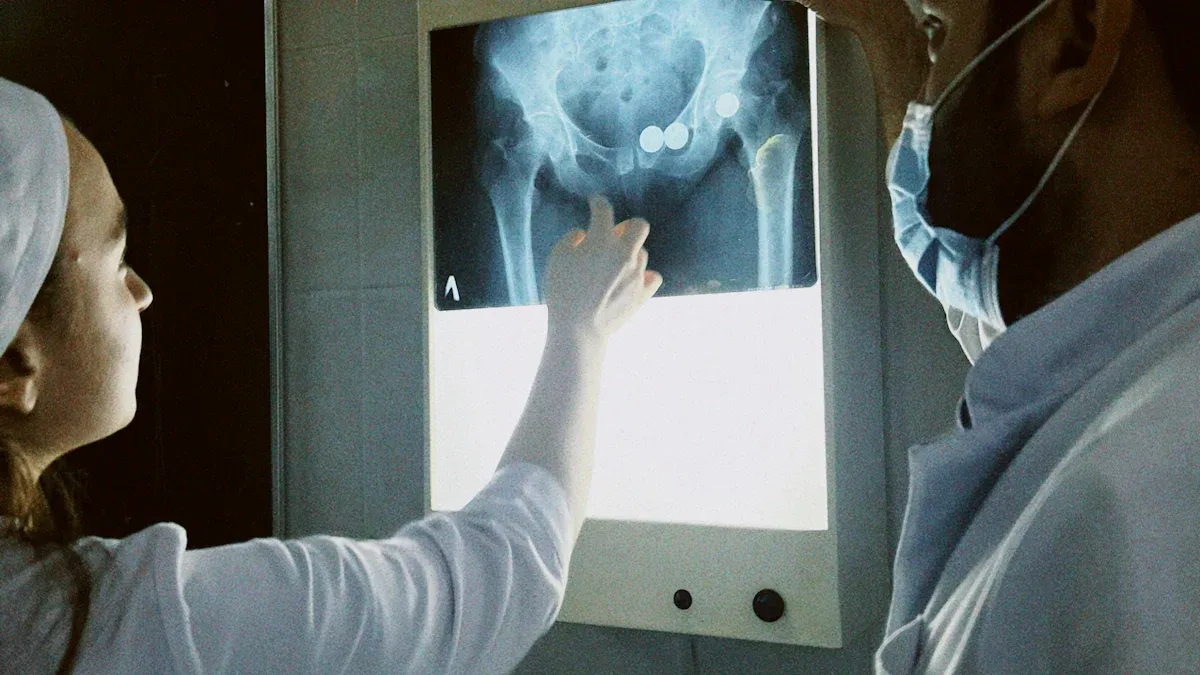
X-ray machines play a vital role in modern laboratories. They help scientists see inside objects without cutting or damaging them. The basic principle starts with an X-ray tube. Inside the tube, a cathode releases electrons when heated. These electrons travel quickly toward an anode because of a strong voltage. When the electrons hit the anode, they produce X-rays. Two main processes create these rays: Bremsstrahlung, which happens when electrons slow down near the anode’s nucleus, and characteristic radiation, which occurs when electrons interact with the anode’s inner shell electrons. Adjusting the voltage and current changes the energy and intensity of the X-rays.
Digital X-ray detectors capture these rays and turn them into electrical signals. Materials like amorphous selenium help in this process. When X-rays hit the detector, they create electron-hole pairs. A strong electric field separates these pairs, which leads to clear and accurate images. The detector’s response matches the strength of the X-ray beam, so scientists get reliable results. X-ray imaging shows the internal structure of materials, while X-ray spectroscopy reveals the chemical composition by measuring how different elements absorb or emit X-rays.
Note: X-ray spectroscopy helps researchers identify elements and study their properties. This technique is important for analyzing metals, minerals, and biological samples.
X-ray Applications in Research and Industry
X-ray technology supports many fields. Scientists use X-rays to study materials, diagnose diseases, and inspect products. Industries rely on X-ray machines for quality control and safety checks. The table below lists major sectors that benefit from X-ray applications:
Application Sector | End-User Industry |
|---|---|
Aerospace Industry | Medical Sector |
Automotive Industry | Industrial Sector |
Construction and Civil Engineering | Research and Development Organizations |
Manufacturing and Fabrication | Quality Assurance and Control Labs |
Oil and Gas | |
Defence and Military Applications |
Chronic diseases increase the need for diagnostic imaging.
Digital radiography and real-time imaging improve accuracy.
Big data analytics and AI make imaging systems smarter.
X-ray machines help doctors find health problems early. Engineers use them to check for flaws in parts. Manufacturers depend on X-rays to ensure products meet safety standards. Researchers use X-ray spectroscopy to discover new materials and study their structure.
SQUID X Ray Machine Integration

Principles of Combined Operation
A squid x ray machine brings together two powerful technologies. The squid detects tiny magnetic signals with unmatched sensitivity. The X-ray system reveals the internal structure of materials. When scientists combine these tools, they can study both the magnetic and physical properties of a sample at the same time. This integration allows for a more complete analysis in one experiment.
The squid works at very low temperatures. It uses superconducting materials to sense changes in magnetic fields. The X-ray machine sends high-energy photons through the sample. These photons interact with the material and create signals that the squid can detect. This process is called photon-in photon-out. The X-ray photons enter the sample, and the squid measures the resulting magnetic or electrical changes. This method gives researchers detailed information about the sample’s composition and behavior.
Scientists often use this combined system to study advanced materials. For example, they can look at superconductors, magnetic materials, or biological samples. The squid x ray machine helps them see how the material reacts to X-rays and how its magnetic properties change. This approach leads to new discoveries in physics, chemistry, and biology.
Note: The combination of squid and X-ray technologies allows for simultaneous measurement of different properties, saving time and improving accuracy.
Mechanisms of Integration
The physical integration of squid and X-ray systems requires careful design. Most squid x ray machine setups use cryogenic detectors called Transition Edge Sensors (TES). These sensors operate at very low temperatures and can detect single photons from the X-ray source. Modern labs build large arrays of TES detectors, sometimes with more than 1000 pixels. This setup increases the area that scientists can study and improves the speed of data collection. For example, the Ali-CMB Polarization Telescope uses four TES modules, each with 1704 detectors. This shows how microfabrication helps scale up the technology for better performance.
In a typical squid x ray machine, the sample sits inside a cryostat. The cryostat keeps the squid and TES detectors cold. The X-ray source shines photons onto the sample. When the sample absorbs the X-rays, it releases energy. The squid detects the resulting magnetic or electrical signals. The system records both the X-ray image and the magnetic response. This dual detection gives a full picture of the sample.
Photon-in photon-out techniques play a key role in these systems. The X-ray photons enter the sample and cause changes that the squid can sense. This method allows for precise detection of small changes in the sample. Scientists can use this information to study new materials, check for defects, or analyze biological tissues.
The squid x ray machine also uses advanced electronics to process the signals. The system must filter out noise and keep the measurements accurate. Engineers design the machine to work smoothly, even at very low temperatures. The integration of squid and X-ray technologies creates a powerful tool for research and industry.
Key features of a squid x ray machine:
Simultaneous measurement of magnetic and structural properties
Use of cryogenic TES detectors for high sensitivity
Large detector arrays for fast data collection
Photon-in photon-out techniques for detailed analysis
Advanced electronics for signal processing
Tip: Regular calibration and maintenance keep the squid x ray machine working at its best. Clean environments and stable temperatures help ensure accurate detection.
Synergistic Benefits of Superconducting and X-ray Technologies
Enhanced Sensitivity and Precision
Modern laboratories demand tools that deliver high sensitivity and precision. The combination of superconducting devices and X-ray systems meets these needs. A squid detects magnetic signals that are too weak for other sensors. Scientists use squid to measure changes in magnetic fields at the quantum level. This ability allows them to find tiny defects or impurities in materials.
X-ray machines provide detailed images of internal structures. When paired with squid, the system can reveal both the physical and magnetic properties of a sample. Researchers gain access to information that would remain hidden with only one technology. For example, a squid can sense magnetic changes caused by X-ray exposure. This process helps scientists understand how materials respond to different conditions.
The integration of squid and X-ray technology improves the accuracy of measurements. Laboratories can detect contaminants, study new materials, and monitor changes in real time. The squid offers rapid feedback, which supports quick decision-making. Food safety teams use squid to find bones or metal fragments in products. Material scientists rely on squid to analyze superconductors and magnetic devices.
Tip: The use of squid in combination with X-ray imaging increases the reliability of results. Teams can trust the data when making important choices.
A squid x ray machine also reduces the chance of missing critical information. The system can identify small changes that might escape traditional sensors. This advantage leads to better quality control and safer products.
Complementary Data for Material Analysis
Material analysis requires a complete view of both structure and properties. The synergy between squid and X-ray technologies provides this comprehensive data. A squid measures magnetic signals while the X-ray system captures images and spectra. Scientists use this dual approach to study metals, ceramics, and biological samples.
The table below shows how squid and X-ray systems complement each other:
Technology | Main Function | Data Provided | Typical Application |
|---|---|---|---|
Squid | Magnetic signal detection | Magnetic flux, quantum states | Superconductors, neuromorphic devices |
X-ray | Imaging and spectroscopy | Structure, composition | Food safety, material science |
Researchers use squid to track changes in magnetic behavior. The X-ray system reveals the shape and composition of the sample. Together, they offer a full picture of the material. For instance, a squid can detect how a metal reacts to X-ray exposure. This information helps scientists design better products and improve safety.
Material scientists often use squid to study quantum effects in new devices. The X-ray system supports this work by showing how the device is built. Food safety labs use squid to find contaminants, while X-ray imaging confirms the integrity of the product. This partnership ensures that products meet strict standards.
Key benefits of combining squid and X-ray technologies:
Complete analysis of structure and properties
Faster detection of defects and contaminants
Improved reliability of laboratory results
Support for innovation in research and industry
Note: The synergy between squid and X-ray systems transforms laboratory practices. Teams can solve complex problems and develop new solutions.
A squid x ray machine stands as a vital tool for modern labs. Scientists and industry experts use it to push the boundaries of discovery and safety.
Scanning SQUID Microscopy and Advanced Applications
Case Studies in Material Science
Scanning squid microscopy has changed how scientists study materials. Researchers use scanning squid microscope tools to see magnetic domains in thin layers. One case study focused on imaging magnetic order in a two-dimensional iron-rich phyllosilicate. Scientists mapped stray magnetic fields and found long-range magnetic ordering in flakes of annite. The scanning squid microscope provided direct images that revealed new details about magnetic behavior.
Case Study Title | Focus | Findings |
|---|---|---|
Imaging magnetic order in a two-dimensional iron-rich phyllosilicate | Visualization of magnetic domains in phyllosilicates | Direct mapping of stray magnetic fields and long-range magnetic ordering in 2D flakes of annite |
Scanning squid microscopy also supports research in quantum anomalous Hall effect and neuromorphic devices. Scientists use scanning squid microscope arrays to study energy-efficient cryogenic memory and robust binary content addressable memory. The table below shows recent research outcomes in these fields.
Title | Authors | Source | Year |
|---|---|---|---|
Energy-efficient cryogenic ternary content addressable memory using ferroelectric SQUID | Alam, S., Hossain, M. S., Aziz, A. | Sci. Rep. 11, 7892 | 2021 |
Quantum anomalous Hall effect-based variation robust binary content addressable memory | Islam, M. M. et al. | Proc. IEEE 66th International Midwest Symposium on Circuits and Systems (MWSCAS), 331–335 | 2023 |
Cryogenic memory array based on ferroelectric squid and heater cryotron | Alam, S. et al. | Proc. Device Research Conference (DRC), 1–2 | 2022 |
A review of cryogenic neuromorphic hardware | Islam, M. M., Alam, S., Hossain, M. S., Roy, K., Aziz, A. | J. Appl. Phys. 133, 070701 | 2023 |
Scanning squid microscopy helps scientists explore quantum effects and develop new biomagnetic devices. High temperature scanning squid microscope systems allow for more flexible experiments. Collaborative lab efforts use scanning squid microscope technology to push boundaries in material science.
Food Safety: Raymantech X-Ray Inspection System
Scanning squid microscopy has a strong impact on food safety. The Raymantech X-Ray Inspection System for Fish Bone uses advanced scanning squid microscope methods to detect bones and contaminants in seafood. The system combines squid and X-ray imaging to find even tiny pieces of metal or plastic. Biomagnetic sensors in the scanning squid microscope identify defects quickly.
Raymantech’s high temperature scanning squid microscope models work in harsh environments. The system’s biomagnetic detection ensures that fish products meet strict safety standards. The scanning squid microscope checks for sealing, fill-level, and weight, supporting nutritional labeling and cost control. Food processors trust scanning squid microscopy for reliable inspection and product integrity.
Scanning squid microscopy also enables remote diagnostics and data transfer. Seafood companies use scanning squid microscope arrays to maintain quality and consumer trust. Biomagnetic technology in the scanning squid microscope helps labs improve safety and efficiency.
Tip: Scanning squid microscopy provides fast and accurate results for both research and industry. Teams use scanning squid microscope systems to solve complex problems in material science and food safety.
Practical Considerations for Integration
Technical and Operational Requirements
Integrating a squid with an X-ray system in a laboratory requires careful planning. Each component must work together to achieve high sensitivity and reliable results. The squid operates at extremely low temperatures. Most labs use a cryogen-free dilution refrigerator to keep the temperature at 65 millikelvin for weeks or even months. This stable environment allows the squid to detect very small magnetic signals.
A separate vacuum system protects the squid and the detector array. The vacuum 'snout' uses a special window that lets X-rays pass through while keeping the system sealed. Magnetic and thermal shields surround the squid, keeping it safe from outside interference. These shields stay at 50 Kelvin and 3 Kelvin, which helps the squid maintain its performance.
The detector array in the squid system uses different absorber sizes. Each size works best for a certain energy range. For example, medium pixels in the array can sense X-ray energies up to 8 keV with an energy resolution of 7 eV at 2 keV. The array sits close to the sample stage, which increases geometric efficiency and helps the squid collect more data.
Requirement Type | Specification |
|---|---|
Operating Temperature | 65 mK with a cryogen-free dilution refrigerator |
Vacuum System | Separate vacuum with a Luxel Lex-HT window |
Thermal Shields | Magnetic and thermal shields at 50 K and 3 K |
X-ray Transmission | Luxel Lex-HT window transmits X-rays down to 0.2 keV |
Detector Array | TES array with multiple absorber sizes for different energy ranges |
Energy Resolution | 7 eV FWHM at 2 keV for medium pixels |
Geometric Efficiency | Detector array positioned close to sample stage |
Calibration, Maintenance, and Safety
Proper calibration ensures the squid and X-ray system deliver accurate results. Technicians must check the squid’s sensitivity and the detector’s energy resolution before each use. Regular calibration helps the squid maintain its ability to detect weak signals. Maintenance includes cleaning the vacuum system, checking the thermal shields, and inspecting the detector array. These steps keep the squid in top condition.
Safety is a top priority in labs that use squid and X-ray systems. Operators must follow strict guidelines to handle cryogenic equipment and X-ray sources. Protective gear and training help prevent accidents. The squid system often includes sensors that monitor temperature and vacuum levels. If the system detects a problem, it can alert the team right away.
Tip: Schedule regular maintenance and calibration for the squid system. This practice extends the life of the equipment and ensures reliable data.
A well-maintained squid X-ray machine supports both research and industry. Teams that follow these practical steps can trust their squid to provide precise and safe results.
Selecting the Right SQUID X Ray Machine
Evaluation Criteria for Labs
Laboratories need to choose the best squid X ray machine for their research or industry needs. Teams should look at several important factors before making a decision. The sensitivity of the squid system matters most. Labs must check if the machine can detect the smallest magnetic signals. The energy resolution of the detector also plays a key role. High energy resolution helps scientists see fine details in samples.
A table below shows common criteria for selecting a squid X ray machine:
Criteria | Description |
|---|---|
Sensitivity | Ability to detect weak magnetic signals |
Energy Resolution | Clarity of X-ray images and spectra |
Detector Array Size | Number of pixels for faster data collection |
Operating Temperature | Stability and efficiency at low temperatures |
Maintenance Support | Availability of technical help and spare parts |
Data Integration | Compatibility with lab software and databases |
Labs should also consider the size of the detector array. A larger array allows for faster and more complete analysis. The operating temperature affects the performance of the squid. Reliable maintenance support ensures the machine works well over time. Data integration helps labs manage results and share findings.
Tip: Labs should compare different models and ask for demonstrations before buying a squid X ray machine.
Implementation Guidance
After selecting a squid X ray machine, labs must plan for smooth installation and operation. Teams should prepare the lab space for the machine. The area must support cryogenic cooling and have stable power. Technicians need to follow the manufacturer’s instructions for setup. Training helps staff use the squid system safely and effectively.
Labs should schedule regular calibration to keep the squid working at peak sensitivity. Maintenance checks include cleaning the detector array and inspecting cooling systems. Teams must record all calibration and maintenance activities. This practice helps labs track performance and spot issues early.
A checklist for successful implementation:
Prepare lab space for cryogenic equipment.
Train staff on squid operation and safety.
Set up regular calibration and maintenance routines.
Integrate data systems for easy analysis.
Contact technical support for any problems.
Note: Careful planning and ongoing support help labs get the most from their squid X ray machine.
Integrating SQUID and X-ray technologies gives laboratories powerful tools for research and industry. Teams gain higher sensitivity, faster detection, and more complete data. Labs should evaluate machine features, train staff, and schedule regular maintenance. These steps help ensure reliable results and long-term performance. Scientists and industry leaders can explore these technologies to unlock new possibilities in analysis and innovation.
Tip: Adopting advanced systems like SQUID X-ray machines supports safer products and smarter discoveries.
FAQ
What is the main advantage of combining SQUID and X-ray technology in labs?
Scientists gain access to both magnetic and structural data. This combination allows for non-destructive imaging and faster detection of defects. Labs can analyze materials more completely and improve product safety.
How does a SQUID X-ray machine help with magnetic field detection?
A SQUID X-ray machine uses superconducting sensors to detect weak magnetic fields. Researchers study changes in materials when exposed to X-rays. This process helps them understand magnetic properties and find hidden flaws.
Can SQUID technology be used for medical applications?
Medical teams use squid magnetoneurography to study nerve signals. This technique helps doctors diagnose neurological conditions. SQUID systems provide detailed maps of magnetic activity in the body.
What role do high-temperature superconductors play in these systems?
High-temperature superconductors allow SQUID devices to operate at warmer temperatures. This feature makes the equipment easier to maintain. Labs benefit from improved reliability and lower cooling costs.
Is the inspection process safe for food products?
The inspection process uses non-destructive imaging. Food products remain unharmed during analysis. The system detects bones and contaminants without changing the quality or taste of the food.
Tip: Regular calibration keeps the system accurate and ensures safe operation in food processing environments.