Why Smart Tea Leaf Sorting Machines Are Gaining Momentum
- Producers rely on advanced technology to improve tea quality and consistency.
- Tea leaf sorting machine uses automation and artificial intelligence to deliver precise results.
- Modern tea processing facilities see faster production and better output with smart machines.
- Global competition pushes manufacturers to adopt innovative solutions.
Key Drivers for Tea Leaf Sorting Machine Adoption
Demand for Higher Quality and Consistency
Tea producers face increasing pressure to deliver premium products that meet evolving consumer expectations. The shift toward specialty and high-grade teas has led manufacturers to prioritize uniformity and quality in every batch. Smart tea leaf sorting machines play a crucial role in this transformation by leveraging advanced technologies such as machine vision and artificial intelligence. These machines analyze tea leaves in real time, detecting subtle differences in color, size, and texture to ensure only the best leaves are selected.
| Feature | Description |
|---|---|
| Machine Vision | High-resolution cameras and image processing algorithms provide real-time analysis of tea leaves. |
| Precision Sorting | Accurate classification based on color, size, and texture. |
| AI Integration | Predictive maintenance reduces downtime and optimizes performance. |
Industry reports highlight that the adoption of automatic tea color sorters reflects a direct response to consumer preferences for premium and specialty tea products. Modernization of tea processing methods is driven by the need for higher quality and consistency, replacing traditional manual sorting with automated solutions. Advanced sorting systems also help producers meet regulatory standards by eliminating impurities and ensuring visual uniformity.
| Evidence Description | Source |
|---|---|
| Uniform color grading and consistent quality achieved through automatic tea color sorters. | Automatic Tea Color Sorter Market |
| Modern machines replace traditional methods to ensure consistency and efficiency. | Tea Processing Machine Market |
| Advanced sorting systems eliminate impurities and ensure visual uniformity. | Tea Sorting System Market |
Efficiency Gains and Automation Needs
The global demand for tea continues to rise, fueled by health consciousness and cultural shifts. Producers must increase output while maintaining quality, which requires more efficient and scalable production methods. Tea leaf sorting machines equipped with AI and IoT technologies enhance sorting precision and operational efficiency. These machines enable frequent and precise harvesting cycles, maximizing yield and quality.
- Integration of AI and IoT technologies improves sorting accuracy and operational efficiency.
- Eco-friendly and energy-efficient machines support sustainability goals.
- Improved sorting mechanisms and enhanced throughput contribute to market growth.
- Smart monitoring systems reduce downtime and provide real-time performance data.
Automation features in smart sorting machines significantly reduce processing time. Sorting robots and machine vision technology allow for rapid and accurate sorting, minimizing post-harvest losses and ensuring timely delivery of higher-grade tea leaves.
- Automation reduces manual labor, leading to faster processing times.
- Sorting robots enhance productivity and product quality.
- Machine vision enables rapid and accurate sorting.
- Deep learning algorithms improve decision-making in sorting operations.
- Autonomous decision-making by manipulators optimizes sorting efficiency.
Addressing Labor Shortages and Rising Costs
Labor shortages and rising costs present significant challenges for tea producers. Traditional tea harvesting relies heavily on skilled manpower, making it labor-intensive and costly. The adoption of smart tea leaf sorting machines helps producers overcome these obstacles by reducing dependence on manual labor and lowering operational expenses.
- Labor costs represent a substantial portion of production expenses.
- Mechanized equipment addresses manual labor scarcity during peak harvest seasons.
- Battery-powered machines offer better efficiency and reduced fuel requirements.
- AI or sensor integration provides real-time performance data for optimizing picking cycles.
| Factor | Impact on Manual Sorting | Impact on Automated Solutions |
|---|---|---|
| Rising Labor Costs | Increased operational costs, reducing viability | More cost-effective in the long run |
| Labor Scarcity | Difficulty in maintaining workforce | Reduces dependency on human labor |
| Quality Standards | Inconsistencies in manual sorting | Ensures uniformity and accuracy |
| Operational Efficiency | Limited by labor availability | Continuous operation increases throughput |
| Sustainability Practices | Higher waste and resource use | Optimizes resource utilization and minimizes waste |
The tea industry faces significant labor shortages due to an aging workforce and rising labor costs. Automated solutions like smart sorting machines help producers maintain efficiency and meet stringent international quality standards by delivering uniform, high-quality products.
Technological Advancements in Tea Leaf Sorting Machines
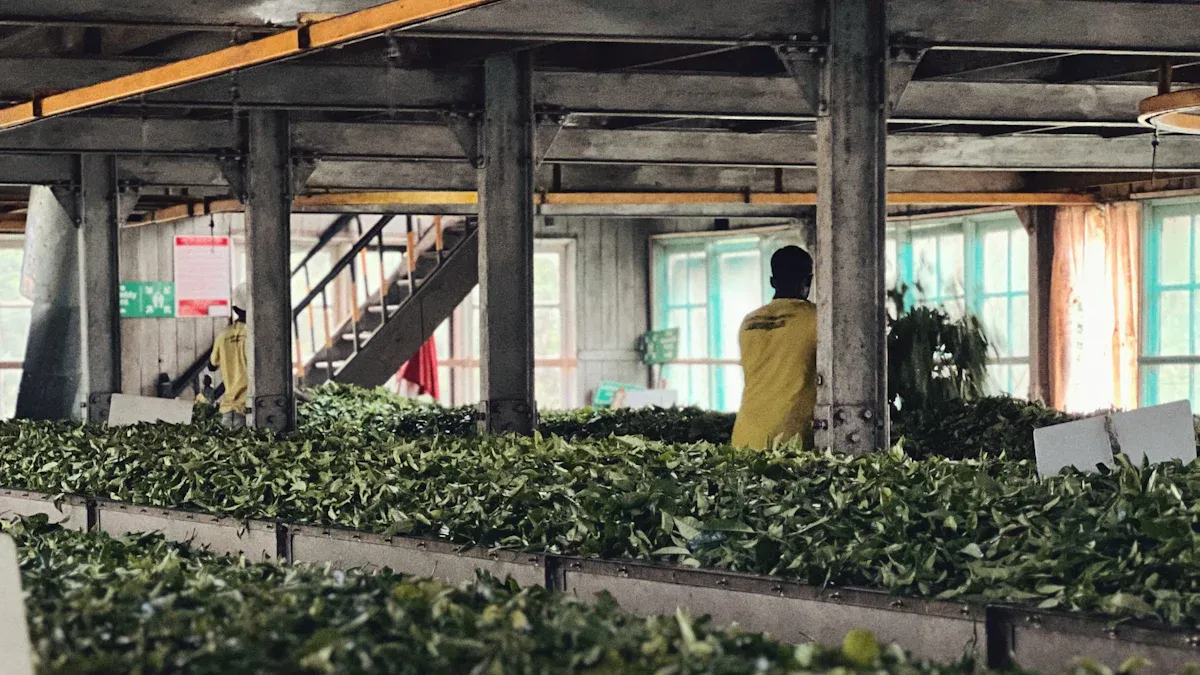
Artificial Intelligence and Machine Learning Integration
Manufacturers now equip tea leaf sorting machines with advanced artificial intelligence and machine learning capabilities. These technologies allow machines to analyze tea leaves in real time, learning from historical data and adapting to new sorting criteria. Machine vision systems use high-resolution cameras and image processing algorithms to detect subtle differences in color, size, and texture. Deep learning algorithms have achieved recognition accuracy rates as high as 99.82% after multiple iterations. Common machine learning models include Support Vector Machines, Random Forests, Linear Discriminant Analysis, K-Nearest Neighbors, and Convolutional Neural Networks. These models enable fast identification and precise grading of tea leaves.
Note: Predictive maintenance powered by AI reduces downtime and optimizes machine performance throughout the production cycle.
Advanced Imaging and Optical Sorting
Modern tea leaf sorting machines utilize cutting-edge imaging and optical technologies to enhance sorting accuracy. Machine vision systems, holographic flash cameras, and RGB spectrum technology provide detailed analysis of each leaf. The latest models feature 260 million pixel cameras for 360° panoramic inspection, ensuring precise removal of impurities. Optical sensors, such as color sorters and X-ray inspection machines, detect both visible and hidden defects.
| Feature | Description |
|---|---|
| Morphology Sorting | Sorts leaves by area, perimeter, and shape. |
| Impurity Removal | Removes glass, stones, and other impurities with over 99% efficiency. |
| RGB Spectrum Technology | Offers over 16 million color variations for enhanced sorting. |
Modular and Automated System Design
Manufacturers design tea leaf sorting machines with modular and customizable components. This approach allows producers to adapt machinery for different tea types, processing scales, and quality standards. Automation features, such as air blowing and adjustable speed controls, further increase flexibility and efficiency. Modular systems support scalability, making it easier for producers to upgrade or reconfigure their equipment as production needs change.
Benefits of Smart Tea Leaf Sorting Machines

Enhanced Product Quality and Uniformity
Smart tea leaf sorting machines deliver a significant boost in product quality and consistency. Producers who implement these systems see measurable improvements in purity and uniformity. For example, a mid-sized grain cooperative in Vietnam achieved over 99 percent purity rates after installing a compact optical sorting system. This improvement allowed the cooperative to double its throughput without increasing labor costs. As a result, the cooperative retained a European export contract and attracted new buyers from the Middle East. These outcomes directly link to the enhanced consistency provided by automated sorting.
- Producers achieve over 99% purity rates with advanced sorting systems.
- Throughput can double without additional labor expenses.
- Improved consistency helps secure and retain international contracts.
Smart machines also reduce the presence of foreign materials in the final tea products. The following table highlights how optical sorters contribute to this benefit:
| Technology | Functionality | Impact on Tea Sorting |
|---|---|---|
| Optical Sorters | Use cameras and AI to detect defects and foreign materials | Enhances accuracy and efficiency, reducing contaminants in final products. |
Lower Labor Costs and Reduced Human Error
Automated sorting systems help tea producers lower labor costs and minimize human error. These machines categorize tea leaves by size, shape, and color, which ensures consistent quality across batches. They also streamline inspections by detecting defects in real time, preventing costly mistakes during packaging and shipping. Compliance with international standards becomes easier, as smart machines identify and remove contaminants before products reach the market.
- Sorting accuracy improves by automating the categorization of tea leaves.
- Real-time defect detection prevents errors in packaging and shipping.
- Machines help maintain compliance with strict quality standards.
- Automation reduces reliance on manual labor, minimizing human error.
Tip: Automation not only cuts costs but also boosts operational efficiency, allowing producers to focus on higher-value tasks.
Improved Supply Chain Transparency
Smart tea leaf sorting machines support greater transparency throughout the supply chain. Producers use technologies such as blockchain and RFID to track tea leaves from farm to consumer. These tools provide secure data access, real-time insights, and traceability, which help prevent fraud and ensure product authenticity.
| Technology | Benefit |
|---|---|
| Blockchain | Provides an immutable ledger for secure data access and traceability. |
| RFID | Tracks movement of tea packages, offering real-time insights and preventing fraud. |
- Consumers gain confidence by tracing tea leaves back to their source.
- Producers can quickly identify and address contamination issues, protecting brand reputation.
- Transparent supply chains support sustainability by demonstrating ethical sourcing and environmental stewardship.
Tea leaf sorting machine technology not only improves product quality but also strengthens trust between producers and consumers. Enhanced traceability and transparency set new standards for the global tea industry.
Challenges and Considerations for Tea Leaf Sorting Machine Implementation
Upfront Investment and Ongoing Maintenance
Smart tea leaf sorting machines require a significant initial investment. Many producers must carefully evaluate the financial commitment before upgrading their facilities. The cost of these machines depends on their capacity and features. For example:
- The upfront investment for a single unit ranges from $20,000 to $50,000.
- Machines with advanced features or higher capacity command higher prices.
- Small-scale tea producers often face challenges in securing the necessary capital.
Ongoing maintenance also adds to the total cost of ownership. Regular servicing, software updates, and replacement parts ensure optimal performance. Producers who plan for these expenses can avoid unexpected downtime and maintain consistent output.
Training and Skill Development
Operators must learn to use new technology effectively. Training programs help staff understand machine functions, troubleshoot issues, and perform routine maintenance. Companies that invest in skill development see smoother transitions and fewer operational errors. Training also empowers workers to adapt to future upgrades or changes in production processes.
Tip: Continuous learning keeps teams prepared for evolving technology and industry standards.
Compatibility with Existing Tea Processing Lines
Integrating smart sorting machines into established processing lines presents technical challenges. Producers must assess whether their current infrastructure supports new equipment. Some facilities require modifications to accommodate machine size, power requirements, or data connectivity. Careful planning ensures seamless integration and minimizes disruptions to production schedules. Compatibility checks help producers maximize the benefits of automation without sacrificing efficiency.
Market Trends and Future Outlook for Tea Leaf Sorting Machines
Regional Growth and Adoption Patterns
Manufacturers see distinct growth patterns across global regions.
- North America experiences expansion in the specialty tea sector. Producers prefer compact, automated machines for small-batch production.
- Middle East and Africa present emerging opportunities, especially in Kenya and Turkey. Producers seek durable, low-maintenance equipment to handle local conditions.
- South America focuses on Argentina and Brazil, where machinery must accommodate diverse leaf sizes.
- Asia-Pacific remains the largest market. High tea production and government support for mechanization drive strong demand for efficient sorting solutions.
Customization for Specialty and Premium Teas
Producers increasingly customize sorting technology to meet the needs of specialty and premium tea markets.
- Precision sorting becomes essential for maintaining high-quality standards.
- AI-powered vision systems and advanced lighting technologies enhance sorting accuracy, which supports the unique requirements of specialty teas.
- Cloud-based analytics tools improve operational efficiency. Producers adapt quickly to varying tea leaf characteristics, ensuring consistent quality.
Focus on Sustainability and Environmental Impact
Sustainability shapes the future of tea processing. Manufacturers design machines with energy-efficient components and recyclable materials. Producers reduce waste by optimizing sorting accuracy and minimizing rejected batches. Many companies invest in eco-friendly practices to meet consumer expectations and regulatory requirements. The tea leaf sorting machine industry continues to innovate, supporting environmental stewardship and responsible sourcing.
Smart tea leaf sorting machine technology now drives quality, efficiency, and competitiveness in the tea industry. Producers who invest in these solutions gain a clear advantage. As innovation accelerates, businesses that adopt advanced sorting systems position themselves for leadership in the evolving global tea market.
FAQ
How often do smart tea leaf sorting machines require maintenance?
Manufacturers recommend scheduled maintenance every six months. Regular checks help ensure optimal performance and extend machine lifespan.
Can these machines integrate with existing tea processing lines?
Most smart sorting machines feature modular designs. Producers can adapt them to fit various processing lines with minimal adjustments.
What is the typical return on investment (ROI) for these machines?
Many producers report ROI within two years. Increased efficiency, reduced labor costs, and improved product quality drive rapid payback.
See Also
Enhancing Pharmaceutical Efficiency With Capsule Decapsulation Technology
Is Investing in Automated Virus Sampling Tube Production Worth It?
The Importance of Capsule Sorters in Eliminating Defects