What machine is used for shrimp grading & sorting?
A shrimp sorting machine separates shrimp by size, weight, and quality, making grading faster and more reliable. AI-powered systems now automate this process, reducing errors and boosting productivity. Countries in Asia-Pacific lead in using these machines, while North America and Europe focus on advanced technology and food safety.
Key Takeaways
Shrimp sorting machines enhance efficiency by automating the grading process, leading to faster and more reliable results.
AI-powered sorters significantly improve accuracy, detecting defects that manual inspection might miss, ensuring high-quality shrimp.
Choosing the right sorting machine depends on factors like production volume, automation level, and food safety standards.
Types of Shrimp Sorting Machines
Sorting shrimp efficiently requires specialized machines that can handle large volumes while maintaining accuracy. The seafood processing industry uses several types of shrimp sorting machine, each designed for specific needs and production scales. The main categories include mechanical graders, optical & AI sorters, and combination systems.
Mechanical Graders
Mechanical graders use physical methods to separate shrimp by size and weight. These machines are common in many processing plants due to their reliability and straightforward operation.
Tip: Mechanical graders are ideal for businesses seeking robust, high-capacity solutions with minimal technical complexity.
The typical process for a mechanical shrimp sorting machine involves several steps:
Feeding: Shrimp are loaded onto the feed system, ensuring an even flow.
Primary Separation: Shrimp pass over rollers or vibrating sieves, which separate them by size.
Secondary Sorting: The machine further refines the separation for greater accuracy.
Vision or Sensor Inspection: Some models include sensors or cameras to check for defects.
Collection and Output: Graded shrimp are collected for further processing or packaging.
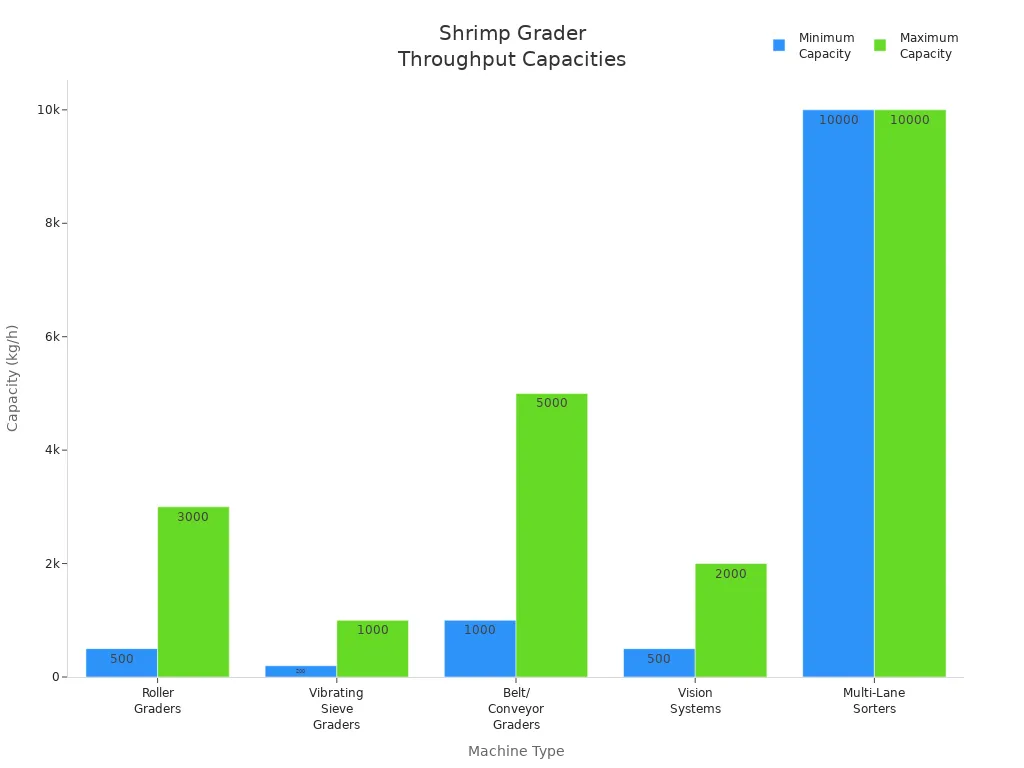
The following table summarizes the main types of mechanical graders and their typical capacities:
Machine Type | Principle | Best For | Typical Capacity |
|---|---|---|---|
Roller Graders | Shrimp pass over rollers set at increasing gaps | All sizes, robust use | 500–3,000 kg/h |
Vibrating Sieve Graders | Shrimp move over vibrating sieves with different hole sizes | Small/medium plants, gentle handling | 200–1,000 kg/h |
Belt/Conveyor Graders | Shrimp are carried on belts past sensors or gates | Large, automated plants | 1,000–5,000+ kg/h |
Multi-Lane Sorters | Multiple sorting lanes for simultaneous grading | High-volume operations | Up to 10,000 kg/h |
RaymanTech Optical & AI Sorters
Optical and AI-powered sorters represent the latest advancements in shrimp sorting machine technology. These systems use high-definition cameras, artificial intelligence, and advanced sensors to inspect each shrimp for size, color, shape, and defects.
A standout example is the AI Medium Speed Belt Optical Sorter from RaymanTech. This machine uses ultra-high definition cameras and AI algorithms to detect even the smallest impurities, such as hair or fine strings. It operates at a belt speed of 96 meters per minute and can achieve sorting accuracy up to 99.9%. The system is built for demanding environments, with an IP66 protection rating that allows it to function reliably in wet or dusty conditions. Its quick-release belt mechanism makes cleaning and maintenance easy, which is essential for food safety.
The table below compares traditional inspection methods with AI-based inspection:
Feature | Traditional Inspection | AI-based Inspection |
|---|---|---|
False Positives | High rates, up to 50% | Cuts false positives by up to 90% |
Adaptability | Rigid; requires reprogramming | Learns from data; adapts to new products |
Defect Detection | Blind to subtle or new defects | Improved detection of complex defects |
AI and machine learning algorithms improve defect detection.
Sensor fusion combines RGB cameras, lasers, and near-infrared spectroscopy for detailed analysis.
Real-time data analytics monitor quality throughout the process.
These features make RaymanTech’s optical and AI sorters especially suitable for premium shrimp processing lines that demand high quality and consistency.
Combination Systems
Combination systems integrate both mechanical and optical technologies to maximize sorting accuracy and efficiency. These systems often use hyperspectral imaging (HSI) and machine learning to analyze shrimp characteristics, such as shell hardness, in a rapid and non-destructive way.
Note: Combination systems can be adapted for both manual and fully automated operations, making them flexible for different production needs.
By automating the sorting process and using advanced imaging, combination systems help maintain product quality and consistency. They are especially valuable for processors who need to meet strict quality standards or handle a wide variety of shrimp products.
How RaymanTech Shrimp Sorting Machines Work
Key Technologies
RaymanTech uses advanced technology to improve shrimp sorting. The shrimp sorting machine combines artificial intelligence, ultra-high definition cameras, and automation. AI analyzes images from the cameras to find defects and impurities. Automation moves shrimp quickly through the system, making the process fast and reliable. X-ray inspection adds another layer of safety by removing dense contaminants like shell fragments or metal. Optical sorting checks the surface of each shrimp for color, size, shape, and texture.
Sorting Technology | Purpose | Key Features |
|---|---|---|
X-ray Inspection | Safety from hazardous contaminants | Removes shell fragments, stones, and metal |
Improve product quality | Analyzes color, size, shape, and texture |
Sorting Criteria
RaymanTech shrimp sorting machines use several criteria to grade and sort shrimp. Size and weight are important for meeting customer requirements. The system also checks for defects such as discoloration, damage, or foreign objects. The AI and X-ray systems can detect tiny impurities, including hair, glass, and fine strings. This level of detail is difficult for manual inspection. Automated sorting provides higher consistency and accuracy, reduces labor, and helps meet food safety standards.
Main Features
RaymanTech designs its machines for speed, accuracy, and easy maintenance. The shrimp sorting machine can process large volumes quickly while keeping results consistent. Automatic roller spacing allows for fast size changes. User-friendly controls make operation simple. Stainless steel construction and easy-access panels support thorough cleaning and food safety. The machines use corrosion-resistant materials to work well in wet or dusty environments.
Feature | Description |
|---|---|
Hygienic Design | Stainless steel and easy-access panels for cleaning and safety |
Anti-Corrosion Technology | Withstands saltwater and moisture, prevents rust |
Corrosion-Resistant Steel | Ensures long life and reduces maintenance in tough environments |
Integrated data logging tracks production for better efficiency.
Advanced vision and AI sorting deliver precise grading every time.
Tip: RaymanTech shrimp sorting machines help processors achieve high quality and safety standards with less manual effort.
Benefits & Choosing the Right Shrimp Sorting Machine

Efficiency & Consistency
Automated shrimp sorting machines bring measurable improvements to seafood processing. These machines deliver consistent grading accuracy and reduce variability in product quality. Processors can handle higher volumes, especially during busy seasons, because machines work faster than manual labor. The following table highlights key improvements:
Improvement Aspect | Description |
|---|---|
Consistent Quality | Automated sorting delivers uniform grading accuracy, reducing variability in product quality. |
Higher Throughput | Machines process shrimp faster, enabling higher volume handling especially during peak times. |
Minimized Product Waste | Accurate grading technology reduces misclassification, lowering product wastage. |
Improved Hygiene | Less human handling enhances food safety and reduces injury risks from repetitive tasks. |
Data-Driven Decisions | Real-time data on yield and batch quality supports operational improvements. |
Grading systems like gap-drop and roller bed designs also help maintain gentle handling, which preserves shrimp quality and ensures uniform results.
Labor Savings & Product Quality
Switching from manual to automated sorting can reduce labor costs by up to 30% and improve yield by 9%. Gentle grading methods protect shrimp texture and appearance, leading to fewer customer complaints and returns. Accurate sorting ensures each grade cooks evenly, which improves taste and satisfaction. The table below shows how these machines impact product quality and customer experience:
Evidence Description | Impact on Product Quality and Customer Satisfaction |
|---|---|
Gentle grading preserves product quality and processes each grade individually. | Higher quality shrimp and reduced complaints. |
Proper grading ensures uniform cooking experience. | Maintains optimal texture and flavor, enhancing satisfaction. |
Accurate sorting reduces misclassification and minimizes product wastage. | Fewer returns due to quality issues. |
Selection Factors
Choosing the right shrimp sorting machine depends on several factors:
Food safety and hygiene standards
Level of automation needed
Production volume and future growth
Facility layout and space
Ease of maintenance and cleaning
Type of seafood processed
Integration with existing equipment
Budget also plays a role. Smaller operations may choose compact, affordable machines, while larger plants need high-capacity systems. Advanced technology and automation help improve efficiency and lower labor costs, especially for bigger facilities.
Tip: Consider both current needs and future expansion when selecting a shrimp sorting machine. Reliable brands with strong support can help ensure long-term success.
Selecting the right shrimp sorting machine shapes business success. Advanced AI-powered sorters improve accuracy and efficiency. Key considerations include technology, market trends, cost, and environmental factors:
Consideration Type | Description |
|---|---|
Technological Advancements | Integration of AI and machine learning enhances accuracy and efficiency in shrimp sorting. |
Market Trends | High demand for precision aquaculture tools is driving innovation in sorting technologies. |
Cost Barriers | High initial costs deter small-scale operators from adopting advanced systems. |
Environmental Robustness | Challenges in maintaining accuracy in varying aquatic environments affect the reliability of systems. |
Consulting with suppliers or industry experts offers these benefits:
Insights into equipment selection and operational efficiency
Guidance on cost management
Access to demos and documentation for better decisions
FAQ
What is the main advantage of using an AI shrimp sorting machine?
AI shrimp sorting machines increase accuracy and speed. They detect tiny defects and impurities that humans often miss.
Can RaymanTech sorters handle wet or dusty environments?
Yes. RaymanTech sorters have an IP66 rating. They work well in wet and dusty processing areas.
How often should the machine be cleaned?
Cleaning should happen daily. The quick-release belt makes this process fast and helps keep food safe.