Innovative X-ray Inspection Powers Shellfish Industry Success
Shellfish processors face increasing demands for quality and safety. Shellfish x-ray inspection delivers precise detection of contaminants, supporting consistent product integrity. Companies improve operational efficiency and reduce costly recalls. Advanced inspection solutions help processors maintain a strong reputation while meeting stringent industry standards.
Overcoming Shellfish Processing Challenges
Risks of Contaminants and Foreign Objects
Shellfish processors face significant risks from contaminants and foreign objects. These hazards threaten both consumer health and brand reputation. Common foodborne pathogens in shellfish include:
- Listeria
- Salmonella
- Vibrio species
- Hepatitis A
- Norovirus
These pathogens can cause severe illness if consumers eat undercooked or raw shellfish. Environmental contaminants also pose a threat. Shellfish may contain:
- Microplastics
- Pharmaceuticals
- Potentially toxic elements
Exposure to these substances can result in neurological, developmental, reproductive, and gastrointestinal disorders. In extreme cases, contaminated shellfish can cause death. Urbanization and increased waste generation contribute to contamination. Non-treated effluents often reach shellfish habitats, raising health risks for consumers. As the global population grows, the demand for safe shellfish continues to rise.
Limitations of Traditional Inspection Methods
Traditional inspection methods struggle to address these challenges. Metal detectors and visual inspections remain common in many facilities. However, these approaches have clear limitations:
- Metal detectors only identify metallic contaminants, missing glass, stone, plastic, and small bones.
- Visual inspections depend on human accuracy, which can vary and decline with fatigue.
- Many non-metallic hazards escape detection, increasing the risk of recalls and consumer harm.
Shellfish x-ray inspection offers a solution by detecting a broader range of contaminants. These advanced systems improve food safety and help processors meet regulatory standards.
Shellfish X-ray Inspection: Transforming Operations
Advanced Detection Capabilities with Leading Systems
Modern shellfish x-ray inspection systems deliver unmatched accuracy in detecting contaminants. Processors rely on advanced technologies such as dual-energy photon-counting detectors to identify foreign objects that traditional methods miss. These systems excel in challenging environments, maintaining performance even after freeze and thaw cycles. They also inspect a wide variety of seafood packages, verifying both weight and package integrity.
| Feature Description | Details |
|---|---|
| Advanced Detection Technology | PXT™ dual-energy photon-counting x-ray detector enhances inspection accuracy and contaminant detection. |
| Superior Foreign Body Detection | Capable of detecting contaminants unaffected by freeze/thaw conditions. |
| Fish Bone Detection | Radically enhances detection down to 0.5 mm. |
| Versatile Inspection | Inspects a wide array of seafood packages while conducting quality checks like weight verification and package integrity. |
Processors benefit from the ability to detect non-metallic contaminants, such as glass, stone, and plastic. The inspection process involves several precise steps:
| Step | Description |
|---|---|
| X-ray Generation | A controlled X-ray beam passes through the product on the conveyor |
| Differential Absorption | Dense contaminants absorb more X-rays than surrounding product |
| Image Capture | Detectors create a detailed grayscale image showing density variations |
| AI Analysis | Advanced algorithms identify anomalies and contaminants in real-time |
| Automatic Rejection | Contaminated products are diverted from the production line |
This technology ensures that only safe, high-quality shellfish reach consumers.
Streamlining Production and Reducing Waste
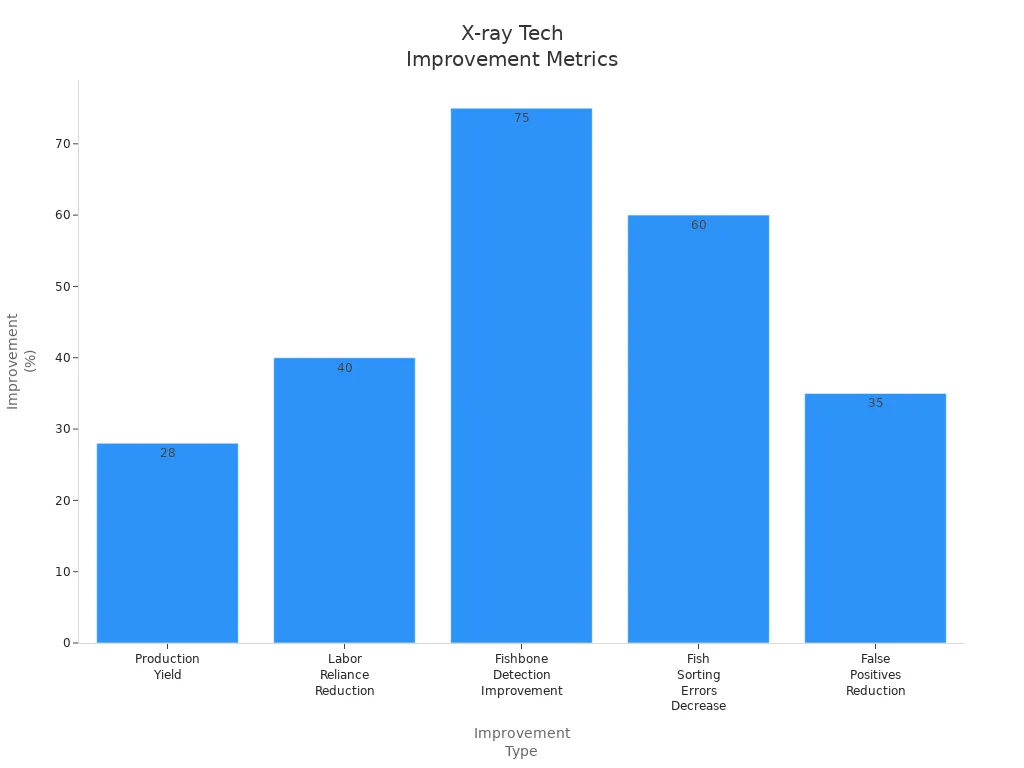
Shellfish x-ray inspection systems transform production efficiency. Automated inspections evaluate every product on the assembly line, eliminating the inconsistencies of manual checks. Processors experience significant improvements in yield, labor reliance, and error rates.
Key operational benefits include:
- Production yield increases by up to 28%.
- Labor reliance drops by 40%.
- Fishbone detection improves by 75% in fillet lines.
- Sorting errors decrease by over 60%.
- False positives reduce by 35%.
Automated x-ray systems operate three to five times faster than manual inspection. Facilities realize substantial cost savings and a strong return on investment. Real-time data collection allows processors to isolate smaller contaminated batches, reducing the scope and cost of recalls. These improvements help companies minimize waste and maximize profitability.
Ensuring Regulatory Compliance and Brand Trust
Food safety regulations require strict adherence to international standards. Shellfish processors must comply with HACCP, IFS, and BRC requirements. X-ray inspection systems play a vital role in meeting these standards by detecting foreign objects and ensuring product integrity.
| Regulatory Standards | Description |
|---|---|
| HACCP | A systematic preventive approach to food safety that addresses physical, chemical, and biological hazards. |
| IFS | International Featured Standards that ensure food safety and quality. |
| BRC | British Retail Consortium standards for food safety and quality assurance. |
| X-ray Inspection | Detects foreign objects and ensures product integrity, crucial for compliance with food safety standards. |
Our state-of-the-art X-ray Inspection Machine acts as your vigilant guardian, safeguarding your brand’s reputation by maintaining impeccable product quality, every single time.
Shellfish x-ray inspection technology demonstrates a commitment to high safety standards. Consumers trust brands that invest in advanced inspection systems. By preventing costly recalls, companies protect their reputation and build lasting consumer confidence. The ability to detect invisible contaminants further enhances food safety and supports long-term business success.
Success Stories in Shellfish X-ray Inspection
Eagle X-ray Systems: Achieving Five-Star Quality
Eagle x-ray systems have set a new benchmark for quality in shellfish processing. Processors rely on advanced features to deliver consistent results. The PXT™ detection technology provides high-resolution imaging, which allows for accurate contaminant detection. Superior bone detection identifies bones as small as 0.5 mm, improving product safety. Reduced false reject rates help maintain efficiency and minimize waste. Enhanced metal detection further strengthens product quality.
| Feature | Contribution to Quality |
|---|---|
| Advanced dual energy PXT™ detector | Superior bone detection down to 1 mm and fish bones down to 0.5 mm, enhancing safety and quality control. |
| Internal diagnostics and self-monitoring | Ensures consistent performance and reliability, contributing to overall quality. |
| Dynamic power adjustment | Tailors power settings for each product, optimizing inspection efficiency. |
| Hygienic design of Pack 400 HC | Reduces cleaning time and meets strict hygiene requirements, ensuring food safety. |
The Pack 400 HC system increases operational and energy efficiencies. Its design allows for quick cleaning and easy conveyor belt removal, reducing downtime and supporting continuous production.
Techik and RAYCON: Enhancing Safety and Flexibility
Techik and RAYCON x-ray systems offer processors high detection accuracy. These systems identify even small, thin bones, which reduces recall risks and builds consumer trust. Non-destructive testing preserves the integrity of the shellfish, maintaining quality during inspection. Automated processes improve efficiency and ensure compliance with safety standards.
- High detection accuracy for small contaminants
- Non-destructive testing maintains product quality
- Automated inspection increases output and consistency
Lessons Learned and Best Practices
Processors have observed measurable business outcomes from adopting shellfish x-ray inspection. Real-time monitoring and data analytics improve throughput and reduce downtime. Companies report reduced recall risks and improved brand trust.
| Measurable Outcome | Description |
|---|---|
| Reduced Recall Risks | X-ray inspection systems help in identifying contaminants, thereby minimizing the chances of product recalls. |
| Improved Brand Trust | Enhanced safety and quality assurance through x-ray inspection fosters greater consumer confidence. |
| Enhanced Operational Efficiency | Real-time monitoring and data analytics from x-ray systems lead to improved throughput and reduced downtime. |
Tip: Regular system calibration and staff training maximize the benefits of x-ray inspection technology.
Shellfish x-ray inspection drives industry progress by raising safety, quality, and profitability. Early adopters like Eagle, Techik, and RAYCON gain measurable advantages.
The latest generation of X-ray inspection technology achieves 0.05 mm resolution, revealing even the smallest bones and identifying high-risk regions, setting new benchmarks for precision and reliability.
FAQ
How does x-ray inspection improve shellfish safety?
X-ray systems detect hidden contaminants, such as glass, bone, and plastic. Processors use this technology to prevent unsafe products from reaching consumers.
Can x-ray inspection systems handle different shellfish types?
Yes. Leading x-ray systems adapt to various shellfish, including shrimp, oysters, and scallops. Processors adjust settings for optimal detection and quality control.
What maintenance do x-ray inspection machines require?
- Operators perform routine cleaning and calibration.
- Technicians inspect components regularly.
- Manufacturers recommend scheduled software updates for peak performance.
See Also
Innovations in Heat Exchanger Manufacturing Boost Industrial Efficiency
Top Locations for Purchasing X-Ray Inspection Equipment in China
New Materials Transforming the Supply of Heat Exchangers
Steel Processing Techniques for Effective Heat Exchange Solutions
Three Essential Industrial Checkweighers for Food Processing Facilities