How to Choose the Best Sewage Treatment Plant for a Single House in 2026
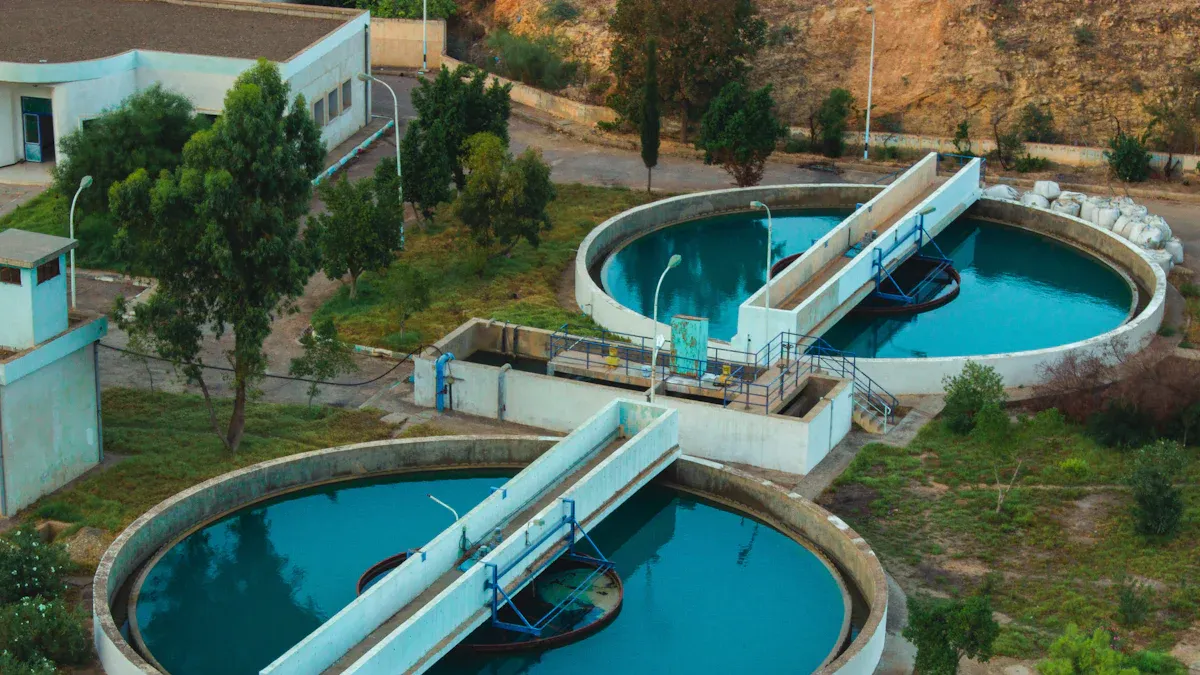
You need a sewage treatment plant for single house if your property cannot connect to a public sewer. Many homes face this issue because suitable sites for traditional systems have already been developed. Common reasons include:
- Rural areas cannot use large regional plants due to high costs.
- Some sites have alternative systems that often fail without proper care.
Choosing the right system helps you manage wastewater safely and legally.
Key Takeaways
- Determine your household size to choose the right sewage treatment plant. A larger family needs a bigger tank and more frequent maintenance.
- Understand local regulations and obtain necessary permits before installation. Compliance ensures safety and protects the environment.
- Assess your site conditions, including soil type and space, to select a suitable system. Proper site evaluation prevents future issues.
Key Factors When Selecting a Sewage Treatment Plant for Single House
Determining Household Size and Wastewater Volume
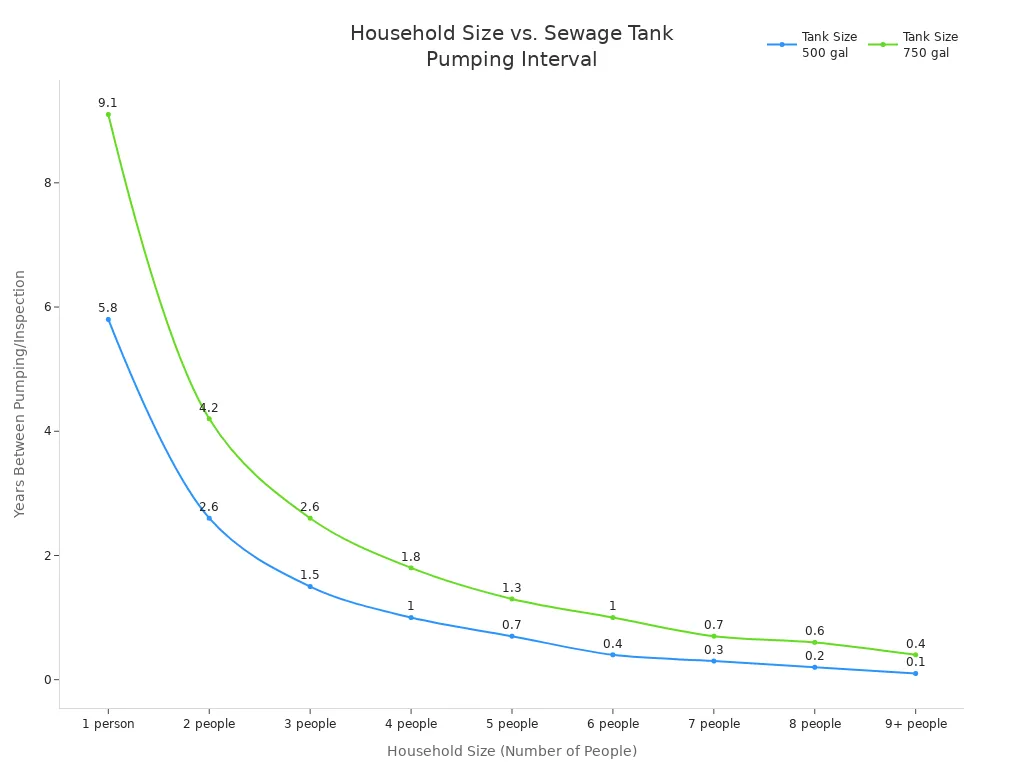
You need to know how many people live in your house before you choose a sewage treatment plant for single house. The number of people affects how much wastewater your system must handle. If you have a small family, you can use a smaller tank. If your family is large, you need a bigger tank and more frequent maintenance.
The table below shows how household size changes the tank size and the time between pumping or inspections:
| Household Size (Number of People) | Tank Size (gal) | Duration (Years) Between Pumping and/or Inspections |
|---|---|---|
| 1 | 500 | 5.8 |
| 2 | 500 | 2.6 |
| 3 | 500 | 1.5 |
| 4 | 500 | 1 |
| 5 | 500 | 0.7 |
| 6 | 500 | 0.4 |
| 7 | 500 | 0.3 |
| 8 | 500 | 0.2 |
| 9+ | 500 | 0.1 |
| 1 | 750 | 9.1 |
| 2 | 750 | 4.2 |
| 3 | 750 | 2.6 |
| 4 | 750 | 1.8 |
| 5 | 750 | 1.3 |
| 6 | 750 | 1 |
| 7 | 750 | 0.7 |
| 8 | 750 | 0.6 |
| 9+ | 750 | 0.4 |
You can also see how the number of people in your home affects how often you need to pump the tank in this chart:
If you choose the wrong size, your system may overflow or need repairs more often. Always match the system size to your household.
Understanding Local Regulations and Permit Requirements
You must follow local rules when you install a sewage treatment plant for single house. Each region has its own permit requirements. These rules protect your health and the environment.
Approval for in-ground sewage treatment is required in all parts of Ontario. The local health unit issues permits for septic systems and checks that you follow the building code. You need a Certificate of Approval for Class 2 through 5 sewage systems.
Here are the main types of systems and their permit classes:
| Classification | Description |
|---|---|
| Class 1 | Composting toilet, pit privy, vault privy |
| Class 2 | Leaching pit (for grey water only) |
| Class 3 | Cesspool (for Class 1 system contents only) |
| Class 4 | Conventional system (septic tank and leaching bed) or alternative system (septic tank and treatment unit) |
| Class 5 | Holding tank (requires regular pumping) |
You need a septic permit to install a new tank or soil treatment area. You also need permits to repair or change an old system. If you use advanced systems, you must get an operating permit. Always check with your local office before you start.
Assessing Site Conditions: Soil, Space, and Access
You must look at your land before you pick a system. Soil type, space, and access all matter. Some soils drain well, but others hold water. If your soil is not good for a standard system, you may need a special design.
The suitability of a building site for on-site sewage treatment and disposal depends upon soil and site conditions. Many sites that are suitable for conventional systems have already been developed, leaving less suitable sites for future use. Consequently, modified conventional and alternative septic systems may become more important for future land development. These systems can function satisfactorily if they are used and maintained properly. However, a recent study in North Carolina found that many alternative septic systems (such as low-pressure pipe systems and sand mound systems) were not being adequately maintained. Without maintenance, alternative systems failed twice as often as conventional systems.
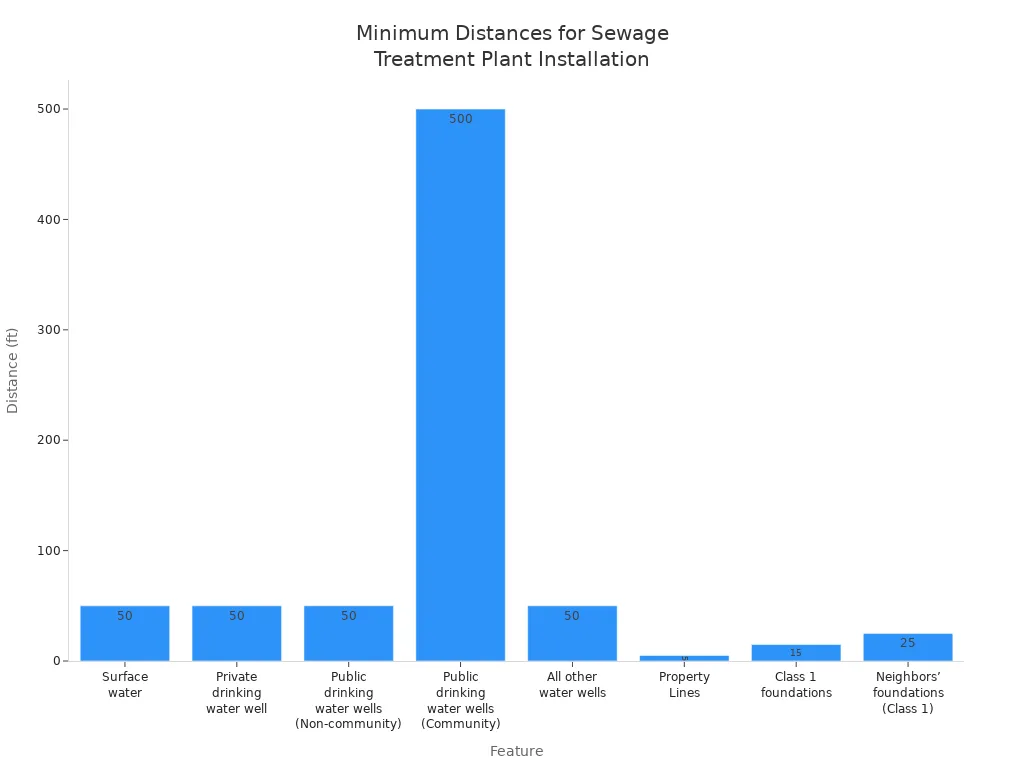
You also need enough space for your system. The table below shows the minimum distances you must keep from wells, water, and buildings:
| Item | Distance to: |
|---|---|
| Septic Tank | Effluent Treatment System |
| Surface water | 50 ft |
| Private drinking water well | 50 ft |
| Public drinking water wells (Non-community system) | 50 ft |
| Public drinking water wells (Community system) | 500 ft |
| All other water wells | 50 ft |
| Property Lines | 5 ft |
| Class 1 foundations | 15 ft |
| Neighbors’ foundations (Class 1) | 25 ft |
You can see these distances in the chart below:
If your site is hard to reach, you may need a system that is easy to install and service. Always check your soil and space before you choose.
Comparing Treatment Technologies for Single Homes
You have several choices for a sewage treatment plant for single house. The main types are:
- Activated sludge systems
- Membrane bioreactors
- Anaerobic digesters
Each type has its own strengths. Activated sludge systems use air to treat waste and work well for most homes. Membrane bioreactors use filters and give very clean water, but they cost more. Anaerobic digesters use bacteria to break down waste without air and need less energy.
You should also think about other factors that affect your choice. These include how close you are to a town, how much money the government spends on public services, and how many people live in your area. The table below shows the top five factors that influence your decision:
| Factor | Description |
|---|---|
| Land Urbanization | Urban growth and better public services can make centralized treatment possible. |
| Population Size | More people can lower costs and make systems more efficient. |
| Leading Industries | Local businesses can affect funding for sewage systems. |
| Radiation Effect of County Towns | Living near a county town can improve your access to services. |
| Investment in Urban Construction | Government spending helps build and improve sewage treatment facilities. |
You should know that government incentives do not always make people install new systems. In many places, people only install a sewage treatment plant for single house if they must. You should plan for your needs and follow the rules, even if there are no extra rewards.
Sizing, Costs, and Maintenance of Sewage Treatment Plant for Single House
How to Size the System (With Practical Examples)
You need to size your sewage treatment plant for single house based on water use and the number of people living in your home. Start by estimating your total daily water demand. Most homes use between 135 and 150 liters per person each day. You can use the following steps to calculate the right size:
| Step | Description | Formula/Calculation |
|---|---|---|
| 1 | Calculate Total Domestic Water Demand | TWD = 135-150 liters per person per day (LPCD) |
| 2 | Estimate Sewage | Sewage = 90% of TWD |
| 3 | Calculate Capacity of STP | Capacity = 0.9 × TWD |
| 4 | Determine Space Requirement | Space = Length × Width × Depth |
| 5 | Example Calculation | If TWD = 1500 liters/day, then Capacity = 1350 liters/day |
Let’s look at a practical example. If you have a four-bedroom house, you need to plan for at least six people. This means your treatment plant must handle the waste from six people, even if fewer people live there. The table below shows how you should size your system:
| Description | Minimum Population Equivalents (P) |
|---|---|
| Single domestic dwelling | 5P |
| Additional bedrooms (over 3) | +1P for each additional bedroom |
| Example for a 4-bedroom house | Minimum 6P treatment plant capacity |
Tip: Always size your system for the maximum number of people your house can hold, not just your current family size. This helps you avoid problems if your household grows or you sell your home.
Installation and Ongoing Costs to Consider
You need to think about both the installation and the ongoing costs when you choose a sewage treatment plant for single house. The initial cost covers the purchase and setup of the system. After installation, you will pay for maintenance, energy, and repairs.
| Cost Component | Percentage of Initial Cost | Description |
|---|---|---|
| Maintenance Costs | 1-3% | Annual maintenance expenses based on initial cost |
| Energy Costs | 35% | Represents a significant portion of operational expenses |
| Labor and Materials | N/A | Additional operational costs not specified in percentage |
Energy costs make up a large part of your yearly expenses. You can lower these costs by choosing energy-efficient systems. Maintenance costs are smaller but still important. You may also need to pay for labor and materials if you need repairs.
Note: You can save money by using low-flow toilets, showerheads, and washing machines. These devices reduce water use and help your system work better.
Maintenance Needs and Long-Term Reliability
You must take care of your sewage treatment plant for single house to keep it working well. Regular maintenance helps you avoid breakdowns and costly repairs. Here are the most common tasks you need to do:
- Inspect your system often to find problems early.
- Pump your septic tank when needed to prevent overflow.
- Check the drain field for signs of failure, such as wet spots or bad smells.
- Do not put non-biodegradable items into your system.
Different treatment technologies offer different levels of reliability. The table below shows how popular models perform over time:
| Technology Type | Performance Trend | Stability Over Time |
|---|---|---|
| VF Wetlands | Positive/Negative | More stable |
| SBR | Mixed | Fluctuating |
| Technical WWTP | Improved | More stable |
Tip: Choose a system with a good track record for stability. Stable systems need fewer repairs and last longer.
Ensuring Compliance and Environmental Protection
You must follow all local and national rules when you install and use your sewage treatment plant for single house. New standards require you to use nitrogen-reducing systems in many areas. These systems protect water sources and the environment.
| Requirement | Effective Date | Description |
|---|---|---|
| ENR-OSTDS for new systems on lots of one acre or less | July 1, 2023 | Required installation of nitrogen-reducing systems instead of conventional septic systems in impacted areas. |
| ENR-OSTDS for new systems on all lot sizes | January 1, 2024 | Required installation of nitrogen-reducing systems in the Indian River Lagoon Protection Program area. |
| Upgrade existing systems or connect to sewer | July 1, 2030 | Existing OSTDS in specific areas must connect to central sewer or upgrade to systems achieving at least 65% nitrogen reduction. |
You can make sure you follow the rules by taking these steps:
- Get all permits and follow state regulations.
- Work with certified professionals who know local codes.
- Ask for engineering plans and proof of certification for your system.
- Pick materials that suit your site’s conditions.
- Choose a location that meets burial depth and setback codes.
- Use risers and access covers for easy maintenance.
You can also protect the environment by using less water and choosing energy-efficient systems. Try these tips:
- Reduce water use by not flushing tissue or other items.
- Install low-flow toilets and showerheads.
- Wash clothes in full loads.
- Adjust water softener settings to use less water.
Choosing advanced technologies, such as aerobic digesters or biogas recovery systems, helps you lower energy use and improve treatment efficiency. These choices make your home more sustainable and reduce your impact on the environment.
You need to balance your needs, site conditions, rules, and budget when choosing a system. Common mistakes include missing permits, underestimating maintenance, and not planning for long-term costs.
- Regular maintenance keeps your system efficient.
- Skipping care leads to repairs and shortens the plant’s life.
- Some systems need more upkeep than others.
FAQ
What is the main benefit of a sewage treatment plant for a single house?
You get safe wastewater disposal. This protects your health and the environment. You also meet local rules.
How often should you maintain your sewage treatment plant?
You should inspect your system every year. Pump the tank every 1-3 years. Regular checks prevent problems.
Can you install a sewage treatment plant yourself?
You should not install it yourself. Always hire a certified professional. This ensures safety and legal compliance.
See Also
A Comprehensive 2025 Overview of Semi-Welded Heat Exchangers
Benefits of Selecting a Self-Priming Water Pump for Systems
Choosing Between Silent and Open Frame 6kW Diesel Generators
Selecting the Ideal High-Power 10KW Diesel Generator for You
Comparing EHEDG Guidelines with 3A SSI Standards for Hygiene