How to Select DDI MDI IPDI TDI HDI for HTPB
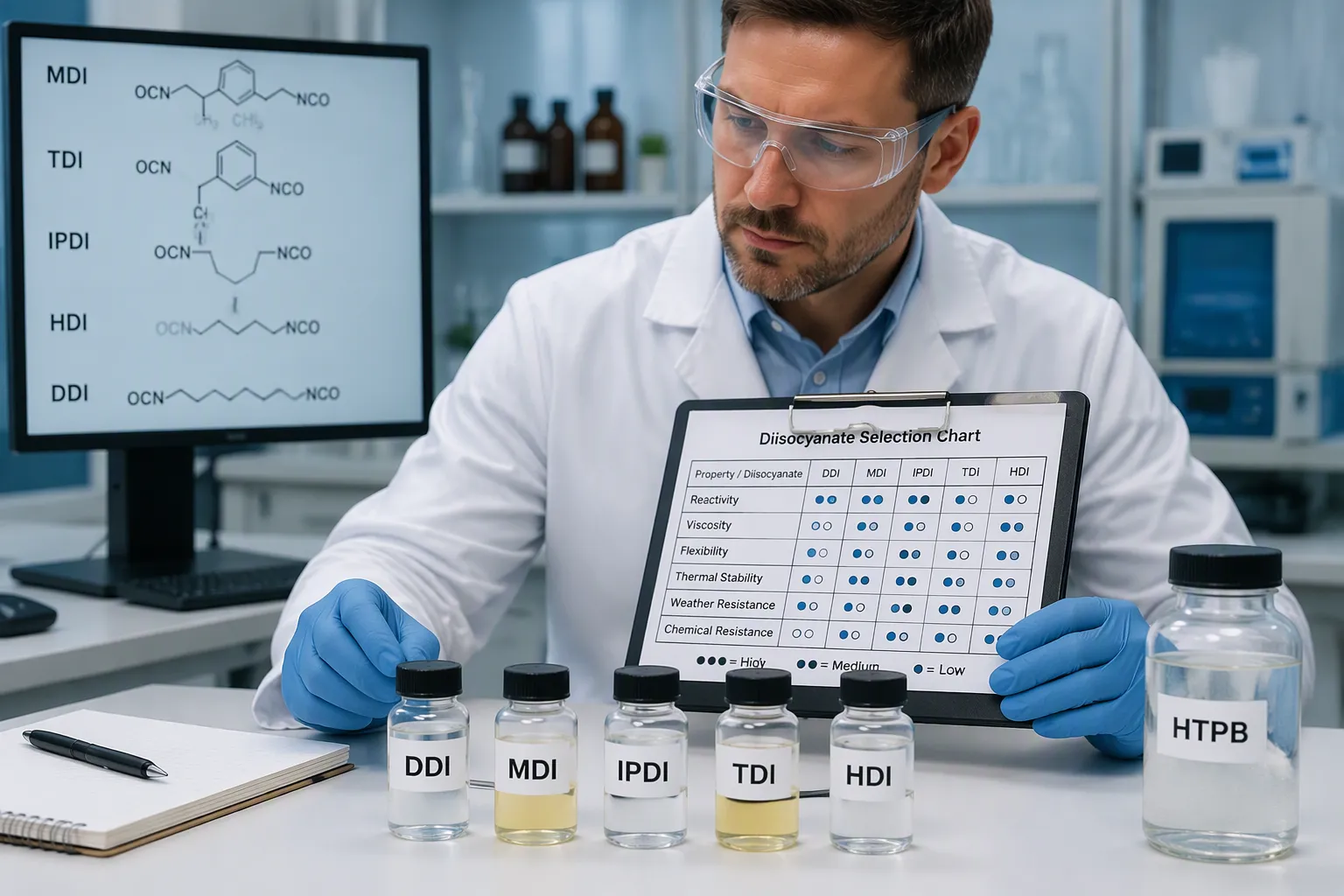
Selection of curing agents DDI suits long pot life. MDI cures fast and handles general-purpose work. TDI cures quickly too. IPDI and HDI resist UV light. Match the curing agent to the application first. Then adjust stoichiometry and catalysts.
Key Takeaways
- Choose a curing agent based on your main need: DDI for long pot life, MDI or TDI for fast cure, and IPDI or HDI for UV resistance.
- Adjust the NCO/OH ratio and catalyst to fine-tune properties like strength and cure speed.
- Always test your chosen curing agent with your specific HTPB grade in a small trial before full production.
HTPB and Curing Agents at a Glance
What Is HTPB?
HTPB stands for hydroxyl-terminated polybutadiene. This liquid rubber prepolymer serves as the backbone for many polyurethane elastomers. Butadiene units form its main chain. Each chain ends with hydroxyl (-OH) groups. These terminal groups react easily with isocyanates. Manufacturers control three key parameters during production.
| Parameter | Typical Value |
|---|---|
| Molecular structure | Telechelic polybutadiene with terminal hydroxyl groups; 70-85% 1,4-addition (cis/trans), 15-30% 1,2-vinyl content |
| Hydroxyl functionality | 0.4-0.9 meq/g (22-50 mg KOH/g); functionality 2.0-2.3 |
| Molecular weight | Number-average 1,000-5,000 g/mol; polydispersity 1.5-2.5 |
The functionality of 2.0-2.3 supplies enough crosslinking sites. The molecular weight range controls starting viscosity and final strength. The vinyl content affects low-temperature flexibility.
How Isocyanates Cure HTPB
Isocyanates carry the reactive -NCO group. This group attaches to the hydroxyl group on HTPB. The reaction forms a urethane bond. A polyisocyanate contains multiple NCO groups. It can link several HTPB chains together. This linking builds a three-dimensional network. The liquid mixture becomes a solid elastomer. The isocyanate structure determines cure speed and final properties.
The Five Curing Agents Compared
The five curing agents are DDI, MDI, IPDI, TDI, and HDI. Each has a distinct molecular structure. DDI offers the longest pot life. MDI provides balanced mechanical strength and rapid reaction. TDI cures quickly for fast production cycles. IPDI and HDI resist ultraviolet light and color change. The property comparison table below shows their differences. Use that data to match a curing agent to the intended application.
Property Comparison Table
The five curing agents differ in four key areas. NCO content and functionality determine mix ratios. Reactivity and pot life control working time. Mechanical properties and UV stability define durability. Toxicity and handling shape safety procedures. The sections below examine each area.
NCO Content and Functionality
NCO content measures the percentage of isocyanate groups by weight. Higher NCO content means a smaller amount of the curing agent can react with HTPB. Functionality is the average number of reactive groups per molecule. A functionality of two forms a linear polymer. A functionality above two forms a crosslinked network. The table below compares typical values for the five curing agents.
| Curing agent | Structure class | NCO content (wt%) | Functionality | Equivalent weight (g/eq) |
|---|---|---|---|---|
| DDI | Aliphatic, dimer acid-based | 21.6 | 2.0 | 195 |
| MDI | Aromatic | 33.5 (pure MDI) | 2.0 (pure MDI) | 125 (pure MDI) |
| TDI | Aromatic | 48.3 | 2.0 | 87 |
| IPDI | Aliphatic, cycloaliphatic | 37.8 | 2.0 | 111 |
| HDI | Aliphatic, linear | 49.7 (monomer) | 2.0 (monomer) | 84 (monomer) |
These values represent pure monomeric forms. Many commercial products are adducts or prepolymers. An HDI biuret has an NCO content near 23% and a functionality around 3. MDI prepolymers also lower the NCO content. Technicians must check the product datasheet for exact numbers.
Reactivity and Pot Life
Aromatic isocyanates react faster than aliphatic ones. MDI and TDI are aromatic. They cure quickly. IPDI and HDI are aliphatic. They react slower. DDI has a bulky alkyl structure. It reacts the slowest. For HTPB/TDI, the rate constant is about 0.8 to 1.5 L·mol⁻¹·s⁻¹ at 60°C. This rate uses a 0.05 wt% dibutyltin dilaurate catalyst. More than 95% of the NCO groups convert within 24 hours.
Final curing conversion also varies among isocyanates. Technicians measured the conversion on an HTPE system:
- TDI: 100% final curing conversion
- N-100 (an HDI-based polyisocyanate): 95% final curing conversion
- HDI: 85% final curing conversion
- IPDI: 80% final curing conversion
Pot life follows the reactivity trend. DDI gives the longest working time. Aliphatic isocyanates generally remain workable for 8 to 12 hours at 25°C. TDI and MDI cure faster and shorten this window. An epoxy-functional additive accelerates gelation. Adding 0.02 meq/g of epoxy functionality reduces the pot life from 8 to 12 hours down to 2 to 4 hours at 25°C.
Mechanical Properties and UV Stability
The NCO/OH ratio controls crosslink density. This ratio strongly affects the final elastomer. The table below shows the property outcomes for different ratios.
| NCO/OH ratio | Property outcome |
|---|---|
| 0.95–1.05 | Optimal tensile strength (2.5–4.0 MPa) and elongation at break (400–600%) |
| Greater than 1.1 | Excess isocyanate forms allophanate crosslinks; increased modulus but reduced elongation |
| Less than 0.9 | Incomplete cure; extractable oligomers and poor solvent resistance |
Technicians use standard test methods to measure these properties. Hardness measurements use a Shore A durometer per GB/T 531.1-2008. Tensile testing follows GB/T528-1998 on an Instron 26022 machine at a strain rate of 100 mm/min. Dynamic mechanical analysis (DMA 2980) runs at loading frequencies of 1, 5, and 10 Hz with a heating rate of 5 °C/min. A VTMR2010V-T low-field NMR spectrometer measures cross-linking density. A Nicolet 8700 FTIR spectrometer monitors the curing process.
UV stability separates the aromatic and aliphatic families. MDI and TDI contain aromatic rings. These rings absorb ultraviolet light and turn yellow. Prolonged exposure also causes surface cracks and loss of strength. DDI, IPDI, and HDI are aliphatic. They absorb little UV light. HDI provides the best color stability. IPDI also performs well. DDI resists UV damage, but its dimer acid base gives a darker initial color.
Toxicity and Handling
All isocyanates require careful handling. They irritate the skin, eyes, and respiratory tract. They also cause sensitization. MDI is a known allergen. Sensitized people can develop severe systemic reactions to extremely small exposures, including respiratory failure. MDI also reacts violently with water and other nucleophiles. HDI, TDI, and IPDI are skin and eye irritants. They act as skin and respiratory sensitizers. DDI lacks published toxicity data. Facilities should treat it as a hazard until proven safe.
| Chemical | Occupational exposure limit | GHS hazard classification | Recommended handling procedures |
|---|---|---|---|
| HDI (monomer) | ACGIH TLV = 0.005 ppm as an 8-hour TWA | Skin/eye irritant and skin/respiratory sensitizer; no formal GHS category labels | Engineering controls (closed systems, ventilation), PPE, medical surveillance, training, spill/decontamination, safe storage |
| MDI | No numeric OEL specified | Allergen and sensitizer; violent reaction toward water | Strict engineering controls and personal protective equipment |
| TDI | No numeric OEL specified | Skin/eye irritant and skin/respiratory sensitizer | General isocyanate controls: ventilation, PPE, medical surveillance, training, spill/decontamination, storage |
| IPDI | No numeric OEL specified | Skin/eye irritant and skin/respiratory sensitizer | General isocyanate controls: ventilation, PPE, medical surveillance, training, spill/decontamination, storage |
| DDI | No information found | No information found | No information found |
Every facility should include closed systems, ventilation, and protective equipment. Operators need spill kits and medical surveillance. Training must cover safe storage and decontamination. These controls protect workers from harmful isocyanate exposure.
Selection of Curing Agents DDI for Long Pot Life
DDI stands apart from the other four isocyanates. Its unique molecular structure delivers the longest working time of any curing agent in this group. Formulators turn to the selection of curing agents DDI when they need extended pot life above all other properties.
Key Characteristics of DDI
DDI is a difunctional aliphatic isocyanate derived from dimer acid. Its long, bulky alkyl chain creates steric hindrance around the NCO group. This hindrance slows the reaction with HTPB hydroxyl groups. The result is a pot life that can exceed 8 to 12 hours at room temperature. DDI has an NCO content of about 21.6% and an equivalent weight near 195 g/eq. These values mean formulators use a larger mass of DDI compared to TDI or HDI. The selection of curing agents DDI also brings low volatility and reduced toxicity concerns relative to volatile monomers. DDI yields a darker initial color because of its dimer acid base. It still resists UV degradation well.
Ideal Applications for DDI
DDI suits large castings and thick-section parts. These applications need long flow times before gelation. Hand lay-up and vacuum infusion processes benefit from the extended working window. DDI also works well in sealants and coatings that require slow, uniform cure. Field-applied systems use DDI for its forgiving mix ratio and long open time. Any project demanding maximum pot life should start with the selection of curing agents DDI.
MDI for General-Purpose Performance
MDI, or methylene diphenyl diisocyanate, is the workhorse of HTPB curing. It balances fast cure with strong mechanical properties. Formulators choose MDI when they want reliable results without extreme processing demands.
Key Characteristics of MDI
MDI is an aromatic isocyanate. Its aromatic rings make the NCO group highly reactive toward HTPB hydroxyls. This reactivity produces a fast cure at room temperature. Pure MDI contains about 33.5% NCO by weight and has a functionality of 2.0. Its equivalent weight sits near 125 g/eq. These values mean formulators use less MDI by mass than DDI. The table below summarizes the core numbers.
| Property | Typical Value |
|---|---|
| Structure class | Aromatic |
| NCO content | 33.5 wt% (pure MDI) |
| Functionality | 2.0 (pure MDI) |
| Equivalent weight | 125 g/eq (pure MDI) |
MDI delivers high tensile strength and good hardness. It also offers a moderate pot life. Aromatic rings absorb UV light, so MDI yellows outdoors. MDI is a known allergen and reacts violently with water. Handlers need strict engineering controls.
Ideal Applications for MDI
MDI suits general-purpose elastomers, rollers, and cast parts. It works well in adhesives and coatings that need fast demold times. Industrial wheels, seals, and gaskets often use MDI-based systems. Any indoor application with balanced strength and speed fits MDI well.
TDI for Fast Cure
TDI, or toluene diisocyanate, delivers the fastest cure of the five curing agents. Its aromatic structure drives a rapid reaction with HTPB hydroxyl groups. Formulators pick TDI when production speed matters most.
Key Characteristics of TDI
TDI is an aromatic isocyanate with two NCO groups on a toluene ring. This compact structure gives TDI the highest NCO content among common aromatic curing agents. The table below lists the core values.
| Property | Typical Value |
|---|---|
| Structure class | Aromatic |
| NCO content | 48.3 wt% |
| Functionality | 2.0 |
| Equivalent weight | 87 g/eq |
The high NCO content means formulators use a small mass of TDI per batch. TDI reacts quickly at room temperature. It reaches 100% final curing conversion, the highest of the five agents. This fast reaction shortens pot life to a few hours. TDI also yellows under UV light because of its aromatic rings. It is a skin and respiratory sensitizer, so handlers need ventilation and protective equipment.
Ideal Applications for TDI
TDI suits high-volume production lines that need quick demold times. It works well in molded elastomers, foams, and coatings for indoor use. Rollers, gaskets, and seals often use TDI-based systems. Any application with short cycle times and no sunlight exposure fits TDI well.
IPDI for UV Stability
IPDI, or isophorone diisocyanate, gives formulators a strong answer to sunlight exposure. Its cycloaliphatic structure balances reactivity with weather resistance. This balance makes IPDI a top choice for outdoor HTPB parts.
Key Characteristics of IPDI
IPDI is a cycloaliphatic diisocyanate. Its ring structure contains no aromatic groups. This feature prevents the yellowing that plagues MDI and TDI. The table below lists the core values for IPDI and its prepolymers.
| Parameter | Typical Value |
|---|---|
| Structure class | Cycloaliphatic |
| NCO content (prepolymer) | 2.0–8.0 wt% |
| Viscosity at 25 °C | 5,000–50,000 mPa·s |
| Gel time at 180 °C | 410–520 s |
Technicians measure NCO content by dibutylamine back-titration. The prepolymer viscosity range shows the expected handling and casting behavior. IPDI reacts slower than aromatic agents. Its isocyanate conversion follows first-order kinetics with a rate constant of 0.005–0.02 s⁻¹ at 80 °C using DBTDL catalyst. This moderate rate extends pot life while still allowing a full cure.
Ideal Applications for IPDI
IPDI suits outdoor coatings, sealants, and clear elastomers. These products must resist yellowing and surface cracking. Automotive trim, building panels, and marine parts often use IPDI-based systems. IPDI also works well in optical components that need color stability. Any HTPB project exposed to sunlight should consider IPDI first.
HDI for Color Stability and Flexibility
HDI provides the best color stability among the five curing agents. It also gives cured elastomers excellent flexibility. Formulators choose HDI for outdoor applications. They value its long-term color and flexibility.
Key Characteristics of HDI
HDI exists as an aliphatic linear diisocyanate. Its full name is hexamethylene diisocyanate. The monomer contains 49.7% NCO by weight and has a functionality of 2.0. Its equivalent weight is 84 g/eq. These values produce linear polymer chains. This linear structure makes the cured elastomer flexible and impact-resistant.
HDI reacts slower than aromatic agents. The monomer form yields an 85% final curing conversion. Commercial products often use biuret or trimer forms. These HDI-based polyisocyanates lower the NCO content to about 23% and raise functionality to around 3. The higher functionality creates more crosslinks. This crosslinking improves solvent resistance. It also keeps the chain flexible.
The aliphatic structure contains no aromatic rings. It absorbs very little ultraviolet light. HDI-based systems resist yellowing and chalking even after long exposure. This stability sets HDI apart from MDI and TDI.
Pure HDI monomer is volatile. It acts as a skin and respiratory sensitizer. Technicians must use closed systems and ventilation during handling.
Ideal Applications for HDI
Outdoor coatings and clear topcoats use HDI. These products need color stability in sunlight. HDI suits flexible sealants and adhesives. These products undergo bending and movement. It also works well for elastomeric membranes, gaskets, and protective finishes. Any application with outdoor exposure and repeated flexing fits HDI best.
Decision Tree for Selection
A formulator faces five curing agent options. Each one solves a different problem. A structured decision process removes guesswork from the selection. The steps below walk through the key questions in order. Each answer narrows the field until one curing agent remains.
Step-by-Step Selection Flow
The selection flow starts with the application requirements. A formulator answers a series of questions. Each question eliminates curing agents that cannot meet the demand. The remaining candidate then moves to fine-tuning.
-
Identify the primary performance demand. The first question asks what matters most. Does the application need a long working time? Does it need a fast cure? Does it need UV resistance? The answer points to a starting family. DDI leads for pot life. MDI and TDI lead for speed. IPDI and HDI lead for weather resistance.
-
Check the UV exposure conditions. An outdoor application rules out MDI and TDI. Their aromatic rings yellow and crack under sunlight. An indoor application keeps all five agents in play. This step often eliminates two options at once.
-
Evaluate the required pot life. A large casting needs hours of flow time before gelation. DDI delivers 8 to 12 hours or more at room temperature. MDI and TDI shorten that window to a few hours. A small mold with a fast cycle can tolerate the shorter pot life. A thick section cannot.
-
Confirm the mechanical property targets. The NCO/OH ratio controls crosslink density. A ratio between 0.95 and 1.05 gives optimal tensile strength and elongation. MDI and TDI build rigid networks with high hardness. HDI builds flexible chains with high impact resistance. DDI sits between these extremes.
-
Review the toxicity and handling constraints. Every isocyanate needs engineering controls. MDI is a known allergen with violent water reactivity. HDI monomer is volatile and requires closed systems. DDI has limited published toxicity data. A facility with limited ventilation may prefer a less volatile option.
-
Match the cure schedule to production. Aromatic agents cure quickly at room temperature. Aliphatic agents need heat or catalyst to reach full conversion. TDI reaches 100% conversion. HDI reaches 85%. IPDI reaches 80%. A production line with limited oven capacity should favor the aromatic family.
-
Fine-tune with stoichiometry and catalysts. The selected curing agent now needs adjustment. A slight excess of isocyanate increases modulus. A slight deficit improves elongation. Dibutyltin dilaurate accelerates the reaction. An epoxy-functional additive shortens pot life when needed.
-
Validate with a small-scale trial. The final step confirms the selection. A bench trial checks mix ratio, pot life, and cure schedule. It also reveals unexpected interactions with the specific HTPB grade. The trial result either confirms the choice or sends the formulator back to step one.
This flow works for most HTPB systems. A formulator can reorder the steps when one requirement dominates. A military specification, for example, may fix the UV requirement first. A high-volume production line may fix the cure speed first. The logic stays the same.
Common Formulation Pitfalls
Even experienced formulators make mistakes during selection. The pitfalls below appear again and again in HTPB work. Each one has a clear cause and a clear fix.
| Pitfall | Cause | Consequence | Fix |
|---|---|---|---|
| Ignoring the NCO/OH ratio | Assuming a 1:1 mix by weight works | Incomplete cure or excess crosslinking | Calculate the ratio from equivalent weights, not mass |
| Using monomer data for prepolymers | Reading the datasheet for pure MDI or HDI | Wrong mix ratio and poor properties | Check the actual product datasheet for NCO content and functionality |
| Overlooking moisture | Water reacts with isocyanate groups | Bubbles, foam, and reduced strength | Dry all components and use a nitrogen blanket |
| Skipping the pot life test | Trusting the datasheet value alone | Gelation inside the mold or mixing equipment | Run a cup test with the actual HTPB grade and catalyst level |
| Choosing an aromatic agent for outdoor use | Focusing on cure speed only | Yellowing, chalking, and surface cracks | Switch to IPDI or HDI for any sunlight exposure |
| Underestimating DDI color | Expecting a clear, water-white product | Darker initial color in the finished part | Accept the color or switch to IPDI for clear applications |
| Neglecting catalyst interaction | Adding catalyst without rechecking pot life | Pot life drops from hours to minutes | Re-measure pot life after every catalyst change |
| Assuming all HTPB grades behave the same | Using a generic formulation | Variable cure and inconsistent properties | Confirm compatibility with the specific HTPB grade |
A formulator should treat every datasheet value as a starting point, not a guarantee. The actual HTPB grade, moisture level, and catalyst package change the outcome. Small-scale trials reveal these effects before they reach production.
Moisture deserves special attention. Water reacts with isocyanate groups and produces carbon dioxide gas. The gas forms bubbles inside the cured elastomer. These bubbles weaken the part and create surface defects. A formulator should dry the HTPB under vacuum before mixing. A nitrogen blanket during processing also helps. The same care applies to pigments and fillers. Many fillers carry absorbed water. Drying them before use prevents the problem.
The NCO/OH ratio is another frequent source of trouble. A formulator sometimes mixes by weight and assumes the ratio is correct. This assumption fails because each curing agent has a different equivalent weight. TDI has an equivalent weight of 87 g/eq. DDI has an equivalent weight of 195 g/eq. The same mass of each agent delivers very different amounts of NCO. A formulator must calculate the ratio from equivalent weights. The calculation uses the hydroxyl value of the HTPB and the NCO content of the curing agent.
Catalyst selection also trips up formulators. Dibutyltin dilaurate speeds up the reaction. The right amount shortens cure time without harming pot life. Too much catalyst collapses the pot life. An epoxy-functional additive offers another lever. Adding 0.02 meq/g of epoxy functionality reduces pot life from 8 to 12 hours down to 2 to 4 hours at 25°C. A formulator should add catalyst in small increments. Each increment needs a fresh pot life measurement.
Storage and shelf life round out the list of concerns. Isocyanates react with atmospheric moisture over time. An opened container absorbs water and loses NCO content. A formulator should use sealed containers and nitrogen padding. Older material needs a fresh NCO titration before use. This step catches degradation before it ruins a batch.
The decision tree gives a formulator a reliable starting point. The pitfalls list gives a checklist for avoiding common errors. Together they turn a complex selection into a repeatable process. A formulator who follows both will reach a workable formulation faster and with fewer failed trials.
The selection of curing agents DDI wins for extended pot life. MDI delivers speed and general-purpose balance. TDI cures fast in aromatic systems. IPDI and HDI provide UV and color stability. Always confirm compatibility, stoichiometry, and cure schedule against the specific HTPB grade. The selection of curing agents DDI works as a starting point. Formulators then validate every choice with small-scale trials.
FAQ
Which curing agent gives the longest pot life for HTPB?
DDI gives the longest pot life. Its bulky structure slows the reaction with HTPB. Formulators get 8 to 12 hours of working time at room temperature.
Which curing agent cures HTPB the fastest?
TDI cures HTPB the fastest. Its aromatic ring drives a rapid reaction. TDI reaches 100% conversion, the highest among the five agents.
Which curing agent resists UV light best for outdoor HTPB parts?
HDI resists UV light best. Its aliphatic chain absorbs little ultraviolet light. HDI-based systems resist yellowing and chalking after long sun exposure.
See Also
Comparing EHEDG Guidelines With 3A SSI Standards For Hygienic Design
Top Eight HTN LCD Displays For Reliable And High Performance
Key Steps Needed To Obtain PED 2014/68/EU Certification Successfully
Three Methods PHE Plates Boost System Performance In 2025
Making AHRI 400/401 Heat Exchanger Assistance Completely Hassle Free