Reactive Liquid Rubbers HTPB CTPB CTBN HTBN ATBN and ATPB Classification and Prospects
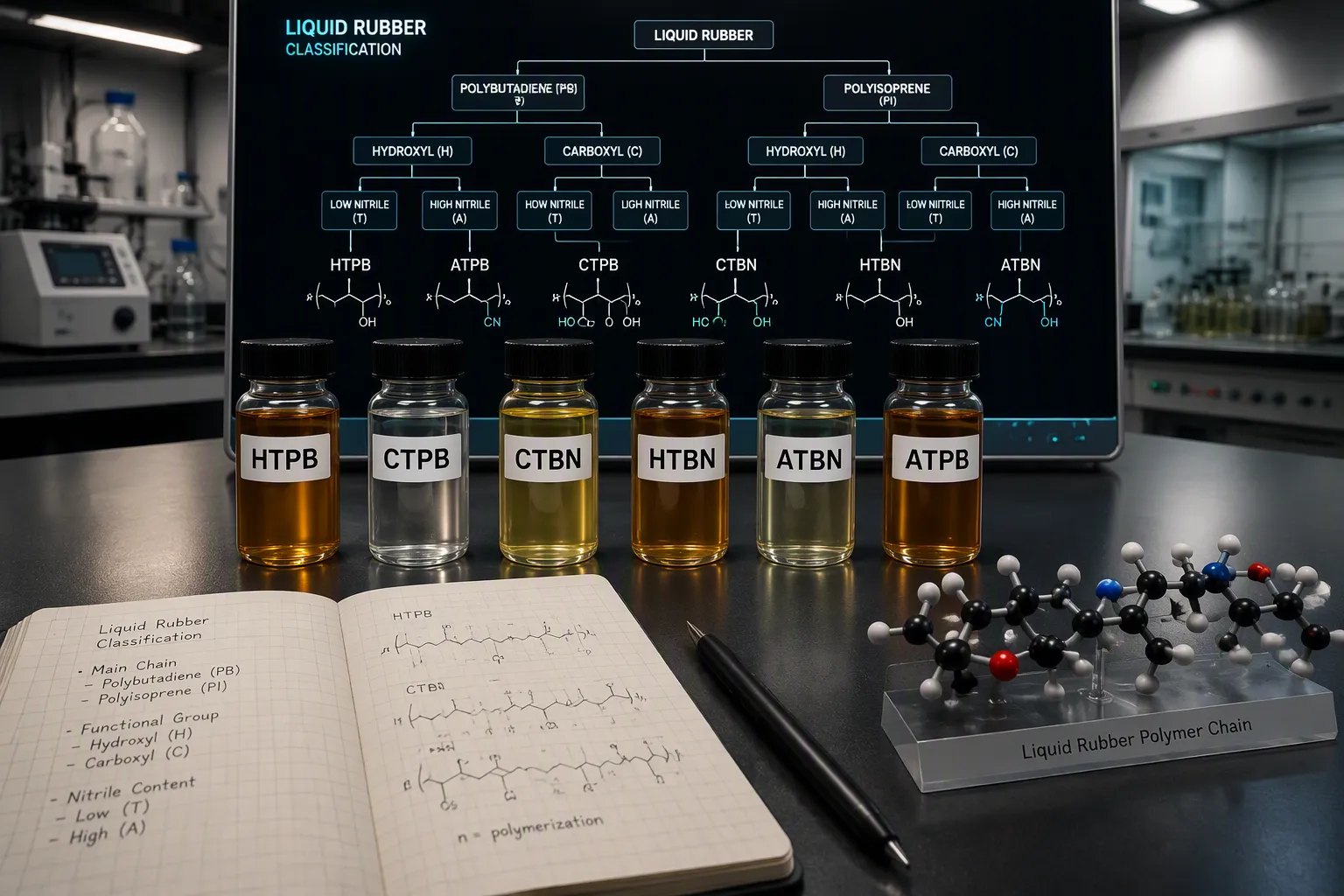
Reactive liquid rubbers are low-viscosity telechelic polymers with functional end-groups like hydroxyl, carboxyl, or amine. These groups enable crosslinking in thermoset systems. They offer dual value: liquid processability plus elastomeric performance. I see them delivering toughening, flexibility, and adhesion enhancement in epoxies, polyurethanes, and composites.
Terminal functional group chemistry dictates reactivity and curing pathways. Backbone composition governs compatibility, oil resistance, and low-temperature properties. These rubbers solve the brittleness problem in high-performance thermosets without sacrificing processability. Regulatory pressure on BPA-based epoxies and lightweighting trends drive demand for Reactive Liquid Rubbers HTPB systems. Understanding the Classification of Reactive Liquid Rubbers and Selection of Curing Systems helps engineers choose correctly.
Key Takeaways
- Reactive liquid rubbers have functional end-groups that enable crosslinking, offering both liquid processing and elastomeric performance.
- Choose the rubber type based on end-group chemistry: hydroxyl for polyurethane, carboxyl for epoxy toughening, and amine for fast curing and strong adhesion.
- Backbone composition determines compatibility and resistance: polybutadiene provides low-temperature flexibility, while nitrile-modified versions improve oil resistance.
- CTBN significantly enhances epoxy toughness by creating a dispersed rubber phase that absorbs energy and stops cracks.
- Future developments focus on bio-based feedstocks and additive manufacturing, expanding the use of these rubbers in advanced applications.
Chemical Foundations: What Sets These Rubbers Apart
Functional End-Groups: The Reactive Handles
I see the end-groups as the primary reactive handles. Hydroxyl, carboxyl, and amine groups each dictate a different curing pathway. Reactive Liquid Rubbers HTPB exemplify this principle. Their hydroxyl end-groups enable polyurethane formation. The polymerization method influences the structure significantly. Anionic polymerization creates a high 1,2-vinyl content. Free radical polymerization produces a low 1,2-vinyl content. The OH functionality also differs.
| Structural Parameter | Anionic Polymerization | Free Radical Polymerization |
|---|---|---|
| 1,2-vinyl content | High (60-90%) | Low (15-20%) |
| OH functionality | f~2.0 (linear diol) | f>2 (branched, avg. 2.4-2.6) |
| Tg | High | Low |
Linear diols with f~2.0 enable thermoplastic polyurethane formation. Branched structures with f>2 lead to thermoset networks. This difference directly controls the final cured properties.
Backbone Architecture: Polybutadiene vs. Nitrile-Modified
The backbone determines the rubber's compatibility with different resins. Polybutadiene backbones offer excellent low-temperature flexibility. They remain flexible below -70°C. However, they show poor oil and solvent resistance. Nitrile-modified backbones solve this problem. Acrylonitrile content imparts oil resistance. It also reduces low-temperature flexibility.
Grades with high acrylonitrile content have better oil resistance whereas low acrylonitrile content gives better low temperature flexibility and resilience.
| Polymer Backbone | Oil Resistance | Low-Temperature Flexibility |
|---|---|---|
| Polybutadiene (BR) | Poor oil and solvent resistance | Excellent; remains flexible to below -70°C, with low stiffening down to -55°C |
| Butadiene-Acrylonitrile (NBR) | Imparted by acrylonitrile content; higher ACN = higher oil/fuel resistance | Impaired by increasing acrylonitrile content; range from -55°C (low ACN) to -10°C (high ACN) |
I select the backbone based on the environmental demands of the application.
How Structure Dictates Performance
The combination of end-group and backbone creates the final performance profile. The branched structure with f>2 imposes limitations on design flexibility. Linear difunctional resins with f~1.95 can prepare thermoplastic polyurethane elastomers. The hydroxyl functionality and backbone microstructure determine the cured properties. I see this structure-property relationship as the core of material selection. Understanding these foundations helps me choose the right Reactive Liquid Rubbers HTPB for each application.
Classification of Reactive Liquid Rubbers HTPB and Its Counterparts
I classify these rubbers primarily by their terminal functional groups. This classification determines the curing chemistry and application scope. Three families dominate the market: hydroxyl-terminated, carboxyl-terminated, and amine-terminated types. Each family offers distinct advantages for specific resin systems and performance requirements.
Hydroxyl-Terminated Types: HTPB and HTBN
Hydroxyl-terminated polybutadiene (HTPB) stands as the most widely used reactive liquid rubber. I see it everywhere from rocket propulsion to consumer goods. Its hydroxyl end-groups react readily with isocyanates to form polyurethane networks. The polybutadiene backbone delivers exceptional low-temperature flexibility and hydrolytic stability.
| Property | Value |
|---|---|
| Number-average molecular weight (Mn) | 1,000–5,000 g/mol |
| Hydroxyl value (OH#) | 0.4–0.9 meq/g (22–50 mg KOH/g) |
| Viscosity at 30°C | 5,000–15,000 mPa·s |
| Glass transition temperature (Tg) | −70 to −85°C |
| Tensile strength (cured PU) | 3.0–5.5 MPa |
| Elongation at break (cured PU) | 450–700% |
| Optimal NCO/OH ratio | 0.95–1.05 |
| Typical propellant binder content | 12–18 wt% |
These properties translate into a remarkable range of applications. I find HTPB-based polyurethanes in rigid foam insulation panels, durable elastomeric wheels for roller coasters and escalators, automotive suspension bushings, and electrical potting compounds. The material also appears in high-performance adhesives, surface coatings, sealants, synthetic fibers like Spandex, carpet underlay, and hard-plastic parts for electronic instruments. Most notably, HTPB serves as the solid rocket propellant binder in launch vehicles, typically formulated as HTPB/AP/Al at 12/68/20 ratios.
Hydroxyl-terminated butadiene-acrylonitrile (HTBN) shares the same reactive chemistry but incorporates acrylonitrile comonomer. This modification improves oil resistance and increases polarity for better compatibility with epoxy and vinyl ester resins. I select HTBN when the application demands both polyurethane reactivity and enhanced solvent resistance.
Carboxyl-Terminated Types: CTPB and CTBN
Carboxyl-terminated polybutadiene (CTPB) and carboxyl-terminated butadiene-acrylonitrile (CTBN) represent the second major family. These rubbers carry carboxylic acid end-groups that react with epoxy resins, amines, and metal oxides. I find them indispensable for epoxy toughening applications.
CTBN creates a rubbery phase within the epoxy matrix. You get better impact resistance and flexibility. The resin absorbs energy and stops cracks from spreading. CTBN reacts with epoxy to form block copolymers with both rigid and flexible segments. CTBN creates a dispersed rubber phase, improving mechanical properties. The whitening of the stress is due to the scattering of visible light from the scattering center layer. In this case, it is the void of the scattering center, which is due to the cavitation of the CTBN particles. It is an important energy dissipation mechanism after CTBN is added into the epoxy resin, which can consume the energy at the time of fracture, and rubber bridging and shear yielding are also reasonable toughening mechanisms.
The quantitative improvements from CTBN addition are substantial. I see consistent gains across multiple mechanical properties.
| Property | Improvement |
|---|---|
| Tensile Strength | Increased by 26% with 5 phr CTBN |
| Elongation-at-Break | Increased significantly |
| Izod Notched Impact Strength | Increased significantly |
| Tensile Modulus | Decreased gradually |
| Maximum Toughness | Achieved at 15 phr CTBN |
| Fracture Toughness (K IC) | Stable for >10 phr CTBN |
| Glass Transition Temperature (Tg) | Increased by 11.3°C with 25 phr CTBN |
For structural adhesive applications, I specify CTBN grades based on carboxyl content and viscosity. The manufacturer's data shows a clear relationship between these parameters.
| CTBN Grade | Carboxyl Value (mmol/g) | Viscosity at 27°C (Pa·S) |
|---|---|---|
| CTBN-1 | 0.45 – 0.55 | ≤180 |
| CTBN-2 | 0.55 – 0.65 | ≤150 |
| CTBN-3 | 0.45 – 0.65 | ≤300 |
| CTBN-4 | 0.65 – 0.75 | ≤200 |
| CTBN-5 | 0.50 – 0.70 | ≤600 |
I choose lower-viscosity grades for easy mixing and higher-carboxyl grades for greater crosslink density. The trade-off between processability and final properties guides my selection.
Amine-Terminated Types: ATPB and ATBN
Amine-terminated polybutadiene (ATPB) and amine-terminated butadiene-acrylonitrile (ATBN) complete the classification triad. These rubbers carry primary amine end-groups that react rapidly with epoxy resins, isocyanates, and anhydrides. I value them for their fast curing kinetics and strong adhesion to polar substrates.
ATBN finds particular favor in epoxy adhesives and coatings. The amine groups react directly with epoxy rings without requiring a separate catalyst. This direct reaction creates strong chemical bonds at the interface. The nitrile groups in ATBN enhance adhesion to metals and engineering plastics. I also appreciate the improved tear strength and fatigue resistance that amine-terminated rubbers impart to cured systems.
The amine functionality offers another advantage: it enables room-temperature curing. This capability simplifies processing and reduces energy costs in manufacturing. I see growing interest in ATBN for field-applied coatings and repair compounds where heat curing is impractical.
These three families—hydroxyl, carboxyl, and amine—cover the vast majority of Reactive Liquid Rubbers HTPB applications. Each functional group chemistry provides a distinct curing pathway and performance profile. The selection ultimately depends on the resin system, processing conditions, and end-use requirements.
Comparative Performance: Selecting the Right Rubber
Viscosity and Processing Characteristics
I consider viscosity the first parameter when choosing a reactive liquid rubber. Lower viscosity simplifies manufacturing. I see this clearly with HTPB-based propellant formulations. Lower slurry viscosity allows easy casting into complex rocket motor casings. Formulators adjust the curing agent ratios to control pot life and viscosity during processing. This balance between workability and reaction time determines production efficiency.
| Aspect | Impact of Viscosity | Practical Example |
|---|---|---|
| Processing | Lower viscosity facilitates mixing and casting | Easy casting into complex rocket motor casings |
| Pot Life | Adjustable through curing agent ratios | Formulators control viscosity during processing |
CTBN grades show higher viscosity than HTPB. The carboxyl content and molecular weight drive this difference. I select lower-viscosity CTBN grades for epoxy toughening applications. Thorough mixing matters in these systems.
Toughening Efficiency and Mechanical Properties
I evaluate toughening efficiency by measuring fracture toughness and impact resistance. CTBN excels in epoxy systems. The rubber particles create a dispersed phase. This phase absorbs energy through cavitation and shear yielding. The mechanism prevents crack propagation. I see consistent improvements in impact strength. The tensile modulus remains largely unchanged.
HTPB-based polyurethanes deliver excellent elongation and tear strength. The linear diol structure creates flexible elastomers. I choose HTBN or ATBN when I need both toughness and oil resistance. Reactive Liquid Rubbers HTPB systems provide the foundation for these performance-tuned formulations.
Chemical Resistance and Thermal Stability
Backbone chemistry determines chemical resistance. Polybutadiene backbones show poor oil and solvent resistance. Nitrile-modified backbones solve this problem. Higher acrylonitrile content improves resistance to fuels and hydrocarbons. I select the backbone based on the operating environment.
Thermal stability depends on the backbone structure. HTPB maintains flexibility below -70°C. Nitrile rubbers sacrifice some low-temperature performance. They gain improved chemical resistance in return. High-temperature applications favor nitrile-modified grades. Low-temperature applications demand pure polybutadiene backbones. I match the rubber to the environmental demands of each application.
Adhesion and Resin Compatibility
I evaluate adhesion and resin compatibility as the final selection gate. These two properties determine whether a reactive liquid rubber actually integrates into the target formulation. Compatibility governs how well the rubber disperses in the resin. Adhesion dictates the bond strength to the substrate.
Resin compatibility depends on solubility parameters. The backbone polarity drives this behavior. Polybutadiene rubbers show excellent compatibility with non-polar resins like polyurethane. They phase-separate in polar epoxy systems. Nitrile-modified rubbers solve this problem. Acrylonitrile increases polarity. This shift improves compatibility with epoxy, vinyl ester, and phenolic resins. I see CTBN and ATBN as the go-to choices for epoxy toughening precisely because of this compatibility.
| Rubber Type | Epoxy Resin | Polyurethane | Vinyl Ester | Phenolic |
|---|---|---|---|---|
| HTPB | Poor | Excellent | Moderate | Poor |
| HTBN | Good | Excellent | Good | Moderate |
| CTPB | Moderate | Good | Moderate | Poor |
| CTBN | Excellent | Good | Excellent | Good |
| ATPB | Moderate | Good | Moderate | Poor |
| ATBN | Excellent | Good | Excellent | Good |
Adhesion follows a different logic. The end-groups form chemical bonds with the substrate. Amine-terminated rubbers create strong bonds with metals and engineering plastics. The amine groups react with epoxy coatings and primer layers. The nitrile groups in ATBN improve wetting and adhesion to polar surfaces. Hydroxyl-terminated rubbers perform well on non-polar substrates. I select HTPB for polyurethane coatings on plastic substrates. I choose ATBN for epoxy adhesives on aluminum and steel.
The rule is simple: match the rubber backbone polarity to the resin for dispersion, and match the end-group reactivity to the substrate for adhesion.
I consider the rubber concentration. Higher loadings can improve adhesion but may reduce cohesive strength. The optimum balance depends on the specific rubber and substrate. I always test compatibility with a small trial batch. Visual clarity after mixing indicates good dispersion. Cloudiness or phase separation signals a compatibility problem. Getting this balance right separates a successful formulation from a failed one. Reactive Liquid Rubbers HTPB systems offer the backbone for this tuning. The nitrile-modified variants provide the polar adhesion pathway.
Application Prospects: Where These Rubbers Are Headed
Aerospace and Defense: Propellants, Liners, and Structural Adhesives
The aerospace sector remains the largest consumer of Reactive Liquid Rubbers HTPB. I see this material dominating solid rocket propellant formulations because it delivers predictable mechanical properties and reliable curing behavior. The binder holds ammonium perchlorate oxidizer and aluminum fuel particles together in a rubbery matrix that withstands thermal cycling and mechanical stress during launch.
| Role | HTPB Variant / Additive | Description |
|---|---|---|
| Binder | R-45 M | Pre-mixed anti-oxidant for long-term storage stability |
| Binder | R-45 HTLO | No anti-oxidants; lower viscosity than R-45 M |
| Binder | Low Molecular Weight HTPB | Very low viscosity; improves castability but may reduce density |
| Liner | HTPB with Melamine | Melamine acts as a flame retardant for liner applications |
I select R-45 M for strategic missile programs where shelf life matters over decades. The anti-oxidant package prevents oxidative degradation during extended storage. R-45 HTLO suits tactical systems with shorter service lives. The lower viscosity simplifies casting into complex grain geometries. Low molecular weight grades help me fine-tune slurry rheology when I need maximum solids loading for higher specific impulse.
Liner materials protect the motor casing from hot combustion gases. I formulate HTPB-based liners with melamine to reduce flame spread and insulate the structural shell. The liner bonds the propellant grain to the casing while accommodating differential thermal expansion. This bond integrity prevents catastrophic failure during ignition.
Structural adhesives in aerospace rely on CTBN and ATBN for toughening epoxy-based bonding agents. I specify these rubbers for secondary bonding of composite panels to metal frames. The rubber phase absorbs peel stresses and prevents crack propagation along the adhesive bond line. Amine-terminated grades provide the fastest cure cycles for production efficiency.
Automotive and Electronics: Sealants, Potting, and Coatings
Automotive engineers face a constant battle against vibration, moisture, and thermal stress. I see reactive liquid rubbers solving these challenges across multiple vehicle systems. Silicone potting compounds represent one prominent application. These materials provide elasticity, flexibility, temperature resistance up to 400°F, and resistance to moisture and chemicals. I specify them for engine control modules, battery management systems, and sensor assemblies.
The electronics industry demands reliable protection for sensitive components. Conformal coatings shield circuit boards from environmental damage. I use one-part silicone liquid rubber dips for shock dampening and vibration isolation applications. These coatings excel in severe impact cushioning and dampening of severe shock.
Typical automotive and electronics applications include:
- Vibration isolation for powertrain mounts and suspension bushings
- Severe impact cushioning for battery pack enclosures
- Dampening of severe shock in transmission control units
- Sealing of connector housings and wire harness penetrations
- Potting of ignition coils and alternator components
I choose HTBN for under-hood sealants that contact fuel and oil. The acrylonitrile content provides the chemical resistance that pure polybutadiene lacks. ATBN finds use in structural adhesives for lightweight vehicle assembly. These adhesives bond dissimilar materials like aluminum to carbon fiber composites. The rubber phase imparts the flexibility needed to accommodate differential thermal expansion between these materials.
Composite Materials: Toughening Epoxy and Vinyl Ester Systems
Composite materials suffer from one persistent weakness: brittleness. Epoxy matrices crack easily under impact or thermal shock. I solve this problem by incorporating CTBN or ATBN into the resin formulation. The rubber creates a dispersed second phase that absorbs energy and arrests crack growth.
I see the toughening mechanism working through several pathways. Rubber particles cavitate under stress, creating voids that dissipate energy. Shear yielding occurs in the epoxy matrix between particles. Rubber bridging connects crack faces and resists propagation. These mechanisms work together to multiply fracture toughness by factors of two to three.
Vinyl ester resins benefit from the same approach. These resins offer excellent corrosion resistance but suffer from poor impact strength. I add CTBN at 5 to 15 parts per hundred resin to achieve the optimal balance. Lower loadings improve toughness without sacrificing modulus. Higher loadings maximize impact resistance but reduce stiffness and glass transition temperature.
The regulatory landscape now shapes my material selections. Stringent environmental regulations limit the use of certain chemical intermediates in liquid rubber manufacturing. I track these compliance requirements carefully:
- REACH compliance in the EU increases operational complexity and capital expenditure for manufacturers
- EPA regulations in North America impose strict VOC emission limits on production facilities
- Regional frameworks in Asia add further compliance burdens that disproportionately affect smaller manufacturers
- These constraints drive investment in advanced synthesis technologies that satisfy both performance and compliance requirements
| Pressure Category | Specific Pressure | Source / Driver | Impact on Bio-Based Liquid Rubbers |
|---|---|---|---|
| Regulatory | Strict VOC emission limits | EPA (North America) | Requires investment in low-emission production technologies; bio-based formulations help meet compliance |
| Regulatory | REACH compliance & regional chemical safety frameworks | EU, North America, Asia | Increases operational complexity and capital expenditure; bio-based variants reduce reliance on restricted chemical intermediates |
| Sustainability | Demand for bio-based monomers | Corporate clients, eco-conscious end-users | Reduces carbon footprint and aligns with sustainable sourcing trends |
| Sustainability | Chemical recycling & circular economy initiatives | US and Canada government programs | Addresses end-of-life disposal challenges of cross-linked rubbers; bio-based and recyclable formulations are prioritized |
I see manufacturers responding with bio-based liquid rubber variants. These products use monomers derived from renewable feedstocks rather than petroleum. The performance profile matches conventional grades while reducing carbon footprint. Automotive OEMs and consumer goods brands increasingly demand these sustainable options. The shift toward low-VOC formulations accelerates innovation in synthesis technology.
The composite market continues expanding in wind energy, marine, and infrastructure applications. Each sector demands specific toughening solutions. I match the rubber chemistry to the resin system and service environment. CTBN remains my default choice for epoxy systems. ATBN provides faster curing when production speed matters. HTBN offers the best oil resistance for automotive composite components.
Emerging Frontiers: Bio-Based Rubbers and Smart Materials
The sustainability movement now reaches deep into polymer science. I watch bio-based reactive liquid rubbers emerge from research laboratories into commercial reality. These products replace petroleum-derived monomers with renewable feedstocks. Castor oil, soybean oil, and crude tall oil provide the carbon backbone for these new materials. The performance profile matches conventional grades while reducing carbon footprint significantly.
I see the regulatory landscape accelerating this transition. Strict VOC emission limits from the EPA force manufacturers to rethink production chemistry. REACH compliance in the EU adds operational complexity and capital expenditure. Bio-based formulations help companies meet these requirements without sacrificing performance. Corporate clients increasingly demand sustainable sourcing across their supply chains. The chemical recycling initiatives in the US and Canada push manufacturers toward circular economy models.
The technical challenge lies in maintaining reactive end-group functionality. Bio-based polyols must still carry hydroxyl, carboxyl, or amine groups at precise concentrations. I evaluate these materials carefully for hydroxyl value and molecular weight distribution. The backbone structure differs from petroleum-derived polybutadiene. Renewable feedstocks produce more complex molecular architectures. These differences affect viscosity and curing kinetics. My testing protocols account for these variations.
Smart materials represent the second frontier. I see reactive liquid rubbers integrating with sensing and responsive technologies. The telechelic structure allows incorporation of functional nanoparticles. Carbon nanotubes and graphene platelets disperse within the rubber matrix. These additives create conductive pathways for strain sensing. The material detects deformation and reports it as a change in electrical resistance. Structural health monitoring becomes possible without separate sensor systems.
Shape memory behavior offers another avenue. I formulate liquid rubbers with reversible crosslinks that respond to temperature stimuli. The material holds a temporary shape below its transition temperature. Heating triggers recovery to the original geometry. This capability finds use in self-healing coatings and deployable aerospace structures.
Additive manufacturing transforms how I process these materials. Chromatic 3D Materials developed Reactive Liquid Additive Manufacturing technology specifically for thermoset elastomers. The process pumps two liquid feed components through a mixing tip where they react. A gel forms immediately, sealing gaps within itself. The material continues reacting with surrounding material, creating chemical bonds throughout the entire printed structure. This approach produces smooth, nonporous thermoset elastomers that require no post-processing.
I find this technology remarkable for several reasons. The liquid components adjust easily to modify toughness, flexibility, elasticity, and color without affecting print quality. I can print directly onto existing substrates like metal, plastic, or textiles. This capability reduces assembly needs and enables multi-material components. The method overcomes traditional 3D printing limitations by avoiding seams, voids, and fusing lines. Industrial applications include hydraulic-seal gaskets and air-brake membranes that demand durability.
The combination of bio-based feedstocks and smart manufacturing creates new possibilities. I formulate renewable liquid rubbers with reactive groups compatible with RLAM processing. The low viscosity of these materials suits the mixing and deposition requirements. The rapid curing kinetics match the layer-by-layer build process. This convergence addresses both environmental concerns and manufacturing efficiency.
I anticipate continued growth in this space. Automotive OEMs seek sustainable materials for interior components. Aerospace programs require lightweight structures with embedded sensing. Medical device manufacturers need biocompatible elastomers with precise property control. Each application demands specific functional group chemistry and backbone architecture. The classification framework I described earlier guides these selections.
The future direction is clear. Bio-based feedstocks will expand beyond current options. Novel reactive groups will enable new curing chemistries. Additive manufacturing will demand tighter viscosity and reactivity specifications. I see reactive liquid rubbers evolving from commodity intermediates into engineered materials for advanced manufacturing. The fundamentals remain unchanged: functional end-groups control reactivity, backbone composition governs compatibility. These principles will guide innovation for decades to come.
The classification logic remains straightforward: end-group chemistry dictates reactivity, backbone composition governs compatibility and resistance. I select rubbers based on application demands, not universal superiority. Growth continues across lightweight composites, high-performance adhesives, and automotive sealants. I see Reactive Liquid Rubbers HTPB leading this expansion. Future innovations center on bio-based feedstocks, novel reactive groups, and additive manufacturing integration. These materials will evolve from commodity intermediates into engineered solutions for advanced manufacturing challenges.
FAQ
How do I choose between HTPB and CTBN for my application?
I evaluate the resin system first. HTPB suits polyurethane formulations requiring excellent low-temperature flexibility. CTBN works best for epoxy toughening. I match the end-group chemistry to the curing pathway. The backbone polarity determines resin compatibility. Consider the service environment for oil resistance needs.
What is the typical shelf life of these reactive liquid rubbers?
I recommend using these materials within 12 months of manufacture. Store them in sealed containers away from moisture and direct sunlight. HTPB grades with anti-oxidants last longer. I always check the hydroxyl or carboxyl value before use. Degradation shows as increased viscosity or discoloration.
Can I blend different reactive liquid rubbers together?
Yes, I frequently blend rubbers to achieve balanced properties. Combining HTPB with HTBN improves oil resistance while maintaining flexibility. I blend CTBN with ATBN to balance toughness and cure speed. Test compatibility with a small trial batch first. Phase separation indicates a problem.
Which rubber type offers the best cost-to-performance ratio?
HTPB provides the lowest cost per kilogram with excellent mechanical properties. CTBN costs more but delivers superior epoxy toughening efficiency. I consider the total formulation cost, not just the rubber price. Lower loadings of CTBN often achieve better results than higher loadings of cheaper alternatives.
Are there any special safety considerations when handling these materials?
I always wear nitrile gloves and safety glasses when handling reactive liquid rubbers. Amine-terminated grades require extra caution due to skin irritation potential. Work in a ventilated area to avoid inhaling vapors. Store away from oxidizing agents and strong acids. Follow the manufacturer's safety data sheet recommendations.
See Also
Top 8 High-Performance HTN LCD Screens for Dependable Use
Important Changes to Shipping Categories for Bearing Housings
How WT20 Thoriated Tungsten Electrodes Improve TIG Welding Quality
Best Prefilter Coatings for Filtration Systems in 2025
Choosing Pressure Vessel Materials Per ASME BPVC Section VIII Rules