Reactive Liquid Rubbers: CTBN vs HTBN vs ATBN Made Simple
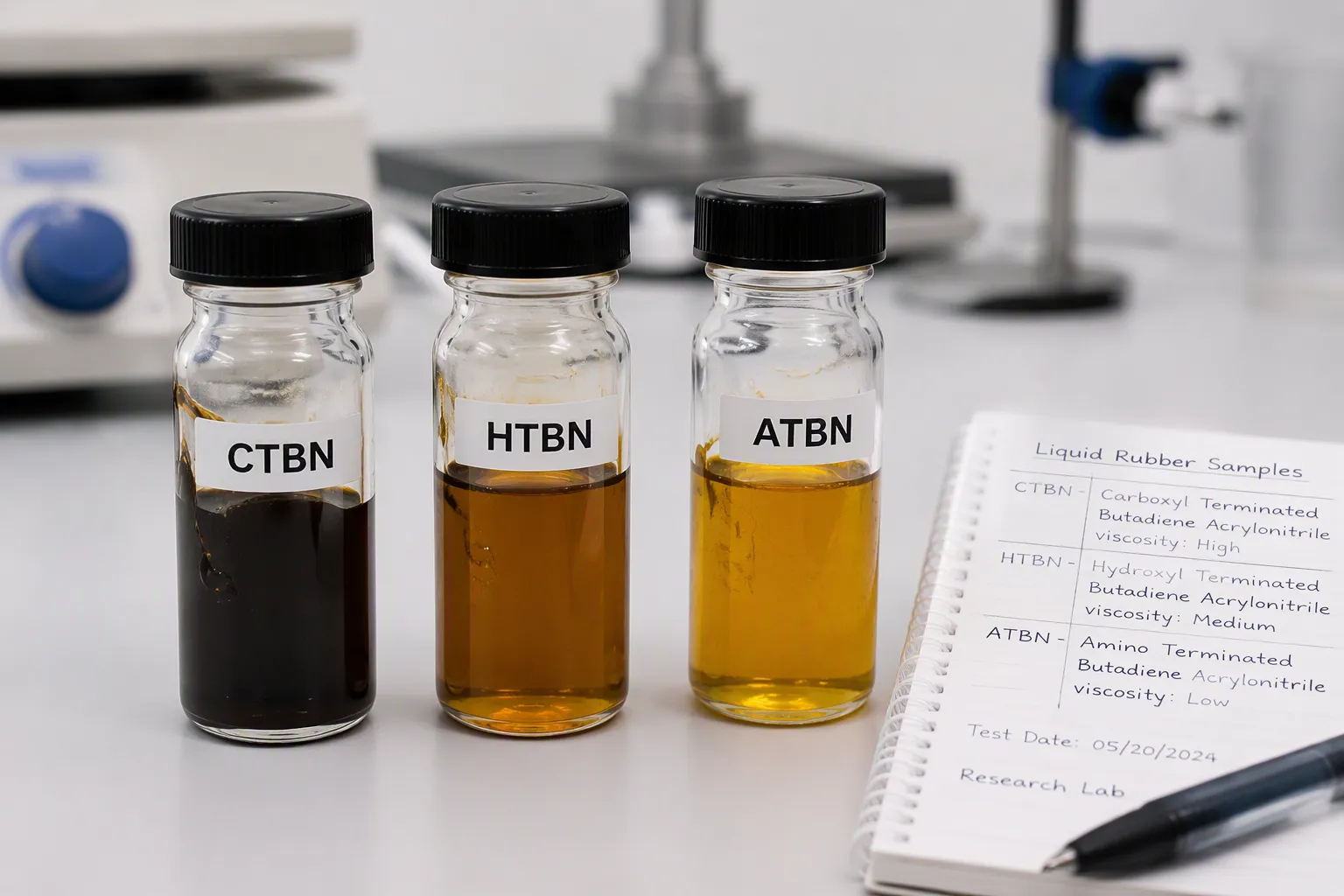
Reactive Liquid Rubbers: CTBN (Carboxy-Terminated Butadiene-Acrylonitrile copolymer) and its siblings are liquid polymers that react into a resin instead of just blending in. The core answer is simple: CTBN toughens epoxy, HTBN adds flexibility to polyurethane, and ATBN boosts adhesion with fast amine cure.
| Rubber Type | Functional Group | Best Partner Resin | Headline Benefit |
|---|---|---|---|
| CTBN | Carboxyl | Epoxy | Toughness |
| HTBN | Hydroxyl | Polyurethane | Flexibility |
| ATBN | Amino | Epoxy | Adhesion and fast cure |
The terminal functional group — carboxyl, hydroxyl, or amino — is the single deciding factor.
Key Takeaways
- CTBN toughens epoxy with carboxyl groups for impact resistance.
- HTBN adds flexibility to polyurethane using hydroxyl ends.
- ATBN boosts adhesion and cures fast with amino groups.
- Match the rubber to your resin and cure chemistry first.
- Start with small batches to test rubber loading levels.
Reactive Liquid Rubbers: CTBN (Carboxy-Terminated Butadiene-Acrylonitrile copolymer) and Its Siblings Explained
What "CTBN" Actually Means
CTBN stands for carboxy-terminated butadiene-acrylonitrile copolymer. This reactive liquid rubber starts with a backbone of butadiene and acrylonitrile units. Carboxyl groups sit at both ends of the polymer chain. Those carboxyl groups drive the chemical reaction with epoxy resin.
The structure of Reactive Liquid Rubbers: CTBN (Carboxy-Terminated Butadiene-Acrylonitrile copolymer) breaks down into clear parts:
| Structural Component | Description |
|---|---|
| Backbone polymer | Random copolymer of 1,3-butadiene and 2-propenenitrile |
| Butadiene repeating unit | –CH₂–CH=CH–CH₂– |
| Acrylonitrile repeating unit | –CH₂–CH(CN)– |
| Terminal functional groups | Carboxyl (–COOH) at both chain ends |
The acrylonitrile content typically ranges from 10% to 40%. This polar nitrile group improves compatibility with epoxy. The carboxyl ends provide the reactive handle.
What "HTBN" Actually Means
HTBN replaces the carboxyl ends with hydroxyl groups. The main chain still consists of butadiene-acrylonitrile units. Hydroxyl groups sit at the ends of the molecular chain. HTBN acts as a telechelic polymer, meaning reactive groups exist at both ends.
This structure makes HTBN a high-performance synthetic polymer and a liquid rubber material. The polar nitrile group (-C≡N) remains along the backbone. HTBN works as the soft segment in polyurethane systems. The hydroxyl ends react with isocyanate groups during cure.
What "ATBN" Actually Means
ATBN swaps the carboxyl ends for amino groups. The butadiene-acrylonitrile backbone stays the same. Amine groups at the chain ends react quickly with epoxy at room temperature. This fast cure makes ATBN useful for adhesives and coatings. The amino termination also improves bonding to many substrates.
Each variant of Reactive Liquid Rubbers: CTBN (Carboxy-Terminated Butadiene-Acrylonitrile copolymer) and its siblings shares the same rubbery backbone. Only the terminal group changes. That single change controls cure speed, compatibility, and final performance.
Why the Functional Group Changes Everything
The terminal functional group determines how the liquid rubber connects to the host resin. Each group targets a different chemical partner. Each group produces a distinct set of final properties.
| Functional Group | Chemical Partner | Primary Reaction | Resulting Property |
|---|---|---|---|
| Carboxyl (–COOH) | Epoxy resin | Carboxyl-epoxy esterification | Toughened epoxy matrix |
| Hydroxyl (–OH) | Isocyanate (NCO) | Urethane formation | Flexible polyurethane |
| Amino (–NH₂) | Epoxy resin | Amine-epoxy addition | Strong adhesion, fast cure |
The carboxyl group reacts with epoxy during high-temperature curing. This reaction creates ester linkages. The rubber becomes part of the epoxy network. The material gains toughness without sacrificing stiffness. Phase separation occurs on a microscopic scale. This process creates tiny rubber domains that stop crack growth.
The hydroxyl group reacts with isocyanates at moderate temperatures. This reaction produces urethane bonds. The rubber becomes a soft segment in the polyurethane chain. The material gains elongation and flexibility. Hard segments provide strength. Soft segments provide flexibility. The two parts work together.
The amino group reacts with epoxy at room temperature. This reaction proceeds quickly. The rubber bonds tightly to the epoxy matrix. It also bonds strongly to many substrates. The material gains adhesion strength and fast cycle times. Manufacturers can cure parts without oven heating.
The butadiene-acrylonitrile backbone stays the same across all three rubbers. That backbone provides flexibility and impact absorption. The terminal group alone controls the cure chemistry. The terminal group alone determines the final application. Selecting the wrong functional group leads to poor reaction. It causes phase separation. It creates weak mechanical properties. The choice determines success or failure. Users must match the functional group to the host resin chemistry first. Everything else comes second.
Head-to-Head Performance Comparison
The three rubbers share one backbone. Their terminal groups differ. That difference drives every performance gap below. This section compares them side by side across the properties that matter most in real formulations.
Toughness and Impact Resistance
CTBN delivers the highest toughness gains in epoxy systems. The carboxyl groups react into the epoxy network during cure. The rubber phase separates into tiny domains. Those domains absorb energy when a crack tries to spread. A typical CTBN loading of 10 to 20 parts per hundred resin can multiply fracture energy several times over. The epoxy keeps its stiffness. It simply stops shattering.
HTBN provides moderate toughness in polyurethane systems. Its hydroxyl ends build into the polymer chain as soft segments. The material stretches under load and recovers. Impact resistance improves through elasticity rather than through phase-separated domains. HTBN excels at flex fatigue and elongation. It does not match CTBN for pure fracture toughness in a rigid matrix.
ATBN sits between the two. Its amino groups react fast with epoxy and form strong interfacial bonds. The rubber domains anchor firmly to the matrix. Impact resistance improves quickly, even at room temperature cure. ATBN often wins in applications where heat curing is not possible. The trade-off is a slightly lower toughness ceiling than CTBN under identical cure conditions.
| Property | CTBN | HTBN | ATBN |
|---|---|---|---|
| Primary toughening mechanism | Phase-separated rubber domains | Soft-segment chain flexibility | Fast-bonded rubber domains |
| Peak toughness in epoxy | Highest | Low to moderate | High |
| Peak flexibility in polyurethane | Low | Highest | Moderate |
| Best cure temperature for toughness | Elevated (150–180°C) | Moderate (60–100°C) | Room temperature to moderate |
Adhesion and Bonding Strength
ATBN leads on adhesion. The amino groups bond aggressively to epoxy and to many substrates. Metals, glass, and polar plastics all form strong bonds with ATBN-modified systems. The fast amine-epoxy reaction creates a tightly crosslinked interphase. That interphase resists peeling and shear. Formulators choose ATBN when bond strength is the top priority.
CTBN improves adhesion modestly. The carboxyl groups react with epoxy and with metal surfaces. The effect is real but slower. CTBN shines more in bulk toughness than in surface bonding. A CTBN-modified adhesive holds up well under impact. It performs less impressively in peel tests against bare metal.
HTBN contributes little direct adhesion in epoxy systems. Its hydroxyl groups target isocyanates instead. In polyurethane adhesives, HTBN improves flexibility at the bond line. That flexibility helps the joint survive movement and thermal cycling. The bond itself depends on the isocyanate partner, not on HTBN alone.
Rule of thumb: pick ATBN when the bond must hold, pick CTBN when the bond must absorb shock, and pick HTBN when the bond must flex.
Heat and Chemical Resistance
CTBN offers the best heat resistance of the three. The carboxyl-epoxy ester linkages stay stable at elevated temperatures. Cured CTBN-epoxy systems routinely withstand continuous service above 120°C. They also resist many oils, fuels, and solvents. The acrylonitrile content adds polarity. That polarity blocks nonpolar chemicals from swelling the rubber phase. Higher acrylonitrile grades resist aromatic and aliphatic hydrocarbons even better.
ATBN performs well at moderate temperatures. The amine-epoxy linkage is strong but less thermally stable than the ester bond. Long exposure above 100°C can degrade ATBN-modified systems. Chemical resistance stays good against water, alcohols, and mild acids. Strong solvents attack the network more easily than they attack CTBN systems.
HTBN depends heavily on its polyurethane host. Polyurethane chemistry limits heat resistance more than the rubber does. Urethane bonds break down at high temperatures. HTBN-based systems typically serve below 100°C. Hydrolytic stability becomes a concern in hot, humid conditions. Formulators add hydrolysis stabilizers to extend service life. Chemical resistance against fuels and oils remains solid at ambient temperatures.
| Property | CTBN | HTBN | ATBN |
|---|---|---|---|
| Continuous service temperature | Above 120°C | Below 100°C | Up to about 100°C |
| Key linkage | Ester | Urethane | Amine-epoxy |
| Oil and fuel resistance | Excellent | Good | Good |
| Hydrolytic stability | Good | Moderate (needs stabilizers) | Good |
| Main weakness | Slow cure | Heat ceiling | Thermal aging |
The pattern is clear. CTBN wins on heat and chemical durability. ATBN wins on adhesion and cure speed. HTBN wins on flexibility inside polyurethane systems. No single grade dominates every column. The next section shows where each rubber earns its place in real applications.
Compatibility with Epoxy, Polyurethane, and More
Compatibility determines whether the liquid rubber disperses evenly or separates into useless pools. Each CTBN, HTBN, and ATBN variant behaves differently across resin systems. The acrylonitrile content in the backbone plays a major role in this behavior. Higher acrylonitrile levels raise the polarity of the rubber. That polarity drives stronger interactions with polar resins.
CTBN and ATBN both target epoxy as their primary partner. The carboxyl and amino ends react directly with epoxy groups. This chemical bonding ensures the rubber integrates into the network. The acrylonitrile segments along the backbone further improve compatibility with epoxy. A typical acrylonitrile content between 10% and 40% provides a good balance. Lower levels give more rubbery flexibility. Higher levels improve polarity and resin mixing.
HTBN works best with polyurethane systems. The hydroxyl ends react with isocyanate groups to form urethane linkages. This reaction builds the rubber directly into the polymer backbone. HTBN also shows good compatibility with other hydroxyl-bearing resins. Formulators use it in polyesters and acrylics where hydroxyl reactivity matters.
Nitrile rubber blends extend beyond these primary pairings. Nitrile rubber can blend with PVC and phenolic resin to improve processing performance, usage performance, and reduce costs. Carboxylated nitrile rubber, which contains acrylonitrile segments that raise polarity, can blend with PVC or phenolic resin to improve processing and physical performance. XNBR is explicitly noted as being compatible with phenolic resin. These blends open additional formulation options beyond the three main resin families.
The acrylonitrile level governs miscibility with PVC in particular. When the ACN content exceeds roughly 40%, the blend shows markedly better miscibility with PVC. Strong polar interactions between the nitrile groups of NBR and the chlorinated polymer chains of PVC promote a more homogeneous phase morphology. NBR/PVC blends typically contain 30–50% PVC resin. Nitrile rubber and PVC resin are described as compatible with each other across this range.
| Rubber Type | Primary Resin Partner | Secondary Compatibility | Key Compatibility Driver |
|---|---|---|---|
| CTBN | Epoxy | Phenolic, PVC (as XNBR) | Carboxyl reactivity, ACN polarity |
| HTBN | Polyurethane | Polyester, acrylic | Hydroxyl reactivity |
| ATBN | Epoxy | Phenolic, PVC (as XNBR) | Amino reactivity, ACN polarity |
ATBN also bonds well to metal and glass substrates. The amino groups interact strongly with surface oxides and hydroxyl groups. This substrate compatibility makes ATBN valuable in adhesives and coatings. CTBN offers moderate substrate bonding through carboxyl groups. HTBN contributes little direct substrate adhesion in epoxy systems. Its strength lies in flexibilizing the polyurethane matrix itself.
Higher acrylonitrile content improves resin compatibility but reduces low-temperature flexibility. Formulators must balance polarity against elasticity for each application.
Viscosity and Processing Behavior
Viscosity controls how easily the liquid rubber mixes, pumps, and flows into molds or bond lines. All three variants share a low viscosity compared to solid rubbers. They pour and pump at room temperature. This liquid form simplifies handling and reduces processing costs. Exact viscosity depends on molecular weight and acrylonitrile content.
CTBN typically ranges from 20,000 to 80,000 centipoise at room temperature. Higher acrylonitrile grades tend to run more viscous. The carboxyl ends react slowly with epoxy at room temperature. Formulators often pre-react CTBN with excess epoxy to form an adduct. This adduct lowers viscosity further and improves storage stability. The adduct then cures with the main epoxy system at elevated temperatures.
HTBN shows similar viscosity ranges to CTBN. Its hydroxyl ends react with isocyanates at moderate temperatures. Pot life depends on the isocyanate reactivity and catalyst level. Formulators control viscosity by adjusting the rubber molecular weight. Lower molecular weight grades flow more easily. Higher molecular weight grades provide better flexibility but thicker consistency.
ATBN offers the lowest viscosity among the three in many commercial grades. The amino ends react quickly with epoxy even at room temperature. This fast reaction shortens pot life significantly. Formulators must mix ATBN and epoxy just before application. They cannot store the combined system for long. The fast cure benefits high-throughput production lines. It challenges formulators who need extended working time.
| Processing Parameter | CTBN | HTBN | ATBN |
|---|---|---|---|
| Typical viscosity range | 20,000–80,000 cP | 20,000–80,000 cP | 10,000–50,000 cP |
| Room-temperature reactivity with epoxy | Slow | None | Fast |
| Pot life after mixing | Long | Not applicable (targets isocyanate) | Short |
| Common processing approach | Pre-react into adduct | Mix with isocyanate at use | Mix and apply immediately |
| Cure temperature for full reaction | 150–180°C | 60–100°C | Room temperature to 100°C |
The acrylonitrile content also affects viscosity. Higher ACN levels increase chain polarity and intermolecular interactions. This raises viscosity slightly. Lower ACN grades flow more freely. Formulators select the grade that balances flow with final properties.
CTBN adducts offer a practical processing advantage. The pre-reaction step converts the liquid rubber into a stable epoxy-based masterbatch. This masterbatch stores for months without separation. End users simply blend it into their epoxy formulation. The adduct approach eliminates the need for high-temperature pre-reaction at the point of use. It also reduces the risk of incomplete rubber incorporation.
HTBN requires different handling. Formulators add it directly to the polyurethane polyol component. The hydroxyl ends remain stable until isocyanate addition. Moisture control becomes critical. Water reacts with isocyanates and creates carbon dioxide bubbles. Proper drying of HTBN and all components prevents foam formation.
ATBN demands the most careful processing. The fast amine-epoxy reaction generates heat. Large batches can exotherm and gel unexpectedly. Formulators use chilled mixing equipment and slow addition rates. They also choose epoxy resins with lower reactivity when extended pot life is necessary. Cycloaliphatic epoxies react more slowly than standard bisphenol-A epoxies. This slower reactivity gives ATBN formulators more working time.
All three rubbers reduce the viscosity of the final formulation compared to solid rubber additives. This viscosity reduction improves wet-out on substrates. It helps the resin penetrate tight bond lines and complex mold geometries. The liquid form also eliminates the need for solvent-based rubber solutions. This reduces volatile organic compound emissions and simplifies environmental compliance.
Where Each Rubber Shines
CTBN for Epoxy Toughening
CTBN excels in epoxy toughening applications. The carboxyl groups react into the epoxy network during elevated-temperature cure. This reaction creates phase-separated rubber domains. Those domains absorb impact energy and stop crack propagation. A formulator typically adds 10 to 20 parts per hundred resin. The epoxy keeps its stiffness and gains significant fracture resistance. Structural adhesives, aerospace composites, and electronic encapsulants all benefit from this chemistry. Reactive Liquid Rubbers: CTBN (Carboxy-Terminated Butadiene-Acrylonitrile copolymer) delivers the highest toughness gains in rigid epoxy systems.
HTBN for Polyurethane Sealants and Elastomers
HTBN serves polyurethane systems as a soft-segment builder. The hydroxyl ends react with isocyanate groups during cure. This reaction forms flexible urethane linkages. The rubber becomes part of the polymer backbone. Sealants made with HTBN stretch and recover under movement. Elastomers gain excellent flex fatigue resistance. Formulators use HTBN in expansion joints, automotive seals, and flexible castings. The material handles thermal cycling without cracking. HTBN works best when flexibility matters more than raw strength.
ATBN for High-Adhesion Coatings and Adhesives
ATBN shines in coatings and adhesives that demand strong bonding. The amino groups react quickly with epoxy at room temperature. This fast cure suits production lines without ovens. ATBN bonds aggressively to metals, glass, and polar plastics. The rubber domains anchor firmly to the matrix and the substrate. Formulators choose ATBN for structural adhesives, protective coatings, and repair compounds. Reactive Liquid Rubbers: CTBN (Carboxy-Terminated Butadiene-Acrylonitrile copolymer) and its siblings each serve distinct roles. ATBN wins when adhesion and cure speed top the priority list.
Overlap Zones: When Two Grades Could Work
The three rubbers do not always occupy separate territory. Some formulations sit in a gray area. Two grades can both deliver acceptable results. The final choice then depends on cure conditions, cost, and supply.
CTBN and ATBN overlap in epoxy toughening. Both react into the epoxy network. Both create phase-separated rubber domains. A formulator without oven access may prefer ATBN. Its amino groups cure at room temperature. A formulator with a heated press may prefer CTBN. Its carboxyl groups give higher fracture toughness after a full elevated-temperature cure. The two grades become nearly interchangeable when the cure schedule allows both reactions to complete.
HTBN and CTBN overlap in hybrid systems. Some formulators build epoxy-polyurethane interpenetrating networks. HTBN flexibilizes the urethane phase. CTBN toughens the epoxy phase. Each rubber targets its own resin. Neither grade replaces the other in this case. They work as a pair.
ATBN and HTBN overlap in flexible adhesives. ATBN bonds strongly to substrates. HTBN stretches under movement. A formulator may blend both to gain adhesion and flexibility at once. The blend ratio controls the balance. Higher ATBN content improves peel strength. Higher HTBN content improves elongation.
| Overlap Scenario | Grade A | Grade B | Deciding Factor |
|---|---|---|---|
| Room-temperature epoxy toughening | CTBN | ATBN | Cure temperature available |
| Hybrid epoxy-urethane network | CTBN | HTBN | Target resin phase |
| Flexible adhesive with strong bonds | ATBN | HTBN | Adhesion versus elongation priority |
Cost and availability also drive substitution. ATBN often costs more than CTBN. HTBN may face longer lead times. A formulator can switch grades when performance targets allow. Testing always confirms the swap. Small-batch trials reveal cure behavior, viscosity shifts, and final mechanical properties. No substitution works without verification.
Overlap zones exist, but they are narrow. Always confirm a grade swap with lab data before scaling up.
How to Choose: A Simple Decision Guide
Selecting the right reactive liquid rubber comes down to three matching exercises. A formulator matches the rubber to the base resin first. Next, they match it to the cure chemistry. Finally, they match it to the performance priority. Each step narrows the field. Together, the three steps point to one clear choice.
Match the Rubber to Your Base Resin
The base resin drives the first decision. Epoxy systems need a rubber that reacts with epoxy groups. Polyurethane systems need a rubber that reacts with isocyanate groups. This chemical pairing determines which rubber can even participate in the cure.
CTBN and ATBN both target epoxy resins. Their carboxyl and amino ends react directly with epoxy groups. This reaction builds the rubber into the crosslinked network. HTBN targets polyurethane systems instead. Its hydroxyl ends react with isocyanate groups to form urethane linkages. A formulator who adds HTBN to a pure epoxy system gets poor results. The hydroxyl groups find no isocyanate partners. The rubber stays unreacted and acts as a weak plasticizer.
Compatibility goes beyond the terminal group. The acrylonitrile content in the backbone affects how well the rubber disperses in the resin. Higher acrylonitrile levels raise polarity. That polarity improves mixing with polar resins like epoxy. Research on bisphenol-A epoxy resins confirms this principle. In one study, a liquid epoxidized nitrile rubber (LENR) showed better compatibility with Epikote 828, a bisphenol-A type epoxy resin, than a standard liquid nitrile rubber (LNR). SEM micrographs revealed the reason:
- The LENR-toughened epoxy had smaller, more evenly distributed rubber particles in the epoxy matrix.
- The LNR-toughened epoxy showed larger, less uniform particles.
- The smaller particle size and better distribution gave LENR-toughened epoxy better mechanical and thermal properties overall.
This finding applies directly to reactive liquid rubber selection. A rubber with better compatibility disperses more finely. Finer dispersion creates more effective toughening. Formulators should check the acrylonitrile content and terminal group against their specific epoxy grade. The same logic applies to polyurethane systems. HTBN with the right molecular weight and hydroxyl value disperses evenly in the polyol component.
| Base Resin | Recommended Rubber | Reason |
|---|---|---|
| Epoxy (bisphenol-A, novolac, cycloaliphatic) | CTBN or ATBN | Carboxyl or amino ends react with epoxy groups |
| Polyurethane (polyether or polyester based) | HTBN | Hydroxyl ends react with isocyanate groups |
| Hybrid epoxy-urethane | CTBN plus HTBN | Each rubber targets its own resin phase |
| Phenolic | CTBN or ATBN (as XNBR) | Carboxyl or amino reactivity with phenolic hydroxyls |
A formulator who works with multiple resin systems should stock more than one rubber grade. CTBN covers epoxy toughening. HTBN covers polyurethane flexibility. ATBN covers fast-cure epoxy adhesion. The base resin eliminates at least one option immediately.
Match the Rubber to Your Cure Chemistry
Cure chemistry determines when and how the rubber reacts. Each terminal group has a different reactivity profile. That profile dictates the cure schedule, the pot life, and the processing equipment.
CTBN reacts slowly with epoxy at room temperature. Full reaction requires elevated temperatures between 150°C and 180°C. This slow reactivity gives formulators long pot life. They can mix large batches and store them for hours. The trade-off is the need for an oven or heated press. CTBN works well in prepregs, molding compounds, and other applications where heat cure is standard. Formulators often pre-react CTBN with excess epoxy to form an adduct. The adduct stores for months and mixes easily into the final formulation.
ATBN reacts quickly with epoxy at room temperature. The amino-epoxy addition proceeds without external heat. This fast reaction shortens pot life dramatically. Mixed batches gel within minutes to hours, depending on the epoxy type and batch size. Formulators must mix ATBN and epoxy just before application. They cannot store the combined system. The fast cure benefits high-throughput production lines. It also enables field repairs and cold-cure adhesives where ovens are impractical. Chilled mixing equipment and slow addition rates help control the exotherm.
HTBN reacts with isocyanates at moderate temperatures between 60°C and 100°C. The reaction proceeds at room temperature as well, but slower. Formulators control the cure speed with catalysts and temperature. Moisture control is critical. Water reacts with isocyanates and creates carbon dioxide bubbles. Proper drying of HTBN and all components prevents foam formation. HTBN offers more flexibility in cure scheduling than ATBN. It offers faster cure than CTBN at lower temperatures.
| Rubber | Cure Temperature | Pot Life After Mixing | Processing Approach |
|---|---|---|---|
| CTBN | 150–180°C | Long (hours to days) | Pre-react into adduct or mix and heat |
| HTBN | 60–100°C | Moderate (controlled by catalyst) | Mix with isocyanate at use |
| ATBN | Room temperature to 100°C | Short (minutes to hours) | Mix and apply immediately |
A formulator without oven access should choose ATBN. A formulator with a heated press should choose CTBN for maximum toughness. A formulator who needs moderate cure temperatures and long pot life should choose HTBN. The cure chemistry narrows the field further.
Match the Rubber to Your Performance Priority
The final decision comes down to the primary performance goal. Each rubber excels in a different area. The formulator must decide which property matters most.
Toughness tops the list for many epoxy applications. CTBN delivers the highest fracture toughness gains in rigid epoxy systems. The carboxyl groups react into the network during elevated-temperature cure. The rubber phase separates into tiny domains. Those domains absorb impact energy and stop crack propagation. A typical loading of 10 to 20 parts per hundred resin can multiply fracture energy several times over. The epoxy keeps its stiffness and gains significant impact resistance. Structural adhesives, aerospace composites, and electronic encapsulants all benefit from this chemistry.
Adhesion and cure speed top the list for other applications. ATBN bonds aggressively to epoxy and to many substrates. The amino groups react quickly at room temperature. This fast cure suits production lines without ovens. ATBN-modified systems bond strongly to metals, glass, and polar plastics. The rubber domains anchor firmly to the matrix and the substrate. Formulators choose ATBN for structural adhesives, protective coatings, and repair compounds. The trade-off is a slightly lower toughness ceiling than CTBN under identical cure conditions.
Flexibility tops the list for polyurethane systems. HTBN serves as a soft-segment builder. The hydroxyl ends react with isocyanate groups during cure. This reaction forms flexible urethane linkages. The rubber becomes part of the polymer backbone. Sealants made with HTBN stretch and recover under movement. Elastomers gain excellent flex fatigue resistance. Formulators use HTBN in expansion joints, automotive seals, and flexible castings. The material handles thermal cycling without cracking. HTBN works best when flexibility matters more than raw strength.
| Performance Priority | Best Rubber | Key Benefit | Typical Application |
|---|---|---|---|
| Maximum toughness in epoxy | CTBN | Highest fracture energy | Aerospace composites, structural adhesives |
| Fast cure and strong adhesion | ATBN | Room-temperature cure, aggressive bonding | Repair compounds, protective coatings |
| Flexibility in polyurethane | HTBN | High elongation, flex fatigue resistance | Sealants, elastomers, expansion joints |
| Balanced toughness and adhesion | CTBN or ATBN | Depends on cure schedule | General-purpose toughened epoxy |
Cost and availability also influence the final choice. ATBN often costs more than CTBN. HTBN may face longer lead times. A formulator can switch grades when performance targets allow. Testing always confirms the swap. Small-batch trials reveal cure behavior, viscosity shifts, and final mechanical properties. No substitution works without verification.
The three matching steps work together. The base resin eliminates incompatible rubbers. The cure chemistry eliminates impractical cure schedules. The performance priority selects the final grade. A formulator who follows these steps reaches a clear decision. Reactive Liquid Rubbers: CTBN (Carboxy-Terminated Butadiene-Acrylonitrile copolymer) and its siblings each serve distinct roles. The right choice depends on the application, not on a universal ranking.
Quick Decision Matrix
The three matching steps converge on one practical tool. A formulator can read the matrix below in seconds. Each row pairs a real-world scenario with the recommended rubber. The matrix removes guesswork from the selection process.
| Application Scenario | Base Resin | Cure Condition | Performance Priority | Recommended Rubber |
|---|---|---|---|---|
| Aerospace composite toughening | Epoxy | 150–180°C oven cure | Maximum fracture toughness | CTBN |
| Electronic encapsulant | Epoxy | Elevated-temperature cure | Toughness plus heat resistance | CTBN |
| Cold-cure structural adhesive | Epoxy | Room temperature | Fast cure and strong bonding | ATBN |
| Field repair compound | Epoxy | Ambient conditions | Adhesion without ovens | ATBN |
| Protective coating for metal | Epoxy | Room temperature to moderate | Substrate bonding | ATBN |
| Polyurethane sealant | Polyurethane | 60–100°C | Flexibility and elongation | HTBN |
| Automotive elastomer | Polyurethane | Moderate heat | Flex fatigue resistance | HTBN |
| Expansion joint filler | Polyurethane | Ambient to moderate | Movement accommodation | HTBN |
| Hybrid epoxy-urethane network | Epoxy plus polyurethane | Staged cure | Balanced toughness and flexibility | CTBN plus HTBN |
| Flexible adhesive with strong bonds | Epoxy or polyurethane | Variable | Adhesion plus elongation | ATBN plus HTBN |
| General-purpose toughened epoxy | Epoxy | Heated press available | Balanced toughness and adhesion | CTBN or ATBN |
| Phenolic composite | Phenolic | Elevated temperature | Toughening and processing | CTBN or ATBN (as XNBR) |
A formulator reads the matrix from left to right. The application scenario identifies the use case. The base resin eliminates incompatible rubbers immediately. The cure condition removes impractical options. The performance priority selects the final grade. The recommended rubber column delivers the answer.
The matrix also reveals patterns. CTBN appears in every row that demands maximum toughness with heat cure. ATBN appears in every row that demands room-temperature cure or strong substrate bonding. HTBN appears in every row that targets polyurethane flexibility. The terminal functional group drives each pattern. Carboxyl groups need heat. Amino groups react fast. Hydroxyl groups build soft segments.
Cost and availability enter the decision after performance. Reactive liquid rubbers carry a higher upfront price than conventional powders. This initial cost difference typically offsets through improved processing, shorter mixing cycles, and increased throughput. Performance additives represent only a small percentage of a formulation's total cost. They contribute to lower overall cycle costs through process improvements and efficiency gains. Powders remain the least expensive raw material option. The cheapest raw material does not always produce the lowest-cost compound. Performance additives earn their place when they deliver clear value. Reduced manufacturing time, improved worker environment, and safer handling of difficult raw materials all count as value.
Reactive liquid rubbers offer additional cost advantages through functional substitution. These products act as reactive plasticizers with much higher molecular weight than conventional plasticizers. They reduce Mooney viscosity and facilitate the mixing process. This improves flowability, increases mixing efficiency, and extends the service life of mixing equipment. Depending on molecular weight, these liquid rubbers can either replace part of the base rubber or replace all or part of the oil in the formulation. High molecular weight grades substitute for base rubber. Low molecular weight grades substitute for oil. These rubbers co-vulcanize with the base rubber. This co-vulcanization prevents migration and improves shelf life and durability. A formulator who can swap a higher-cost or less available rubber or oil component for a reactive liquid rubber gains both processing benefits and performance benefits.
A formulator should weigh several practical factors before finalizing the choice:
- Upfront price versus total cycle cost: reactive liquid rubbers cost more per pound, but they often reduce mixing time and boost throughput.
- Substitution potential: high molecular weight grades can replace part of the base rubber, and low molecular weight grades can replace oil.
- Migration resistance: co-vulcanizable rubbers stay in place and extend shelf life.
- Availability: supply chain reliability matters when production schedules are tight.
- Testing requirements: small-batch trials always confirm a grade swap before scale-up.
The matrix points to a starting grade. Lab data confirms the final choice. Never skip the trial batch.
The matrix works as a screening tool, not a guarantee. Real formulations involve interactions that no table can capture. Epoxy grade, acrylonitrile content, molecular weight, catalyst level, and filler loading all shift the outcome. A formulator uses the matrix to narrow the field to one or two candidates. Small-batch trials then reveal cure behavior, viscosity shifts, and final mechanical properties. The best grade for a specific application emerges from testing, not from a universal ranking.
The decision process stays simple when a formulator follows the sequence. Match the rubber to the base resin first. Match it to the cure chemistry second. Match it to the performance priority third. Check cost and availability last. The matrix captures all four steps in one view. A formulator who internalizes this sequence can select the right reactive liquid rubber for any new project with confidence.
Common Mistakes to Avoid
Using a Non-Reactive Rubber Instead
A formulator sometimes grabs a standard liquid nitrile rubber by mistake. That rubber has no terminal functional groups. It cannot react into the resin network. It simply sits inside the cured matrix as a loose filler. The result is a soft, weak material. The rubber may also migrate to the surface over time. This migration creates oily films and poor paint adhesion. Reactive liquid rubbers solve this problem through chemical bonding. The terminal carboxyl, hydroxyl, or amino groups lock the rubber into the network. A formulator should always check the technical data sheet for the functional group. The label "CTBN," "HTBN," or "ATBN" confirms reactivity. A generic "liquid NBR" label does not.
Ignoring Cure Temperature Limits
Each rubber needs a specific temperature range to react fully. CTBN requires 150°C to 180°C for complete carboxyl-epoxy reaction. A formulator who cures at 80°C leaves most carboxyl groups unreacted. The rubber then acts like a plasticizer instead of a toughener. ATBN reacts at room temperature, so heat is not the issue. The problem with ATBN is the opposite. Excessive heat can degrade the amine-epoxy linkage. HTBN needs 60°C to 100°C for full urethane formation. A formulator should match the cure schedule to the rubber's reactivity profile. Skipping this step wastes material and ruins performance.
Overloading the Formulation
More rubber does not mean more toughness. Every rubber has an optimal loading range. CTBN typically works best at 10 to 20 parts per hundred resin. ATBN performs well at similar levels. HTBN follows its own range based on the polyurethane formulation. A formulator who adds too much rubber creates problems. The rubber phase may become too large and coarse. The glass transition temperature drops. The modulus and heat resistance fall. The material becomes soft and rubbery instead of tough. A formulator should start at the low end of the recommended range. Small-batch trials reveal the best loading level. The data sheet provides a safe starting point.
The rule stays simple. CTBN toughens epoxy, HTBN flexibilizes polyurethane, and ATBN boosts adhesion. The terminal functional group — carboxyl, hydroxyl, or amino — decides everything. Reactive Liquid Rubbers: CTBN (Carboxy-Terminated Butadiene-Acrylonitrile copolymer) and its siblings add toughness without sacrificing the host resin's core strength. A formulator should consult technical data sheets or reach out for formulation-specific guidance before scaling up.
FAQ
What do CTBN, HTBN, and ATBN stand for?
CTBN means carboxy-terminated butadiene-acrylonitrile copolymer. HTBN means hydroxy-terminated butadiene-acrylonitrile copolymer. ATBN means amine-terminated butadiene-acrylonitrile copolymer. All three share the same rubbery backbone. Only the terminal group differs. That group controls the cure chemistry and the final application.
Can a formulator swap one grade for another?
Sometimes, but the swap needs testing. CTBN and ATBN both toughen epoxy, so a heated cure favors CTBN and a room-temperature cure favors ATBN. HTBN targets polyurethane instead. A formulator should always run a small trial batch before scaling up.
How much rubber should a formulation contain?
Most epoxy systems use 10 to 20 parts per hundred resin. HTBN loadings depend on the polyurethane formulation. Too much rubber lowers modulus, heat resistance, and glass transition temperature. A formulator should start at the low end and confirm the best level with lab data.
Does a standard liquid nitrile rubber work the same way?
No. A standard liquid nitrile rubber carries no terminal functional groups. It cannot react into the resin network. It acts as a loose filler and may migrate to the surface. A formulator should check the data sheet for carboxyl, hydroxyl, or amino ends before buying.
How should a formulator store these rubbers?
Store all three grades in sealed containers away from moisture and heat. ATBN demands the most care because amine groups react quickly. HTBN needs dry conditions because water reacts with isocyanates. CTBN adducts store for months and offer the easiest handling.
See Also
Understanding Nozzle Uses For Gardeners Bioprinters And Lubrication Experts
Key Details On WT20 Thoriated Tungsten To Enhance TIG Welding
Eight Top Rated HTN LCD Displays For Performance And Reliability
Simplify AHRI 400/401 Heat Exchanger Troubleshooting Hassle Free
Five Effective Methods For Single Stage Rotary Vane Vacuum Pumps