PTFE cable film basics for everyday cable users
PTFE cable film plays a crucial role in the world of cable insulation. This material offers excellent resistance to heat, chemicals, and electrical stress. Many industries rely on it for safe and reliable cable performance.
- In the electronics sector, high-purity PTFE coatings and films appear in about 30% of cable and wire insulation systems.
- PTFE films and tapes hold the second-largest market share in the PTFE tapes and films market.
Understanding the different types of PTFE cable film helps users make better choices for safety and durability.
PTFE cable film: Definition and Key Properties
Simple Definition of PTFE Cable Film
PTFE cable film refers to a thin, flexible layer made from polytetrafluoroethylene. Manufacturers use this material to insulate wires and cables in a wide range of industries. PTFE cable film stands out for its ability to resist heat, chemicals, and electrical stress. Many cable systems rely on this film to ensure safe and reliable operation, especially in demanding environments such as aerospace, automotive, and industrial settings.
Essential Properties for Cable Insulation
PTFE cable film offers a unique combination of chemical, physical, and mechanical properties that make it ideal for cable insulation. The following table highlights the main characteristics that set this material apart:
| Property | Description |
|---|---|
| Volume Resistivity | High resistance to electrical leakage, making it one of the most effective electrical insulators. |
| Melting Point | Transitions to an amorphous state at ~327°C; stable up to ~260°C in continuous use. |
| Thermal Expansion | Dimensions change with temperature; engineers must account for volumetric shifts. |
| Heat Deflection Temperature | Performs reliably under heat, despite lower mechanical stiffness compared to other plastics. |
| Corrosion Resistance | Immune to oxidation and moisture; does not rust or degrade in harsh environments. |
| Chemical Inertness | Prevents reactions with most industrial solvents and reagents; ideal for handling aggressive chemicals. |
| Stability Under Acids | Strong acids do not break down polymer chains; base solutions do not cause degradation. |
| Electrical Insulation | Insulating properties remain unaffected by temperature, humidity, or frequency; used in cable insulation. |
Engineers often choose PTFE cable film because of its outstanding dielectric strength. The following table compares its performance to other common insulation materials:
| Material | Dielectric Strength | Comparison |
|---|---|---|
| PTFE | High | Outperforms FEP and other materials |
| FEP | Good | Lower than PTFE |
Temperature resistance is another critical factor. PTFE cable film maintains its properties across a wide temperature range, making it suitable for extreme environments:
| Property | Value |
|---|---|
| Maximum Temperature | 260°C |
| Melting Temperature | 327°C |
| Softening Temperature | 267°C |
Mechanical properties also play a vital role in cable performance. The table below summarizes the most important mechanical characteristics:
| Property | Description |
|---|---|
| Tensile Strength | Ranges from 1,000 to 3,000 psi (6.9 to 20.7 MPa), depending on thickness. |
| Elongation | Important for flexibility in cables. |
| Wear Resistance | Improved with fillers like glass, carbon, or bronze. |
| Density | Low density offers a low dielectric constant; high density provides superior electrical and chemical properties. |
| Application | Recommended for heating cables, aircraft, automotive, and military uses. |
Tip: PTFE cable film remains stable and reliable even when exposed to harsh chemicals, high temperatures, and electrical stress. Everyday users benefit from these properties through safer and longer-lasting cables.
Types of PTFE cable film Used in Cable Insulation
Skived PTFE Cable Film
Skived PTFE cable film is produced by slicing thin layers from a solid PTFE block. This process creates a film with excellent surface quality and uniform thickness. Skived PTFE cable film offers a wide range of thickness options, making it suitable for various insulation needs.
- Thickness ranges from 0.001" (0.025 mm) to 0.060" (1.5 mm).
- Provides electrical insulation for components and assemblies.
- Used in high-temperature wire harness insulation.
- Acts as an abrasion and vibration barrier.
- Serves in composite layup and mold release applications.
- Functions as thermal insulation and gasketing.
- Supports masking, wrapping, and process protection.
Engineers value skived PTFE cable film for its conformability and high dielectric properties. It protects sensitive components and ensures clean release in demanding production environments. Its chemical resistance makes it a reliable choice for harsh industrial settings.
Tip: Skived PTFE cable film adapts well to irregular surfaces, making it ideal for wrapping and protecting complex cable assemblies.
Extruded PTFE Cable Film
Extruded PTFE cable film is manufactured by forcing PTFE through a die, resulting in a continuous, seamless film. This method produces a material with consistent thickness and exceptional purity. Extruded PTFE cable film is widely used in high-frequency and data transmission cables.
- Acts as an excellent electrical insulator.
- Maintains a low dielectric constant (2.3-2.1).
- Exhibits a low loss factor and high dielectric strength.
- Remains stable with minimal impact from temperature changes.
- Absorbs very little moisture.
- Resists chemicals and solvents.
- Delivers consistent electrical properties over time.
Extruded PTFE cable film supports applications that demand stable signal transmission and minimal interference. Its uniformity and electrical performance make it a preferred choice for coaxial cables, RF cables, and other high-frequency wiring systems.
Note: Extruded PTFE cable film ensures reliable insulation in environments where signal integrity is critical.
Expanded PTFE Cable Film
Expanded PTFE cable film, also known as ePTFE, is created by mechanically stretching PTFE. This process forms a micro-porous structure that combines flexibility, strength, and thermal stability. Expanded PTFE cable film stands out for its enhanced flexibility compared to other insulation materials.
Expanded PTFE cable film adapts easily to cable movements and bends without cracking or losing its insulating properties. Its unique structure allows it to maintain performance in both static and dynamic cable applications. The film also provides excellent resistance to chemicals and extreme temperatures, making it suitable for challenging environments.
Callout: Expanded PTFE cable film is often used as cable insulation tape or membrane, offering superior flexibility and durability for wires and cables that require frequent movement or bending.
Comparing PTFE cable film Types
Differences in Performance and Application
PTFE cable film types each bring unique strengths to cable insulation. Their performance varies based on electrical, thermal, and mechanical properties.
- Skived PTFE films deliver high dielectric strength, reaching up to 100 KV/mm. These films prevent short-circuiting in electrical components and suit high-voltage applications.
- All PTFE films maintain a low dielectric constant (2.3-2.1) across a broad frequency and temperature range. This property ensures stable insulation for transformers, capacitors, and power cables.
- Expanded PTFE (ePTFE) films further reduce the dielectric constant. This feature enhances performance in data transmission cables by minimizing signal loss.
- PTFE materials resist moisture and humidity. Their electrical properties remain stable until the glass transition temperature, making them reliable in environments with fluctuating conditions.
- PTFE cable film withstands extreme temperatures, operating from -200°C to 260°C. It tolerates short-term exposure up to 300°C. This thermal stability supports use in aerospace and other high-temperature settings.
Note: PTFE cable films also offer excellent chemical stability, flame retardancy, and low water absorption, which contribute to their popularity in demanding industries.
Best Uses for Each PTFE Cable Film Type
Selecting the right PTFE cable film type depends on the specific application. The table below summarizes recommended uses based on industry standards:
| PTFE Film Type | Recommended Applications |
|---|---|
| Skived PTFE Cable Film | High-voltage insulation, electrical protection |
| Extruded PTFE Cable Film | Data transmission, RF and coaxial cables |
| Expanded PTFE (ePTFE) Cable Film | Flexible cable insulation, dynamic cable systems |
| PTFE Film For Aerospace Cable | Aerospace and high-temperature environments |
| PTFE Wrapping Film For Electrical Cable | Electrical insulation and process protection |
Engineers often choose skived PTFE films for high-voltage and protective insulation. Extruded PTFE films excel in applications that require consistent electrical performance, such as RF and data cables. Expanded PTFE films provide flexibility and durability for cables that move or bend frequently. PTFE cable film remains a top choice for environments that demand reliability, safety, and long service life.
Why PTFE cable film Type Matters for Everyday Cable Users
Impact on Cable Performance and Safety
The type of PTFE cable film selected for cable insulation directly affects both performance and safety. Everyday users depend on cables that deliver consistent electrical insulation and protect against hazards. Safety certifications help ensure that cables meet strict industry standards. The following table lists common certifications found on cables using PTFE insulation:
| Certification | Description |
|---|---|
| ISO 9001 | Quality management system standard |
| RoHS | Restriction of hazardous substances |
| REACH | Registration, Evaluation, Authorisation and Restriction of Chemicals |
| UL | Underwriters Laboratories safety certification |
| WRAS | Water Regulations Advisory Scheme |
| DVGW | German Technical and Scientific Association for Gas and Water |
| ACS | Health Compliance Certificate |
Cables with these certifications provide assurance of quality, environmental compliance, and user safety. PTFE cable film types with high dielectric strength and chemical resistance help prevent electrical failures and reduce the risk of fire or toxic exposure. Users benefit from reliable insulation, especially in environments with temperature swings or exposure to chemicals.
Durability and Longevity in Daily Use
Durability remains a key factor for everyday cable users. The right PTFE cable film type extends the lifespan of cables, reducing the need for frequent replacements. Several factors influence durability, as shown in the table below:
| Factor | Description |
|---|---|
| Operating conditions | Temperature, pressure, speed, load, and media encountered by the PTFE product. |
| Desired properties | Key properties needed for the application, such as chemical resistance and mechanical strength. |
| Chemical resistance | PTFE's resistance to most chemicals, with some fillers affecting compatibility. |
| Mechanical strength | Virgin PTFE's softness can be enhanced with fillers for better strength and wear resistance. |
| Wear resistance | Filled PTFE grades are preferred in applications requiring improved wear resistance. |
| Frictional properties | Low coefficient of friction is advantageous for non-stick applications. |
| Electrical properties | Excellent electrical insulation properties, including high dielectric strength. |
| Dimensional stability | Impact of PTFE grade and manufacturing on stability under varying conditions. |
| Biocompatibility | Virgin and ePTFE are non-toxic and suitable for food, pharmaceutical, and medical applications. |
Cables insulated with PTFE materials often outperform those with conventional insulation. The chart below compares tensile strength, dielectric breakdown voltage, and abrasion resistance for different cable types:
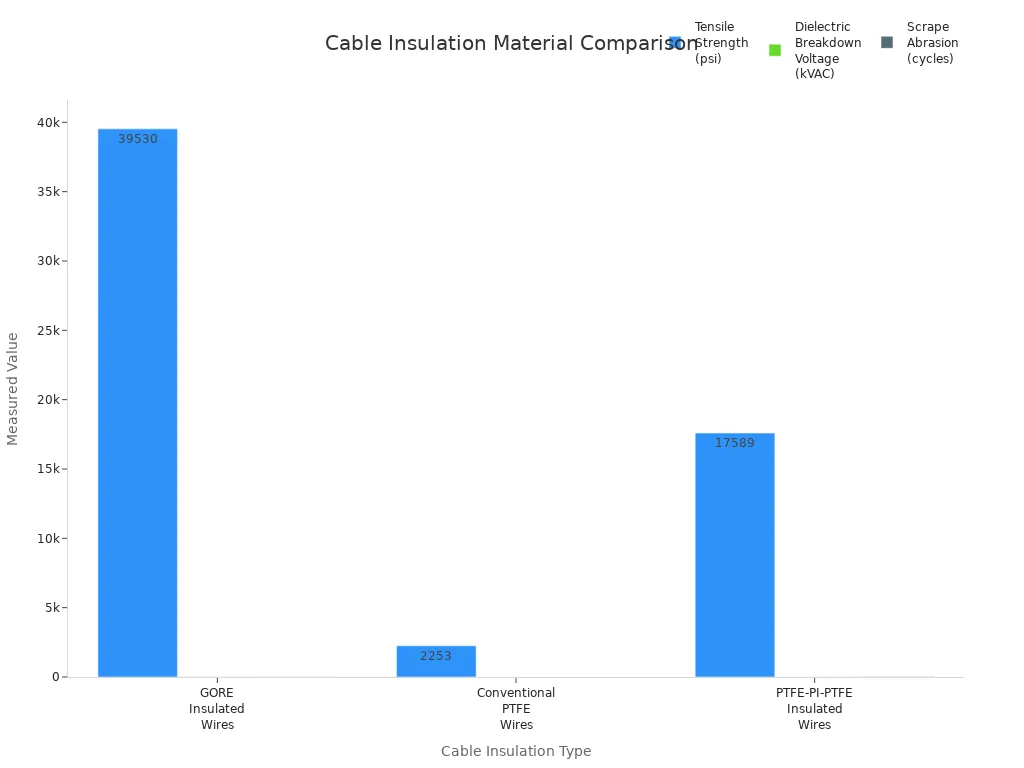
This data shows that PTFE-insulated cables offer higher mechanical strength and better electrical protection. Users experience fewer cable failures and longer service life, even in demanding conditions. Choosing the right PTFE cable film type ensures cables remain safe, reliable, and cost-effective for everyday applications.
PTFE cable film offers unique advantages for cable insulation. Everyday users benefit from its low dielectric constant, flexibility, and chemical stability.
- Minimizes signal loss in high-frequency applications
- Maintains durability in harsh environments
- Withstands extreme temperatures
- Resists corrosive substances
Selecting the correct PTFE film type ensures optimal performance and safety. The table below highlights key characteristics and uses:
| PTFE Film Type | Characteristics | Applications |
|---|---|---|
| Low Density | Light, flexible, flame retardant | Data, military, medical cables |
| High Density | Superior electrical and chemical properties | Heating, aircraft, automotive cables |
| Skived | Heat, chemical, and dielectric resistance | Industrial and electrical insulation |
Users should specify PTFE tape accurately, consider cable flex life, and choose designs that match their application needs. This approach helps prevent failures and extends cable lifespan.
FAQ
What makes PTFE cable film different from other insulation materials?
PTFE cable film offers high dielectric strength, chemical resistance, and thermal stability. These properties set it apart from common plastics. Engineers often select PTFE for cables that must perform in harsh or demanding environments.
Can expanded PTFE cable film handle frequent cable movement?
Yes. Expanded PTFE cable film features a micro-porous structure. This design provides flexibility and durability. Cables insulated with expanded PTFE resist cracking and maintain performance during repeated bending.
Is PTFE cable film safe for use in household electronics?
PTFE cable film meets strict safety standards. Manufacturers use it in many household and industrial cables. Its non-reactive nature and high-temperature resistance help prevent electrical hazards.
How does PTFE cable film affect cable lifespan?
PTFE cable film increases cable longevity. Its resistance to heat, chemicals, and abrasion reduces wear. Users experience fewer cable failures and enjoy longer service life.
Where can users find PTFE-insulated cables?
Many electronics and hardware suppliers offer PTFE-insulated cables. Users should check product specifications for PTFE insulation or ask suppliers directly. Look for certifications to ensure quality and safety.
See Also
Money-Saving Insights About Pressure Plates You Should Know
Best Precoating Options for Filtration Systems This Year
Essential WT20 Thoriated Tungsten Electrode Tips for TIG Welding