3 Ways PHE Plates Improve System Performance in 2025
Phe plate technology advances drive remarkable gains in energy efficiency, reliability, and adaptability for industrial systems. The global market for plate heat exchangers will reach USD 4,509.7 million in 2025. Innovative heat transfer designs and smart controls help facilities cut energy costs, optimize efficiency, and prepare for evolving operational demands.
Enhanced Thermal Efficiency with PHE Plate Technology
Advanced Plate Designs for Superior Heat Transfer
Recent years have seen remarkable innovation in plate heat exchanger design. Engineers now use advanced profile designs, surface roughness enhancements, and fins to boost heat transfer efficiency. Capsule-type embossing, for example, achieves a high Nusselt number while keeping friction low. Novel gasket modifications can enhance heat transfer by up to 75%. The table below highlights several advancements and their impact on high heat transfer efficiency:
| Advancement Type | Impact on Heat Transfer Efficiency |
|---|---|
| Rib Design Modifications | Increased heat transfer coefficient by over 4% and heat transfer area by 11% |
| Surface Roughness | 4.46–17.95% rise in heat transfer coefficient |
| Baffle Integration | Induces turbulence, enhancing thermal performance |
| Novel Gasket Design | Increased Nusselt number by up to 70% |
These improvements ensure that plate heat exchangers deliver superior heat transfer efficiency and support high heat transfer efficiency in demanding applications.
Lower Energy Consumption and Cost Reduction
Modern plate heat exchanger technology delivers significant energy savings. Advanced designs can reduce energy consumption by up to 30% compared to traditional models. Some configurations achieve a 40% reduction in pressure drop and up to 55% lower energy costs. Facilities benefit from lower operational expenses and improved efficiency. Enhanced fluid flow and optimized heat transfer allow systems to maintain peak performance while minimizing waste.
Sustainability Benefits in Modern Applications
Plate heat exchangers play a vital role in energy efficiency and sustainability. They recover waste heat from industrial processes, reducing greenhouse gas emissions and supporting waste heat recovery. Their compact design uses fewer materials, lowering environmental impact. In renewable energy systems, plate heat exchangers optimize solar thermal and geothermal applications. Their durability and ease of maintenance extend operational life, further supporting sustainability goals.
Improved Maintenance and Longevity of PHE Plate Systems
Simplified Cleaning and Reduced Fouling
Phe plate systems deliver easy maintenance and superior operational reliability. Their design enables quick dismantling for inspection and cleaning, which streamlines upkeep. The modular structure allows technicians to access individual plates without removing the entire unit. Facilities experience reduced fouling, with rates five to twenty times lower than shell-and-tube heat exchangers. This advantage extends cleaning intervals and minimizes downtime.
- Phe plate systems can be dismantled easily for cleaning and inspection.
- Shell-and-tube exchangers require more effort to clean, especially on the shell side.
- High-quality phe plate units operate efficiently for up to ten years without maintenance.
Extended System Lifespan and Reliability
Phe plate technology supports long-term durability and consistent performance. Most units achieve a service life of fifteen to twenty years, which exceeds many alternative heat exchanger types. At the end of their operational life, metal components can be recycled, contributing to sustainability and waste heat recovery efforts. Reliability metrics highlight enhanced stability and reduced risk of unexpected failures, which minimizes production disruptions. The choice of plate material ensures corrosion resistance and withstands high pressure and elevated temperatures. Predictive maintenance technologies use advanced analytics to forecast potential failures, improving energy management and operational efficiency.
Lower Operational and Maintenance Costs
Facilities benefit from lower operational and maintenance costs with phe plate systems. The table below summarizes key advantages:
| Maintenance Benefit | Description |
|---|---|
| Lower Maintenance Frequency | Reduced fouling leads to longer intervals between cleaning, minimizing downtime and labor costs. |
| Accessibility | Easy access to plates for inspection and cleaning reduces maintenance time and associated costs. |
| Cost-effective Repairs | Ability to replace individual plates rather than entire units results in lower repair costs. |
Superior heat transfer capabilities and optimized fluid flow reduce operational costs. Anti-fouling strategies and modular design allow for easy system modifications, supporting innovation and efficiency. Maintenance costs remain lower compared to shell-and-tube exchangers, while easy access for inspection and cleaning reduces labor expenses. Individual plate replacement ensures cost-effective repairs and supports long-term energy efficiency and thermal efficiency.
Flexibility and Scalability of PHE Plate Solutions
Easy System Expansion and Adaptation
PHE plate solutions offer unmatched adaptability for evolving industrial requirements. Their modular design enables quick assembly, disassembly, and reconfiguration, allowing facilities to scale capacity as needed. Customizable configurations accommodate different fluid types and operational demands, while easier maintenance and cleaning enhance overall system adaptability. The following table summarizes these features and their benefits:
| Feature | Benefit |
|---|---|
| Modular Design | Enables quick assembly, disassembly, and reconfiguration to meet varying capacity needs. |
| Customizable Configurations | Accommodates different fluid types and operational requirements. |
| Easier Maintenance and Cleaning | Facilitates maintenance operations, enhancing overall system adaptability. |
Case studies highlight the scalability of PHE plate systems in large-scale projects. Marine lubricating oil coolers demonstrate cleaning efficiency in high-temperature environments. Central coolers show improved maintenance and operational efficiency. Water generators benefit from non-disassembled internal cleaning methods. Marine boiler and fuel oil systems emphasize the importance of regular maintenance and specialized cleaning agents.
Integration with Smart Controls and Automation
Modern facilities rely on advanced technology for optimal performance. PHE plate systems integrate seamlessly with smart controls and automation, leveraging Industry 4.0 innovations. Smart sensors and IoT devices monitor critical parameters such as temperature and pressure in real time. Machine learning algorithms analyze this data, enabling predictive maintenance and operational optimization. Digital twin technology simulates and optimizes PHE designs, while advanced control systems automatically adjust parameters to maintain peak heat transfer and thermal regulation.
Tip: Incorporating advanced sensors and monitoring devices enables real-time performance monitoring, supporting predictive maintenance and automated optimization of operating parameters.
Customization for Diverse Industrial Applications
Industries require tailored solutions to meet unique operational challenges. PHE plate systems provide extensive customization options, ensuring compatibility and optimal performance across sectors. The table below outlines key customization features:
| Customization Option | Description |
|---|---|
| Multi-Section Design | Allows sectioning into multiple compartments for various heat transfer processes. |
| Tailored Materials | Customizable materials suit specific fluid properties and temperature requirements. |
| Flexible Plate Patterns | Different plate patterns optimize heat transfer efficiency. |
| Custom Flow Configurations | Adaptable flow configurations meet unique operational needs. |
| Sealing Solutions | Various sealing options enhance performance and reliability in different environments. |
In food processing, PHE plate systems ensure efficient heat transfer for heating, cooling, pasteurization, and sterilization. Their compact design allows easy installation and cleaning, supporting food safety standards. Pharmaceutical applications depend on precise temperature control and hygiene, with PHE plate technology supporting fermentation, API synthesis, and sterilization. The HVAC sector benefits from superior heat transfer efficiency and compact design, meeting the growing demand for energy-efficient temperature control in commercial and industrial settings.
SHPHE Plate Heat Exchanger: Leading Performance Example
Key Features of SHPHE Plate Heat Exchangers
Shanghai Heat Transfer Equipment Co., Ltd. delivers plate heat exchanger solutions that set industry benchmarks. Their brazed plate heat exchanger models incorporate several advanced features:
- Efficient heat transfer through counter-current flow, maximizing thermal exchange.
- Space-saving compact design, reducing installation costs and freeing up valuable facility space.
- Fast response to temperature and flow changes due to low fluid hold-up volume.
- Hygienic construction, meeting strict food industry standards for cleanliness and safety.
- Material advancements, enabling resistance to higher temperatures and pressures.
- Tighter temperature control, supporting precise process management.
- Reduced equipment sizes, lowering both installation and operational costs.
- Improved product yields, enhancing overall efficiency in demanding environments.
These features position SHPHE plate heat exchanger technology as a preferred choice for facilities seeking reliability and performance.
Performance Advantages in Demanding Environments
SHPHE brazed plate heat exchanger units excel in high-demand settings. Their technology consistently outperforms competitors across critical metrics:
| Metric | Improvement |
|---|---|
| Heat exchange rate | 28% better |
| Effectiveness | 6.75% improvement |
| NTU | 17.3% increase |
| Biot number | 35.3% increase |
| Pressure drop | 32.1% reduction |
| Je improvement | 61% increase |
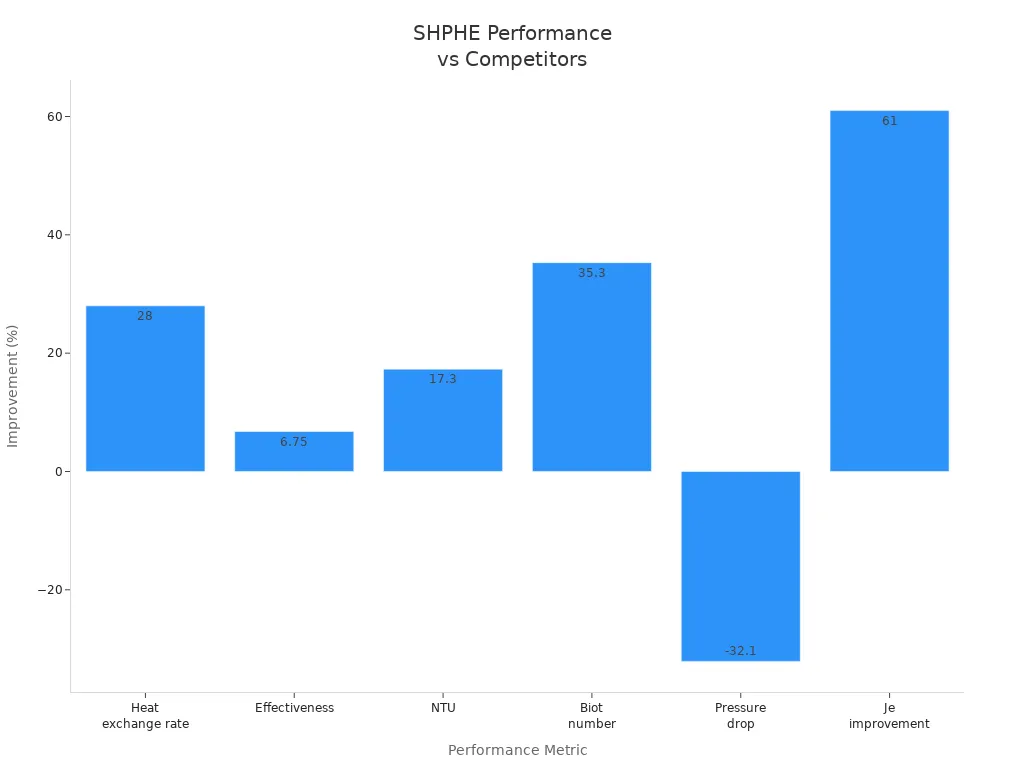
Facilities benefit from higher heat exchange rates, lower pressure drops, and greater overall system efficiency. These improvements support reliable operation in oil, gas, chemical, and power generation sectors.
Application Scenarios Across Industries
SHPHE plate heat exchanger solutions serve a wide range of industries. The following table highlights common application scenarios:
| Sector | Application Scenarios |
|---|---|
| HVAC Systems | Transferring heat between chilled water and conditioned air; recovering waste heat; isolating fluid circuits. |
| Food and Beverage Industry | Pasteurizing milk, juices, beer; rapid heating or cooling to preserve quality and shelf life. |
| Solar Thermal Energy Systems | Transferring heat from solar collectors to water tanks; isolating glycol-based fluids from potable water. |
| Chemical Processing Industry | Cooling or heating chemical fluids; supporting reaction processes with temperature control. |
| Oil, Gas, and Power Generation | Cooling turbine lubricants; cooling condensate water; heat recovery from process streams. |
SHPHE brazed plate heat exchanger technology adapts to diverse operational needs, supporting efficiency and reliability in every sector.
Facilities in 2025 benefit from PHE plates through enhanced efficiency, reliability, and adaptability. The table below highlights these impacts:
| Aspect | Impact |
|---|---|
| Efficiency | PFHEs deliver high thermal efficiency and compact design. |
| Reliability | Consistent heat transfer supports precise process control. |
| Adaptability | Modular nature enables easy integration and customization. |
Industry experts recommend:
- Properly size the PHE for optimal performance.
- Design for efficient heat transfer with acceptable pressure drop.
Efficient heat exchange systems from SHPHE future-proof operations in rapidly evolving industries.
FAQ
What industries benefit most from SHPHE plate heat exchangers?
SHPHE plate heat exchangers serve oil and gas, chemical, food processing, metallurgy, new energy, and environmental protection sectors. Facilities in these industries achieve higher efficiency and reliability.
How does the 'Smart Eye' digital monitoring system improve maintenance?
| Feature | Benefit |
|---|---|
| Real-time data | Enables predictive maintenance |
| AI analytics | Reduces downtime |
The system monitors performance and alerts technicians to potential issues.
Can SHPHE plate heat exchangers be customized for specific applications?
SHPHE offers tailored designs, materials, and flow configurations. Facilities select options that match their operational requirements and industry standards. Customization ensures optimal performance.