Essential Factors for Picking Offshore Heat Exchangers in Marine Applications
Selecting an offshore heat exchanger for marine engineering can present serious challenges. Marine power systems face harsh conditions, so the right heat exchanger must handle seawater cooling, main engine cooling, and other critical marine cooling systems. Durability and efficient thermal energy transfer play a key role in the selection process. Readers must consider environmental exposure, operational reliability, and compliance with regulations during selection. Advanced solutions like the Printed Circuit Heat Exchanger from Shanghai Plate Heat Exchanger offer compact size and high performance for these demanding needs.
Offshore Heat Exchanger Challenges
Corrosion and Saltwater Effects
Marine heat exchangers face constant exposure to seawater, which creates a harsh environment for metals. Saltwater contains chloride ions that attack metal surfaces, making corrosion resistance a top priority. The table below shows the most common corrosion mechanisms that affect marine heat exchangers:
Corrosion Mechanism | Description |
|---|---|
Pitting Corrosion | Localized pits or holes caused by chloride ions, leading to rapid material failure. |
Crevice Corrosion | Occurs in confined spaces, leading to severe localized corrosion that is difficult to detect. |
Galvanic Corrosion | Results from dissimilar metals in contact, causing accelerated corrosion of the anodic metal. |
Stress Corrosion Cracking (SCC) | Cracks form due to tensile stress and corrosive environments, especially in high-pressure systems. |
Erosion-Corrosion | Caused by mechanical erosion combined with chemical corrosion, common in high-velocity fluid areas. |
Seawater can quickly damage unprotected surfaces. Marine heat exchangers must use materials and designs that provide strong corrosion resistance. Advanced solutions, such as the Printed Circuit Heat Exchanger from Shanghai Plate Heat Exchanger, offer excellent protection and long service life in these conditions.
Fouling and Biofouling
Fouling and biofouling are major threats to thermal management in marine heat exchangers. Seawater carries particles, organic matter, and living organisms that can stick to heat exchanger surfaces. This buildup reduces heat transfer and can block flow channels. The table below explains the main sources of fouling and their impact on efficiency:
Source of Fouling | Impact on Efficiency |
|---|---|
Turbid or polluted water | Accelerates biofouling, reducing efficiency by 20-50% |
Cleaner, oxygenated seawater | Supports stable oxide films on Cu-Ni surfaces |
Deposits | Insulate surfaces, increasing thermal resistance and dropping heat transfer by up to 40% |
Regular cleaning and smart design help control fouling. Marine heat exchangers with smooth surfaces and compact layouts, like those from Shanghai Plate Heat Exchanger, make maintenance easier and improve thermal management.
Vibration and Mechanical Stress
Vibration and mechanical stress can cause serious problems for marine heat exchangers. Ships and offshore platforms create constant movement. Flow-induced vibration, mechanical equipment vibration, acoustic resonance, and thermal expansion all add to the stress. About 25% of heat exchanger failures link to vibration damage. In 1985, a petrochemical facility suffered a major failure because of unaddressed vibration issues. Strong construction and careful installation help reduce these risks and keep thermal management systems reliable.
Temperature and Pressure Extremes
Marine heat exchangers must handle wide temperature swings and high pressures. Seawater temperature can change quickly, and power systems often run at high pressure. These extremes test the limits of materials and design. Only heat exchangers with high corrosion resistance and robust construction can survive in these conditions. The Printed Circuit Heat Exchanger from Shanghai Plate Heat Exchanger stands out for its ability to manage these challenges, making engineering safer and more efficient.
Types of Marine Heat Exchangers
Shell and Tube Designs
Shell and tube designs have served as the backbone of marine heat exchangers for decades. These units use a bundle of tubes inside a cylindrical shell. Hot and cold fluids flow through separate channels, allowing heat to transfer between them. Many engineers choose this type for its robust construction and ability to handle high pressures and temperatures. However, these heat exchangers often require more space and weigh more than other options. Maintenance can be challenging because technicians must extract tube bundles for cleaning or repairs.
Feature | Plate Heat Exchanger (PHE) | Shell-and-Tube Heat Exchanger (STHE) |
|---|---|---|
Design | Compact, uses corrugated plates for heat transfer | Larger, uses tubes within a cylindrical shell |
Space Requirements | Requires less space, ideal for constrained areas | Bulkier, may not fit well in limited spaces |
Operational Efficiency | High turbulence, large heat transfer coefficients | More robust, less efficient in terms of footprint |
Maintenance | Easier to clean and replace plates | More labor-intensive, requires tube bundle extraction |
Application in Marine Use | Suitable for modern ships with space constraints | Traditional design, better for high pressure/temperature services |
Plate Heat Exchangers
Plate heat exchangers have become popular in marine applications that demand compactness and efficiency. These units use a series of thin, corrugated plates to create multiple channels for fluid flow. The design increases turbulence, which boosts heat transfer rates. Plate type marine heat exchangers require less space and allow for easier maintenance. Technicians can remove and clean individual plates without dismantling the entire unit. This feature makes them ideal for ships with limited room and strict maintenance schedules.
Printed Circuit Heat Exchanger (PCHE)
Shanghai Plate Heat Exchanger offers the Printed Circuit Heat Exchanger as an advanced solution for offshore and marine use. The PCHE uses chemically etched microchannels in stacked metal plates, creating a structure that is both compact and highly efficient. This technology supports operations at extreme temperatures and pressures. The PCHE can achieve up to 98% heat transfer efficiency and occupies up to 85% less space than traditional shell and tube designs. Its lightweight construction reduces installation and operational costs. The robust, leak-proof design ensures long-term reliability in harsh marine environments.
Feature | Printed Circuit Heat Exchangers (PCHEs) | Traditional Shell and Tube Designs |
|---|---|---|
Footprint | Up to 85% smaller | Larger |
Weight | Significantly lighter | Heavier |
Installation Costs | Lower | Higher |
Operational Costs | Lower | Higher |
Safety | Improved | Standard |
Compact Solutions for Marine Power Systems
Modern marine power systems rely on compact marine heat exchangers to maximize space and efficiency. These solutions help maintain fuel efficiency, reduce emissions, and extend equipment life. Plate and PCHE designs stand out for their ability to deliver high performance in tight spaces. Shanghai Plate Heat Exchanger’s PCHE technology provides a reliable and efficient answer for operators who need advanced thermal management in challenging offshore environments.
Marine plate heat exchangers optimize heat transfer and space efficiency.
These exchangers support emission reduction and longer equipment lifespan.
Compact designs are essential for modern marine operations.
Material Selection for Durability
Stainless Steel and Nickel Alloys
Marine heat exchangers must withstand harsh conditions. Stainless steel and nickel alloys offer strong protection against corrosion from seawater and freshwater. Stainless steel provides moderate to high resistance, making it suitable for many marine applications. Nickel alloys perform better in highly corrosive environments, especially where seawater exposure is constant. The table below compares these materials:
Material Type | Corrosion Resistance | Cost Considerations |
|---|---|---|
Stainless Steel | Moderate to high | Generally more affordable |
Nickel Alloys | Superior in highly corrosive | Higher initial costs but lower lifecycle costs due to reduced maintenance and longer service life |
Shanghai Plate Heat Exchanger uses these materials in its Printed Circuit Heat Exchanger. This choice ensures durability and reliability for both seawater and freshwater cooling systems.
Coatings and Surface Treatments
Coatings and surface treatments extend the service life of marine heat exchangers. They protect against corrosion from seawater and freshwater. The coating process includes surface preparation, application of protective layers, and quality checks. Effective coatings provide advanced corrosion resistance, enhance material durability, improve performance under extreme conditions, and offer cost-effective maintenance.
Advanced Corrosion Resistance
Enhanced Material Durability
Improved Performance Under Extreme Conditions
Cost-Effective Maintenance
Common coatings include:
Epoxy Coatings: Excellent chemical resistance.
Polyurethane Coatings: Flexible and durable.
Phenolic Coatings: Suitable for aggressive environments.
Ceramic Coatings: For high protection needs.
Shanghai Plate Heat Exchanger applies these treatments to its Printed Circuit Heat Exchanger, ensuring long-term operation in both seawater and freshwater cooling systems.
Balancing Cost and Longevity
Choosing the right material involves balancing cost and longevity. Carbon steel costs less upfront but needs frequent maintenance in seawater and freshwater environments. Stainless steel (316) has a higher initial cost but offers excellent resistance to chloride corrosion, making it ideal for marine and freshwater cooling. Titanium costs the most but saves money over time due to its exceptional resistance to seawater. Non-metallics work well in low-temperature and low-pressure freshwater applications.
Material Type | Cost Implication | Corrosion Resistance | Typical Applications |
|---|---|---|---|
Carbon Steel | Economical upfront, higher long-term costs | Prone to rust without coatings | Non-corrosive environments like HVAC |
Stainless Steel (316) | Higher initial cost, lower maintenance | Excellent resistance to chloride corrosion | Food processing, pharmaceuticals, marine |
Titanium | High initial cost, significant long-term savings | Exceptionally resistant to seawater | Offshore platforms, desalination plants |
Non-Metallics | Lower cost, limited applications | Ideal for highly corrosive environments | Low-temperature and low-pressure applications |
Tip: Investing in premium materials and coatings reduces maintenance and extends the life of marine heat exchangers. Shanghai Plate Heat Exchanger’s Printed Circuit Heat Exchanger offers a smart solution for operators who need reliable performance in both seawater and freshwater cooling systems.
Performance and Maintenance
Heat Duty and Efficiency
Marine heat exchangers must deliver strong heat duty and high efficiency to keep ship systems running smoothly. Engineers use several key metrics to measure heat exchanger efficiency and thermal performance. These metrics help operators choose the right equipment for demanding marine environments.
Metric | Value |
|---|---|
Capacity Ratio | 94% |
Effectiveness | 85.5% |
Heat Duty | 88% |
Log Mean Temperature Difference | 88.7% |
Overall Heat Transfer Coefficient | 71% |
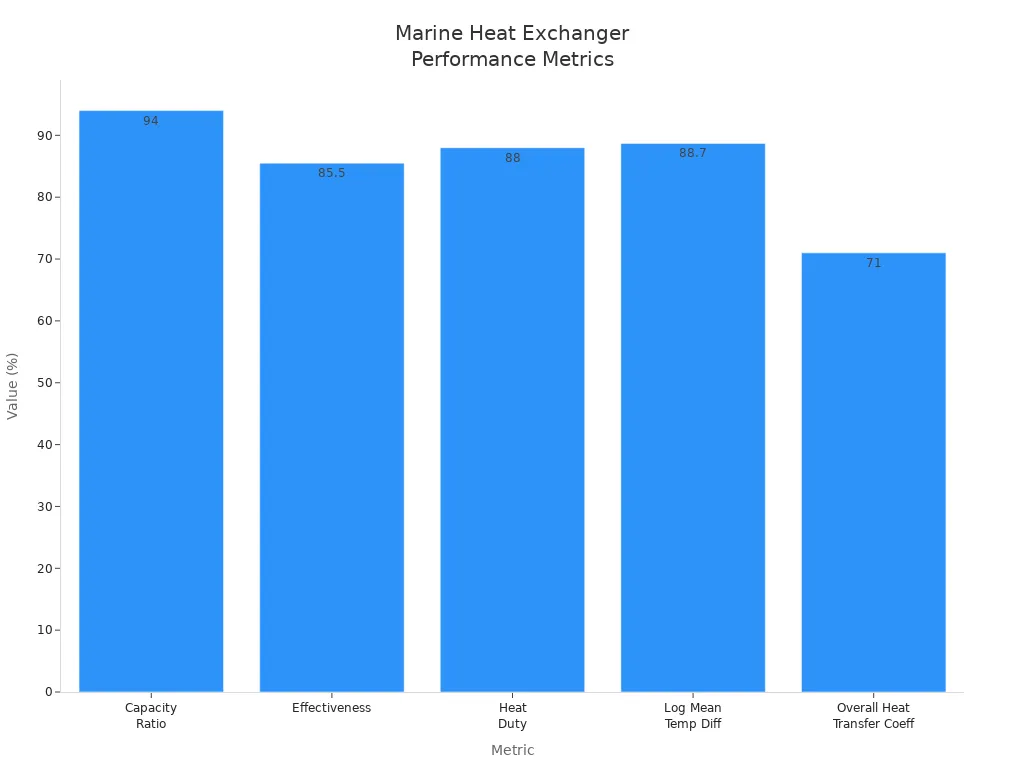
Printed Circuit Heat Exchangers from Shanghai Plate Heat Exchanger stand out for their ability to maintain high heat duty and efficiency, even when exposed to seawater and harsh marine conditions. Their compact design and advanced materials help ships save space and energy.
Maintenance Needs
Regular marine heat exchanger maintenance is essential for reliable operation. Operators must inspect and clean these units every 6-12 months, especially when working with seawater that contains more particles. Common problems include fouling, corrosion, tube leaks, and gasket failures. Technicians can detect fouling or scaling by monitoring coolant temperatures, pressure drops, or reduced flow rates.
Maintenance Aspect | Details |
|---|---|
Cleaning Frequency | Inspect and clean every 6-12 months; more often in turbid waters. |
Common Problems | Fouling, corrosion, tube leaks, and gasket failures due to water quality. |
Detection of Fouling/Scaling | Monitor coolant temperatures, pressure drops, or reduced flow rates. |
Causes of Tube Leaks | Erosion, galvanic corrosion, vibrations, or manufacturing defects. |
Shanghai Plate Heat Exchanger designs its products for easy cleaning and long service life, reducing downtime and repair costs.
Reliability in Marine Power Systems
Marine heat exchangers play a vital role in ship engines and HVAC systems. They help maintain fuel efficiency and reduce emissions by optimizing heat transfer and space use. High-grade materials like stainless steel and titanium resist corrosion from seawater, which boosts reliability.
Critical component failures often link to cooling systems.
The lubricating system shows the highest reliability.
The cooling system has the lowest reliability.
Major faults include sea chest blockage and scale build-up.
Operators who choose advanced solutions like the Printed Circuit Heat Exchanger from Shanghai Plate Heat Exchanger benefit from improved reliability and reduced risk of failure. These exchangers support stable marine power systems, even in challenging offshore environments.
Compliance and Safety Standards
Marine Certifications
Offshore heat exchangers must meet strict marine certifications to ensure safety and reliability. Certification bodies set standards for construction, material quality, and performance under harsh conditions. These organizations check that heat exchangers can handle seawater exposure, high pressure, and constant vibration. The table below shows the main certification bodies and their requirements:
Certification Body | Requirements |
|---|---|
DNV GL | Ship Classification Code, material certification, pressure test, anti-pollution design |
ABS | Steel Ocean-Going Vessel Construction Code, structural integrity focus |
CCS | Steel Ocean-going Vessel Classification Code, material and pressure testing requirements |
Many vessels rely on approvals from groups such as ABS, DNV, and BV. ABS focuses on structural integrity, DNV emphasizes environmental compliance, and BV covers pressure vessel safety. These certifications help operators trust that their equipment will perform well in seawater environments.
Tip: Choosing a heat exchanger with these certifications, like the Printed Circuit Heat Exchanger from Shanghai Plate Heat Exchanger, ensures compliance and peace of mind for marine operators.
Environmental and Safety Regulations
Offshore heat exchangers must also follow environmental and safety regulations. These rules protect marine ecosystems and keep crews safe. Operators must select equipment that meets standards for emissions, explosion protection, and material use. The table below outlines key regulations:
Regulation Type | Description |
|---|---|
Emission Standards | Strict regulations govern emissions and discharges from offshore installations to protect marine ecosystems. |
Explosion Protection | Equipment must comply with standards such as ATEX, IECEx, and NEC for hazardous locations. |
Material Use | Specific materials are required to withstand harsh marine conditions and ensure safety. |
Seawater cooling systems must prevent leaks and minimize pollution. Explosion protection standards require equipment to operate safely in hazardous areas, especially where seawater and fuel may mix. Material regulations ensure that only corrosion-resistant metals, like those used by Shanghai Plate Heat Exchanger, come into contact with seawater. Meeting these standards helps operators avoid fines and maintain safe, efficient operations.
Selecting the Right Offshore Heat Exchanger
Matching Design to Application
Every marine project has unique requirements, so the selection of an offshore heat exchanger must start with a clear understanding of the operating environment. Engineers look at fluid properties, operating conditions, fouling resistance, pressure drop, and material selection. These factors help match the right design to each application.
Factor | Description |
|---|---|
Fluid Properties | Specific heat, flow rate, and temperature of the fluids are critical for calculating heat load. |
Operating Conditions | Pressure and temperature variations influence design and material selection. |
Fouling Resistance | Accounts for efficiency loss due to deposits on heat transfer surfaces over time. |
Pressure Drop | Trade-off between exchanger size and pressure drop, affecting efficiency and costs. |
Material Selection | Must withstand operating temperature, pressure, and potential corrosion. |
Tip: Fluid compatibility, thermal requirements, and maintenance needs should always guide the selection process.
Many operators make mistakes during selection. They might ignore cleaning strategies, underestimate corrosion risks, or mix dissimilar metals without a plan. Some choose oversized units instead of optimizing airflow, while others neglect pressure drop budgets. Careful selection avoids these common errors and ensures reliable performance.
Customization and Upgrades
Customization plays a key role in the selection of an offshore heat exchanger. Custom finned tubes can boost thermal efficiency by meeting specific system requirements. Specialized coatings and advanced materials extend the lifespan of the equipment. Although customization may increase initial costs, it reduces maintenance and improves performance, leading to a better return on investment.
Custom finned tubes enhance thermal efficiency.
Specialized coatings and materials increase equipment life.
Customization reduces maintenance and improves long-term performance.
Case studies show that part consolidation, material optimization, and rapid prototyping help marine operators. Engineers can print multiple components as a single part, which reduces leak paths and simplifies assembly. Advanced alloys improve thermal conductivity and corrosion resistance. Quick prototyping and on-demand production lower inventory needs and speed up replacements.
Note: Customization ensures that each selection fits the exact needs of the marine environment, supporting both performance and longevity.
Partnering with Shanghai Plate Heat Exchanger
Shanghai Plate Heat Exchanger stands out as a preferred partner for offshore heat exchanger selection. The company offers advanced solutions like the Printed Circuit Heat Exchanger, which brings several advantages to marine projects.
Advantage | Description |
|---|---|
Compact Structure | Small footprint, easy to install and disassemble, flexible operation, and convenient maintenance. |
Reduces energy consumption and improves efficiency, with cooling water consumption only 1/3 of tube type. | |
Long Equipment Life | Optimized design extends equipment life and reduces operating costs. |
All-Round After-Sales Service | Professional team provides timely guidance during installation and operation. |
Shanghai Plate Heat Exchanger uses advanced manufacturing to consolidate parts and optimize materials. This approach reduces leak paths and boosts corrosion resistance. The company also offers rapid prototyping, which helps operators get replacements quickly and keep downtime low.
The Printed Circuit Heat Exchanger from Shanghai Plate Heat Exchanger improves operational efficiency in marine power systems. It handles extreme temperatures and pressures, making it ideal for demanding offshore environments. The compact design saves space, while high heat transfer efficiency reduces energy use.
Expert Recommendation: Extruded fins resist corrosion from sea salt, making them a smart choice for offshore heat exchanger selection.
Shanghai Plate Heat Exchanger supports clients with all-round after-sales service. The team provides guidance during installation and operation, ensuring each selection meets the highest standards for safety and performance.
Selecting the right heat exchanger for offshore marine use requires careful attention to material quality, pressure rating, and maintenance design. Operators should consider environmental, technical, and regulatory needs to ensure reliable performance. Advanced options like the Printed Circuit Heat Exchanger from Shanghai Plate Heat Exchanger offer compactness and high efficiency. Consulting with experts helps match the heat exchanger to specific requirements and extends equipment life. For more guidance, resources such as the GPHE selection guide provide valuable support.
Trend | Description |
|---|---|
Sustainability | Focus on eco-friendly materials and reduced environmental impact. |
High Efficiency | Preference for compact, high-performance heat exchanger designs. |
Hybrid Propulsion | Need for efficient thermal management in new marine power systems. |
FAQ
What makes the Printed Circuit Heat Exchanger suitable for marine environments?
The Printed Circuit Heat Exchanger from Shanghai Plate Heat Exchanger uses corrosion-resistant materials and a compact design. This makes it ideal for harsh marine conditions where space and durability matter most.
How often should marine heat exchangers be maintained?
Operators should inspect and clean marine heat exchangers every 6 to 12 months. More frequent checks may be needed in areas with high fouling or poor water quality.
Which certifications should offshore heat exchangers meet?
Offshore heat exchangers should meet certifications from DNV, ABS, or CCS. These standards ensure safety, reliability, and compliance with marine regulations.
Can Shanghai Plate Heat Exchanger customize solutions for unique marine needs?
Yes. Shanghai Plate Heat Exchanger offers custom designs, materials, and coatings. Their team helps operators match the right heat exchanger to each marine application.
Why choose a compact heat exchanger for marine power systems?
Compact heat exchangers save valuable space, reduce weight, and improve efficiency. The Printed Circuit Heat Exchanger provides high performance in a small footprint, making it a smart choice for modern marine vessels.