The Ultimate Guide to Nylon Curing Tape Selection in 2025
Choosing the right Nylon Curing Tape means you focus on key properties. The tape must handle high temperatures and keep its bond strong under heat. When you match the tape to your surface, like aluminum or glass, you help the adhesive work better. This careful selection boosts performance and durability.
Nylon Curing Tape: What It Is and How It Works
Definition and Purpose
You use Nylon Curing Tape when you need a strong, heat-resistant tape for industrial processes. This tape has a tough nylon backing that lets it handle high temperatures. It can go through bake cycles up to 400°F (204°C) without breaking down. The adhesive is a non-silicone rubber type, so you can remove the tape cleanly after use.
- The tape often uses PA46, an aliphatic polyamide made from butanediamine and adipic acid.
- PA46 has high crystallinity, about 70%, which gives it a melting point of 295°C.
- You can use it for long periods at temperatures up to 163°C. This makes it better for heat resistance than many other nylons.
Nylon Curing Tape works well because it combines strength, flexibility, and clean removal. You can trust it to keep its shape and stick during tough jobs.
Tip: Always check the tape’s temperature rating before using it in your process.
Primary Uses in 2025
In 2025, you will see Nylon Curing Tape used in more industries than before. Its main job is to help with curing and bonding in high-temperature settings. The tape is now a key part of industrial vulcanization. It helps rubber cure faster and with fewer problems. This reduces waste and saves time.
Here is how the tape performs during curing:
| Characteristic | Description |
|---|---|
| High-Temperature Resistance | Handles temperatures over 300°F (about 150°C), perfect for curing. |
| Strong Adhesion | Stays in place during the whole process. |
| Flexibility and Conformability | Bends and fits many shapes, so it seals tightly and stops leaks. |
| Chemical Resistance | Stands up to solvents and resins, which is important in composite work. |
| Ease of Removal | Comes off cleanly, leaving no sticky residue. |
You will find this tape in composite manufacturing, aerospace, and automotive work. Its ability to handle heat and pressure makes it a smart choice for modern industry.
Types of Nylon Curing Tape
Standard Nylon Curing Tape
You will find standard Nylon Curing Tape in many factories. This tape uses 100% nylon 66, which gives it high strength and excellent temperature resistance. You can use it for the vulcanization of rubber products. The tape stays flexible and reusable, even after several uses. It also has low thermal shrinkage, so it keeps its shape during heating.
Here is a table showing the main specifications:
| Thickness | Yarn Count | Width Range | Breaking Strength | Elongation | Thermal Aging Breaking Strength |
|---|---|---|---|---|---|
| 0.28mm +/- 0.01mm | 235dtex/110dtex | 20~50mm | ≥2400N/mm | 20%~30% | ≥2200N/mm |
| 0.31mm +/- 0.01mm | 235dtex/110dtex | 20~50mm | 1300~3500N/mm | 20%~30% | 1200~3300N/mm |
| 0.36mm +/- 0.01mm | 235dtex/235dtex | 20~50mm | 1400~3100N/mm | 20%~30% | 1100~2900N/mm |
Note: Standard tapes offer high strength, low density, and safe, non-toxic performance.
High-Temperature Nylon Curing Tape
You should choose high-temperature Nylon Curing Tape when your process needs extra heat resistance. This tape can handle insulation up to 550°C. It works well for jobs that need strong heat insulation and protection. You can trust it to keep its strength and shape, even in extreme heat.
Adhesive-Backed Nylon Curing Tape
Adhesive-backed Nylon Curing Tape makes your work easier and faster. You can apply it quickly without mess. This tape bonds instantly, but you need to prepare the surface well. It may not fill gaps as well as liquid glue, and it can be sensitive to high temperatures.
| Feature | Adhesive-Backed Nylon Tape | Non-Adhesive (Liquid Glue) |
|---|---|---|
| Ease of Use | Easy to apply | Can be messy and requires precision |
| Speed of Application | Instant bonding | Requires curing time |
| Surface Preparation | Extensive preparation needed | May require less preparation |
| Temperature Sensitivity | Sensitive to temperature | Some are temperature resistant |
| Strength | Weaker than liquid glue | Stronger bonds |
| Gap Filling Ability | Limited gap-filling | Can fill gaps |
| Durability | Susceptible to migration | More durable after curing |
Tip: Use adhesive-backed tape for quick jobs, but check if your process needs higher strength or temperature resistance.
Specialty and Custom Nylon Curing Tape
You can find specialty and custom Nylon Curing Tape for unique needs. Some tapes, like Dartek® T-424, can be thermoformed to fit special shapes. Manufacturers also offer tapes for cord assemblies, press tape, and wrap tape. Heavyweight webbing and strapping fabrics can be made to match your exact requirements. Specialty films can provide high-barrier packaging and match the shrinkage of your materials, which helps keep tension during curing.
Nylon Curing Tape Selection Criteria
Temperature Resistance
You need to check the temperature resistance of the tape before you use it. Each type of nylon has a different limit for heat. Some tapes can handle high temperatures for a long time, while others work best at lower levels. If you use the tape in places like engine parts or ovens, you must pick one that matches your needs.
Here is a table showing how different nylon types compare in temperature resistance:
| Component | Typical Nylon Type | Temperature Resistance |
|---|---|---|
| Engine Fan Shrouds | Glass-Filled Nylon 66 | Up to 150°C continuous |
| Intake Manifolds | Heat-Stabilized Nylon 66 | 140–160°C |
| Valve Covers, Clips | Nylon 6 + Additives | 120–140°C |
| Food Conveyor Belts | Nylon 11 (FDA-compliant) | 100–120°C, high wear |
| Bearings in Mixers | Nylon 6 with lubricants | Thermally stable |
| Ironing Board Covers | Heat-Resistant Nylon 6 | Resists melting and warping |
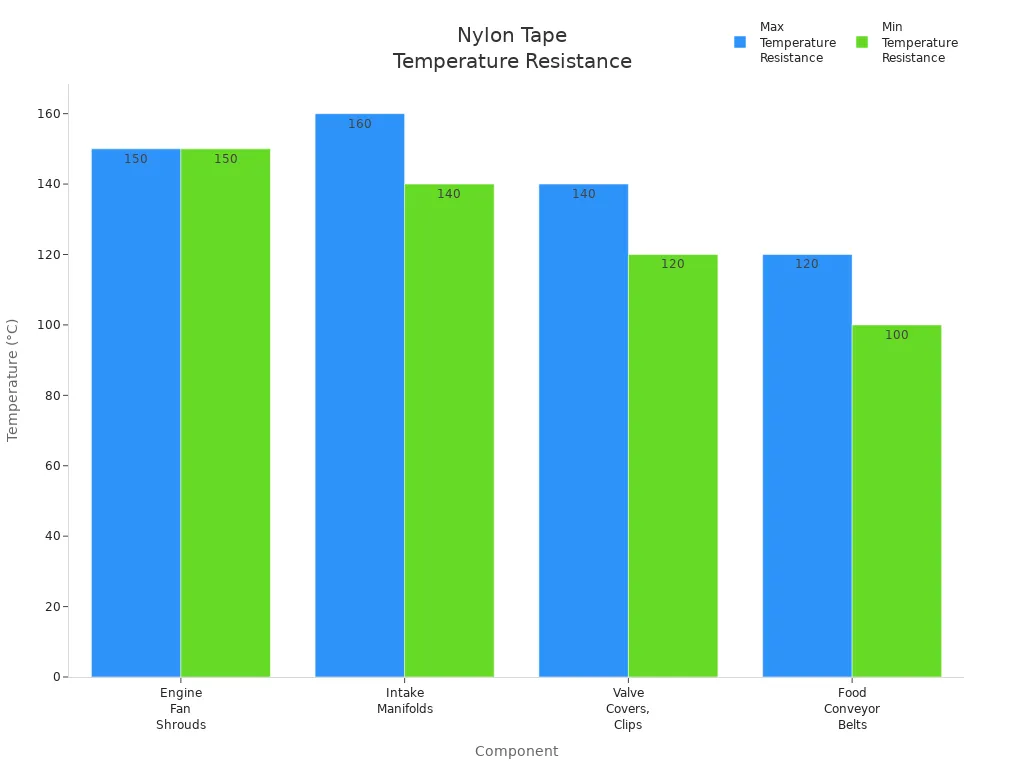
Tip: Always match the tape’s temperature rating to your process. If you use the wrong tape, it may melt or lose strength.
Adhesive Strength and Type
You must look at how well the tape sticks to surfaces. Adhesive strength tells you if the tape will stay in place during curing. Different tests help you measure this strength. Some tests are simple, while others give you exact numbers.
Here are common testing methods:
| Testing Method | Description |
|---|---|
| Knife Test | You use a knife to lift the tape and see how well it sticks. |
| Tape Test | You press tape onto cuts in the coating and pull it off to check adhesion. |
| Pull-Off Adhesion Test | You attach a fixture and pull until the tape comes off, measuring the force needed. |
If you need strong bonds, choose tapes with high pull-off adhesion values. For quick jobs, a tape test may be enough.
Compatibility with Substrates
You should always check if the tape works with your material. Some tapes stick better to metal, glass, or plastic. If you use the wrong tape, it may not bond well or could damage the surface. Test the tape on a small area first. This helps you avoid problems later.
- Nylon Curing Tape works best on clean, dry surfaces.
- If you use it on rough or oily surfaces, the bond may weaken.
- Some tapes have special adhesives for hard-to-bond materials.
Note: Always read the manufacturer’s guide for substrate compatibility.
Environmental Durability
You need to think about where you will use the tape. Sunlight, water, and chemicals can change how the tape works. If you use the tape outside or in wet places, pick one made for those conditions.
- Sunlight and UV rays make nylon tape brittle and change its color.
- Standard tape breaks down after about 500 hours in direct sunlight.
- UV-resistant tape lasts up to three times longer.
- High humidity weakens the adhesive and can make the tape peel off.
- Water exposure causes the tape to lose grip within hours.
- Organic solvents like acetone or ethanol break down the tape fast.
- Most tapes lose adhesion within minutes of contact with these chemicals.
- UV rays can reduce nylon’s strength by 30% after several months, and by more than 50% after three years.
If you need the tape to last, choose one with UV and chemical resistance.
Compliance with Industry Standards
You must check if the tape meets safety and quality standards. In 2025, top certifications include UL Solutions, ANSI/CAN/UL 510, and CSA-C22.2 No. 197. These standards show that the tape is safe and works well. Manufacturers use these certifications to prove their products are reliable. If you work in aerospace, automotive, or food processing, you need certified tapes.
Tip: Certified tapes help you meet legal rules and keep your project safe.
Common Applications for Nylon Curing Tape
Aerospace and Automotive
You see Nylon Curing Tape used in both aerospace and automotive work. In these fields, you need materials that can handle high heat and pressure. This tape helps seal and support parts during manufacturing. It keeps its shape and strength, even when exposed to extreme conditions. You can rely on it for tasks like sealing joints, wrapping wires, or holding parts in place while they cure. Many engineers choose this tape because it helps create strong, reliable products that last.
Composite Manufacturing
You use Nylon Curing Tape often in composite manufacturing. This process needs careful control to make strong, lightweight parts. Here are some ways you use the tape:
- You wrap woven nylon tape around composite parts for compaction, especially during vulcanization.
- You can reuse the tape several times unless you expose it to very high heat.
- Hi-Shrink Tape, a special type, gives more compressive force as it heats up. This helps you get a more even finish on your parts.
These features make the tape a smart choice for factories that want to save money and improve quality.
Industrial and DIY Projects
You find Nylon Curing Tape in many industrial and home projects. It works well for repairs, sealing, and even decoration. The table below shows some common uses:
| Use Case | Description |
|---|---|
| Industrial | You use it in vulcanization for its durability, heat resistance, and ability to fit many shapes. |
| Automotive | It helps you seal and support car parts during assembly or repair. |
| Aerospace | You trust it to handle tough conditions and keep products safe. |
| Consumer Goods | You use it for repairs or crafts, showing its flexibility in DIY projects. |
Tip: Always pick the right tape for your project to get the best results.
Step-by-Step Nylon Curing Tape Selection Guide
Assess Your Application Needs
Start by understanding what your project requires. You need to look at the environment, the materials, and the job you want the tape to do. Use this checklist to help you:
- List all environmental threats. Think about heat, moisture, chemicals, and any mechanical stress.
- Identify the best tape material for your job. Sometimes you need polyimide or PTFE, but often nylon works best.
- Check the adhesive properties. Make sure the adhesive can handle high temperatures and resist chemicals.
- Decide what you want the tape to do. Do you need insulation, protection, or something else?
- Look for extra needs. You might need clean removal or UV resistance.
- Measure the area you need to cover. This helps you buy the right amount.
- Read the installation guidelines from the manufacturer.
- Test a small piece first. Check for good adhesion and durability.
Tip: Always test the tape on a small area before using it on the whole project.
Match Tape Properties to Requirements
You need to match the tape’s features to your project’s needs. Use a comparison chart to make this easier. Here is a simple way to compare:
| Step | What to Check | Features to Compare |
|---|---|---|
| 1 | Look at the tape’s edge alignment | Overall edge pattern |
| 2 | Check the tape’s edge features | Edge features |
| 3 | Compare each section of the tape | Edge similarity, eight key features |
You can also look at properties like temperature resistance, adhesive strength, and flexibility. Make sure the tape you pick matches every need on your list.
Note: If you skip this step, you might choose a tape that fails during use.
Evaluate Supplier Quality and Support
Not all suppliers offer the same quality or service. You should check these points before you buy:
| Criteria | What to Look For |
|---|---|
| Material Specifications | Nylon6 or Nylon66 for the right curing temperature |
| Manufacturing Capabilities | Tapes in widths from 20mm to 100mm, special non-stick coatings |
| Product Features | High strength, heat-set for even shrinkage, works well after many uses |
| Customer Service | Good prices, strong support, and a promise to beat rivals in quality |
You should also check if the tape has:
- High temperature and chemical resistance
- High breaking strength
- Low thermal shrinkage
- Flexibility
When you talk to suppliers, ask if their tape is protected against greases, chemicals, and water. See if they offer different colors if you need them. Make sure the tape works well for your specific job, like binding parts in automotive work.
Tip: Choose a supplier who answers your questions and offers support after you buy.
Test Before Full-Scale Use
Before you use the tape on your whole project, you need to test it. This helps you avoid mistakes and wasted materials. Here are the main tests and what they show:
| Testing Method | What It Measures | Why It Matters |
|---|---|---|
| Tack Test | How quickly and firmly the tape sticks | Shows if the tape will stay in place right away |
| Cohesion Test | How well the tape holds under weight | Tells you if it will last over time |
| Temperature Resistance Test | How the tape handles heat | Makes sure it will not fail in hot conditions |
| Elongation | How much the tape stretches before breaking | Balances stretch and strength |
| Thickness | How thick the tape is | Thicker tape is better for heavy-duty jobs |
| Shear Strength | How well the tape resists sliding | Important for parts that move or shift |
| Adhesion | How strong the bond is with your material | Ensures the tape will not peel off too soon |
Note: Always test a small sample first. This helps you catch problems before they affect your whole project.
You get the best results when you match nylon curing tape features to your project needs. Use the step-by-step guide and checklist for smart choices.
Stay alert for new materials and standards in 2025. This helps you keep your work safe, strong, and up to date.
FAQ
What is the main benefit of nylon curing tape?
You get strong heat resistance and clean removal. This tape helps you finish projects faster and keeps your work area tidy.
Can you reuse nylon curing tape?
You can reuse some nylon curing tapes several times. Always check the manufacturer’s instructions before you try to reuse the tape.
How do you store nylon curing tape for best results?
Store your tape in a cool, dry place. Keep it away from sunlight and chemicals. This helps you keep the tape strong and ready for use.