Unlocking Business Growth with Nut Sorting Machines
Nut sorting machine technology drives immediate business growth. Companies experience higher productivity and profitability through automation.
- Automation increases operational efficiency and accuracy.
- Labor costs decrease, allowing smarter resource allocation.
- The global market for nuts processing equipment grows at 5.7% annually, reflecting strong automation trends.
Advancements in sorting technology and compliance with food safety regulations fuel market expansion. North America leads with innovation, responding to consumer demand for quality and safety.
Nut Sorting Machine Benefits for Business Growth

Operational Efficiency and High-Volume Processing
Nut sorting machines transform processing lines by delivering unmatched speed and accuracy. Companies that rely on manual sorting face bottlenecks due to human limitations. In contrast, automated systems handle millions of pieces daily, maintaining consistent quality and reducing errors. The following table highlights the differences between optical sorting and manual sorting:
| Feature | Optical Sorting | Manual Sorting |
|---|---|---|
| Processing Speed | Handles millions of pieces/day | Limited by human capacity |
| Quality Consistency | Maintains high standards | Prone to human error |
| Labor Costs | Reduces significantly | High due to labor intensity |
| Detection Capabilities | Identifies subtle variations | Limited to visual inspection |
| Compliance with Standards | Meets stringent regulations | Often fails to meet standards |
Nut sorting machines utilize advanced cameras and sensors to evaluate every piece, ensuring uniformity. These systems process thousands of pounds per hour, making them ideal for high-volume operations. They also detect contaminants, such as aflatoxin, that are invisible to the naked eye. This capability is crucial for food safety and regulatory compliance.
Product Quality, Consistency, and Waste Reduction
Businesses that adopt nut sorting machines observe measurable improvements in product quality. Automated systems achieve a defect detection rate exceeding 99%, increase yield by 15%, and reduce waste by 20%. The table below summarizes these improvements:
| Improvement Type | Measurement |
|---|---|
| Defect Detection Rate | Exceeding 99% |
| Increase in Yield | 15% |
| Reduction in Waste | 20% |
Deep learning and multi-camera systems automate the grading process, ensuring high accuracy and minimizing human error. This technology delivers uniform results across batches. By accurately identifying and removing only defective nuts, these machines improve overall yield and reduce waste. Sorting machines also prevent substandard fruits from entering the supply chain, significantly reducing post-harvest losses and supporting environmental preservation.
Tip: Pneumatic and vision-based sorting machines consume less energy and ensure only high-quality products are selected, further reducing waste and conserving resources.
Cost Savings and Workplace Safety
Nut sorting machines deliver substantial cost savings by automating labor-intensive tasks. Automated sorting reduces reliance on manual labor, leading to significant savings on wages. Enhanced accuracy minimizes product waste, lowering material expenses. High precision sorting prevents defective products from being shipped, reducing costs associated with recalls and customer complaints.
| Evidence Type | Description |
|---|---|
| Labor Cost Reduction | Automated sorting reduces reliance on manual labor, leading to significant savings on wages. |
| Waste Reduction | Improved accuracy in sorting minimizes product waste, lowering material expenses. |
| Efficiency Improvement | High precision sorting prevents defective products from being shipped, reducing associated costs. |
Automatic nut packing machines can pack up to 30% more nuts per day than manual operations, increasing throughput. Real-time monitoring systems help reduce waste and improve product quality, further lowering costs. Energy-efficient motors in these machines can cut energy consumption by up to 15%, adding to long-term savings.
Nut sorting machines also improve workplace safety. Automation reduces the need for repetitive manual tasks, decreasing the risk of workplace injuries. Skilled workers can focus on higher-value activities, increasing overall productivity.
Scalability and Market Opportunities
Nut sorting machines support business scalability by integrating advanced technologies such as AI and machine learning. These advancements enhance sorting accuracy, reduce waste, and increase yield. Automation addresses labor shortages and accelerates the deployment of machinery, modernizing supply chains.
| Evidence Type | Description |
|---|---|
| Technological Advancements | Integration of AI and machine learning enhances sorting accuracy, reducing waste and increasing yield. |
| Consumer Demand for Quality and Safety | Regulatory standards and consumer awareness drive the need for precise sorting solutions. |
| Supply Chain Modernization | Automation addresses labor shortages and improves efficiency, accelerating the deployment of machinery. |
| Market Penetration in Emerging Segments | Demand for organic and premium products creates new revenue streams for sophisticated sorting technology. |
| Customization and Product Differentiation | Modular and scalable machines can meet diverse customer needs, increasing market share. |
The development of automated nut processing machines has significantly improved productivity and quality. Global consumption of nuts and nut-based products continues to rise, driven by health-conscious and plant-based diets. Advancements in nut processing equipment fuel market growth, leading to higher efficiency and consistency. Companies can now enter new markets, including organic and premium segments, by leveraging modular and scalable solutions.
Note: The nut sorting machine market is expanding rapidly, with emerging markets in Asia-Pacific, Latin America, and Africa presenting significant growth opportunities. The focus on sustainability has also led to the development of eco-friendly machines, aligning with global trends.
Real-World Impact and Implementation of Nut Sorting Machines
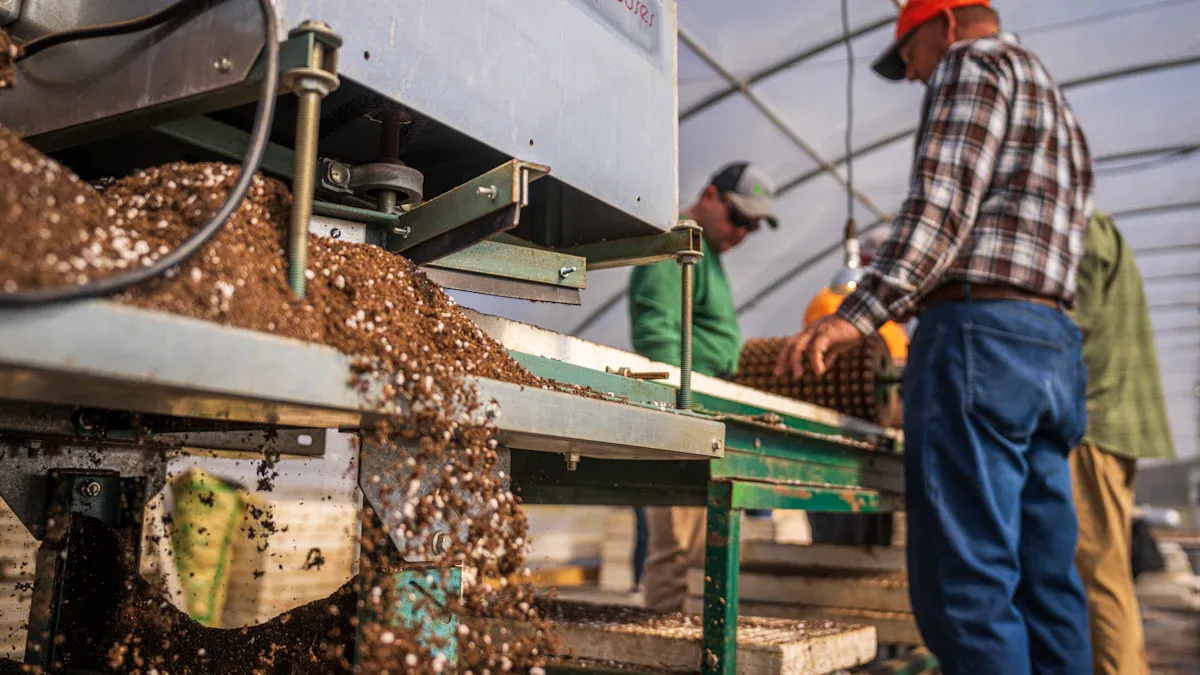
Industry Case Studies and Success Stories
Manufacturers in various sectors have adopted nut sorting machines to achieve measurable improvements. One project automated the sorting of hexagonal nuts using sensors and microcontrollers. This innovation eliminated manual sorting, reduced labor costs, and increased efficiency. Strelen Control Systems introduced the Safe-Ident Sort, a hyperspectral sorting machine that uses advanced imaging to distinguish nuts from contaminants. This technology enhances quality control, ensuring only perfect nuts reach consumers and minimizing health risks. Companies report higher customer satisfaction due to improved product quality and fewer defects.
| Benefit | Impact on Customer Satisfaction |
|---|---|
| Enhanced product quality | Increases customer trust and satisfaction |
| Removal of defects | Ensures uniformity, leading to higher satisfaction |
| Reduction of human error | Improves operational efficiency, contributing to satisfaction |
| Automation | Streamlines processes, enhancing overall customer experience |
Selecting the Right Nut Sorting Machine
Businesses must evaluate several factors before choosing a nut sorting machine. The type of material, sorting accuracy, and throughput capacity play critical roles. User-friendly interfaces reduce training time and boost productivity. Maintenance and durability ensure reliable performance, while cost and return on investment influence long-term profitability.
| Factor | Description |
|---|---|
| Type of Material | Ensure the machine is designed for nuts, as different materials require different sorting applications. |
| Sorting Accuracy | Look for high-resolution cameras and advanced software for precise sorting results. |
| Capacity and Throughput | Assess the amount of material to be sorted per hour to choose the right machine size. |
| Ease of Operation | Opt for user-friendly interfaces to reduce training time and enhance productivity. |
| Maintenance and Durability | Choose machines with durable components and good after-sales support for reliable performance. |
| Cost and Return on Investment | Consider the long-term savings and profitability from reduced waste and improved product quality. |
Tip: Model selection should match production needs. Stability, precision, and ease of maintenance are essential for consistent results.
Integration Steps for Seamless Adoption
Successful implementation of nut sorting machines requires careful planning. Integration of AI improves sorting precision and reduces false positives, meeting strict quality standards and accelerating ROI. Companies must address challenges such as high capital investment, energy consumption, and technical maintenance.
- High capital investment
- Energy consumption
- Technical maintenance
Training and support services play a vital role in adoption. Vendors offer 24/7 service call availability, support through multiple channels, and on-site installation. Staff receive training on operation and maintenance, ensuring effective machine use.
| Key Aspect | Description |
|---|---|
| After-sales support | Assess the vendor's global service network and technical support responsiveness. |
| Training programs | Essential for operators and maintenance staff to ensure effective machine operation and upkeep. |
| Machine effectiveness | Directly influenced by the quality of support provided by the vendor. |
Note: Intelligent color sorters and X-ray inspection systems help overcome challenges such as low output, uncontrollable quality, and the presence of impurities.
Nut sorting machines drive business growth by increasing productivity and improving quality control. Companies report reduced labor costs, enhanced yields, and long-term savings.
- Market value reached USD 450 million in 2023 and will grow to USD 780 million by 2032.
- Automation delivers consistent quality, energy savings, and export-ready products.
Investing now secures lasting value.
FAQ
What types of nuts can a nut sorting machine process?
A nut sorting machine handles almonds, peanuts, cashews, walnuts, and hazelnuts. Manufacturers design models for specific nut varieties and processing requirements.
How does a nut sorting machine improve food safety?
Advanced sensors and imaging systems detect contaminants and defects. The machine removes unsafe nuts before packaging, helping companies meet strict food safety standards.
Is it difficult to maintain a nut sorting machine?
Routine maintenance involves cleaning sensors and checking mechanical parts. Most manufacturers provide user-friendly interfaces and support, making upkeep straightforward for operators.
Tip: Regular maintenance extends machine lifespan and ensures consistent sorting accuracy.
See Also
Essential Checkweighers For Every Food Processing Facility
Evaluating Custom Cargo Lifts: Benefits And Drawbacks For Businesses
Enhancing Pharmaceutical Efficiency With Advanced Capsule Decapsulation Machines
Innovative Folder Gluer Features To Watch In 2025 Carton Production