Understand the Core Differences in Nickel 200 and 201 Flanges
The primary distinction between Nickel 200 and Nickel 201 lies in their carbon content; Nickel 201 is the low-carbon variant. This specific composition makes it suitable for service above 600°F (315°C). Standard Nickel 200 Flanges can become susceptible to graphitization and embrittlement at these elevated temperatures. This material-specific behavior is also seen when comparing other alloys, like Inconel 625 Pipe Fittings, for different service conditions.
Note: Selecting the correct alloy is critical for ensuring operational safety and long-term structural integrity in high-temperature environments.
Key Takeaways
- Nickel 200 and Nickel 201 are different because of their carbon content. Nickel 201 has less carbon.
- Nickel 201 is better for hot places, above 600°F (315°C). Nickel 200 can break easily at these high temperatures.
- Always check the temperature of your project. This helps you pick the right nickel type for safety and long-lasting use.
- Nickel 201 is easier to shape and weld. It is good for making complex parts.
Chemical Composition: The Core Difference
The performance characteristics of Nickel 200 and Nickel 201 flanges originate from a single, crucial variance in their chemical makeup: carbon. While both are commercially pure wrought nickel alloys, their specified carbon limits dictate their suitability for different thermal environments. Understanding this compositional distinction is the first step in selecting the correct material for your application. This control over elemental content ensures predictable and reliable performance in demanding industrial settings.
Carbon Content in Nickel 200
Nickel 200 (UNS N02200) is a versatile alloy known for its excellent corrosion resistance and high thermal conductivity. Its chemical specification permits a controlled, yet notable, amount of carbon. This element is a standard component of the alloy's matrix.
According to ASTM B564, the standard specification for nickel alloy forgings, the carbon content is defined as follows:
| Grade | Carbon (C) Maximum % |
|---|---|
| Nickel 200 | 0.15 |
This carbon level is perfectly suitable for a wide range of applications, particularly those operating at ambient or moderately elevated temperatures.
The Low-Carbon Advantage of Nickel 201
Nickel 201 (UNS N02201) was developed specifically to address the high-temperature limitations of Nickel 200. It achieves this through a significant reduction in carbon content. This modification prevents detrimental changes to the material's microstructure when exposed to heat.
The compositional difference is clear when comparing the two alloys directly:
| Element | Nickel 200 (UNS N02200) | Nickel 201 (UNS N02201) |
|---|---|---|
| Carbon (C) | 0.15% Max | 0.02% Max |
Key Takeaway 💡: The extremely low carbon content in Nickel 201 is not an accident; it is a deliberate design choice. This modification directly prevents the risk of embrittlement in services operating above 600°F (315°C), making it the superior choice for high-temperature caustic environments.
The Impact of Carbon on High-Temperature Performance
The difference in carbon content between Nickel 200 and Nickel 201 directly governs their performance when heat is applied. While both alloys are robust at room temperature, their behavior diverges significantly in high-temperature environments. This divergence is rooted in a metallurgical phenomenon known as graphitization, which can compromise the structural integrity of a component.
Graphitization and Embrittlement in Nickel 200
Nickel 200 flanges provide excellent service in many applications. However, their use has a distinct temperature ceiling. The alloy contains a carbon content of up to 0.15%. At ambient temperatures, this carbon remains dissolved within the nickel's metallic structure and contributes to its mechanical properties.
The situation changes dramatically when service temperatures rise. Nickel 200 is typically limited to applications where temperatures remain below 600°F (315°C). Prolonged exposure to temperatures above this threshold initiates a process called graphitization. During this process, the carbon atoms precipitate out of the nickel matrix. They accumulate at the grain boundaries of the metal, forming brittle graphite. This accumulation severely compromises the material's properties, reducing its overall ductility and impact strength. The flange essentially becomes brittle and susceptible to fracture under stress.
⚠️ Critical Temperature Limit: For Nickel 200, any long-term service above 600°F (315°C) poses a significant risk of intergranular embrittlement. This makes temperature monitoring a critical safety factor for systems using this alloy.
How Nickel 201 Prevents High-Temperature Failure
Engineers developed Nickel 201 specifically to overcome the high-temperature limitations of Nickel 200. The solution was elegant and effective: drastically reduce the carbon content. With a maximum carbon level of just 0.02%, Nickel 201 contains insufficient carbon to form embrittling graphite precipitates at elevated temperatures.
This low-carbon design makes Nickel 201 the preferred choice for applications exceeding 600°F (315°C). It remains stable and ductile even after prolonged exposure to high heat. For this reason, specifications recommend Nickel 201 for service up to 1100°F (600°C), as it reliably resists graphitization. The alloy's microstructure remains secure, preventing the intergranular embrittlement that affects standard Nickel 200.
The stability of Nickel 201 is not just theoretical; it is confirmed through rigorous material science. Advanced microstructural analysis techniques, such as Scanning Electron Microscopy (SEM), are used to study the alloy's performance after prolonged exposure to extreme conditions, like molten sodium hydroxide at 600°C. These studies confirm the material's behavior and ensure its reliability for critical high-temperature services.
Key advantages of Nickel 201's low-carbon chemistry include:
- Prevention of Embrittlement: It eliminates the risk of graphite precipitation at grain boundaries.
- Enhanced High-Temperature Service: It allows for safe and continuous operation in environments well above the 600°F (315°C) limit of Nickel 200.
- Maintained Ductility: The material retains its toughness and resistance to fracture, ensuring long-term structural integrity.
Ultimately, the deliberate reduction of carbon in Nickel 201 provides a built-in safety mechanism against high-temperature failure.
Mechanical Properties: A Comparative Analysis
Beyond their chemical differences, Nickel 200 and Nickel 201 exhibit distinct mechanical behaviors that influence their selection for fabrication. While their properties are similar at room temperature, their response to manufacturing processes like cold working reveals important distinctions. These differences in strength, hardness, and formability are critical for engineers designing components that require specific shaping or machining.
Tensile Strength and Hardness
In their annealed (softened) state, both Nickel 200 and Nickel 201 possess comparable tensile strength and hardness. This similarity makes them functionally interchangeable for many low-stress applications. However, their behavior changes when they are work-hardened (strengthened through cold working).
The typical tensile strength values for commercially pure nickel illustrate this point:
| Condition | Approx. Tensile Strength (ksi) | Approx. Tensile Strength (N/mm²) |
|---|---|---|
| Annealed | <73 | <500 |
| Hard Drawn | 102 – 131 | 700 – 900 |
While both can be strengthened, Nickel 201 has a lower work-hardening rate. This means it remains softer and more workable during forming processes compared to Nickel 200.
Ductility and Formability
Ductility measures a material's ability to be stretched or shaped without breaking. Here, Nickel 201 demonstrates a clear advantage. Its lower carbon content and lower base hardness contribute to superior formability.
Key Insight: Nickel 201 is generally easier to form and weld than Nickel 200. Its higher ductility is especially beneficial for cold working processes like deep drawing and spinning.
The elongation values provide a direct measure of this enhanced ductility:
| Material | Condition | Elongation (% in 2 in.) |
|---|---|---|
| Nickel 200 | Annealed Rods & Bars | 40 |
| Nickel 201 | Annealed | 50 |
This higher elongation percentage indicates that Nickel 201 can undergo more significant deformation before fracturing. Both alloys can be formed using standard methods. However, Nickel 201's low work-hardening rate makes it the preferred choice for fabricating complex components where precision shaping is essential.
Corrosion Resistance in Critical Environments
Both Nickel 200 and Nickel 201 flanges exhibit exceptional corrosion resistance, a defining characteristic of commercially pure nickel. This inherent robustness makes them a primary choice for equipment handling aggressive chemicals. Their performance in reducing media and caustic alkalies is particularly noteworthy, ensuring long-term reliability and process purity in demanding industrial applications. The selection between the two often depends on the specific chemical environment combined with the operating temperature.
Performance in Caustic Alkalies
Nickel 200 and 201 are renowned for their outstanding resistance to caustic alkalies, such as sodium hydroxide (caustic soda). This makes them premier materials for manufacturing and handling these chemicals.
Industry Standard: These alloys are frequently specified for caustic evaporators, heat exchangers, and piping systems where maintaining product purity and preventing equipment degradation is paramount.
Both alloys demonstrate excellent performance across a wide range of concentrations and temperatures. They form a passive oxide film that protects the underlying metal from attack. This protective layer ensures the structural integrity of the flange and prevents contamination of the process fluid. For services involving caustic solutions at temperatures above 600°F (315°C), engineers specify Nickel 201 to leverage this corrosion resistance while also preventing high-temperature embrittlement.
Resistance to Reducing Acids and Salts
The high nickel content of these alloys provides reliable performance in various reducing environments. While not intended for oxidizing acid service, they offer good resistance to non-oxidizing acids and salts.
Key areas of strong performance include:
- Reducing Acids: They resist corrosion from acids like hydrochloric and sulfuric acid at moderate concentrations and temperatures.
- Neutral and Alkaline Salts: Both alloys show excellent resistance to corrosion by neutral and alkaline salt solutions. They are virtually immune to stress corrosion cracking in these media.
- Halogens: Nickel 200 and 201 perform well in dry halogens like chlorine and hydrogen chloride at ambient and moderately elevated temperatures.
This broad resistance profile makes Nickel 200 and 201 flanges a dependable choice for chemical processing equipment, marine hardware, and other critical components exposed to reducing chemical conditions.
Application Guide: When to Specify Nickel 200 Flanges

Selecting the right material is crucial for operational success. Nickel 200 flanges are an excellent and cost-effective choice for a wide array of industrial applications, provided the service temperature remains below 600°F (315°C). Their unique combination of corrosion resistance, high purity, and good mechanical properties makes them a reliable solution in specific environments.
Low-Temperature Chemical Processing
In the chemical industry, Nickel 200 flanges provide exceptional performance for processes operating at moderate temperatures. Their primary advantage is outstanding resistance to aggressive chemicals that would quickly degrade lesser alloys. This material ensures both equipment longevity and process purity.
Note: Engineers specify this alloy for applications where temperatures stay below 315°C (600°F) to avoid any risk of graphitization.
Common applications where Nickel 200 excels include:
- Manufacturing and handling of caustic soda (sodium hydroxide).
- Processes involving anhydrous hydrofluoric acid.
- Equipment used in salt production.
- Systems that utilize fluorine gas.
Marine and Food Handling Equipment
The robust nature of Nickel 200 makes it highly suitable for marine hardware and food processing equipment. Its inherent resistance to corrosion ensures long-term durability in challenging conditions. In marine environments, the alloy withstands constant exposure to saltwater and other corrosive elements.
Its performance is particularly strong due to its:
- Excellent resistance to distilled, natural, and high-velocity flowing seawater.
- Immunity to corrosion from neutral and alkaline salt solutions.
- High durability against general marine atmospheric corrosion.
For food handling, the high purity of Nickel 200 flanges is a key benefit. The material does not contaminate food products, making it a safe and reliable choice for processing systems where hygiene and product integrity are top priorities.
Application Guide: When to Specify Nickel 201 Flanges
Engineers specify Nickel 201 flanges for applications where high temperatures would compromise the integrity of standard Nickel 200. Its low-carbon chemistry provides a crucial defense against embrittlement, making it the mandatory choice for demanding, high-heat environments. This ensures long-term operational safety and reliability in critical systems.
High-Temperature Caustic Service
Nickel 201 flanges are the premier choice for handling caustic solutions at elevated temperatures. While both Nickel 200 and 201 offer excellent resistance to hydroxides, Nickel 201's key advantage emerges in services operating above 600°F (315°C). At these temperatures, its extremely low carbon content (0.02% max) provides virtual immunity to intergranular attack. This prevents the embrittlement that can affect higher-carbon alloys.
Critical Application Alert ⚠️: For any process involving caustic alkali concentrations at temperatures exceeding 600°F (315°C), Nickel 201 is essential. It is approved for service up to 1250°F (677°C), ensuring component stability.
This makes Nickel 201 flanges indispensable in several industrial processes:
- Chemical processing and storage
- Caustic handling equipment and evaporators
- Synthetic fiber production
- Reactors and vessels where sodium hydroxide is used
ASME Pressure Vessel Components
The reliability of Nickel 201 at high temperatures makes it a trusted material for constructing regulated pressure equipment. The ASME Boiler and Pressure Vessel Code, a leading standard for safety, approves this alloy for critical applications.
Specifically, Nickel 201 is approved for use under ASME Section VIII, Division 1 for the construction of pressure vessels. This code sanctions its use for service temperatures up to 1230°F (665°C). Designers of high-temperature reactors, vessels, and piping systems specify Nickel 201 flanges to meet these stringent safety and performance standards. Its proven stability under pressure and heat ensures the structural integrity required for safe, long-term operation in the most demanding environments.
Fabrication and Weldability Considerations
Proper fabrication techniques are essential for maximizing the performance of Nickel 200 and Nickel 201 flanges. Both alloys are readily weldable and formable, but their distinct properties require specific handling procedures to maintain their corrosion resistance and mechanical integrity. Understanding these nuances ensures successful component manufacturing and installation.
Welding Best Practices for Both Alloys
Both Nickel 200 and Nickel 201 can be joined using standard welding processes. While preheating is generally not required, fabricators may warm the metal to prevent moisture condensation. The primary goal during welding is to maintain cleanliness and control heat input.
Important Note: Before any heat treatment, operators must thoroughly clean all alloy surfaces. Contaminants like oil, grease, or paint can cause catastrophic corrosion at high temperatures.
Key welding considerations include:
- Heat Input: A maximum interpass temperature of 175°C (350°F) is a common guideline to manage the heat-affected zone.
- Stress Reduction: While solid solution nickel alloys typically do not need post-weld heat treatment (PWHT) for corrosion resistance, it can be used to reduce residual stress after extensive forming.
- Molten Metal Flow: Light preheating can help improve the flow of the molten weld pool for a smoother bead.
Following these practices helps preserve the alloy's intended properties in the as-welded condition.
Machining and Forming Characteristics
Nickel 200 and 201 are prone to work-hardening, which makes machining a careful process. Operators must use sharp tools and maintain steady, continuous feeds to avoid hardening the surface. Stopping a cut mid-pass should be avoided.
The choice of cutting tool depends on the specific operation:
| Tool Type | Recommended Use Case |
|---|---|
| Carbide Inserts | Ideal for high-speed cutting and most general cuts. |
| HSS Tools | Suitable for low-speed operations and finishing. |
| Ceramic Tools | Best for high-speed finishing cuts for a smooth surface. |
Regarding formability, Nickel 201 holds a distinct advantage. Its lower carbon content results in a lower work-hardening rate and superior ductility. This makes it the preferred material for components requiring extensive cold forming, such as deep drawing or spinning complex shapes. Nickel 200 is also formable but will harden more quickly during the process.
Relevant Standards and Specifications
To ensure safety, reliability, and interchangeability, industry standards govern the manufacturing of Nickel 200 and Nickel 201 flanges. These specifications provide a universal framework for dimensions, materials, and performance ratings. Adherence to these standards is mandatory for critical applications, especially in pressure systems.
Common ASTM and ASME Designations
Engineers rely on a set of established ASTM and ASME standards to specify and procure the correct flanges. The primary specification for nickel alloy forgings, including flanges, is ASTM B564. Beyond this, several dimensional and pressure-related standards apply.
Key governing specifications include:
- ANSI/ASME B16.5: Covers pipe flanges and flanged fittings for sizes NPS ½ through NPS 24.
- ANSI/ASME B16.47 Series A & B: Defines standards for large-diameter steel flanges (NPS 26 through NPS 60).
- ANSI/ASME B16.48: Pertains to line blanks, often used with flanges.
- MSS SP-44: Provides specifications for steel pipeline flanges.
These standards also define the pressure classes available for different flange types.
| Standard | Pressure Class |
|---|---|
| ASME/ANSI B16.5 | 150, 300, 400, 600, 900, 1500, 2500 |
| ASME/ANSI B16.47 | 75, 150, 300, 400, 600, 900 |
Pressure-Temperature Rating Compliance
A flange's ability to contain pressure is directly dependent on its service temperature. As the temperature of a system rises, the strength of the alloy decreases, reducing its maximum allowable working pressure. Standards like ASME B16.5 provide detailed pressure-temperature rating charts for this reason.
Key Concept ⚙️: Engineers must always consult these charts to ensure a selected flange can safely handle the operational pressure at the highest anticipated temperature.
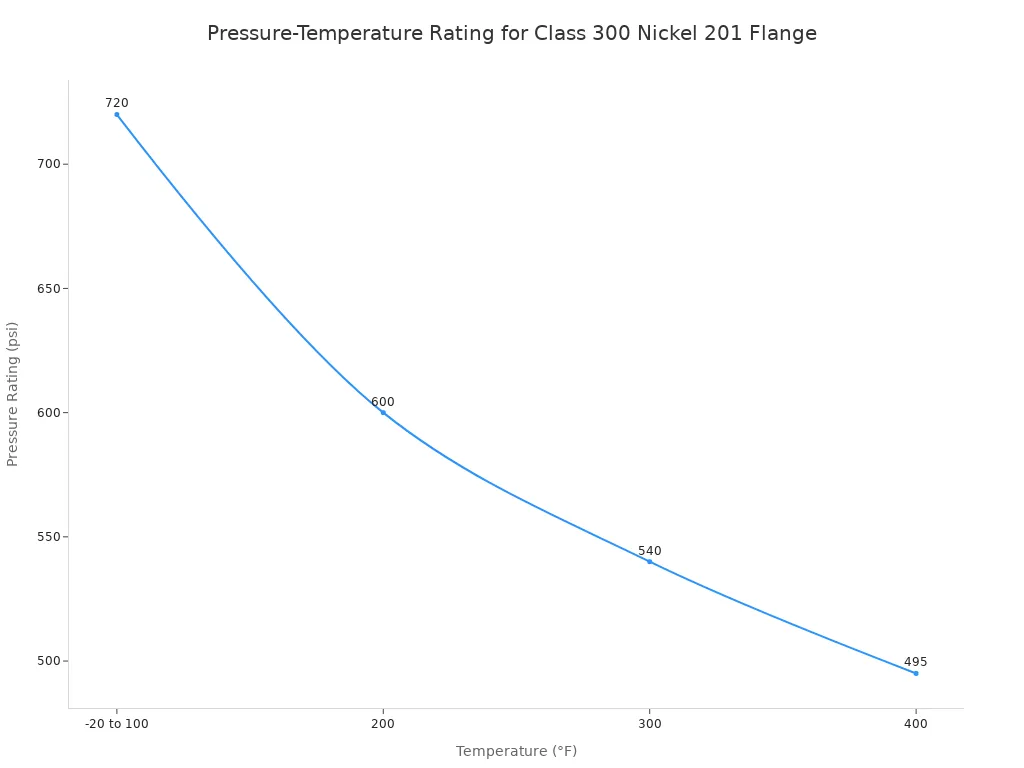
For example, a Class 300 Nickel 201 flange has the following pressure ratings at different temperatures:
| Temperature °F | Class 300 Pressure Rating (psi) |
|---|---|
| -20 to 100 | 720 |
| 200 | 600 |
| 300 | 540 |
| 400 | 495 |
This inverse relationship is a critical design consideration. The flange can handle 720 psi at ambient temperature but is limited to 495 psi at 400°F.
Verifying these ratings ensures the long-term structural integrity and safety of the entire piping system.
Engineers select Nickel 200 Flanges for general corrosion resistance in applications operating below 600°F (315°C). These Nickel 200 Flanges offer a suitable and economical solution for moderate-temperature service. For any application involving temperatures above this critical threshold, Nickel 201 is the mandatory selection to prevent intergranular embrittlement and ensure component safety.
Always verify your application's temperature requirements against material specifications before procurement. For expert guidance, consult a qualified material specialist to ensure system integrity.
FAQ
What is the primary difference between Nickel 200 and 201?
The core difference is carbon content. Nickel 201 is the low-carbon version of Nickel 200. This deliberate chemical modification gives Nickel 201 superior resistance to embrittlement at high temperatures, making it suitable for service above 600°F (315°C).
Why is 600°F (315°C) a critical temperature for these alloys?
Above this temperature, the carbon in Nickel 200 can precipitate, causing graphitization and severe embrittlement. Nickel 201's low carbon content prevents this phenomenon. This makes the temperature limit a critical safety factor for material selection.
Which alloy is easier to fabricate?
Nickel 201 is generally easier to fabricate. Its lower carbon content provides superior ductility and a lower work-hardening rate. This makes it the preferred choice for complex forming processes like deep drawing or spinning, where extensive shaping is required.
Can Nickel 200 and 201 flanges be used interchangeably?
No, they are not interchangeable for all applications. ⚠️ Engineers must select the alloy based on the maximum service temperature. Nickel 200 is for use below 600°F (315°C), while Nickel 201 is mandatory for any service above this critical threshold.
See Also
Unlock Superior TIG Welding: Essential Facts About WT20 Thoriated Electrodes
Simplifying Heat Exchanger Solutions: Hassle-Free AHRI 400/401 Guidance
Tee Versus Strap Hinges: Understanding Key Differences for 2025
Hygienic Design Excellence: Comparing EHEDG Guidelines and 3A SSI Standards
Mastering Pass Partition Plate Welding: Expert Techniques and Advice for 2025