Exploring the Function and Design of Molybdenum High-Temperature Furnaces
When you use a molybdenum high-temperature furnace, you rely on a special tool that reaches temperatures up to 1700°C. This furnace uses molybdenum as its main heating element, which gives you fast and even heat. The furnace includes a vacuum system that keeps air out and stops oxidation, while advanced controls help you set the right temperature. Cooling systems with water jackets protect each part. Molybdenum stands out because it handles extreme heat and keeps your work clean and safe.
Molybdenum High-Temperature Furnace Design
Key Components
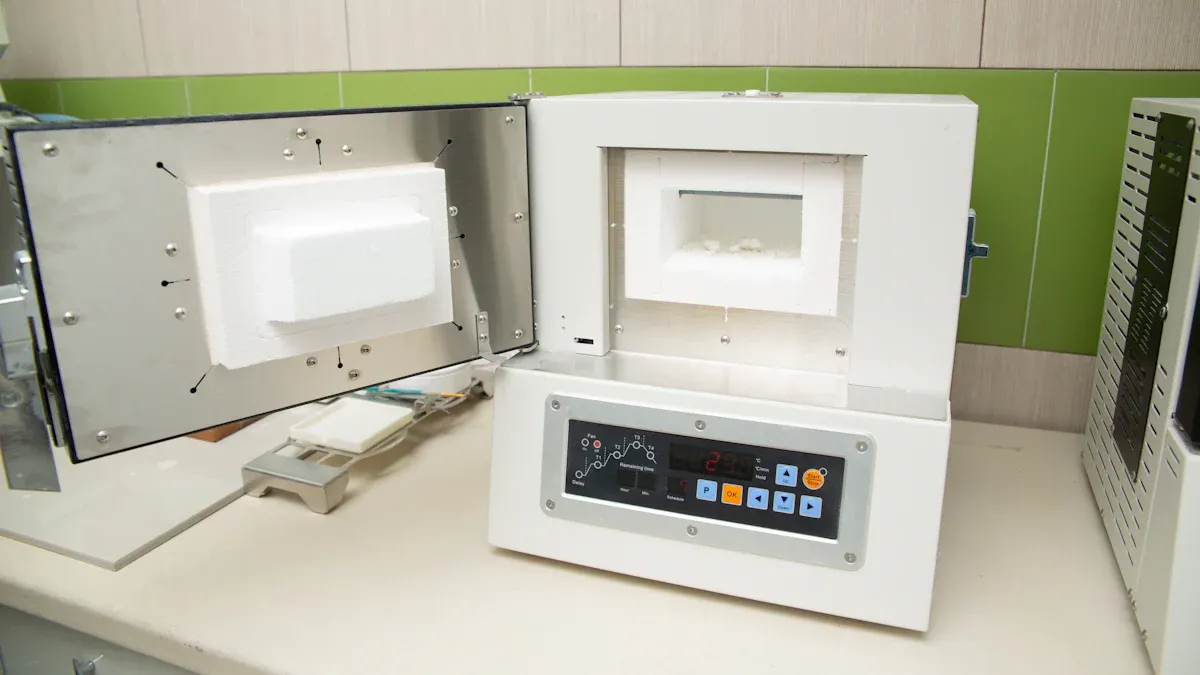
When you look inside a molybdenum high-temperature furnace, you find several important parts. Each one plays a special role in making the furnace work safely and efficiently. Here is a table that shows the main components and what they do:
| Component | Role |
|---|---|
| Furnace Body | Houses all components and provides structural integrity. |
| Lid | Facilitates access to the interior and helps control temperature gradients. |
| Bottom | Supports loading/unloading and includes an electrode extraction device for connectivity. |
| Heating Elements | Ensures uniform temperature distribution and maintains thermal efficiency. |
| Vacuum System | Maintains required vacuum levels for optimal operation. |
| Temperature Control System | Regulates and monitors temperature for consistent sintering processes. |
| Cooling System | Prevents deformation and deterioration of components after prolonged heating. |
You see that each part has a clear job. The furnace body and lid keep everything together and help control the heat. The heating elements, made from molybdenum, give you even temperatures. The vacuum system keeps air out, which protects your materials from oxidation. The temperature control system lets you set and monitor the heat. The cooling system keeps the furnace safe after long periods of use.
You also find that different materials make up these parts. Here is another table that shows what materials you might see in a molybdenum high-temperature furnace:
| Component | Material Used | Purpose |
|---|---|---|
| Furnace Body and Lid | High-grade stainless steel | Maintains vacuum and structural integrity |
| Heating Elements | High-purity molybdenum | Achieves and maintains high temperatures |
| Insulation Screens | N/A | Minimizes heat loss and ensures uniformity |
| Vacuum System | N/A | Maintains vacuum environment and controls atmosphere |
You often see other materials like tungsten, alumina ceramic, quartz glass, graphite, and refractory metals such as platinum and silicon carbide. Each material helps the furnace handle high heat and tough conditions.
Properties of Molybdenum
Molybdenum stands out because of its special properties. When you use it in a furnace, you get several benefits:
- Molybdenum forms a protective layer of molybdenum trioxide (MoO3) at high temperatures. This layer stops further oxidation.
- It keeps its strength and does not become brittle unless you heat it above 1700°C (3100°F). This means it can handle tough jobs without breaking.
- Molybdenum has good thermal conductivity. This property helps spread heat evenly, which is important for your work.
- You get low thermal expansion with molybdenum. This means the metal does not change shape much when you heat it up.
- Molybdenum resists softening at high temperatures. It stays strong even in very hot conditions.
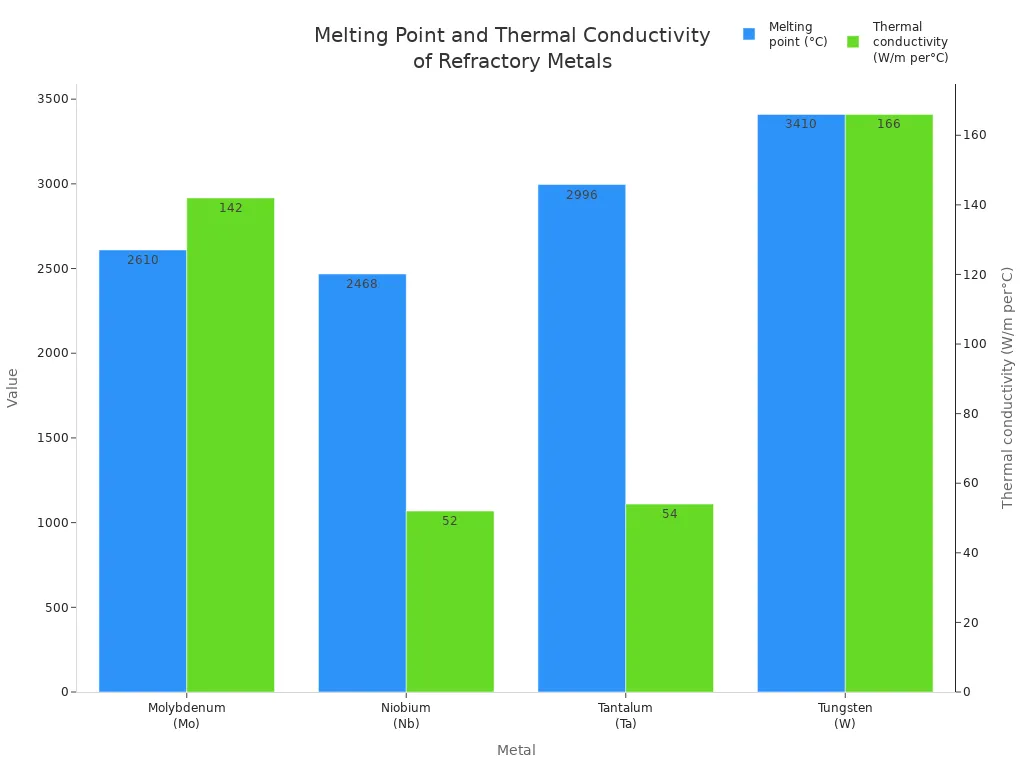
You can compare molybdenum to other metals used in furnaces. The chart below shows how it matches up with niobium, tantalum, and tungsten:
| Property | Molybdenum (Mo) | Niobium (Nb) | Tantalum (Ta) | Tungsten (W) |
|---|---|---|---|---|
| Melting point (°C) | 2610 | 2468 | 2996 | 3410 |
| Thermal conductivity (W/m°C) | 142 | 52 | 54 | 166 |
You see that molybdenum has a high melting point and excellent thermal conductivity. These features make it a top choice for high-temperature furnaces.
Advantages in Furnace Construction
When you choose a molybdenum high-temperature furnace, you get several advantages over other types. Here are some of the main benefits:
| Advantage | Description |
|---|---|
| Oxidation Resistance | Molybdenum disilicide heating elements have a protective silicon dioxide layer that enhances longevity. |
| Durability and Longevity | These elements are robust and can withstand high temperatures, leading to a longer service life. |
| Efficient Heating | They provide uniform heating, crucial for processes needing precise temperature control. |
| High-Temperature Performance | MoSi2 elements operate effectively at temperatures up to 1800°C, outperforming alternatives like silicon carbide. |
You also get a furnace that lasts longer and needs less maintenance. Molybdenum forms a protective layer that stops oxidation. It keeps its strength even after many heating cycles. The good thermal conductivity means you get even heating, which helps prevent damage to your materials.
Tip: Regular inspections of the heating elements and connections help you keep your furnace running smoothly. You can repair damaged heating elements up to three times if you follow safety steps.
When you use a molybdenum high-temperature furnace, you benefit from its strong, reliable design. You get efficient heating, long life, and protection against oxidation. These features make it a smart choice for demanding jobs.
Working Principles of Molybdenum High-Temperature Furnaces
Heating Elements and Temperature Generation
When you use a molybdenum high-temperature furnace, you rely on special heating elements to reach extreme temperatures. These elements often use molybdenum or molybdenum disilicide. You find these materials in both industrial and laboratory furnaces because they can handle very high heat and provide even warmth throughout the chamber.
Molybdenum heating elements work by turning electrical energy into heat. As electricity flows through the element, its resistance causes it to heat up. This process allows the furnace to reach temperatures up to 1700°C (3100°F). If you use Kanthal® Super HT MoSi2 elements, you can reach even higher temperatures, up to 1830°C (3330°F). The table below shows the maximum operating temperatures for different materials:
| Material | Maximum Operating Temperature (°C) | Maximum Operating Temperature (°F) |
|---|---|---|
| Molybdenum | 1700 | 3100 |
| Kanthal® Super HT MoSi2 | 1830 | 3330 |
You benefit from these heating elements because they resist oxidation and last a long time, even in tough environments. They also spread heat evenly, which helps you get consistent results in your work.
- Molybdenum heating elements are used in vacuum furnaces due to their oxidation resistance and high melting point.
- They are suitable for industrial and laboratory furnaces, providing uniform heat distribution.
- Their design allows for use in high-temperature oxidation environments, ensuring longevity.
Temperature Control and Monitoring
You need precise control over temperature when you work with a molybdenum high-temperature furnace. Modern furnaces use advanced systems to help you set, monitor, and adjust the heat. These systems include computer automation, programmable logic controllers (PLC), and user-friendly touch screens.
- Computer automation lets you manage and monitor temperature and pressure with special software. This reduces mistakes and keeps your process accurate.
- PLC systems automate heating and cooling steps. You can watch and change settings in real time.
- Remote monitoring allows you to adjust the furnace from a safe distance.
- Energy efficiency improves because the system can change power use automatically.
- Data logging records each cycle. You can review this data for quality checks or reports.
- Touch screen panels make it easy for you to operate and check the furnace.
For temperature monitoring, you often use infrared (IR) sensors. These sensors measure heat without touching the material, and they respond quickly. Some systems use advanced algorithms that reach up to 96% accuracy. This means you can trust the readings and keep your process stable.
Tip: Always check your temperature sensors before starting a new cycle. This helps you avoid errors and keeps your results reliable.
Vacuum and Atmosphere Management
You must control the atmosphere inside your furnace to protect your materials. A molybdenum high-temperature furnace often works in a vacuum or with a special gas. This setup keeps oxygen and other reactive gases away from your work, which prevents contamination and oxidation.
The vacuum system uses pumps, valves, and gauges. These parts work together to remove air and keep the right pressure. You can reach very low pressures, sometimes better than 5 x 10^-6 mbar. Most operations run between 10 and 1000 mbar. When you need a pure gas atmosphere, the vacuum system helps you achieve it.
- Molybdenum vacuum furnaces operate in a vacuum or controlled atmosphere to prevent contamination.
- The vacuum environment eliminates oxygen and other reactive gases, preserving material purity.
- The vacuum system includes pumps, valves, and gauges that work together to maintain necessary vacuum levels.
- The highest purity gas atmosphere is achieved due to the vacuum capability.
You get a clean and controlled environment, which is important for high-quality results. By managing the vacuum and atmosphere, you protect your materials and improve the performance of your furnace.
Performance Characteristics of Molybdenum High-Temperature Furnaces
Temperature Stability and Uniformity
When you use a molybdenum high-temperature furnace, you get strong temperature stability and even heat. This is important for processes like sintering, where you need steady and uniform heat. Molybdenum can handle temperatures up to 1700°C. Its high thermal conductivity helps spread heat quickly and evenly across the chamber.
- You can reach very high temperatures without large swings.
- The furnace keeps the same temperature for long periods.
- Heat spreads evenly, so your materials get the same treatment everywhere.
Design features help with this uniformity. Look at the table below to see how different parts work together:
| Design Feature | Contribution to Temperature Uniformity |
|---|---|
| Heating Elements | Made from high-purity molybdenum for efficient heat distribution |
| Insulation Screens | Optimized to maintain stable temperature and reduce heat loss |
Insulation materials like tungsten and stainless steel also help keep the temperature steady and reduce heat loss.
Energy Efficiency
You want your furnace to save energy and lower costs. Modern molybdenum high-temperature furnaces use several smart features to do this:
- Advanced insulation materials keep heat inside and cut down on waste.
- Cooling systems use waste heat, making the process more efficient.
- Intelligent control systems adjust energy use to match your needs.
- New designs focus on reducing waste and improving recycling.
- Many furnaces now meet international energy standards.
Some companies even explore renewable energy sources to power these furnaces. These steps help you use less energy and protect the environment.
Tip: Regularly check your insulation and control systems. This helps you keep your furnace running efficiently.
Contamination Prevention
Keeping your materials clean is very important. The vacuum system in a molybdenum high-temperature furnace removes air and keeps out oxygen. This stops oxidation and keeps your work pure. The system uses pumps, valves, and gauges to create the right vacuum level.
Common sources of contamination include molybdenum oxides and air leaks. The table below shows where problems can start:
| Contamination Source | Description |
|---|---|
| Molybdenum Oxides | The presence of molybdenum trioxide (MoO3) on heat shields indicates contamination, which is difficult to clean. |
| Air Infiltration | A common source of contamination is the front door 'O' ring, which may allow air to enter the system when it is not functioning properly. |
You can prevent most contamination by checking seals and cleaning heat shields. This keeps your furnace and your materials safe.
Applications and Configurations of Molybdenum High-Temperature Furnaces
Industrial Uses
You find molybdenum high-temperature furnaces in many industries. These furnaces help you create products that need very high heat and clean environments. Here are some main uses:
- In the ceramics industry, you use these furnaces to make high-quality ceramics. The furnace can reach up to 2400°C, which prevents oxidation and keeps your ceramics pure.
- Metallurgy relies on these furnaces for melting and heat-treating metals that need to stay strong at high temperatures. You improve the purity and strength of metals like tungsten and tantalum.
- Electronics manufacturing uses these furnaces to produce semiconductor devices. You need precise temperature control and a clean space to avoid contamination.
- Special material treatments, such as brazing, nuclear fuel processing, and glass melting, also depend on these furnaces. You get high-quality results for each application.
Tip: When you need to keep materials pure and strong, choose a molybdenum high-temperature furnace.
Common Furnace Configurations
You can pick from several furnace configurations to match your needs. Each type has a special shape and use. The table below shows the most common configurations:
| Configuration | Description | Applications |
|---|---|---|
| Wire | Thin, flexible, good for compact heating | Compact furnaces |
| Rod | Rigid, strong, used in high-temperature furnaces | High-temperature jobs |
| Strip | Flat, wide, spreads heat evenly for surfaces | Surface heating |
| Tubes | Hollow, best for heating inside or gas flow | Internal heating tasks |
You see that each configuration helps you solve different heating problems. For example, you use tube furnaces in research labs for crystal growth or chemical reactions.
Application Selection Criteria
When you choose a furnace, you look at several factors. These factors help you match the furnace to your job. The table below explains how different aspects affect performance:
| Configuration Aspect | Impact on Performance and Suitability |
|---|---|
| Size | Decides how much material you can process at one time |
| Loading Method | Changes how easy and fast you can load or unload materials |
| Chamber Design | Affects how heat spreads and the quality of your results |
- You use molybdenum vacuum furnaces for heat treatment and sintering because they give you precise temperature control.
- Tube furnaces work well in science labs for tasks like calcination and crystal growth.
Note: Always match the furnace configuration to your process needs. This helps you get the best results and keeps your work efficient.
Maintenance and Future Trends for Molybdenum High-Temperature Furnaces
Routine Maintenance
You need to keep your molybdenum high-temperature furnace in good shape to get the best results. Regular checks help you spot problems early. Clean the heating elements and chamber to remove dust or debris. Inspect seals and gaskets for any signs of wear. Replace them if you see cracks or leaks. Check the vacuum system and make sure pumps and valves work well. Test the temperature sensors before each use. Lubricate moving parts as needed. Keep a maintenance log to track repairs and inspections. This routine helps you avoid costly breakdowns and keeps your furnace running safely.
Tip: Schedule maintenance during downtime to prevent interruptions in your work.
Limitations and Challenges
You may face some challenges when using a molybdenum high-temperature furnace. Molybdenum can oxidize if exposed to air at high temperatures. You must keep a strong vacuum or use a protective gas. The cost of molybdenum and its parts can be high. Handling and replacing heating elements takes skill. The furnace needs careful setup to avoid contamination. Sometimes, you may find it hard to get replacement parts quickly. These challenges mean you must plan ahead and follow safety steps.
Innovations and Future Developments
You will see many new features in modern molybdenum high-temperature furnaces. Recent designs use intelligent control systems. You can now use advanced PLC systems and touch-screen panels for better control. Many furnaces offer customizable setups with special modules for different jobs. New insulation materials and cooling systems help save energy and keep the furnace cool.
Here is a table that shows future trends for these furnaces:
| Category | Description |
|---|---|
| Efficiency Improvements | New heating elements and insulation lower energy use and keep heat even. |
| New Applications | You can use these furnaces in fields like additive manufacturing and advanced ceramics. |
| Material Innovations | New molybdenum alloys and composites work better at high temperatures. |
| Environmental Considerations | Designs now focus on using less energy and making less impact on the environment. |
You can expect more changes as technology grows. These updates will help you work faster, save energy, and use your furnace in new ways.
You now understand how molybdenum high-temperature furnaces work. These furnaces use strong materials and smart designs to reach extreme heat. You get reliable performance, energy savings, and clean results. Many industries trust these furnaces for ceramics, metals, and electronics. When you need steady heat and pure products, you can count on molybdenum furnaces to meet tough demands.
Remember: Choosing the right furnace helps you achieve the best results in challenging environments.
See Also
Assessing Molybdenum Inserts for Steel Pipe Manufacturing in 2025
Comprehensive Overview of Plate Heat Exchanger Functionality
Ways to Reduce Environmental Impact Using Heat Exchangers
Unexpected Techniques for Diagnosing Sulfur Recovery Catalysts