Breakthroughs in Heat Exchanger Production Enhance Industrial Performance
Recent advancements in the manufacturing of heat exchangers have revolutionized industrial performance. Industries now benefit from innovations such as artificial intelligence, biomimetic designs, and additive manufacturing. These technologies deliver increased efficiency and energy savings. The adoption of advanced heat exchanger technology results in enhanced manufacturing processes, improved efficiency, and superior operational performance.
Limitations of Traditional Heat Exchanger Technology
Common Inefficiencies and Performance Barriers
Traditional heat exchanger technology faces several well-documented inefficiencies that hinder industrial operations. Engineers often encounter the following issues:
- Vibration problems that can damage internal components
- Leakage, which leads to energy loss and safety concerns
- Increased energy consumption during operation
- Pass partition bypassing, resulting in thermal leakage
- Air cooler air recirculation, reducing overall effectiveness
- Fouling, which decreases heat transfer rates over time
These barriers limit the efficiency and performance of conventional systems. In many cases, the outlet temperature of the cold fluid cannot exceed the inlet temperature of the hot fluid, and the outlet temperature of the hot fluid cannot drop below the inlet temperature of the cold fluid. These constraints restrict the range of applications for traditional heat exchangers, especially when comparing traditional vs. modern designs.
Durability and Maintenance Challenges
Inspections of installed heat exchangers are often difficult to perform due to the impact on process operations and limited access ports to internal heat transfer surfaces. Even if inspections are performed, the scope is often limited, and correlation between visual inspection results and fouling resistance is often not accurate.
The integral components of heat exchangers, particularly the tubes, tubesheets, and tube-to-tubesheet joints, play vital roles in the proper functioning of this equipment. Frequent instances of premature failures at the tube-to-tubesheet joints have resulted in significant investment losses. Proper regular online and offline inspections of heat exchangers are essential to predict their effectiveness and performance.
Constraints in Customization and Compactness
Traditional heat exchangers, such as shell-and-tube models, require larger physical sizes to achieve necessary heat transfer. This design limits customization and makes it difficult to install in space-constrained environments. Modern alternatives, including plate heat exchangers, offer greater efficiency and compactness, highlighting the advantages of updated engineering approaches.
Advanced Materials in the Manufacturing of Heat Exchangers
Graphene and Carbon Nanotubes for Enhanced Efficiency
Recent advancements in the manufacturing of heat exchangers have introduced graphene and carbon nanotubes as transformative materials. These carbon-based nanomaterials possess exceptional thermal properties, making them ideal for improving heat transfer efficiency in industrial applications. Researchers have demonstrated significant performance gains by incorporating these materials into heat exchanger design.
| Study | Nanoparticles Used | Findings |
|---|---|---|
| Balaga et al. | f-MWCNTs (60%), Fe2O3 (40%) | Heat transfer enhancement of 21.66 to 31.66% with increased nanoparticle concentration. |
| Hemmat Esfe et al. | MWCNT/CuO/SiO2 | Thermal conductivity increases of 37.10% and 16.20% compared to base fluid. |
Engineers value carbon-based nanofluids for their ability to boost system efficiency and performance. Graphene and carbon nanotubes feature large aspect ratios and unique physical and chemical properties, which contribute to superior heat transfer surfaces. These materials enable shell-and-tube heat exchangers to achieve higher heat transfer efficiency, supporting more compact and customizable heat exchanger design.
- Carbon-based nanofluids improve system efficiency and performance.
- CNTs and graphene offer unique physical and chemical properties.
- Enhanced thermal conductivity leads to better heat exchanger technology.
Corrosion-Resistant Alloys and Composites
The use of corrosion-resistant alloys and composites marks a significant advancement in heat exchanger technology. These advanced materials extend the lifespan of heat exchangers and reduce maintenance requirements. Stainless steel, nickel alloys, titanium, and certain copper alloys form protective layers that resist corrosive attacks, ensuring durability in harsh environments.
| Application Area | Benefits of CRAs |
|---|---|
| Chemical Processing | Resists strong acids, bases, and oxidizing chemicals, ensuring durability. |
| Energy | Essential for components exposed to high temperatures and chemically aggressive fluids. |
| Maintenance | Reduces maintenance needs and extends service life in challenging environments. |
Shell-and-tube heat exchangers benefit from these materials, especially in chemical processing and energy sectors. The adoption of corrosion-resistant alloys supports reliable heat exchanger design and minimizes downtime. Engineers select these advanced materials to maintain optimal heat transfer efficiency and reduce lifecycle costs.
- Stainless steel, nickel alloys, titanium, and copper alloys provide excellent corrosion resistance.
- These materials ensure long-term durability and reduce maintenance cycles.
Improved Energy Efficiency and Longevity
Advanced materials have redefined energy efficiency and operational longevity in the manufacturing of heat exchangers. Technologies such as HeatX reduce surface fouling and buildup, maintaining optimal heat transfer rates over extended periods. This improvement in heat transfer efficiency translates to fewer shutdowns and lower lifecycle costs.
- HeatX technology maintains optimal heat transfer rates and enhances thermal efficiency.
- Reduced cleaning requirements contribute to improved energy efficiency.
- Prevention of common damage mechanisms extends operational uptime and longevity.
Additive manufacturing enables the creation of complex heat exchanger design structures, such as TPMS gyroid and diamond lattices. These designs offer high surface area and load-bearing capabilities, further improving heat transfer efficiency and structural integrity. Engineers leverage these advancements to produce shell-and-tube heat exchangers with superior performance and reliability.
| Material Type | Examples | Key Properties |
|---|---|---|
| Metals | Copper, Aluminum, Stainless Steel | Excellent thermal conductivity, durability |
| Alloys | Nickel alloys, Titanium alloys | Environmentally friendly properties |
| Brazing Clad Materials | Copper brazing, Silver brazing | Enhanced corrosion resistance, thermal conductivity |
Tip: The integration of advanced materials in heat exchanger technology supports higher efficiency, longer service life, and greater adaptability for demanding industrial environments.
Innovative Geometries Enhancing Efficiency
Twisted-Tube and Microchannel Designs
Engineers have embraced twisted-tube and microchannel heat exchangers to address the limitations of conventional designs. Twisted-tube configurations create secondary flows, which disrupt boundary layers and enhance heat transfer. Microchannel heat exchangers use small hydraulic diameters to maximize surface area, resulting in rapid thermal exchange and reduced material usage.
Recent studies demonstrate the advantages of these innovative designs:
| Study Title | Key Findings | Performance Improvement |
|---|---|---|
| Enhancing heat exchanger performance with combined twisted tubes and twisted tapes | Up to 15% reduction in pressure drop compared to conventional heat exchangers | Pressure Drop Reduction |
| Thermohydraulic performance of twisted tubes with different cross-sectional shapes using supercritical CO2 | Significant enhancement in heat transfer and lower pressure drop | Heat Transfer Efficiency |
| Design, Fabrication and Performance of Twisted Tube Heat Exchanger | Improved heat transfer performance while controlling pressure drop | Heat Transfer Performance |
Twisted-tube designs not only improve heat transfer but also help control pressure drop, which is critical for energy savings. Microchannel heat exchangers, with their compact geometry, support high-density applications and enable integration into modern, space-constrained systems. These advances in design allow for greater flexibility and pave the way for customised heat exchanger designs that meet specific industrial requirements.
Plate Heat Exchangers and SHPHE Solutions
Plate heat exchangers have transformed industrial heat transfer by offering a modular, high-surface-area approach. The design consists of thin, corrugated plates stacked to form channels for fluid flow. This configuration increases turbulence, which boosts heat transfer rates and minimizes fouling.
Cleaning remains essential for maintaining efficiency. When fouling occurs, thermal resistance rises, making it harder for the refrigerant to transfer heat. This leads to higher flow rates and pressures, which increases energy consumption. Self-cleaning plate heat exchanger (SHPHE) solutions address this challenge by minimizing fouling and simplifying maintenance.
| Advantage | Description |
|---|---|
| Compact Design | SPHEs are significantly more compact, reducing internal space volume by 60% compared to STHEs. |
| Enhanced Heat Transfer | Heat transfer coefficients improve with velocity, beneficial for viscous fluids. |
| Reduced Fouling | The design minimizes fouling, as solids are less likely to settle in the single flow channel. |
| Ease of Cleaning | The design allows for effective chemical cleaning and straightforward mechanical cleaning. |
| Thermal Stress Management | The spiral design mitigates stress from uneven thermal expansion. |
| Lower Maintenance Costs | Reduced maintenance needs lead to long-term cost savings. |
Shanghai Heat Transfer Equipment Co., Ltd. (SHPHE) has advanced this technology with a comprehensive range of plate heat exchangers, including welded, gasketed, and wide gap models. Their solutions deliver high efficiency, compactness, and durability, making them ideal for demanding sectors such as oil and gas, chemical processing, and new energy. The modular design also supports rapid installation and easy scalability.
Compact and Modular Configurations
The demand for compact and modular heat exchanger configurations continues to rise in modern industry. These designs offer several advantages:
- Compact heat exchangers contribute to energy savings and high-efficiency utilization.
- There is a growing demand for heat exchangers that align with ecological and economic sustainability principles.
- Compact plate heat exchangers provide a minimal footprint, making them suitable for space-constrained environments.
- They offer quick thermal response, which is essential for temperature-sensitive applications.
- Gasketed plate and frame heat exchangers help balance energy demand and reduce system losses in various applications.
Innovative geometric designs further enhance performance. Engineers now use highly conductive periodic open cellular structures, 3D-printed fins, and nature-inspired patterns to improve heat transfer. Additive manufacturing enables complex 3D geometries, which can outperform traditional heat exchangers by 30% to 50%. Topology optimization expands the design space, allowing for practical fabrication and improved efficiency across industries.
| Design Type | Heat Transfer Rate Improvement | Friction Factor Increase | Nusselt Number Increase |
|---|---|---|---|
| TPMS | 2–3 times over traditional | 3–10 times higher | 1–15 times under laminar flow |
| Schwarz-D | 41–52% higher than others | N/A | N/A |
| Fischer-Koch | 358.4% increase | N/A | N/A |
| Gyroid | 178.1% increase | N/A | N/A |
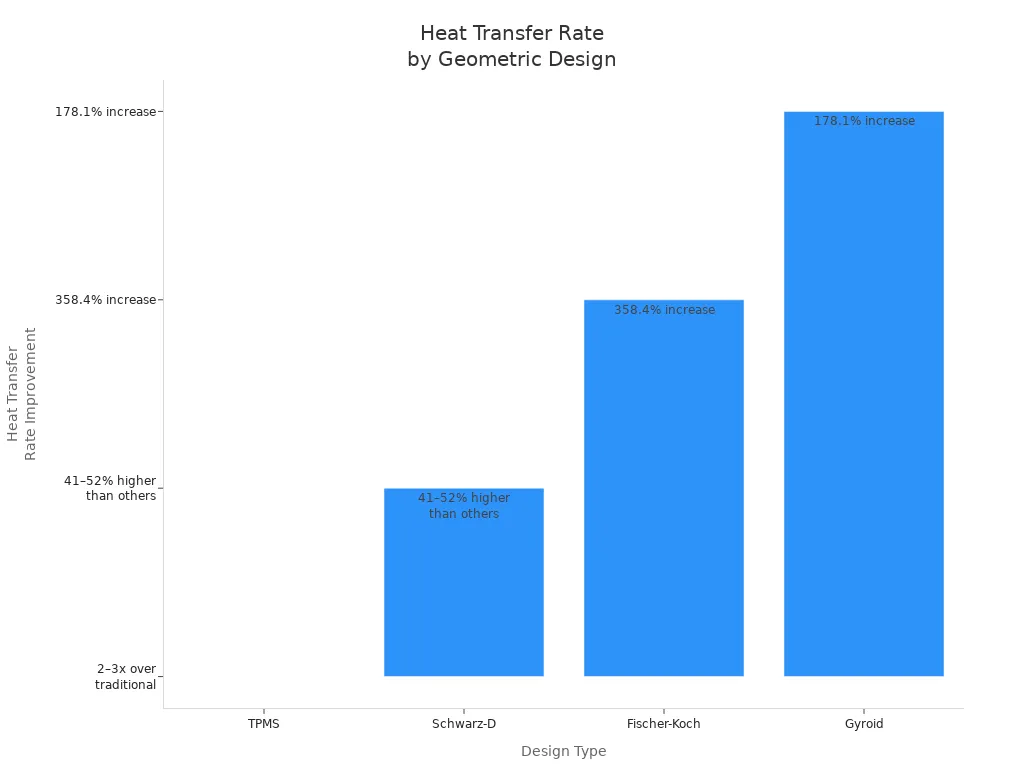
Note: Additive manufacturing and conformal geometric design allow for the integration of fin structures, which further enhances convective heat transfer performance.
The combination of compactness, modularity, and advanced geometric design positions modern heat exchangers as essential components for next-generation industrial systems. These innovations support optimization, sustainability, and adaptability in a rapidly evolving technological landscape.
Cutting-Edge Manufacturing Methods for Heat Exchanger Technology
Additive Manufacturing and 3D Printing
Additive manufacturing has transformed the manufacturing of heat exchangers. Engineers now create intricate geometries that maximize surface area and thermal performance. 3D printing enables rapid prototyping and customization, reducing production costs and lead times. Several case studies highlight the impact of this technology:
| Case Study | Industry | Key Findings |
|---|---|---|
| GE UPHEAT Project | Aerospace & Energy | Metal AM heat exchanger operates above 900 °C and 3,600 psi, supporting cleaner power generation. |
| Conflux Technology | Automotive & Aerospace | Monolithic design achieves over 30% higher thermal efficiency, reduces weight, and simplifies maintenance. |
| University of Glasgow Gyroid HX | Research & Prototyping | Gyroid structure delivers ~50% higher effectiveness at one-tenth the size of conventional designs. |
- SyBridge Project: 3D printed heat exchangers using Carbon DLS™ process show double the heat transfer and lower costs.
Expanded Metal Baffles and Advanced Joining
Manufacturing advances include expanded metal baffles and innovative joining techniques. These improvements enhance heat exchanger technology by increasing durability and optimizing flow patterns. Studies demonstrate the effectiveness of these methods:
| Study | Findings |
|---|---|
| Sadeghianjahromi et al. | Examined chevron angles and brazing joints for better heat transfer and pressure drop. |
| Picón-Núñez and Rumbo-Arias | Welded crossflow heat exchangers can reduce energy use by 25%. |
| Hashimoto et al. | Ni–P plating as brazing filler metal improves corrosion resistance. |
| Deep et al. | Tungsten inert gas welding boosts mechanical properties in stainless steel. |
Engineers also use electroless coatings and fatigue testing to extend the lifespan of plate-and-shell heat exchangers.
Automation and Precision Engineering
Automation now plays a vital role in the manufacturing of heat exchangers. Robotics and smart assembly lines ensure consistent quality and lower costs. Automated machines perform repetitive tasks with high precision, minimizing human error. Quality control systems detect defects early, reducing waste and improving reliability. The integration of AI in enthalpy exchanger systems enables real-time monitoring and predictive analytics. Manufacturers optimize performance and energy recovery by adjusting operations based on data insights.
Tip: Smart and adaptive controls, IoT integration, and nanotechnology represent significant advancements in manufacturing, supporting higher efficiency and sustainability.
Real-World Applications Demonstrating Efficiency
Power Generation: Maximizing Output and Reliability
Power generation facilities rely on advanced heat exchangers to maintain high performance and operational efficiency. Engineers use shell-and-tube heat exchangers to restore output by removing scale buildup, which improves heat transfer. The Hawaiian Electric Company applied HeatX technology, achieving a 97% reduction in fouling. This led to substantial efficiency gains and cost savings. The table below highlights these improvements:
| Example | Description | Efficiency Gain |
|---|---|---|
| Shell-and-tube heat exchanger | Cleaning restores heat transfer and boosts power output. | Improved operational efficiency |
| HeatX application at HECO | Significant reduction in fouling, leading to better performance. | 97% reduction in fouling |
Engineers also deploy heat exchangers in solar thermal energy and carbon capture, maximizing energy conversion and supporting environmental goals.
HVAC Systems: Improving Energy Efficiency
Modern HVAC systems integrate next-generation heat exchangers to enhance energy efficiency and operational efficiency. Facilities use microchannel heat exchangers, finned tube designs, and spiral configurations to optimize thermal transfer and minimize system size. Automated controls and IoT components enable precise operation, improving comfort and reducing energy consumption. The following technologies demonstrate these advancements:
- Cold climate heat pumps operate efficiently in subzero temperatures, replacing fossil fuel systems.
- Automated controls optimize HVAC operation using real-time data.
- Microchannel heat exchangers improve thermal transfer and reduce refrigerant charge.
- Finned tube heat exchangers increase surface area for better heat transfer.
- Spiral heat exchangers enhance fluid mixing and heat transfer rates.
- Air-to-air heat exchangers recover waste heat, improving energy efficiency.
- Phase change materials store latent heat, increasing operational efficiency during peak loads.
These solutions support sustainability and align with climate goals.
Chemical Processing: Enhancing Safety and Throughput
Chemical processing plants benefit from advanced heat exchangers that improve operational efficiency, safety, and throughput. Engineers implement performance monitoring and predictive maintenance software to manage fouling. Dynamic fouling models assess network performance, while tube inserts mitigate fouling and enhance operational efficiency. Safety metrics, such as Safety Rating (SR), help assess overpressure risks. Optimization-based Heat Exchanger Network Synthesis (HENS) ensures safe configurations and minimizes costs.
| Aspect | Description |
|---|---|
| Safety Metrics | Safety Rating (SR) assesses overpressure risks in heat exchanger designs. |
| Methodology | HENS includes safety considerations for optimal network synthesis. |
| Outcome | Achieves safe configurations and cost minimization, enhancing operational efficiency. |
Chemical and petrochemical industries use these technologies to manage extreme conditions, ensuring product quality and safety.
Future Trends in the Manufacturing of Heat Exchangers
Smart Sensors and IoT Integration
Smart sensors and IoT integration are reshaping heat exchanger management. Engineers deploy IIoT sensors for continuous monitoring, which improves long-term performance tracking. Wireless temperature sensors can be added to existing systems, enhancing monitoring capabilities. Advanced IIoT technology now includes adaptive models and knowledge-based diagnostics, supporting effective performance management. Self-powered IoT sensors, such as triboelectric nanogenerators, deliver energy-efficient thermal monitoring. IoT-enabled flow calorimeters increase the accuracy of thermal property assessments in solar and geothermal applications. These innovations allow real-time heat transfer management and support energy recovery in renewable energy systems.
Sustainable and Eco-Friendly Manufacturing
Manufacturers are prioritizing sustainable operations and environmental sustainability. Facilities have achieved a 12% reduction in energy intensity and a 35% decrease in natural gas consumption by implementing heat recovery systems and leak detection programs. Counter-flow rinsing systems have led to a 40% reduction in water consumption and significant savings in chemical usage. Vision-assisted verification systems have reduced rework rates by 65% and material waste by 15%. These practices enhance product quality and operational efficiency, supporting sustainability and energy recovery goals.
Emerging Technologies and Ongoing Research
Ongoing research continues to drive innovation in heat exchanger technology. Interconnected and intelligent manufacturing systems enable real-time monitoring and predictive maintenance. Engineers focus on eco-friendly designs that minimize material waste and utilize renewable energy sources. The table below highlights challenges and opportunities for next-generation heat exchangers:
| Challenges | Opportunities |
|---|---|
| Suboptimal designs lead to thermal inefficiencies | Innovations in materials enhance performance |
| Corrosion and fouling reduce efficiency | Advanced designs prioritize compactness and scalability |
| Large systems are difficult to retrofit | Smart technologies enable predictive maintenance |
| High initial costs hinder adoption | Sustainability drives innovation and efficiency |
| Specialized knowledge required for maintenance | Hybrid systems combine multiple technologies |
Industry analysts predict that compact designs, advanced materials, and integration with renewable energy systems will shape the future. The expansion of HVAC and refrigeration industries, along with rising energy demand, will continue to drive energy recovery and sustainability efforts.
Recent innovations in heat exchanger technology drive efficiency and industrial performance across sectors. Engineers leverage advanced manufacturing techniques and materials to create compact, energy-saving solutions. The table below highlights industry trends:
| Statistic/Forecast | Description |
|---|---|
| Global Energy Use | Industrial energy consumption accounts for approximately 37% of global final energy use. |
| Market Growth Rate | The heat exchanger market in India is expected to grow at a CAGR of 8.9% from 2025 to 2033. |
| Technological Impact | Continuous advancements in heat exchanger design and materials are enhancing performance and expanding applications. |
Innovations in plate design, additive manufacturing, and smart sensors continue to reshape the market. Experts note that additive manufacturing enables complex heat exchanger geometries, while modern gasketed plate heat exchangers improve energy efficiency. Innovations in compact configurations optimize mechanical room space and support energy conservation. The demand for heating and cooling solutions rises as industries focus on harnessing waste heat and meeting energy efficiency standards. Innovations in flow management, hydraulic performance, and thermal transfer will define the next generation of heat exchangers. Engineers anticipate that future innovations will further enhance efficiency, sustainability, and adaptability.
FAQ
What industries benefit most from advanced plate heat exchangers?
Oil and gas, chemical processing, metallurgy, food production, and new energy sectors see significant efficiency gains and reliability improvements with advanced plate heat exchangers.
How does SHPHE ensure the durability of its heat exchangers?
SHPHE uses corrosion-resistant alloys and advanced manufacturing techniques. These methods extend product lifespan and reduce maintenance needs in demanding industrial environments.
What role does digital monitoring play in heat exchanger performance?
Digital monitoring systems, such as SHPHE’s Smart Eye, provide real-time data. This technology enables predictive maintenance and ensures optimal heat exchanger operation throughout its lifecycle.