You Won't Believe How Nickel 200 Flanges Are Made Now
Modern manufacturing integrates a trio of powerful technologies to produce today's Nickel 200 Flanges. These advanced innovations deliver components with superior strength, flawless dimensional accuracy, and unmatched reliability. The precision achieved with this digital-first approach elevates performance standards for critical components, including the Monel 400Flange.
Key Technologies Driving Innovation:
- 3D Model-Guided Closed-Die Forging
- Multi-Axis CNC Machining
- Advanced Non-Destructive Testing (NDT)
This combination ensures every flange meets the most demanding industrial requirements with guaranteed consistency.
Key Takeaways
- Modern Nickel 200 Flanges use advanced methods like 3D modeling and closed-die forging for strong, precise parts.
- Multi-axis CNC machines create perfect shapes and smooth surfaces for reliable, leak-proof connections.
- Advanced tests like PAUT and CMM ensure every flange is free from hidden flaws and meets exact size needs.
- Strict material checks and full tracking guarantee pure nickel and high quality for every flange.
- These new ways of making flanges mean they are more dependable and last longer in tough industrial jobs.
Innovation 1: Digital Precision in Forging
The foundation of a superior flange begins with the forging process. Modern manufacturing has moved beyond traditional methods, embracing digital technologies to create a stronger, more consistent product from the very start. This digital-first approach ensures that every flange possesses an ideal internal structure for maximum performance.
From Open-Die to Closed-Die Forging
Manufacturers now predominantly use closed-die forging for Nickel 200 Flanges. This technique uses two custom dies that completely enclose a heated nickel billet. A powerful press then forces the metal to fill every part of the die cavity. This process offers a significant advantage over older open-die methods.
The closed-die process refines the metal's grain structure. It induces metallurgical recrystallization, which realigns the grains. This controlled metal flow creates a directional "graininess," making the final part exceptionally strong and resistant to fatigue.
The Role of 3D CAD/CAM Modeling
Digital precision starts with a perfect blueprint. Engineers use 3D CAD (Computer-Aided Design) and CAM (Computer-Aided Manufacturing) software to design the flange and the forging dies. This virtual model allows for unparalleled complexity and optimization before any metal is heated. Designers can integrate intricate features directly into the flange, such as:
- Angled sections to clear other system components.
- Integrated mounts or ports to reduce leak paths.
- Configurable bolt patterns for various pressure ratings.
This digital approach also enables topology optimization, a technique that uses algorithms to remove unnecessary material. This significantly reduces waste and cost, which is especially important for high-value alloys.
Automated Temperature and Pressure Control
Consistency is key to quality. Modern forging presses are equipped with automated systems that provide real-time control over temperature and pressure. Sensors monitor these critical variables throughout the process, allowing for micro-adjustments that maintain optimal conditions. This automation eliminates the inconsistencies of manual monitoring. It produces clean, strong forgings free from defects like porosity, ensuring every flange meets the same high standard of quality and strength.
Innovation 2: The Revolution in Machining and Finishing
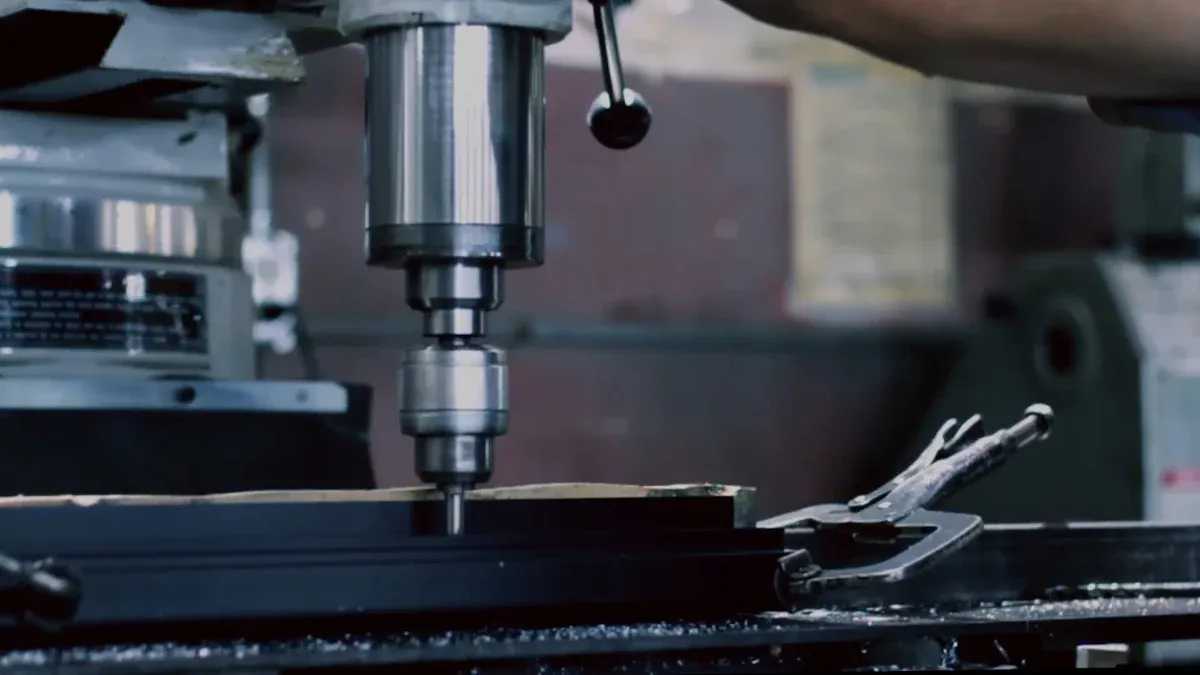
After forging creates a strong, near-net shape, precision machining transforms the raw part into a finished component with exacting tolerances. Modern machining and finishing technologies are automated, fast, and incredibly accurate, ensuring every flange performs flawlessly.
Multi-Axis CNC for Unmatched Accuracy
Modern facilities rely on multi-axis CNC (Computer Numerical Control) machines to achieve unparalleled dimensional accuracy. Unlike older three-axis machines, four- and five-axis mills add rotational axes. This allows the cutting tool to approach the workpiece from virtually any angle. These advanced machines complete complex geometries with fewer setups, which significantly reduces production time. While the hourly rate for a 5-axis machine may be higher, the ability to finish a part in a single run often makes it more cost-effective for intricate designs by minimizing labor and machine adjustments.
Perfecting Sealing Faces (RF/RTJ)
The most critical surface of a flange is its sealing face, as it ensures a leak-proof connection. CNC machining provides the precision needed to create perfect sealing surfaces on both Raised Face (RF) and Ring-Type Joint (RTJ) designs. These machines achieve the exact surface roughness required for optimal gasket performance.
ASME B16.5 Sealing Face Standards
- Raised Face (RF): The surface finish must have an average roughness (Ra) between 125 and 250 micro-inches. This is typically achieved with a spiral or concentric serrated finish.
- Ring-Type Joint (RTJ): These require precision-machined grooves with an even smoother finish to accommodate a metal ring gasket, guaranteeing a tight seal in high-pressure applications.
Automated Surface Finishing and Polishing
The final step involves automated surface finishing. This process is not just for aesthetics; it enhances the corrosion resistance of the base metal. Automated systems create a uniform and consistent finish across the entire surface of the Nickel 200 Flanges. Depending on the application's requirements, manufacturers can apply various finishes with robotic precision.
Common automated finishes include:
- Matte or Sand Brushed
- Bright Annealed (BA)
- Hairline
- Bright Black Polish
This automated approach guarantees that every flange leaves the factory with a flawless, protective, and specification-compliant surface.
Innovation 3: Next-Gen Quality Assurance for Nickel 200 Flanges
Modern manufacturing integrates quality assurance directly into the production workflow. After forging and machining, every flange undergoes a rigorous inspection process using next-generation technology. This ensures that the final Nickel 200 Flanges are free from defects and perfectly match the design specifications, guaranteeing reliability in the field.
Advanced Non-Destructive Testing (NDT)
Manufacturers use advanced Non-Destructive Testing (NDT) to inspect the internal structure of a flange without causing any damage. This critical step verifies the material's integrity after the intense pressures of forging. NDT methods can detect microscopic internal flaws, such as porosity or cracks, that are invisible to the naked eye. This process confirms that each flange possesses a solid, uniform internal structure capable of withstanding extreme operational demands.
Phased Array Ultrasonic Testing (PAUT)
Phased Array Ultrasonic Testing (PAUT) is a leading NDT technique for this purpose. This advanced method uses a probe with multiple small ultrasonic elements. A computer controls the timing of each element's pulse. This allows the system to electronically steer sound beams at different angles and depths into the material, creating detailed, accurate cross-sectional images of the flange's internal structure at high inspection speeds.
PAUT emits beams at multiple angles sequentially. This technique significantly increases the probability of detecting anomalies like cracks or corrosion, especially in complex geometries and nickel alloy welds.
Laser Scanning and CMM Verification
Dimensional accuracy is just as important as material integrity. Manufacturers use state-of-the-art measurement equipment like Coordinate Measuring Machines (CMMs) to verify every critical dimension against the original 3D CAD model. A high-precision probe on the CMM touches multiple points on the flange to confirm geometric dimensioning and tolerancing (GD&T).
Key CMM verification checks include:
- Bolt hole alignment validation: Ensures bolt holes are in their true positions for perfect mating.
- Roundness and flatness checks: Guarantees even contact for sealing faces.
- Verification of mating/sealing faces: Confirms the surface meets flatness specifications for a leak-proof seal.
This meticulous inspection process ensures every flange will fit perfectly and perform reliably upon installation.
Innovation 4: Material Integrity and Traceability
Ensuring the integrity of the raw material is just as crucial as the manufacturing process itself. Modern production protocols for Nickel 200 Flanges emphasize verifiable material purity and complete traceability. This guarantees that every component meets stringent industry standards for safety and performance.
Ensuring 99.6% Pure Nickel Composition
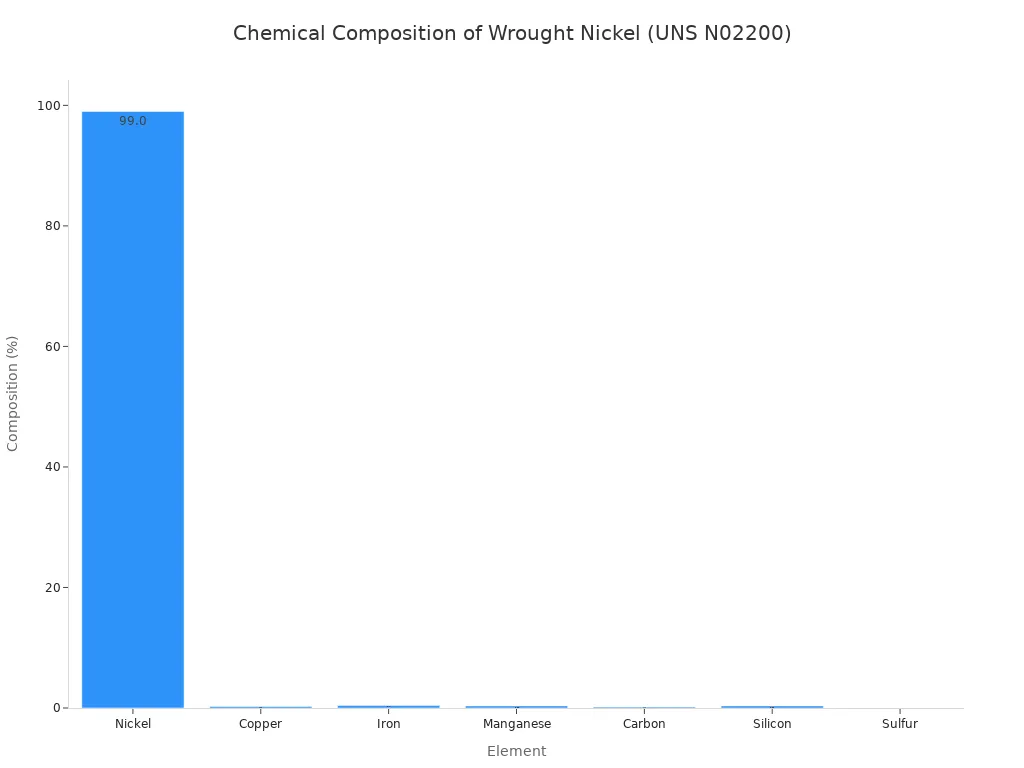
The performance of a flange hinges on its chemical makeup. Manufacturers must verify that the material is commercially pure wrought nickel, containing at least 99.6% nickel as specified by UNS N02200. To confirm this, they employ advanced analytical techniques.
X-Ray Fluorescence (XRF) is a primary method for this verification. An XRF analyzer offers a non-destructive way to confirm the elemental composition of nickel alloys with superior accuracy. Modern analyzers like the SciAps X-200 provide rapid, reliable results, ensuring the material meets the required purity levels before manufacturing even begins.
The chemical composition for UNS N02200 is strictly controlled to ensure its signature corrosion resistance and thermal conductivity.
Full Material Traceability from Start to Finish
Traceability is essential for quality control and accountability. Manufacturers implement digital traceability systems that track each flange from the raw material melt to the final product. This creates an unbroken chain of custody, which is vital for preventing counterfeit materials from entering the supply chain.
Every batch of material receives a unique heat number. This identifier is linked to a comprehensive Material Test Report (MTR). The MTR documents every critical detail, including:
- Heat Code: The unique number tracing the material to its origin.
- Chemical Analysis: A full breakdown of the material's elemental composition.
- Physical Properties: Data on tensile strength, yield strength, and hardness.
- Heat Treatment: Records of any thermal processes applied.
This digital record provides a verifiable history, assuring customers of the product's authenticity and quality.
Compliance with ASME and ASTM Standards
Adherence to industry standards is non-negotiable. Reputable manufacturers produce flanges in strict compliance with key specifications like ASTM B564 and ASME B16.5. ASTM B564 governs the requirements for nickel alloy forgings, defining their chemical and mechanical properties.
ASME B16.5 outlines the standards for pipe flanges and flanged fittings. It specifies critical details such as:
- Pressure-temperature ratings
- Materials and dimensions
- Tolerances and markings
- Testing and inspection requirements
By rigorously following these standards, manufacturers guarantee that every flange is safe, reliable, and fully interoperable with other compliant system components.
Key innovations like digital forging, multi-axis CNC machining, and advanced NDT have redefined manufacturing standards. These advancements provide end-users with flanges offering higher reliability, longer service life, and guaranteed leak-proof performance. Modern manufacturing makes Nickel 200 Flanges a more dependable, high-performance choice than ever for critical industrial applications.
Key Benefiting Industries:
- Chemical Processing: For superior corrosion resistance.
- Aviation & Aerospace: For high-temperature strength.
- Food Processing: For purity and resistance to acidic media.
- Electronics: For excellent electrical conductivity.
FAQ
Why is closed-die forging better for Nickel 200 flanges?
Closed-die forging produces a superior grain structure. The process forces the metal to conform to a precise die shape. This creates exceptional strength and high resistance to fatigue. It also results in a near-net shape, which minimizes material waste and subsequent machining time.
What is the purpose of Phased Array Ultrasonic Testing (PAUT)?
PAUT is an advanced non-destructive test. It inspects the flange's internal structure for microscopic defects like cracks or porosity. This method uses multiple ultrasonic beams to create a detailed internal image, ensuring the final product has flawless material integrity for reliable service.
How do manufacturers verify the 99.6% nickel purity?
Manufacturers use X-Ray Fluorescence (XRF) analyzers. This non-destructive technique quickly confirms the elemental composition of the raw material. It ensures the nickel alloy meets the strict UNS N02200 standard for purity before the manufacturing process begins, guaranteeing corrosion resistance and performance.
Which standards govern Nickel 200 flange dimensions and materials?
Nickel 200 flanges adhere to two primary standards. ASTM B564 specifies the requirements for the nickel alloy forging material itself. ASME B16.5 defines the flange's dimensions, pressure-temperature ratings, and testing protocols, ensuring interchangeability and safety in industrial piping systems.
See Also
Assessing Molybdenum Plugs for 2025 Seamless Steel Pipe Manufacturing Efficiency
Professional Guidance for Welding Partition Plates in 2025 Applications
Cutting-Edge Materials Transforming the Heat Exchanger Supply Chain
WT20 Thoriated Tungsten Electrodes: Enhancing TIG Welding Performance Significantly
Leading Ampoule Filling Production Line Manufacturers: A Competitive Analysis