How Lithium Aluminum Hydride Reduces Challenging Functional Groups
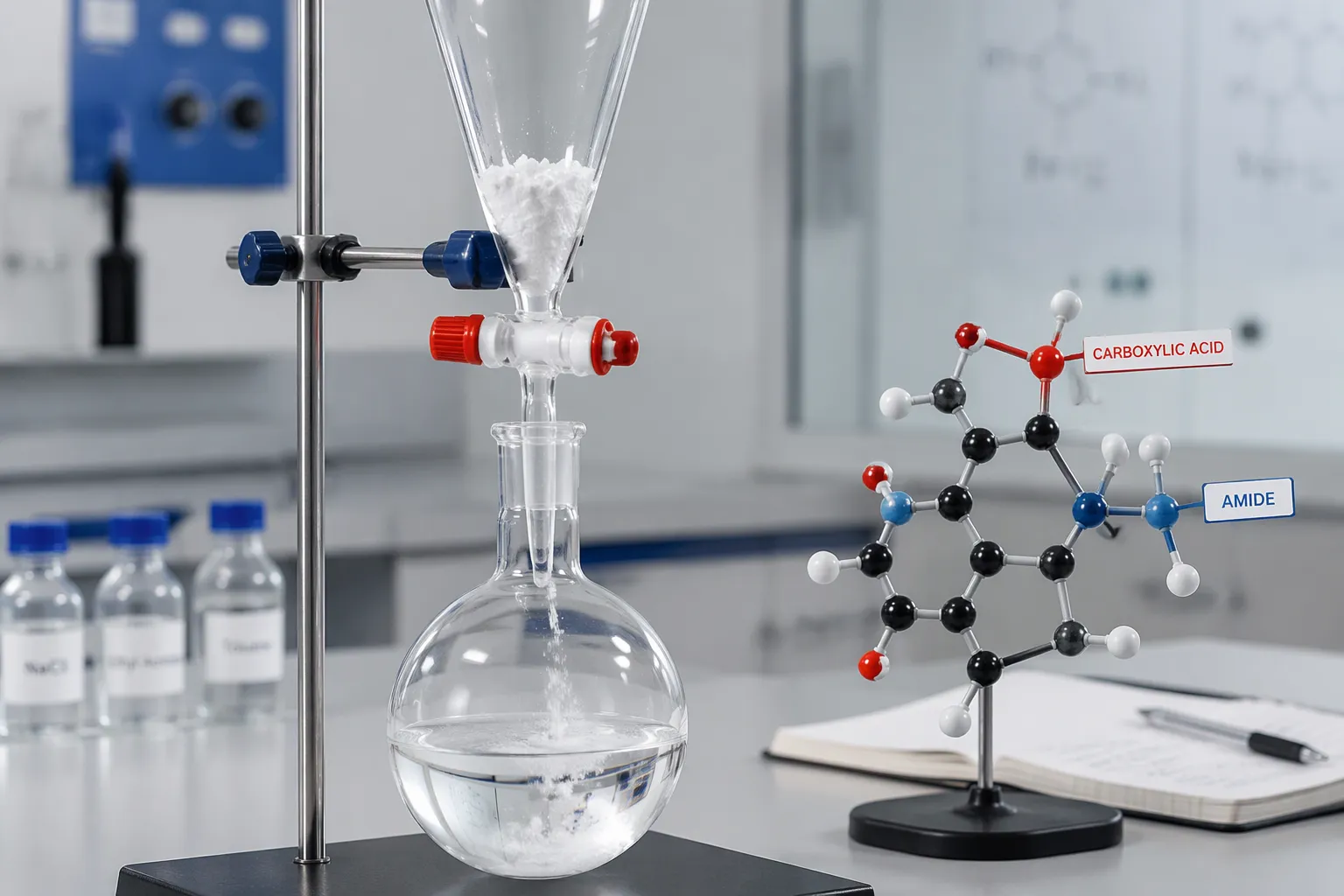
Lithium aluminum hydride is a powerful hydride donor. It reduces carboxylic acids, esters, amides, and nitriles—groups that milder reagents leave untouched. Sodium borohydride cannot match this reach. The Al–H bonds in lithium aluminum hydride are more polarized and more nucleophilic, so the reagent has the driving force to attack electron-rich carbonyls. These reductions often demand excess reagent, higher temperatures, or longer reaction times. That is the practical price of this power.
Key Takeaways
- Lithium aluminum hydride reduces tough groups like carboxylic acids and amides that milder reagents cannot handle.
- These reductions often need extra reagent and heat, so always use anhydrous conditions and inert atmosphere.
- For partial reduction to aldehydes, choose DIBAL instead of lithium aluminum hydride.
Why Lithium Aluminum Hydride Outperforms Milder Reagents
The Polarized Al–H Bond
The secret to lithium aluminum hydride's reducing power lies in the aluminum–hydrogen bond. Aluminum is less electronegative than hydrogen. This difference pushes electron density toward the hydrogen atom. The result is a polarized bond with a hydride-like hydrogen that carries a partial negative charge.
That partial negative charge makes the hydrogen nucleophilic. It seeks out electron-poor centers, and carbonyl carbons are prime targets. Sodium borohydride has a similar B–H bond, but boron and hydrogen share electrons more evenly. The B–H bond is less polarized. Its hydride is less nucleophilic and less eager to attack.
This single difference in bond polarity explains much of the reactivity gap. A more polarized Al–H bond gives lithium aluminum hydride a stronger thermodynamic driving force. It can attack carbonyl groups that milder hydride sources cannot touch.
Hydride Delivery and Lewis Acid Assistance
Hydride transfer is only half the story. The aluminum center plays a second role as a Lewis acid. After the first hydride transfer, the aluminum atom coordinates to the carbonyl oxygen. This coordination pulls electron density away from the carbonyl carbon. The carbon becomes more electrophilic and more receptive to the next hydride attack.
This dual action—nucleophilic hydride delivery plus Lewis acid activation—sets lithium aluminum hydride apart. Sodium borohydride lacks this strong Lewis acidity at boron. Its reductions often stall at less challenging substrates.
The mechanism unfolds in steps. The reagent first delivers a hydride to the carbonyl carbon. A tetrahedral intermediate forms. The aluminum then stabilizes the developing alkoxide through coordination. Subsequent hydride transfers from the same aluminum center complete the reduction. Each step reinforces the next, and the overall process drives forward with remarkable efficiency.
When Forcing Conditions Are Required
Power comes at a cost. The same strong Al–H bonds that make lithium aluminum hydride so reactive also make it less selective. It attacks many functional groups at once. Chemists often need excess reagent to push a difficult reduction to completion. One molar equivalent rarely suffices for carboxylic acids or amides.
Higher temperatures and longer reaction times are common. Refluxing in tetrahydrofuran or diethyl ether helps drive stubborn reductions forward. These conditions demand careful handling. The reagent reacts violently with water and protic solvents, so reactions require anhydrous setup and inert atmosphere.
Milder reagents like sodium borohydride work under gentler conditions. They tolerate alcohols and water in some cases. They offer selectivity that lithium aluminum hydride cannot match. The trade-off is clear. Sodium borohydride handles easy reductions with finesse. Lithium aluminum hydride tackles hard reductions with brute force. Each reagent has its place, and the choice depends on the functional group at hand.
Reducing Carboxylic Acids, Esters, Amides, and Nitriles
Carboxylic Acids: Deprotonation Before Reduction
A carboxylic acid presents a special problem for any hydride reagent. The acidic proton on the oxygen reacts faster with hydride than the carbonyl carbon does. A simple hydride attack would waste reagent on an acid–base reaction. Lithium aluminum hydride handles this problem well. The reagent first acts as a base. It strips the acidic proton from the hydroxyl group and releases hydrogen gas. This step forms a carboxylate salt.
The carboxylate salt is the true substrate for reduction. Its carbonyl carbon carries a full negative charge on the adjacent oxygen. That charge makes the carbon less electrophilic than a neutral carbonyl. A weaker hydride source would stall here. The strongly nucleophilic Al–H bond of lithium aluminum hydride still attacks the carboxylate carbon. A tetrahedral intermediate forms, and the aluminum center coordinates to the oxygen atoms. Further hydride transfers follow. The final product after aqueous workup is a primary alcohol.
The overall transformation converts RCOOH into RCH₂OH. The reaction typically needs two equivalents of hydride or more. One equivalent goes to deprotonation, and the rest drive the reduction. Refluxing tetrahydrofuran is a common solvent choice. The gas evolution from the first step provides a visible sign that the reaction has started.
Esters: The Tetrahedral Intermediate
Esters reduce more smoothly than carboxylic acids. They lack the acidic proton, so no deprotonation step competes with hydride attack. The carbonyl carbon of an ester is electrophilic and open to nucleophilic attack. The first hydride transfer forms a tetrahedral intermediate. This intermediate holds an alkoxide leaving group on the former carbonyl carbon.
The fate of that intermediate decides the product. The alkoxide group departs, and the carbonyl reforms as an aldehyde. This aldehyde is more reactive than the starting ester. A second hydride attack follows almost immediately. The aluminum center assists by coordinating to the carbonyl oxygen throughout the sequence. The final product is a primary alcohol, and the alkoxy group leaves as a separate alcohol molecule.
A classic example is the reduction of ethyl acetate to ethanol. Both the ester carbonyl and the ethoxy group end up as ethanol. The reaction runs in diethyl ether or tetrahydrofuran at low temperature first, then warms to room temperature. Lactones follow the same pathway. The ring opens, and a diol forms. This transformation makes lithium aluminum hydride a dependable tool for converting esters into primary alcohols in a single step.
Amides: C–N Cleavage to Amines
Amides are among the hardest carbonyl groups to reduce. The nitrogen lone pair donates electron density into the carbonyl. This resonance stabilization makes the carbonyl carbon less electrophilic. The C–N bond also has partial double-bond character. Both features resist hydride attack.
Lithium aluminum hydride overcomes this resistance through a sequence of hydride transfers. The first attack forms a tetrahedral intermediate with an amide nitrogen attached. The aluminum coordinates strongly to the carbonyl oxygen. This coordination weakens the C–N bond and sets up cleavage. The C–N bond breaks, and the nitrogen leaves as an amine or amide anion. The carbon fragment becomes an aldehyde-like species bound to aluminum. Further hydride transfers reduce it to a carbon–nitrogen unit that ends as a methylene group.
The net result converts a primary amide into a primary amine. A secondary amide gives a secondary amine, and a tertiary amide gives a tertiary amine. The carbon count stays the same. The carbonyl oxygen leaves as water during workup. This C–N cleavage pathway explains why amide reductions need strong conditions. Refluxing tetrahydrofuran and excess reagent are standard. The product amines serve as building blocks for pharmaceuticals, agrochemicals, and fine chemicals.
Nitriles: From Imine Intermediate to Primary Amine
A nitrile carries a carbon–nitrogen triple bond. The carbon is electrophilic but less so than a carbonyl carbon. Hydride attack on the nitrile carbon forms an imine anion intermediate. This intermediate picks up a proton during workup or from the reaction medium. The result is an imine, a carbon–nitrogen double bond with a hydrogen on the carbon.
The imine is more reactive than the starting nitrile. A second hydride attack follows readily. The aluminum center again assists by coordinating to the nitrogen. The double bond reduces to a single bond, and the nitrogen ends as an NH₂ group. The final product is a primary amine with one more hydrogen on the carbon than the starting nitrile had.
The overall conversion turns RCN into RCH₂NH₂. The reaction typically requires two equivalents of hydride. Diethyl ether or tetrahydrofuran serves as the solvent, and reflux conditions help drive the reduction to completion. This route offers a direct path from nitriles to primary amines. It avoids the need for catalytic hydrogenation and works well on molecules that contain other reducible groups.
Other Challenging Groups and Selective Alternatives
Epoxides and Alkyl Halides
Lithium aluminum hydride also opens epoxides. The hydride attacks the less hindered carbon of the three-membered ring. The ring opens, and an alcohol forms. This reaction converts an epoxide into a single alcohol product with good control.
Alkyl halides react in a different way. The hydride replaces the halogen atom, and the carbon skeleton loses its halogen. Reactivity follows the carbon–halogen bond strength. Iodides react fastest, bromides next, and chlorides slowest. This order reflects how easily the halide leaves.
These reactions show the broad reach of the reagent. A chemist can reduce an epoxide or strip a halogen in the same flask. Few milder hydride sources handle these groups at all.
Choosing DIBAL for Partial Reduction
Full reduction is not always the goal. Esters and nitriles often need to stop at the aldehyde stage. Lithium aluminum hydride pushes these groups all the way to alcohols and amines. Diisobutylaluminum hydride, or DIBAL, offers a gentler path.
DIBAL delivers one hydride at low temperature, usually around −78 °C. The reaction pauses at the aldehyde. Warming the mixture or adding excess reagent drives the reduction further. A chemist controls the product by controlling the conditions.
| Reagent | Typical Product from an Ester |
|---|---|
| Lithium aluminum hydride | Primary alcohol |
| DIBAL (low temperature) | Aldehyde |
The choice depends on the target molecule. Lithium aluminum hydride suits full reduction of stubborn groups. DIBAL suits partial reduction where an aldehyde must survive. Each reagent fits a distinct job in the synthetic sequence.
Lithium aluminum hydride reduces acids, esters, amides, and nitriles that sodium borohydride cannot touch. Its polarized, highly nucleophilic hydride does the work. Excess reagent and forcing conditions are often the price of this power. DIBAL offers a selective alternative for partial reduction, such as esters to aldehydes. Lithium aluminum hydride suits full reduction of stubborn groups. DIBAL fits when an aldehyde must survive.
FAQ
Why does lithium aluminum hydride reduce groups that sodium borohydride cannot?
The Al–H bond is more polarized than the B–H bond. This polarity gives lithium aluminum hydride a stronger, more nucleophilic hydride. That hydride attacks electron-rich carbonyls, including carboxylic acids, esters, amides, and nitriles. Sodium borohydride lacks this driving force.
Why do these reductions often need excess reagent and heat?
Stubborn groups resist the first hydride attack. Extra reagent supplies more hydride equivalents. Higher temperatures and longer times push the reaction forward. Refluxing tetrahydrofuran helps drive carboxylic acid and amide reductions to completion.
When should a chemist choose DIBAL instead of lithium aluminum hydride?
DIBAL works at low temperature and stops at the aldehyde stage. Lithium aluminum hydride pushes esters and nitriles to full reduction. A chemist picks DIBAL when an aldehyde must survive. Full reduction calls for lithium aluminum hydride.
See Also
Modern Synthesis Methods for Aminoguanidine Bicarbonate and Industrial Uses
Data-Backed Strategies to Enhance 2 5-Furandicarboxylic Acid Sustainability
Industrial Uses and Dissolution Methods of 2 5-Furandicarboxylic Acid
Understanding the Chemical Structure of 2 5-Furandicarboxylic Acid
Synthesis of Aminoguanidine Bicarbonate and Its Key Applications