Adhesive Industry Revolution The Role of CTBN and HTPB Liquid Rubbers
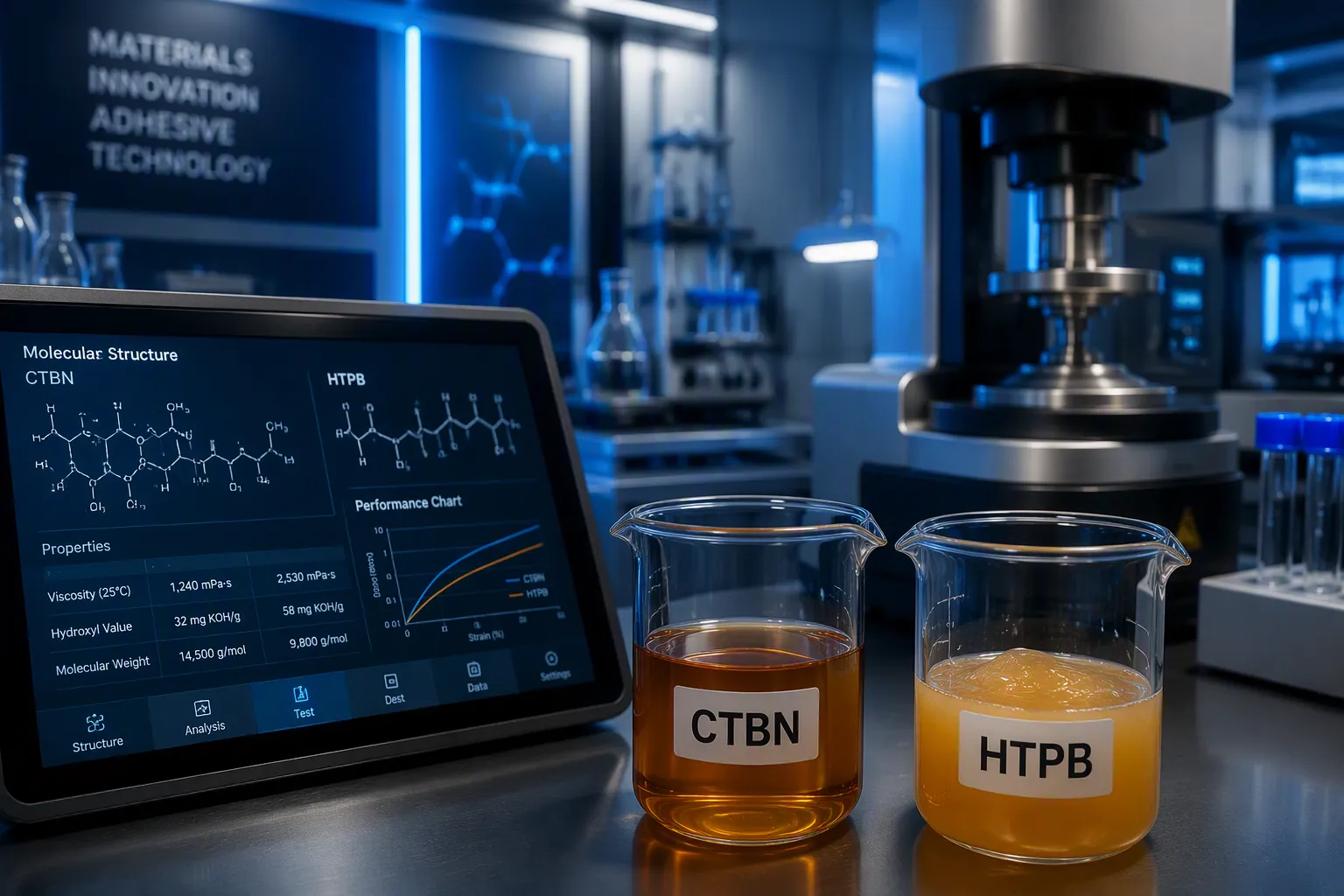
CTBN and HTPB are transforming adhesive technology. They create bonds that withstand extreme stress, temperature swings, and harsh environments. Traditional adhesives often fail under impact. Liquid rubber systems deliver toughness and flexibility you cannot get from conventional formulas. The Liquid Rubber Series (HTPB, CTBN, and others) provides tools to engineer adhesives for aerospace, automotive, construction, and electronics.
Key Takeaways
- CTBN liquid rubber toughens epoxy adhesives, making them resist impact and cracks for strong structural bonds.
- HTPB liquid rubber provides flexibility and moisture resistance, ideal for polyurethane adhesives in harsh environments.
- Choose CTBN for toughness in rigid bonds; choose HTPB for flexibility and waterproofing in dynamic applications.
Understanding the Liquid Rubber Series (HTPB, CTBN, and Beyond)
Before you select a liquid rubber for your adhesive formulation, you need to understand what makes these materials special. The Liquid Rubber Series (HTPB, CTBN, and others) includes low-viscosity polymers that remain fluid at room temperature. These rubbers differ from solid elastomers because they flow easily and mix readily with resins and curing agents.
What Defines a Special-Grade Liquid Rubber?
Special-grade liquid rubbers share several defining characteristics. They possess low molecular weights, typically ranging from 1,000 to 10,000 g/mol. This low molecular weight keeps viscosity manageable, allowing easy handling and precise formulation. These rubbers also carry specific functional groups at their chain ends, which enable chemical reactions with adhesive matrices.
Different liquid rubber types serve different purposes. The table below summarizes key variations:
| Liquid Rubber Type | Key Property Differences |
|---|---|
| Homopolymer L-IR (L-IR-30, L-IR-50) | Good miscibility with natural rubber; acts as reactive plasticizer for NR, IR, SBR, BR, IIR |
| Copolymer L-IR (L-IR-390) | Low Tg, good cold temperature resistance; unique structure provides high reactivity and compatibility with BR, hydrocarbon resins, and rosin resins |
| L-SBR (L-SBR-870, L-SBR-841N, L-SBR-822) | Good compatibility with S-SBR and E-SBR; high Tan Delta over wide temperature range; good reactivity |
| Malenized L-IR (403) & Carboxylated L-IR (410) | High molecular weight with carboxyl functionality; improves adhesion to metals and filler dispersion; stable adhesive properties after heat aging |
| UV-Curable L-IR (UC-102M, UC-203M) | Good flexibility from polyisoprene structure; low shrinkage; good low-temperature properties; moisture absorption and permeation resistance |
| Silane-modified GS-L-BR | Silane functionality enhances interaction with silica; improves dispersion, grip, rolling, and abrasion resistance in tires |
The Common Thread: Reactive End-Groups
The reactive end-groups define how each liquid rubber participates in curing. CTBN carries carboxyl end-groups at both chain ends. These carboxyl groups react with epoxy resin during curing, creating a toughening effect that improves impact resistance and adhesion.
HTPB contains hydroxyl end-groups. These hydroxyl groups react with isocyanate curing agents in polyurethane systems. The reaction forms urethane linkages, which contribute to adhesion and toughness in polyurethane adhesives.
ATBN offers amino end-groups that react with both epoxy groups and isocyanate curing agents. This dual reactivity allows ATBN to work in both epoxy and polyurethane systems, enhancing adhesion through covalent bonding with the respective matrices.
These reactive end-groups transform liquid rubbers from simple plasticizers into active participants in the adhesive network. You gain precise control over the final properties by choosing the right end-group chemistry.
CTBN: The Toughness Enhancer for Structural Adhesives
When you need an adhesive to hold under extreme impact, CTBN delivers the toughness that standard epoxies cannot provide. Carboxyl-terminated butadiene acrylonitrile, or CTBN, stands as the most widely used liquid rubber for toughening structural adhesives. This material transforms brittle epoxy systems into resilient bonds that absorb energy and resist crack propagation.
Chemistry and Key Properties
CTBN belongs to the Liquid Rubber Series (HTPB, CTBN, and others) that formulators use to modify adhesive performance. The polymer chain consists of butadiene and acrylonitrile units, with carboxyl groups at both ends. This structure gives CTBN its unique character.
The acrylonitrile content controls the rubber's polarity and compatibility with epoxy resins. Higher acrylonitrile levels improve miscibility, allowing the rubber to dissolve uniformly in the resin system. The butadiene segments provide flexibility and impact resistance. Together, these components create a rubber that phase-separates during curing to form microscopic particles within the epoxy matrix.
CTBN typically has a molecular weight between 3,000 and 4,000 g/mol. Its viscosity ranges from 50,000 to 500,000 cP at room temperature, depending on the specific grade. The carboxyl end-groups react with epoxy groups during curing, creating chemical bonds that anchor the rubber particles to the matrix.
How CTBN Improves Impact and Peel Strength in Epoxies
The toughening mechanism begins during the curing process. As the epoxy crosslinks, CTBN phase-separates into small particles dispersed throughout the matrix. These rubber particles act as stress absorbers when the adhesive experiences impact or peel forces.
When a crack starts to form in the adhesive, it encounters these rubber particles. The particles deform and cavitate, absorbing energy that would otherwise propagate the crack. This mechanism, known as rubber particle toughening, dramatically improves fracture toughness.
The quantitative improvements are significant. Research studies report that CTBN-modified epoxy systems achieve fracture energy values around 1.2 kJ/m² for bulk adhesives. Fiber composites modified with CTBN reach approximately 1.0 kJ/m². When formulators combine CTBN with zirconia-toughened alumina nanoparticles in glass fiber composites, the interlaminar fracture toughness increases by 48 percent compared to unmodified systems.
| Material System | Reported GIC (kJ/m²) | Improvement vs. Baseline |
|---|---|---|
| CTBN-modified bulk epoxy | 1.2 | Not specified |
| CTBN-modified fiber composites | 1.0 | Not specified |
| CTBN + ZTA nanoparticles in fiber composites | Not directly given | 48% increase in interlaminar fracture toughness |
These numbers translate to real-world performance. Adhesives containing CTBN resist delamination, withstand repeated impact loading, and maintain bond integrity under stress concentrations. Peel strength improves because the rubber particles bridge the adhesive layer, distributing stress across a wider area.
Primary Applications: Aerospace, Composites, and Structural Bonding
Aerospace manufacturers rely on CTBN-modified adhesives for critical structural bonds. Aircraft panels, wing components, and fuselage sections experience extreme vibration, temperature cycling, and impact loads. CTBN provides the toughness these applications demand while maintaining the high strength of epoxy systems.
Composite bonding represents another major application area. Carbon fiber and glass fiber composites require adhesives that match their mechanical properties. CTBN-modified epoxies bond composite panels without creating stress concentrations at the bond line. The rubber particles absorb energy during impact events, preventing catastrophic failure of the bonded structure.
Structural bonding in general industry benefits from CTBN as well. Steel-to-steel bonds, aluminum assemblies, and mixed-material joints all gain improved durability. Construction applications use CTBN-modified adhesives for panel bonding, facade attachment, and infrastructure repairs where impact resistance matters.
The versatility of CTBN extends to adhesive formulations for marine environments, wind turbine blades, and automotive body structures. Each application demands the unique combination of high strength and toughness that CTBN provides. When you select CTBN for your formulation, you gain a proven solution backed by decades of industrial use and extensive research.
HTPB: The Flexible and Moisture-Resistant Workhorse
When your application demands flexibility and moisture resistance, HTPB steps in as the reliable solution. Hydroxyl-terminated polybutadiene, or HTPB, brings a different set of strengths compared to CTBN. This liquid rubber excels in polyurethane systems where you need elasticity, waterproofing, and resistance to fuels and chemicals. The Liquid Rubber Series (HTPB, CTBN, and others) offers you this versatile option for demanding environments.
Chemistry and Key Properties
HTPB consists of butadiene units with hydroxyl groups at both ends of the polymer chain. This structure gives the rubber a non-polar, hydrocarbon backbone that repels water and resists chemical attack. The hydroxyl end-groups react readily with isocyanates to form urethane linkages, making HTPB a natural fit for polyurethane adhesive systems.
The glass transition temperature of HTPB sits at approximately -75°C. This exceptionally low Tg means the rubber remains flexible even in extreme cold. Many other polyols become stiff and brittle at temperatures well above this point. HTPB keeps working when temperatures drop far below freezing.
HTPB also demonstrates outstanding resistance to fuels and oils. When exposed to JP-8 fuel, HTPB-based elastomers swell less than 10 percent by volume. This minimal swelling prevents shape deformation and maintains bond integrity in fuel-contact applications. Other polyol types often swell significantly more, leading to adhesive failure over time.
The adhesion performance of HTPB-based systems earns top marks as well. On the ASTM D3359 adhesion test, HTPB achieves a 5B rating, the highest possible score. This rating indicates excellent bonding strength across various substrates, giving you confidence in demanding applications.
Enabling High-Performance Polyurethane Adhesives and Sealants
You gain several advantages when you formulate polyurethane adhesives with HTPB. The hydroxyl end-groups react with isocyanate curing agents to create strong urethane bonds. These bonds contribute to the adhesive's toughness and durability.
The non-polar backbone of HTPB provides natural moisture resistance. Water molecules struggle to penetrate the hydrocarbon structure, so the adhesive maintains its properties in humid or wet environments. This characteristic proves essential for outdoor applications and marine environments.
HTPB-based polyurethane systems also resist cure shrinkage. Many adhesive formulations shrink as they cure, creating internal stresses that weaken the bond. HTPB minimizes this shrinkage, producing dimensionally stable bonds that resist long-term cracking.
The low-temperature flexibility of HTPB translates directly to adhesive performance. Your bonded components remain flexible and impact-resistant even in freezing conditions. This flexibility prevents stress concentrations at the bond line, reducing the risk of adhesive failure during thermal cycling.
Primary Applications: Automotive, Construction, and Electronics
HTPB-based adhesives serve critical functions across multiple industries. The table below summarizes key applications and the performance requirements they fulfill:
| Industry | Specific HTPB Adhesive Applications | Key Performance Requirements Fulfilled |
|---|---|---|
| Automotive & Heavy Equipment | Adhesives, anti-vibration gaskets, coatings; EV battery pack encapsulants | Low-temperature elasticity for cold starts; moisture resistance in electrical systems; durability in harsh environments; dielectric strength for EV battery junctions |
| Construction & Civil Engineering | Spray-applied polyurethane waterproofing systems; joint sealants for concrete bridges; protective elastomeric coatings | Adhesion to substrates; temperature flexibility; solvent resistance; performance in chemically aggressive or high-moisture zones |
| Electronics & Power Grid | Potting compounds for wind turbine converters; moisture-proof cable joints; outdoor switchgear sealants | Long-term chemical and electrical stability; resistance to cure shrinkage; resistance to long-term cracking |
In automotive applications, HTPB-based adhesives handle the punishing conditions of engine compartments and underbody components. These adhesives maintain flexibility during cold starts when temperatures drop well below freezing. They also resist moisture intrusion in electrical systems, protecting sensitive components from corrosion and short circuits. Electric vehicle battery packs benefit from HTPB encapsulants that provide dielectric strength and protect against vibration.
Construction projects rely on HTPB-based sealants and coatings for waterproofing and joint sealing. Spray-applied polyurethane systems protect concrete bridges and building foundations from water damage. These sealants bond strongly to concrete and metal substrates while maintaining flexibility across wide temperature ranges. Solvent resistance ensures the sealants survive exposure to chemicals and aggressive environmental conditions.
Electronics manufacturers use HTPB-based potting compounds and sealants to protect critical components. Wind turbine converters require potting materials that resist chemical degradation and maintain electrical stability over decades of service. Moisture-proof cable joints keep water out of electrical connections in underground and outdoor installations. Outdoor switchgear sealants withstand UV exposure, temperature swings, and humidity without cracking or losing adhesion.
The performance profile of HTPB-based adhesives includes enhanced adhesion to various materials, chemical resistance against solvents, fuels, and oils, thermal stability under heat and flame, and flame retardancy for improved fire safety. These properties collectively enable the adhesives to withstand vibration, moisture, and temperature fluctuations across automotive, construction, and electronics applications. When you need an adhesive that stays flexible, resists moisture, and survives harsh conditions, HTPB delivers the performance you require.
CTBN vs. HTPB: Selecting the Right Liquid Rubber
Choosing between CTBN and HTPB requires a clear understanding of your performance priorities. Each rubber excels in different areas. You need to match the rubber's strengths to your specific bonding challenge.
Comparing Performance Metrics: Toughness vs. Flexibility
CTBN delivers superior toughness. It excels in rigid epoxy systems where impact resistance and crack prevention matter most. The rubber particles absorb energy and stop cracks from spreading through the bond line.
HTPB provides exceptional flexibility. Its low glass transition temperature keeps the adhesive elastic even in extreme cold. This flexibility allows bonded parts to move and flex without breaking the adhesive bond.
| Performance Metric | CTBN | HTPB |
|---|---|---|
| Primary Strength | Toughness, impact resistance | Flexibility, elasticity |
| Glass Transition Temp | Moderate | Very low (-75°C) |
| Moisture Resistance | Good | Excellent |
| Fuel/Oil Resistance | Moderate | Excellent |
| Best Matrix | Epoxy | Polyurethane |
Matching the Rubber to Your Application Requirements
You should select CTBN for structural bonds that face repeated impact or vibration. Aerospace components, composite panels, and load-bearing joints benefit from CTBN's toughening effect. These applications demand high strength with the ability to absorb sudden shocks.
You should choose HTPB for applications requiring flexibility and environmental resistance. Automotive seals, construction joint sealants, and electronic potting compounds need elasticity and moisture protection. The Liquid Rubber Series (HTPB, CTBN, and others) offers you this clear choice based on your primary need.
Formulation Considerations: Compatibility and Curing Behavior
CTBN requires epoxy resin systems. The carboxyl end-groups react with epoxy groups during curing. You must ensure proper mixing to achieve uniform phase separation. This separation creates the rubber particles that provide toughening.
HTPB requires isocyanate curing agents. The hydroxyl end-groups form urethane linkages. You need to control moisture levels during formulation because water reacts with isocyanates. This reaction can create unwanted bubbles in the cured adhesive.
Consider your curing conditions carefully. CTBN systems typically cure at elevated temperatures. HTPB systems can cure at room temperature with appropriate catalysts. Your production environment and application requirements will guide this decision.
Real-World Impact: How These Liquid Rubbers Solve Bonding Challenges
Theory matters. Results matter more. You need to see CTBN and HTPB in real applications. These case studies show how each liquid rubber solves specific bonding problems.
Case Study: CTBN in Aerospace Structural Adhesives
A major aerospace manufacturer faced a persistent problem. Aircraft wing panels required a strong bond. The bond had to withstand extreme vibration. It also had to survive temperature cycling. Standard epoxy adhesives cracked under these conditions. The bonds failed during testing.
The solution came from CTBN-modified epoxy. Formulators added CTBN to the epoxy system. The rubber particles formed during curing. These particles absorbed impact energy. The adhesive stopped cracks from spreading through the bond line.
Test results showed a dramatic improvement. The CTBN-modified adhesive achieved fracture energy values three times higher than unmodified epoxy. The bond survived impact tests. These tests destroyed conventional adhesives. Aircraft produced with this adhesive now fly millions of hours without bond failure. This adhesive solved a problem that seemed impossible to fix.
The Liquid Rubber Series (HTPB, CTBN, and others) provides formulators with proven solutions for demanding applications. CTBN transforms brittle epoxy into a tough adhesive.
Case Study: HTPB in Automotive and Construction Sealants
An automotive manufacturer needed a sealant for windshield bonding. The sealant had to remain flexible at -40°C. It also had to resist moisture and road chemicals. Standard polyurethane sealants failed in cold weather testing.
HTPB provided the solution. The hydroxyl-terminated polybutadiene reacted with isocyanate curing agents. The resulting polyurethane sealant maintained flexibility at temperatures below -50°C. The non-polar backbone resisted moisture and chemical attack.
Construction applications followed a similar pattern. Bridge joint sealants required flexibility across wide temperature swings. HTPB-based sealants delivered that performance. The sealants bonded to concrete and metal substrates. They expanded and contracted with the bridge deck. The bonds remained watertight for years. Road salts and chemicals did not damage the sealant.
The Liquid Rubber Series (HTPB, CTBN, and others) offers you a clear choice. You select CTBN for toughness and impact resistance. You choose HTPB for flexibility and environmental resistance.
Future Trends in Liquid Rubber Adhesive Technology
The adhesive industry continues to evolve. You will see exciting developments in liquid rubber technology. These advances will expand your formulation options and solve even more challenging bonding problems.
Innovations in High-Performance Formulations
Researchers are developing new CTBN and HTPB grades with enhanced properties. You will find liquid rubbers with tailored molecular weights. These variations give you precise control over viscosity and curing behavior. Some new grades feature hybrid end-group chemistry. You can now combine carboxyl and hydroxyl functionality in a single polymer. This versatility allows you to formulate adhesives that work in both epoxy and polyurethane systems.
Nanotechnology is also entering liquid rubber formulations. You can now incorporate nanoparticles into CTBN and HTPB systems. These particles improve mechanical strength without sacrificing flexibility. The result is an adhesive that performs better than either component alone. You gain superior toughness, thermal stability, and adhesion in one package.
Smart adhesives represent another frontier. You will soon see liquid rubber systems that respond to environmental stimuli. These adhesives can change properties when exposed to heat, light, or moisture. This capability opens new possibilities for self-healing bonds and reversible adhesive systems.
Sustainability and Bio-Based Liquid Rubber Alternatives
Environmental concerns are driving innovation in bio-based liquid rubbers. You will see new products derived from renewable resources. Researchers are developing CTBN alternatives from plant-based oils. These bio-based rubbers offer similar performance with a lower carbon footprint.
HTPB producers are exploring sustainable production methods too. You can expect bio-derived butadiene to replace petroleum-based feedstocks. This shift reduces dependence on fossil fuels while maintaining the performance you need.
Recyclability is another focus area. You will find liquid rubber systems designed for easier disassembly. These adhesives allow bonded components to separate at end-of-life. This capability supports circular economy principles in manufacturing.
The future of liquid rubber adhesives combines performance with responsibility. You can expect formulations that meet demanding specifications while supporting environmental goals.
These trends will shape your formulation choices in the coming years. You will have more tools to create adhesives that perform better and last longer. The Liquid Rubber Series (HTPB, CTBN, and others) will continue to evolve, giving you solutions for tomorrow's challenges.
CTBN and HTPB are essential building blocks, not simple additives. They drive the adhesive industry revolution. CTBN delivers toughness for rigid structural bonds. HTPB provides flexibility and moisture resistance for dynamic sealing applications. You gain a competitive edge by leveraging these liquid rubbers. You can create adhesives that meet the most demanding performance specifications.
FAQ
Can I combine CTBN and HTPB in one adhesive formulation?
Yes, you can blend both rubbers in hybrid systems. This approach lets you balance toughness from CTBN with flexibility from HTPB. Test compatibility carefully before scaling production.
How much liquid rubber should I add to my epoxy adhesive?
You typically add 5 to 20 parts per hundred resin. Start with 10 parts and test performance. Adjust based on your target toughness and viscosity requirements.
Do CTBN and HTPB require special storage conditions?
Store both rubbers in sealed containers away from direct sunlight. Keep temperatures between 15°C and 30°C. Moisture exposure can degrade HTPB's reactivity over time.
See Also
Innovative Materials Transforming Heat Exchanger Market
Nozzle Guide for Gardeners, Bioprinters, and Lubrication Pros
Key Facts About WT20 Electrodes Enhance TIG Welding
Production Advances Boost Heat Exchanger Industrial Efficiency
Micro-Channel Innovations Improve Hydrogen Fuel Cell Cooling