Latest Materials Revolutionizing Heat Exchanger Supply
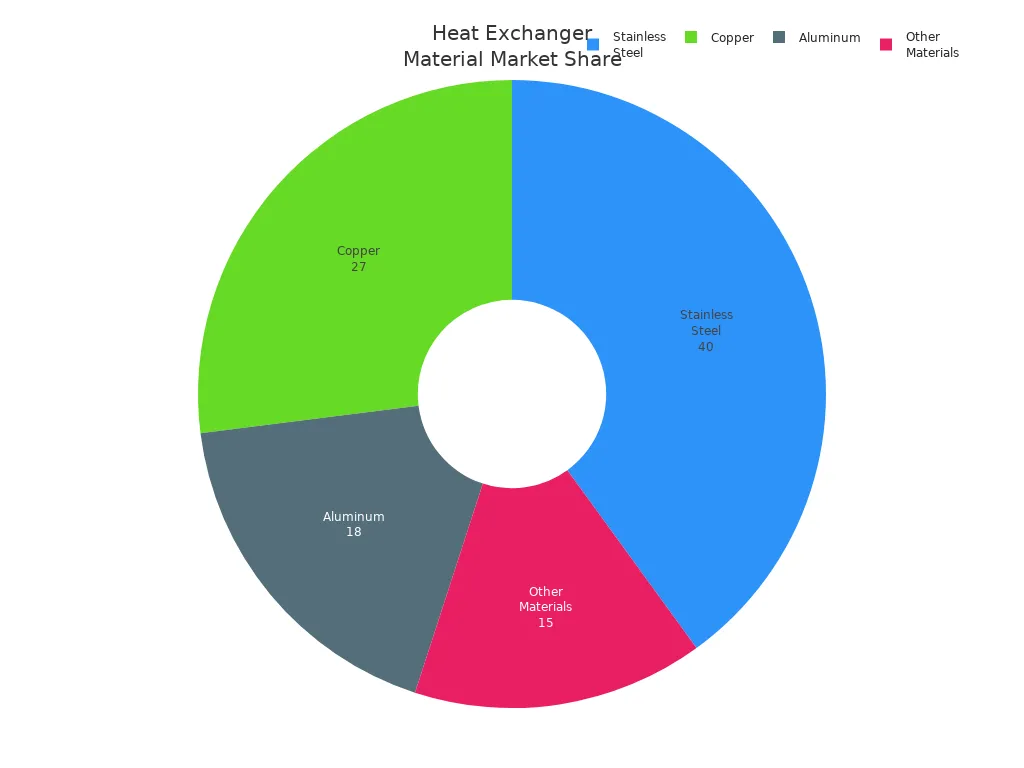
New materials continue to shape heat exchanger supply, driving advances in efficiency and sustainability. Stainless steel holds 40% of the market, as shown below. The latest hvac heat exchanger solutions use nanotechnology, compact designs, and sustainable materials, helping the hvac industry focus on optimising energy usage and environmental impact.
| Material | Market Share (%) |
|---|---|
| Stainless Steel | 40 |
| Copper | 27 |
| Aluminum | 18 |
| Other Materials | 15 |
Material Innovation in Heat Exchanger Supply
Meeting Industry Demands for Efficiency
The heat exchange industry continues to evolve as new materials and manufacturing techniques emerge. Many sectors, such as power generation, chemical processing, and HVAC systems, require higher efficiency from heat exchanger technology. Stainless steel, which holds a 40% market share, remains a popular choice due to its durability and corrosion resistance. Companies now use advanced materials like titanium and high-grade stainless steel to further improve performance and extend equipment lifespan.
Recent innovations include 3D printing technology, which allows for intricate and customized designs. These designs optimize heat exchanger surfaces and boost overall efficiency. Nanotechnology also plays a key role by introducing materials that enhance thermal conductivity and corrosion resistance. As a result, heat exchanger supply can better support energy efficiency and optimization in industrial processes.
| Innovation Type | Description |
|---|---|
| 3D Printing Technology | Enables intricate and customized designs, optimizing heat exchanger surfaces |
| Nanotechnology | Enhances thermal conductivity and corrosion resistance |
| Advanced Materials | Uses titanium and high-grade stainless steel for durability |
Addressing Sustainability and Compliance
Sustainability and regulatory compliance drive material innovation in the heat exchange industry. Agencies such as the EPA and DOE set standards for greenhouse gas emissions and energy consumption. These regulations encourage companies to adopt advanced heat exchanger technology and invest in sustainable solutions. Government subsidies also provide financial incentives for projects that use renewable energy sources and energy-efficient equipment.
| Regulatory Agency | Impact on Heat Exchanger Adoption |
|---|---|
| EPA | Sets standards for emissions and energy consumption, driving upgrades in thermal systems |
| DOE | Promotes energy efficiency and incentivizes advanced technologies |
| Government Subsidies | Lowers costs for sustainable infrastructure and equipment |
Advanced Alloys Transforming Heat Exchanger Supply
Stainless Steel and Titanium Alloys
The heat exchange industry relies on advanced alloys to meet the growing demands for durability, efficiency, and reliability. Stainless steel and titanium alloys stand out as the most widely used materials in modern heat exchanger technology. These alloys offer unique properties that support optimization and innovation across diverse sectors, including HVAC, chemical processing, and renewable energy sources.
| Alloy Type | Properties | Applications |
|---|---|---|
| Titanium and alloys | High resistance to seawater, acids, and alkalis | Marine and chemical industries |
| Nickel alloys | Excellent corrosion resistance, especially in aggressive acids | Chemical and petrochemical industries |
| Stainless steels | Improved corrosion resistance, but less than titanium and nickel alloys | General applications, less aggressive |
| Hastelloy | Retains properties at high temperatures, resistant to temperature changes | Energy and metallurgy industries |
| High-alloy stainless | Resistant to elevated temperatures, less to aggressive chemicals | High-temperature applications |
| Heat-resistant steels | Maintains strength at high temperatures, often with molybdenum or vanadium | High-pressure heat exchangers |
Stainless steel remains a popular choice due to its balance of cost, performance, and availability. It provides solid resistance to corrosion in many environments and supports high heat transfer efficiency. Titanium, on the other hand, excels in environments where corrosion poses a significant threat. Marine and chemical industries often select titanium for its ability to withstand seawater, acids, and alkalis.
- Titanium resists corrosion in seawater and chloride-rich environments, while stainless steel can experience pitting and crevice corrosion.
- In polluted seawater, titanium shows no signs of corrosion even after 16 years, while stainless steel may struggle to maintain integrity.
- Titanium performs reliably at high temperatures (up to 500°F) and velocities (up to 120 ft/sec), conditions that challenge stainless steel.
- While titanium heat exchangers require a higher initial investment, their maintenance costs remain low over time.
- Titanium’s exceptional corrosion resistance minimizes the need for frequent repairs or replacements, allowing it to last the entire 20-year lifespan of a yacht without requiring replacement.
- In contrast, materials like Copper-Nickel often need replacement every 4-7 years due to corrosion, increasing costs and disrupting operations.
By choosing titanium, industries can reduce downtime and maintenance expenses, ensuring consistent performance over the long term. However, titanium’s lower thermal conductivity means it is not as efficient as stainless steel in transferring heat. Its ability to withstand extreme environmental conditions makes it ideal for applications where corrosion resistance is critical.
Corrosion Resistance and Extended Lifespan
Corrosion remains a leading cause of premature failure in heat exchanger supply. Advanced alloys such as titanium, nickel alloys, and high-alloy stainless steels address this challenge by offering superior resistance to aggressive chemicals and harsh environments. These materials help extend the operational lifespan of heat exchangers, reduce maintenance costs, and improve reliability.
| Alloy Type | Application Area | Benefits |
|---|---|---|
| Alloy 825 | Offshore platforms | Excellent resistance to pitting and crevice corrosion |
| Inconel 625 | Chemical plants | High durability and thermal performance |
| CRAs | Heat tracing systems | Extended lifespan and reduced maintenance costs |
Innovative solutions in coatings, inhibitors, and materials further enhance corrosion resistance. Many companies now focus on technological advancements that integrate smart monitoring systems and sustainable practices. These trends support the shift toward sustainability and the adoption of renewable energy sources in industrial operations.
- Corrosion can lead to premature failure of heat exchangers, affecting operational reliability.
- Innovative solutions include advancements in coatings, inhibitors, and materials.
- Future trends focus on sustainability and smart technologies for enhanced corrosion control.
The ongoing development of advanced alloys and protective technologies ensures that heat exchanger supply continues to evolve. This progress supports optimization, reliability, and long-term value for industries worldwide.
Composites and Lightweight Materials in Heat Exchanger Supply
Polymer Matrix and Fiber-Reinforced Composites
Polymer matrix and fiber-reinforced composites have become essential in modern heat exchanger supply. These materials offer a unique combination of strength, low weight, and design flexibility. Engineers often select fiber-reinforced polymers (FRPs) for their ability to withstand harsh environments and reduce overall system weight. Ceramic matrix composites and metal matrix composites also play a role, especially in applications that demand high-temperature resistance or enhanced mechanical properties.
- Polymer matrix composites (PMCs) provide high mechanical strength and low density.
- Ceramic matrix composites excel in high-temperature environments.
- Metal matrix composites combine the benefits of metals with added durability.
A comparison of polymer matrix composites and traditional materials highlights their advantages:
| Property | Polymer Matrix Composites (PMCs) | Traditional Materials |
|---|---|---|
| Mechanical Strength | High | Varies |
| Thermal Conductivity | Improved | Generally lower |
| Density | Low | Higher |
| Cost | Lower | Higher |
| Environmental Resistance | Good (with natural fibers) | Varies |
| Fabrication Ease | Easier | More complex |
Durability and Weight Reduction
Composites deliver significant benefits in durability and weight reduction. Carbon and glass fiber composites, for example, resist fatigue and corrosion, making them ideal for demanding environments such as aircraft and automotive systems. These properties translate well to heat exchanger supply, where lightweight construction and long service life are critical.
- High strength-to-weight ratios improve structural integrity.
- Durability reduces maintenance and repair needs.
- Complex shapes can be molded, streamlining assembly processes.
- Low thermal expansion and high temperature handling (up to 650 °C) support advanced applications.
The hvac industry increasingly adopts these materials to improve energy efficiency and reduce emissions. As a result, composites help industries achieve better performance while supporting sustainability goals.
Nanomaterials and Coatings for Heat Exchanger Supply
Nano-Coatings for Enhanced Heat Transfer
Nanostructured coatings have transformed the performance of modern heat exchangers. Superhydrophobic and oleophobic coatings, for example, can increase the overall heat transfer coefficient by more than ten times in steam condensation applications. Hydrophilic coatings also play a vital role in air conditioning systems, reducing pressure drop and improving heat transfer. Engineers have adopted advanced nano-coatings such as carbon nanomaterials, graphene, and carbon nanotubes to further boost efficiency. These materials enhance the surface area and thermal conductivity, leading to measurable gains in performance.
| Coating Type | Performance Improvement (%) | Heat Transfer Rate Increase (%) |
|---|---|---|
| Carbon Nano-material | 12 | 12 |
| Graphene | 21.5 | 6 |
| Carbon Nano Tubes (CNT) | N/A | 11 |
| General Heat Sink | 14 (heating) | N/A |
| General Heat Sink | 17 (cooling) | N/A |
Smart heat exchange systems now leverage these nano-coatings to optimize energy use and maintain consistent operation, especially in demanding hvac environments.
Improved Fouling and Corrosion Resistance
Nanomaterial coatings not only improve heat transfer but also protect against fouling and corrosion. SiO2 and SiO2-FPS coatings, for instance, can reduce corrosion rates by over 60% in highly corrosive geothermal water. This protection extends the lifespan of heat exchangers and lowers maintenance costs. Studies have shown that vinyl-terminated polydimethylsiloxane coatings embedded with nano-SiO2 inhibit bacterial attachment by over 98% and achieve 99.9% corrosion inhibition efficiency. These results highlight the potential of nanomaterials to address persistent challenges in heat exchanger supply.
| Coating Type | Properties Demonstrated | Application Context |
|---|---|---|
| Ni–P-nanoparticles | High hardness, corrosion resistance, improved performance | Flue gas heat exchangers |
| SiO2 nanoparticles | Cost-effective, high wear resistance, excellent corrosion resistance | Flue gas heat exchangers |
| SiO2 and SiO2-FPS | Superior antifouling and corrosion properties | Geothermal applications |
Tip: Regular application of advanced nanocoatings can significantly extend the operational life of heat exchangers in harsh industrial settings.
Eco-Friendly and Recyclable Materials in Heat Exchanger Supply
Bio-Based Polymers and Recycled Metals
Manufacturers now prioritize bio-based polymers and recycled metals to advance environmental sustainability in heat exchanger supply. Bio-based materials, sourced from renewable resources, help reduce greenhouse gas emissions. These materials store biogenic carbon, which supports climate change mitigation and lowers the net carbon footprint. The European Union highlights the importance of bio-based materials in achieving climate neutrality by 2050, recognizing their ability to reduce reliance on finite resources and close carbon loops. Recycled polymers also improve the environmental performance of virgin plastics, especially when used in long-lasting products.
- Bioplastics offer advantages in climate change and fossil resource depletion.
- The performance of plastics and metals remains balanced for many applications.
- Recycled polymers enhance the sustainability of conventional plastics.
Advanced materials, such as nanomaterials like graphene and carbon nanotubes, further contribute to sustainability efforts. These options not only improve thermal conductivity but also reduce the weight and size of heat exchangers, making them more cost-effective and environmentally friendly. The U.S. Department of Energy notes that these trends align with the growing demand for lightweight and efficient solutions in industries such as hvac.
Supporting Circular Economy and Sustainability
The heat exchanger industry increasingly adopts circular economy principles. Manufacturers design components for easy replacement and recycling, which minimizes waste and extends product life. By analyzing the lifetime and quality of each part during the design phase, they ensure that components remain accessible for refurbishment or recycling.
- Enhances energy efficiency
- Reduces environmental footprint
- Saves money
- Minimizes waste
- Contributes to sustainability
This approach supports both environmental sustainability and long-term cost savings, helping companies meet modern regulatory and market expectations.
SHPHE Plate Heat Exchangers: Innovation in Heat Exchanger Supply
SHPHE Product Range and Technological Advancements
Shanghai Heat Transfer Equipment Co., Ltd. (SHPHE) stands at the forefront of the heat exchange industry, delivering innovative solutions that address the evolving needs of modern operations. The company’s product portfolio covers a wide spectrum, including heat exchangers, condensers, and evaporators. Each product features unique design elements and advanced engineering to support optimization and operational efficiency across industries.
| Product Type | Innovations | Applications |
|---|---|---|
| Heat Exchanger | Unique plate corrugation design, fully welded structure | Oil refinery, Oil & gas, Chemical, Power, HVAC, Other industries |
| Condenser | Flexible design, high heat transfer efficiency | Vapor condensing, dehumidification, process cooling |
| Evaporator | Compact structure, small footprint | Phase change processes, various chemical substances |
SHPHE’s commitment to innovation is evident in its adoption of enhanced materials and advanced manufacturing techniques. The company uses new alloys and composite materials to improve corrosion resistance and thermal performance. These advancements extend the lifespan of equipment and reduce maintenance requirements. SHPHE also integrates smart heat exchange systems, leveraging IoT, artificial intelligence, and sensor technologies. These systems enable real-time monitoring and predictive maintenance, which help companies maximize uptime and reduce unexpected downtime.
| Advancement Type | Description |
|---|---|
| Enhanced Materials | New alloys and composite materials improve corrosion resistance and thermal performance. |
| Smart Monitoring Systems | IoT, AI, and sensor technologies enable real-time monitoring and predictive maintenance. |
| Energy-Efficient Designs | Innovations in plate geometry and flow dynamics increase thermal efficiency and reduce energy use. |
| Sustainable Manufacturing | Eco-friendly processes reduce the environmental impact of production, aligning with sustainability goals. |
SHPHE’s energy-efficient designs focus on optimizing plate geometry and flow dynamics. These improvements increase heat transfer rates and lower energy consumption, supporting energy efficiency goals. The company also prioritizes sustainable manufacturing, using eco-friendly processes that align with global trends toward renewable energy sources and reduced environmental impact.
Note: SHPHE’s technological advancements set new benchmarks in heat exchanger technology, helping industries achieve higher performance and sustainability.
Real-World Applications and Industry Impact
SHPHE plate heat exchangers play a vital role in diverse sectors, from oil and gas to HVAC and chemical processing. Their advanced features and robust construction allow them to meet the rigorous demands of modern industrial environments. Companies benefit from improved operational efficiency, reduced energy consumption, and enhanced reliability.
One notable example comes from the paper industry. Schumacher Packaging GmbH, located in Schwarzenberg, Germany, implemented SHPHE plate heat exchangers in its wastewater treatment processes. This upgrade resulted in a 40% reduction in natural gas usage. The company achieved significant energy savings and improved process efficiency, demonstrating the real-world impact of SHPHE’s innovative solutions.
SHPHE’s products also support optimization in oil refineries, chemical plants, and power generation facilities. Their flexible designs and advanced materials withstand harsh conditions and aggressive media. In HVAC applications, SHPHE heat exchangers help maintain precise temperature control and support energy efficiency initiatives.
- SHPHE plate heat exchangers deliver reliable performance in demanding environments.
- Advanced monitoring systems enable predictive maintenance and minimize downtime.
- Energy-efficient designs contribute to lower operational costs and reduced emissions.
These achievements highlight the importance of technological advancements in heat exchanger supply. SHPHE continues to drive innovation, supporting industries as they adapt to new challenges and pursue sustainability goals.
Overcoming Challenges in Heat Exchanger Supply
Boosting Efficiency and Performance
The heat exchange industry faces several obstacles that impact operational efficiency and heat transfer efficiency. High raw material costs, corrosion, and fouling remain persistent issues. Companies respond by selecting advanced materials, such as stainless steel and nickel alloys, to combat corrosion and extend equipment lifespan. Regular maintenance, including cleaning and inspection, helps remove fouling and scaling, ensuring optimal performance. Optimization of flow rates and the use of high-efficiency surfaces further enhance energy efficiency in hvac and industrial applications. Automated systems now provide real-time monitoring and predictive maintenance, supporting technological advancements and reducing downtime.
| Challenge | Solution |
|---|---|
| High raw material costs | Use cost-effective materials and optimize design |
| Corrosion | Select corrosion-resistant alloys and apply protective coatings |
| Fouling | Implement regular cleaning and maintenance programs |
Achieving Sustainability Goals
Companies in the heat exchanger supply sector prioritize sustainability by improving efficiency and reducing waste. Many organizations adopt renewable energy sources and design heat exchangers for heat recovery systems, capturing waste heat to lower emissions. Waste reduction serves as a key metric, minimizing costs and environmental impact. Compliance with environmental regulations enhances brand reputation and attracts talent, reflecting current trends in corporate responsibility. Firms also focus on energy efficiency improvements, which lead to cost savings and support long-term sustainability.
- Efficiency improvements drive cost reductions.
- Waste reduction minimizes environmental impact.
- Compliance with regulations boosts brand recognition.
Navigating Regulatory Requirements
Regulatory standards shape material selection and design in heat exchanger supply. The ASME Code ensures materials withstand design pressures and temperatures, while FDA guidelines require cleanable surfaces made from stainless steel or higher alloys. ASME BPE standards mandate specific properties for sanitary applications, especially in food and bioprocessing industries. Companies navigate these requirements by adhering to industry standards and integrating technological advancements that meet regulatory expectations.
| Regulatory Requirement | Impact on Material Selection |
|---|---|
| ASME Code | Materials must withstand design pressures and temperatures |
| FDA | Surfaces must be cleanable and made of approved alloys |
| ASME BPE | Specific properties required for sanitary applications |
Tip: Regular inspection and adherence to standards help companies maintain compliance and optimize operational efficiency.
Future Trends in Heat Exchanger Supply Materials
Emerging Technologies and Smart Solutions
The heat exchange industry continues to evolve as new technologies and smart solutions emerge. Additive manufacturing, also known as 3D printing, now enables the production of complex components for electric vehicle battery cooling. This approach improves thermal performance by up to 25%. Nanofluid-based heat exchangers in power plants increase heat transfer efficiency by as much as 15%. IoT sensor integration with predictive analytics reduces unplanned downtime and lowers maintenance costs. The table below highlights these innovations and their impact:
| Innovation Type | Measurable Improvement | Impact on Energy Savings/Efficiency |
|---|---|---|
| Additive Manufacturing for EV Battery Cooling | Up to 25% improved thermal performance | Enhances cooling efficiency, reducing energy consumption |
| Nanofluid-based Heat Exchangers in Power Plants | Up to 15% increase in heat transfer efficiency | Enables higher power output without extra energy input |
| IoT Sensor Integration with Predictive Analytics | Significant reduction in unplanned downtime | Lowers maintenance costs and improves operational efficiency |
Other trends include the use of corrosion-resistant plastics, thin-walled tubes for better heat transfer, and modular block units for quick assembly. These technological advancements support the growing demand for efficiency and sustainability in hvac and industrial applications. The integration of renewable energy sources also makes heat exchanger supply more adaptable and environmentally friendly.
The Evolving Role of Material Science
Material science plays a crucial role in shaping the future of heat exchanger supply. Researchers now develop new materials with enhanced thermal conductivity, corrosion resistance, and durability. Advanced alloys and specialized composites improve heat transfer and mechanical strength in harsh environments. Phase change materials (PCMs) have become especially valuable for applications with fluctuating thermal loads. These materials store and release large amounts of thermal energy at nearly constant temperatures, leading to stable heat transfer and improved energy efficiency. Recent innovations in manufacturing techniques have made it easier to integrate PCMs into existing systems. As material science advances, the heat exchange industry will continue to benefit from improved performance, longer equipment life, and greater support for innovation.
Recent advances in micro-channel designs and corrosion-resistant materials drive efficiency and durability in heat exchanger supply. Industries like hvac benefit from carbon composites, nanocoatings, and smart monitoring systems. Material science will continue to deliver innovations, optimizing performance and supporting energy-efficient solutions for the next decade.
FAQ
What are the main benefits of advanced materials in heat exchanger supply?
Advanced materials increase efficiency, extend equipment lifespan, and improve resistance to corrosion. These benefits help industries reduce maintenance costs and support sustainable operations.
How do SHPHE plate heat exchangers support industry trends?
SHPHE plate heat exchangers use innovative materials and smart monitoring systems. These features align with current industry trends focused on efficiency, sustainability, and digital transformation.
Can heat exchangers be recycled or reused?
Many modern heat exchangers use recyclable metals and bio-based polymers. Manufacturers design these products for easy disassembly, supporting circular economy practices and reducing environmental impact.