What Should You Consider Before Buying a Lip Gloss Filling Machine?
The global lip gloss market demonstrates robust health, with multiple analyses projecting a Compound Annual Growth Rate (CAGR) between 5% and 6%. This industry expansion makes selecting an efficient lip gloss filling machine a critical business decision. A company’s production scale dictates the necessary speed and automation. The gloss formula's viscosity determines the appropriate filling system. Considering packaging can represent up to 40% of production costs, features like filling accuracy and supplier reliability are paramount for managing expenses and ensuring long-term operational success.
1. Assess Your Production Needs and Business Scale
Selecting the right equipment begins with a thorough evaluation of a company's operational requirements and long-term goals. A business must align its machinery investment with both current production demands and future growth projections. This strategic approach ensures the chosen machine serves as a valuable asset, not a production bottleneck.
a. Calculate Your Required Production Output
Defining Units Per Hour (UPH) and Bottles Per Minute (BPM)
Understanding production metrics is fundamental. Units Per Hour (UPH) and Bottles Per Minute (BPM) are standard measures of a machine's output capacity. A business calculates its target UPH or BPM based on sales forecasts and inventory requirements. For example, a brand needing to produce 12,000 units for a monthly launch requires a machine capable of at least 75 UPH (assuming a standard 160-hour work month). This calculation provides a clear performance benchmark for evaluating different models.
Planning for Future Production Growth
A machine should not only meet today's needs but also accommodate tomorrow's ambitions. Businesses should forecast their growth over the next three to five years. A startup might anticipate doubling its output within two years. This foresight prevents the need for a premature and costly upgrade. Investing in a machine with scalable capacity or a modular design allows a company to expand production without replacing its entire line.
b. Match Machine Type to Your Operational Scale
The scale of an operation directly influences the ideal level of automation. Before deciding, a business should consider several key factors:
- What is the current production volume?
- What is the available budget for the initial investment?
- How much physical space is available in the facility?
- What are the company's long-term growth plans?
Manual Fillers for Startups and R&D Batches
Manual fillers are the entry point for many businesses. Their low initial cost and simple operation make them perfect for startups, small-batch artisans, and research and development labs. These machines offer maximum flexibility for testing new formulas but rely entirely on operator speed and consistency.
Semi-Automatic Fillers for Small to Medium Businesses
Semi-automatic filling machines provide a crucial balance of precision, speed, and affordability. They are ideal for businesses transitioning from manual methods or those with moderate production needs.
Semi-automatic fillers offer a balance of precision and flexibility, making them ideal for businesses that don't require a fully automated system. They are suitable for small batch production, seasonal or specialty products, and startups with limited space or budget, providing reliable performance without unnecessary complexity.
Fully Automatic Lines for Large-Scale Manufacturing
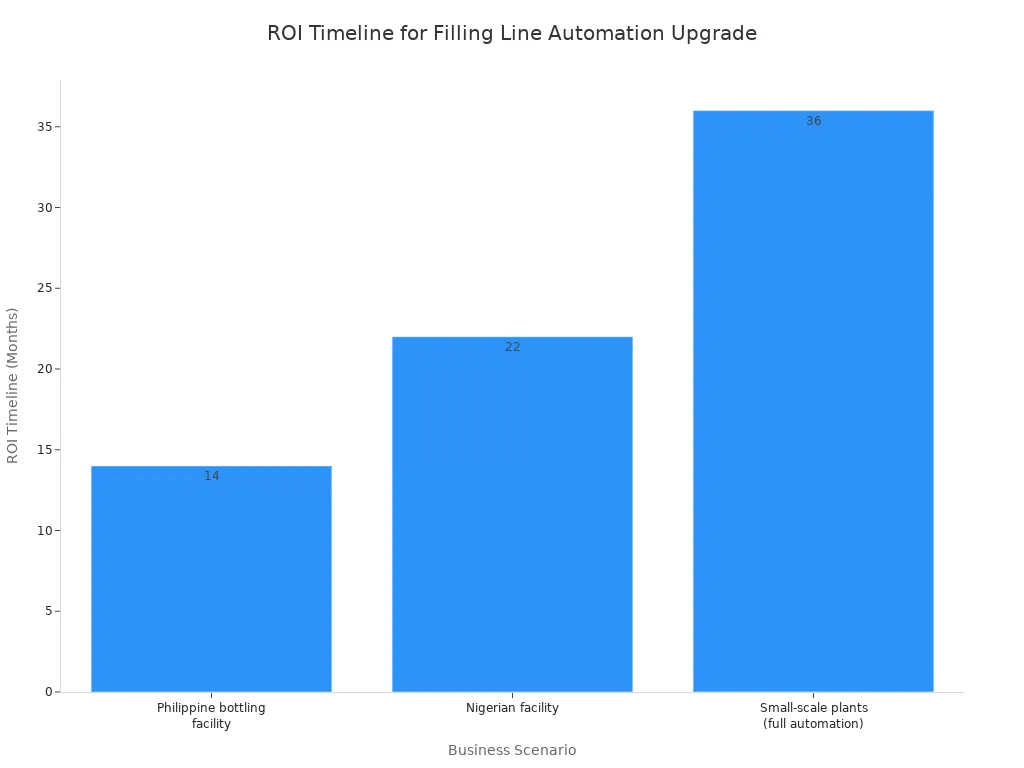
Fully automatic lines are designed for high-volume manufacturing where efficiency and consistency are paramount. These integrated systems handle everything from container feeding to filling, capping, and labeling with minimal human intervention. While the initial investment is significant, the return on investment (ROI) from labor savings and increased throughput is compelling. For example, one facility recovered its investment in 22 months after reducing staff from 120 to 55. However, the ROI timeline varies significantly based on scale.
| Business Type/Scenario | ROI Timeline (Months) | Notes |
|---|---|---|
| Mid-sized businesses (general) | 12-24 | Varies based on production volume and market prices |
| Philippine bottling facility (20-valve rotary) | 14 | Achieved full ROI |
| Nigerian facility (semi-automatic upgrade) | 22 | Recovered investment due to significant labor savings |
| Small-scale plants (full automation) | >36 | Over three years to see returns |
A fully automatic lip gloss filling machine represents a major capital expenditure, but for large-scale producers, it unlocks unparalleled productivity and long-term cost savings.
2. Analyze Your Lip Gloss Formulation and Ingredients
A product's formula is the heart of a cosmetics brand. Its unique characteristics directly impact the type of machinery required for production. A business must select a lip gloss filling machine that can handle its specific formulation without compromising product integrity or filling accuracy.
a. Understand Product Viscosity and Consistency
Viscosity is a critical technical specification for lip gloss. It influences the product's flow, texture, and application feel. For lip glosses, the typical viscosity range is between 5,000 and 20,000 centipoise (cP). This measurement is essential for formulations like hydrating plumping glosses or opaque shimmer products. Different filling technologies are engineered to handle specific viscosity ranges.
Piston Fillers for Thick, Viscous Glosses
Piston fillers are the industry standard for high-viscosity products. These machines use a volumetric piston to draw a precise amount of gloss from a hopper and dispense it into the container. Their powerful action easily manages thick, sticky formulas, ensuring consistent fill volumes with every cycle. This makes them ideal for rich, non-runny glosses.
Peristaltic Pumps for High-Purity or Abrasive Formulas
Peristaltic pump fillers offer a unique advantage for certain formulations. The product only touches the inside of a single piece of medical-grade tubing. This design is perfect for high-purity organic formulas or products containing abrasive materials like glitter. The gentle squeezing action prevents damage to particulates and eliminates cross-contamination, as the tubing can be easily changed between batches.
Gear Pump Fillers for Medium-Viscosity Products
Gear pump fillers provide a versatile solution for products with medium viscosity. They use the rotation of intermeshing gears to move the product. These fillers offer a continuous flow and can be easily adjusted for different fill volumes. They strike a balance between the power of a piston filler and the gentle handling of a peristaltic pump.
b. Accommodate Formulas with Special Ingredients
Modern lip glosses often contain more than just oils and pigments. Special ingredients require specialized machine features to maintain the formula's intended appearance and efficacy.
Handling Products with Glitter and Particulates
Formulas with glitter, mica, or other suspended particulates need careful handling to ensure even distribution.
A machine for these products should feature a mixing system within the hopper, such as an agitator or a sweep arm. This continuous motion keeps particulates suspended, preventing them from settling at the bottom and ensuring every tube contains the perfect amount of sparkle.
Managing Temperature-Sensitive Formulations
Some gloss formulas, particularly those with waxes or certain polymers, must be heated to a specific temperature to flow properly. These products require a machine with a heated, jacketed hopper and temperature-controlled nozzles. Maintaining a consistent temperature is crucial. Advanced control systems, from simple thermostats to sophisticated PLC-based systems, ensure the right temperature is consistently maintained. For optimal performance, a business should regularly:
- Inspect insulation to prevent heat loss.
- Check heating elements for even operation.
- Monitor moisture levels and adjust settings as needed.
- Verify that airflow and temperature control systems are functioning correctly.
Implementing these checks ensures product quality and operational stability.
3. Scrutinize Key Features of a Lip Gloss Filling Machine
Beyond production speed, the specific features of a machine determine its true value. A business must examine the technical specifications that impact accuracy, versatility, and day-to-day operations. These details directly influence product quality, operational costs, and the ability to adapt to market trends.
a. Prioritize Filling Accuracy and Consistency
Consistent fill levels are non-negotiable in cosmetics. Overfilling wastes expensive product, while underfilling damages brand reputation and can lead to regulatory issues. Precision is paramount for profitability and consumer trust.
The Importance of Fill Volume Tolerance (+/- 1%)
Fill volume tolerance measures the acceptable deviation from the target fill amount. A tighter tolerance means less product giveaway and greater consistency.
- Automatic filling machines generally offer an accuracy within a ±1% tolerance.
- Semi-automatic fillers typically provide an accuracy of around ±2%.
While pharmaceutical applications may demand even tighter precision (±0.5%), achieving a ±1% tolerance is a strong benchmark for cosmetic quality control.
Servo-Driven vs. Pneumatic Actuation Systems
The system that drives the filling mechanism significantly affects precision. Pneumatic systems use compressed air and are a cost-effective solution, but they can be susceptible to inconsistencies from pressure fluctuations. Servo-driven systems, however, offer superior control.
Servo motors use a closed-loop feedback system to make instantaneous micro-adjustments to the filling process. This technology allows a programmable logic controller (PLC) to precisely manage the piston's speed and stroke, ensuring exceptional accuracy. Advanced servo systems can even detect product variations and adjust on the fly, consistently achieving accuracies within 0.1%.
Utilizing Drip-Free Nozzle Technology
Messy containers are unprofessional and costly. Drip-free nozzles are an essential feature that prevents product from leaking after a fill cycle is complete. These nozzles use various mechanisms, such as suck-back or valve shut-offs, to ensure a clean cutoff, keeping tubes and bottles pristine and minimizing product waste.
b. Evaluate Container Handling and Versatility
The cosmetics market thrives on innovative packaging. A versatile lip gloss filling machine allows a brand to explore creative container designs without needing to purchase new equipment for every product launch.
Adjustability for Different Tube and Bottle Sizes
A machine should easily accommodate various container heights and diameters. Look for equipment with simple, tool-less adjustments for guide rails, nozzle height, and container holders. This flexibility is crucial for businesses that offer multiple product sizes or plan to expand their product line in the future.
Compatibility with Uniquely Shaped Containers
Standard cylindrical tubes are not the only option. Brands often use square, oval, or other custom-shaped containers to stand out. A flexible machine can be adapted to handle these unique designs. For example, some models use customizable "pucks" or holders that secure unusually shaped containers, ensuring stability and accuracy during the filling process.
Systems for Handling Various Wand and Cap Types
Filling is only one part of the process. The machine must also be compatible with different applicators and closures. Whether a product uses a classic doe-foot applicator, a brush, or a rollerball, the system must be able to insert the wand and tighten the cap correctly without causing damage.
4. Focus on Operational Efficiency and Maintenance
A machine's value extends beyond its purchase price. Its long-term operational efficiency and ease of maintenance directly impact a company's profitability. Downtime for cleaning and product changeovers can significantly erode production capacity. Therefore, businesses must prioritize equipment designed for maximum uptime and minimal labor.
a. Demand Simple and Effective Cleaning Processes
Cleaning is a critical step in cosmetic manufacturing to prevent cross-contamination and ensure product safety. An efficient cleaning process minimizes downtime and ensures compliance with regulatory standards. The US Food & Drug Administration (FDA) expects manufacturers to have validated cleaning procedures.
A robust cleaning validation protocol is essential. It should include written Standard Operating Procedures (SOPs), defined acceptance criteria for residue, and a final report confirming the process's effectiveness for specific equipment. This ensures the cleaning method is reliable and repeatable.
Clean-in-Place (CIP) Systems for Automated Cleaning
For high-volume operations, Clean-in-Place (CIP) systems offer significant advantages. These automated systems circulate cleaning solutions, sanitizers, and rinse water through the machine's product contact parts without requiring disassembly. A Clean-in-Place (CIP) system is a much quicker method for cleaning equipment compared to manual cleaning. It is also a less labor-intensive process, freeing up operators for other productive tasks.
Tool-Less Disassembly for Fast Manual Cleaning
When CIP is not feasible, a machine designed for fast manual cleaning is the next best option. Features like tool-less disassembly allow operators to quickly break down pumps, hoppers, and nozzles by hand. This simplifies access for thorough cleaning and inspection. To validate any manual cleaning method, a common industry practice is the "Three Consecutive Runs" rule, where the procedure is successfully executed and tested three times to prove its consistency.
b. Analyze Changeover Speed and Flexibility
The ability to switch quickly from one product to another is crucial for brands with diverse color palettes or formulations. Changeover time is non-productive, so minimizing it directly increases manufacturing capacity.
Quick-Release Parts and Sanitary Fittings
Machines equipped with quick-release clamps and sanitary tri-clamp fittings are instrumental in reducing changeover times. These components allow for swift removal and replacement of parts like hoppers and filling nozzles. This design not only speeds up the physical changeover but also simplifies the cleaning process between batches.
Programmable Recipes for Different Products
Modern filling machines often feature a Programmable Logic Controller (PLC) with recipe storage capabilities. This technology revolutionizes changeover efficiency. Instead of manual adjustments, an operator simply selects a pre-programmed recipe from the control panel. The system then automatically configures the machine's parameters.
- Immediate retrieval of stored recipes reduces setup time between runs.
- Automated adjustment of variables like fill volume and speed improves consistency.
- System alerts can notify operators of any deviations, ensuring quality control.
This level of automation ensures that every product is filled according to its exact specifications, improving efficiency and reducing the potential for human error.
5. Evaluate Material Quality and Construction
The durability and safety of a filling machine depend heavily on its construction materials and build quality. A business must inspect these aspects to ensure the equipment is robust, compliant, and built to last. This evaluation protects both the product and the long-term investment.
a. Check Material of Product Contact Parts
Any surface that touches the lip gloss formula is a "product contact part." These components must be made from materials that do not react with, add to, or alter the product. This preserves the formula's purity and safety.
304 vs. 316L Stainless Steel for Purity
Stainless steel is the standard material for cosmetic equipment due to its resistance to corrosion. The two most common grades are 304 and 316L. Both 304L and 316L stainless steels are suitable for a wide range of cosmetic ingredients, including oils, alcohols, and mild acids. The choice depends on the formula's specific chemical properties.
316L stainless steel offers significantly enhanced corrosion resistance compared to 304. The inclusion of molybdenum in 316L grade steel provides superior protection against chlorides and acids. This makes 316L the preferred choice for more aggressive formulas or for companies adhering to the strictest purity standards.
Gasket and Seal Material Compatibility
Gaskets, seals, and O-rings are also critical contact parts. These components must be chemically compatible with the lip gloss ingredients to prevent them from degrading, swelling, or leaching into the product. Common materials include:
- Viton™ (FKM): Excellent resistance to oils and chemicals.
- EPDM: Good for water-based products and glycols.
- Silicone: Suitable for a wide temperature range but has limitations with certain oils.
A manufacturer should provide a chemical compatibility chart to help a business verify that the machine's seals are appropriate for its specific formulations.
b. Assess Overall Build Quality and Durability
A well-built machine operates reliably and withstands the demands of a production environment. A company should look beyond the shiny surfaces and inspect the fundamental construction of the equipment.
Frame Construction and Stability
The machine's frame provides its structural integrity. Most high-quality frames are constructed from heavy-gauge 304 stainless steel for strength and corrosion resistance.
A robust, stable frame is the foundation of a reliable lip gloss filling machine. It minimizes vibration during operation, which is essential for maintaining consistent filling accuracy and reducing long-term wear and tear on mechanical components.
Quality of Welds and Finishes
The quality of welding is a clear indicator of manufacturing expertise. Welds should be smooth, continuous, and fully penetrated. Poorly executed welds can create microscopic cracks and crevices. These imperfections are difficult to clean and can harbor bacteria, creating a contamination risk. A polished or finely brushed finish on all stainless steel surfaces not only looks professional but also makes the equipment easier to clean and sanitize.
6. Verify Safety and Regulatory Compliance
Ensuring a machine meets safety and regulatory standards is not just a legal formality; it is a fundamental requirement for protecting operators and maintaining brand integrity. A business must verify that any potential equipment adheres to established industry guidelines for both operational safety and product purity.
a. Confirm Good Manufacturing Practice (GMP) Compliance
Good Manufacturing Practice (GMP) provides a framework for ensuring products are consistently produced and controlled according to quality standards. A machine's design and construction are central to achieving GMP compliance in a cosmetics facility.
Hygienic Design and Construction Standards
The design of a filling machine must prevent product contamination. GMP guidelines dictate several key principles for equipment suitability.
- The equipment must be suitable for its intended purpose and not used for other functions.
- All materials must be inert, meaning they do not interact with ingredients or cleaning agents.
- The machine must allow for adequate cleaning, sanitization, and maintenance to prevent contamination.
- It should be stored properly when not in use, and any broken parts must be repaired or replaced immediately.
Adherence to these standards ensures the final product remains pure and safe for consumers.
Documentation for Material Traceability
A manufacturer must provide comprehensive documentation that proves the traceability of all product contact parts. This is a core tenet of GMP. A company should expect detailed Batch Production Control Records (BPCR) that provide a complete history of each production run.
For metallic components, a manufacturer should supply material certificates like the DIN EN 102004 3.1, which confirms material conformity and links back to specific test results. For polymer parts like gaskets, certificates confirming compliance with food-grade standards (e.g., FDA CFR 21 177.2600) are essential.
This documentation provides auditable proof that the machine is built from safe, appropriate materials.
b. Look for Essential Machine Safety Features
Beyond product safety, a machine must incorporate features that protect its operators from injury. These systems are designed to prevent accidents during operation, cleaning, and maintenance.
Emergency Stop (E-Stop) Buttons
Emergency stop buttons are a non-negotiable safety feature. These highly visible, easily accessible buttons must be placed at key operator stations around the machine. When pressed, an E-stop immediately halts all machine movement and power to hazardous components, providing a critical failsafe in an emergency.
Safety Guarding and Sensor Interlocks
Physical guards, such as polycarbonate doors or panels, create a barrier between the operator and moving parts. However, these guards are only effective when paired with sensor interlocks. An interlock is a safety device that monitors the position of a guard. If a door or panel is opened, the interlock sends a signal to the machine's control system, which immediately stops hazardous motion. This ensures an operator cannot access dangerous areas while the machine is running. Modern systems often use non-contact interlocks, such as RFID technology, which are difficult to bypass and offer a higher level of safety.
7. Evaluate Supplier Reputation and After-Sales Support
An exceptional machine is only as good as the company that stands behind it. A business's relationship with its equipment supplier extends far beyond the initial purchase. It is a long-term partnership that impacts operational stability, maintenance costs, and future growth potential. Therefore, a thorough evaluation of a manufacturer's reputation and after-sales support is a critical step in the procurement process.
a. Research Manufacturer Reliability and Expertise
A supplier's track record provides valuable insight into the quality of their products and services. A business should seek out manufacturers with a proven history of success and a deep understanding of the cosmetics industry's unique demands.
Customer Reviews and Case Studies
Authentic customer feedback is an invaluable resource. A company should look for detailed reviews and case studies that offer a transparent look at a supplier's performance.
- Manufacturers like Fillsol and Groninger provide dedicated case study pages on their websites.
- These resources showcase real-world applications of their equipment in the cosmetics sector.
- They demonstrate the supplier's ability to develop solutions for various product types, from liquid to highly viscous formulas.
Reviewing these success stories helps a business gauge a manufacturer's problem-solving capabilities and customer satisfaction levels.
Industry Experience in Cosmetics
Specialized expertise matters. A supplier with extensive experience in the cosmetics industry understands the nuances of handling diverse formulations and adhering to strict quality standards.
For example, LIENM, with over 30 years in the field, has supplied equipment to over 90 countries and is trusted by leading brands like SKY COSMETIC. Their deep knowledge allows them to address challenges related to viscosity and container variety effectively.
Other reputable manufacturers known for their cosmetic industry focus include:
- Eugeng International: Offers machinery tailored to specific client needs.
- Mic Machinery: Known for precision and reliability.
- Axomatic: Manufactures innovative and user-friendly equipment.
Choosing a supplier with this level of industry-specific experience ensures the equipment is truly fit for purpose.
b. Clarify Technical Support and Service Terms
Downtime is costly. When a machine requires service, a swift and effective response from the supplier is essential. A business must have a clear understanding of the support terms before committing to a purchase.
24/7 Technical Support Availability
Production schedules do not always align with standard business hours. A company should inquire about the availability of after-hours support, including weekends and holidays. While some issues can wait, critical failures require immediate attention. It is important to clarify if 24/7 service is available and whether it incurs additional charges. Standard service-level agreements (SLAs) for response times can range from a few minutes to over an hour.
On-Site Installation and Operator Training
Proper installation and training are fundamental to maximizing a machine's performance and lifespan. A reputable supplier should offer on-site installation by qualified technicians. This service ensures the equipment is set up correctly and integrated smoothly into the production line. Comprehensive operator training is equally important. It empowers the production team to operate the machine safely, perform routine maintenance, and troubleshoot minor issues, reducing reliance on external support.
c. Inquire About Warranty and Spare Parts
A strong warranty and a reliable supply of spare parts provide long-term security for the investment. These elements protect a business from unexpected repair costs and extended periods of downtime.
Comprehensive Warranty Coverage and Duration
A warranty is a manufacturer's promise of quality. A business should carefully review the terms of the warranty, paying close attention to its duration and what it covers.
A comprehensive warranty typically lasts one to three years and should cover defects in materials and workmanship. Some suppliers also bundle provisions for technical support response times and on-site training within their warranty packages.
Spare Part Availability and Lead Times
Even the most durable machines have parts that wear out over time. A company must confirm that the supplier maintains a ready inventory of common spare parts. Inquiring about lead times for both standard and custom components is crucial. Long waits for a critical part can halt production for days or even weeks. A supplier with a well-managed parts inventory and efficient logistics demonstrates a commitment to minimizing customer downtime.
Selecting the right lip gloss filling machine requires a careful analysis of several critical factors. A business must answer key questions before making a final decision.
- Does the machine's output meet current and future production demands?
- Is the filling system suitable for the gloss viscosity and special ingredients?
- Does it provide the necessary fill accuracy and allow for efficient changeovers?
- Is the manufacturer reputable and able to offer reliable long-term support?
Answering these questions ensures the chosen lip gloss filling machine becomes a valuable asset that boosts productivity and supports business growth.
FAQ
How does a business choose between a semi-automatic and fully automatic filler?
A business should assess its production volume. Semi-automatic fillers suit small to medium operations needing flexibility. Fully automatic lines are ideal for large-scale manufacturing. They offer high speed and require minimal labor, providing a strong return on investment for high-volume producers.
What is the best filler type for a thick, high-viscosity lip gloss?
Piston fillers are the industry standard for thick glosses. They use a powerful volumetric piston to accurately dispense viscous formulas without compromising consistency. This technology ensures precise fill volumes for rich, non-runny products, making it a reliable choice for most lip gloss formulations.
What machine feature is essential for lip gloss with glitter?
A machine needs a mixing system in the hopper to handle glitter. An agitator or sweep arm keeps particulates suspended evenly throughout the formula. This feature prevents glitter from settling, ensuring every tube receives a consistent amount of sparkle for a high-quality final product. ✨
Why is 316L stainless steel better than 304 for some formulas?
316L stainless steel contains molybdenum, offering superior corrosion resistance. It provides better protection against chlorides and acids compared to 304 steel. A company should choose 316L for aggressive formulas or when adhering to the strictest GMP purity standards to ensure product integrity.
How can a company reduce machine cleaning time?
A business can reduce downtime by choosing a machine designed for easy cleaning.
- Clean-in-Place (CIP) systems automate the process for high-volume lines.
- Tool-less disassembly allows operators to quickly break down parts for fast manual cleaning, minimizing changeover time between batches.
What should a warranty for a lip gloss filling machine include?
A comprehensive warranty should last one to three years and cover defects in materials and workmanship. A business should also look for clear terms on technical support response times, on-site service availability, and access to operator training to protect its investment effectively.
See Also
Top Ampoule Filling Line Manufacturers: A Comprehensive Industry Comparison
Essential Capsule Checkweighers for Pharmaceutical Buyers to Evaluate in 2025
Evaluating Investment in Automated Virus Sampling Tube Assembly Lines: A Guide
Boosting Pharma Efficiency: Modern Capsule Decapsulation Machines' Impact Explained
Key Trending Folder Gluer Innovations for 2025 Carton Production Lines