Are Food X-Ray Scanners Safe for Consumers?
Food recalls are projected to reach a record high in 2024. An x ray checking machine for food offers a vital safety check against contaminants. Consumers can be confident that scanned food is 100% safe to eat. The extremely low radiation dose has no effect on food's nutritional value, taste, or texture.
Note: This safety inspection process is completely different from food irradiation.
Why Doesn't the X-Ray Harm My Food?
The safety of X-ray food inspection hinges on two fundamental principles: an extremely low energy dose and a purpose that is entirely different from food irradiation. Understanding these concepts clarifies why the process has no negative effect on food products.
The Dose Is Incredibly Low
The term "radiation" can sound alarming, but the energy level used in food inspection is the most important factor. An x ray checking machine for food uses an exceptionally low dose of radiation. The primary goal is simply to see through the food product, not to alter it.
A food item passing through a scanner receives a minuscule amount of energy, measured in micro-Sieverts (μSv). To put this into perspective, the radiation dose is far less than the natural background radiation people encounter daily from sources like the sun and soil.
| Measurement Type | Radiation Dose (μSv) |
|---|---|
| Per item (food traveling through) | 1.5 μSv |
| Leakage radiation (per hour) | ≤ 1 μSv/h |
An operator working 40 hours a week directly with an X-ray system receives an annual dose of about 2,000 μSv. The average person's annual exposure to natural background radiation is higher, at approximately 2,400 μSv. This shows that the technology operates well within established natural safety benchmarks.
Inspection vs. Irradiation: What's the Difference?
Consumers often confuse X-ray inspection with food irradiation, but they are two distinct processes with different purposes and energy levels. X-ray inspection finds physical contaminants. Food irradiation sterilizes the food itself.
This table highlights the key differences:
| Feature | X-Ray Food Inspection | Food Irradiation |
|---|---|---|
| Primary Purpose | Detects physical contaminants (e.g., metal, glass) | Eliminates harmful microorganisms (e.g., Salmonella) |
| Mechanism | Uses low-energy X-rays to create an image | Uses high-energy ionizing radiation to break microbial DNA |
| Impact on Food | Non-invasive; no change to food's structure or nutrition | Extends shelf life; may cause minimal nutrient loss |
| Effect on Pathogens | Does not eliminate bacteria or viruses | Kills harmful pathogens to improve microbiological safety |
Food irradiation uses a much stronger dose of radiation, measured in kiloGrays (kGy), to achieve its goals. The dose is thousands, or even millions, of times higher than that used for inspection.
| Food Type/Purpose | Minimum Dose (kGy) |
|---|---|
| Inhibit sprouting (potatoes) | 0.05 - 0.15 |
| Pest control (grains) | 0.15 - 0.50 |
| Destroy pathogens (chicken) | 2.0 - 5.0 |
| Sterilize herbs and spices | 30 |
Due to this intensive process, regulations require special labeling for irradiated foods.
- The U.S. Food and Drug Administration (FDA) mandates that irradiated food must display the international Radura symbol.
- The packaging must also include a statement like “treated with radiation” or “treated by irradiation.”
Food that only passes through an inspection scanner does not undergo irradiation. Therefore, it does not carry the Radura symbol or any special labeling, because its composition, taste, and nutritional value remain completely unchanged.
How Does an X-Ray Checking Machine for Food Work?
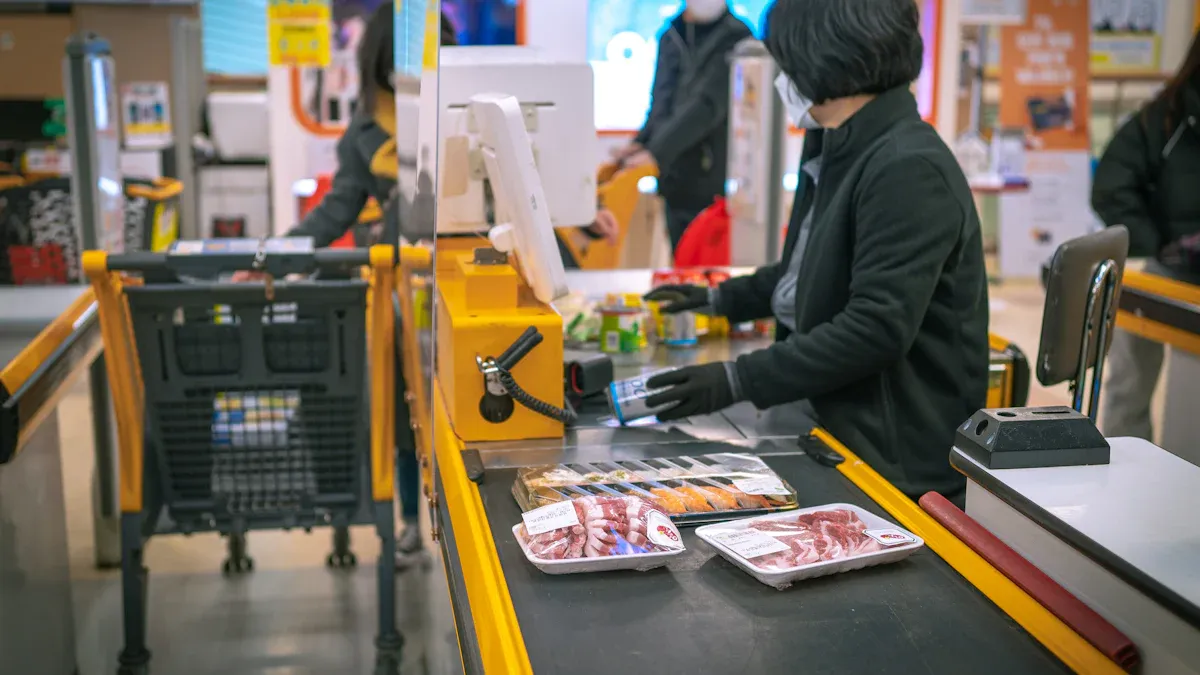
An x ray checking machine for food operates on a simple yet powerful principle: analyzing density. The system uses several key components working together to create a detailed internal view of a product as it moves along a production line. These components include:
- An X-ray generator to emit low-energy rays.
- A detector to capture the rays that pass through the food.
- A computer with advanced software to analyze the resulting image.
- A reject mechanism to automatically remove any flagged items.
Finding Dangers by Density
The system's ability to find contaminants comes from how different materials absorb X-rays. As the rays penetrate a food item, they lose energy based on the density of the material they encounter. The detector on the other side measures these energy changes and sends the data to a computer.
The software converts this information into a grayscale image. Less dense food matter appears lighter, while denser foreign objects absorb more X-rays and show up as darker areas. This technology allows an x ray checking machine for food to reliably identify a wide range of contaminants, including:
- Metal fragments (ferrous and non-ferrous)
- Glass shards
- Calcified bone
- Mineral stones
- High-density plastics
Protecting Food Quality
Modern X-ray systems do more than just find physical hazards. They are also powerful quality control tools that help manufacturers maintain brand standards. The same imaging technology can perform several checks simultaneously at high speeds.
Beyond safety, these systems verify product integrity. They can measure the overall mass of a package, check that fill levels are correct, and identify missing or broken items inside a sealed container.
This capability also extends to packaging. The system can spot defects like product trapped in a seal, which could compromise freshness, or identify misshapen packages. This ensures that the product reaching the consumer is both safe and meets quality expectations.
Will X-Ray Scanning Affect My Food's Quality?

A primary concern for many consumers is whether X-ray inspection technology alters the food they eat. The scientific and regulatory consensus is clear: this process does not compromise food quality, nutritional value, or organic status. The technology is designed for detection, not modification.
No Change to Nutrition, Taste, or Texture
The quality of food remains completely unchanged after passing through an X-ray scanner. The energy dose is minimal and the exposure time is incredibly brief, lasting only a fraction of a second. This is not enough energy or time to alter the molecular structure of the food. As a result, the food's taste, aroma, and texture are not affected.
Scientific research confirms that X-ray inspection preserves the nutritional integrity of food products.
A 2020 systematic review by Zakiyeh B Zehi et al., titled 'The Effects of X-Ray Irradiation on Safety and Nutritional Value of Food,' concluded that the low doses used for inspection do not alter nutritional content.
Global studies consistently show that this technology has a negligible effect on essential nutrients. Key vitamins, minerals, and macronutrients are fully retained.
- Vitamins: Vitamin C, Vitamin A, and B-complex vitamins remain stable.
- Minerals: Levels of calcium, iron, and potassium are unaffected.
- Macronutrients: Proteins, fats, and carbohydrates do not undergo any changes.
This robust body of evidence confirms that food is just as nutritious after an X-ray scan as it was before.
Keeping Organic Food Organic
Consumers of organic products can be confident that X-ray inspection aligns with organic principles. While regulations rightly protect organic food from certain processes, it is crucial to distinguish between inspection and irradiation.
The USDA National Organic Program (NOP) and equivalent international bodies prohibit the use of high-dose ionizing radiation for sterilization or pest control. This process, known as food irradiation, fundamentally alters the food to kill microorganisms and is not permitted for any product labeled "organic."
X-ray inspection, however, is an entirely different process. It is a quality control check, not a food treatment.
The distinction lies in the radiation intensity and purpose. Organic standards permit X-ray inspection for contaminant detection because the energy level is thousands of times lower than the doses used for irradiation.
Legally, product testing is permitted up to a dose of 0.5 gray (Gy). In practice, an X-ray inspection system uses a tiny fraction of that limit. Some advanced systems emit a dose as low as 0.000015 Gy, which is over 30,000 times lower than the maximum permitted testing dose.
This table clarifies the regulatory standing:
| Process | Purpose | Energy Level | Organic Status |
|---|---|---|---|
| X-Ray Inspection | Finds physical contaminants | Extremely Low | ✅ Permitted |
| Food Irradiation | Kills pathogens, extends shelf life | High | 🚫 Prohibited |
Because X-ray inspection does not treat or change the food, certifiers allow its use. It is considered a vital tool for ensuring the safety and quality of organic products without compromising their integrity.
Who Makes Sure This Technology Is Safe?
The safety of food X-ray inspection is not left to chance. A robust framework of government regulation and intentional engineering ensures these systems protect both the food supply and the people who operate them. This stringent oversight provides confidence in the technology's reliability.
Strict FDA Regulations
The U.S. Food and Drug Administration (FDA) enforces strict rules for all cabinet X-ray systems. These regulations ensure that equipment is designed and operated safely. Key FDA rules include:
- 21 CFR 1020.40: This regulation governs the design of cabinet X-ray systems. It mandates safety interlocks that immediately stop X-ray generation if a door or panel is opened, preventing any human exposure.
- Radiation Limits: The FDA requires that external radiation emissions from a cabinet system do not exceed 0.5 milliroentgens per hour. This ensures leakage is negligible.
- Food Contact Materials: Any part of the machine that touches food, like the protective curtains, must comply with regulations like
21 CFR 177.2600. This ensures materials are lead-free and "FDA Compliant" for safe, repeated use with food.
Built-In Safety for Food and People
Manufacturers design every x ray checking machine for food with multiple layers of physical protection. The primary goal is to completely contain the X-rays within a shielded cabinet, typically built from dense materials like stainless steel and lead. This construction ensures radiation does not escape into the surrounding environment.
Key Safety Features:
- Safety Interlocks: Doors and access panels have redundant interlocks that cut power to the generator if opened.
- Lead-Lined Curtains: Tunnels have protective curtains to block rays at the entry and exit points.
- Warning Lights & Emergency Stops: Highly visible indicators show when the system is active, and accessible emergency stops allow for immediate shutdown.
Beyond machine design, safety extends to personnel. Comprehensive training programs ensure operators understand how to use the equipment correctly, perform routine safety checks, and follow all compliance protocols, safeguarding both themselves and the integrity of the food inspection process.
X-ray food scanners are safe, regulated tools protecting consumers from harmful contaminants. Scientific evidence from organizations like the World Health Organization confirms the process does not alter food quality or make it radioactive. Consumers can be confident that scanned food remains just as safe and nutritious as it was before inspection.
FAQ
Does X-ray inspection make food radioactive?
No. The energy is too low to cause radioactivity. Food passes through the scanner unchanged. It remains completely safe for consumption.
Can X-ray scanners detect all contaminants?
X-ray systems excel at finding dense contaminants like metal, glass, and stone. They cannot reliably detect low-density materials such as wood, hair, or insects.
Is there a health risk for machine operators?
No. Shielded cabinets and safety interlocks contain all radiation. Operator exposure remains well below established safety limits and natural background radiation levels.
See Also
Discovering Top Chinese Suppliers for X-Ray Inspection Machine Purchases
Essential Industrial Checkweighers: A Must-Have for Every Food Processing Plant
Key Capsule Checkweighers for Buyers to Evaluate in the Year 2025
Understanding Pharmaceutical Checkweighers: Definition and Crucial Operational Features
Boosting Pharmaceutical Efficiency with Advanced Capsule Decapsulation Machine Technology