A Closer Look at VCH Mass Fraction in HTPB-Based Propellants
You see the influence of VCH mass fraction on the application performance of HTPB CAS 69102-90-5 Hydroxyl-terminated polybutadiene right away. This factor changes how strong, safe, and efficient your propellant becomes. When you adjust the VCH content, you make HTPB CAS 69102-90-5 Hydroxyl-terminated polybutadiene work better for your needs.
Tip: Small changes in VCH mass fraction can lead to big differences in results.
Key Takeaways
- VCH mass fraction significantly affects the performance of HTPB-based propellants. Adjusting this percentage can enhance strength, safety, and efficiency.
- A VCH mass fraction between 4% and 6% is recommended for a good balance of flexibility and strength. Start within this range for optimal results.
- Always test small batches before large-scale production. This helps identify issues early and ensures safety and performance meet your needs.
Influence of VCH Mass Fraction on HTPB CAS 69102-90-5 Hydroxyl-terminated polybutadiene Formulations
What Is VCH Mass Fraction?
You may wonder what VCH mass fraction means. VCH stands for vinylcyclohexene, a chemical that you add to HTPB-based propellants. The mass fraction tells you how much VCH is present compared to the total mass of the propellant mixture. You usually see this value as a percentage. For example, if you have a propellant with a VCH mass fraction of 5%, it means that 5% of the total weight comes from VCH.
You need to pay attention to this number because it changes how your propellant behaves. The influence of VCH mass fraction on the application performance of HTPB CAS 69102-90-5 Hydroxyl-terminated polybutadiene starts with this basic measurement. Even a small change in the VCH mass fraction can make a big difference in the final product.
Note: Always check the VCH mass fraction before you mix or use HTPB-based propellants.
Role of VCH in HTPB-Based Propellants
You use VCH to adjust the properties of HTPB-based propellants. VCH helps control how the propellant cures and how strong it becomes. When you change the VCH mass fraction, you can make the propellant softer or harder. You can also affect how well it burns and how safe it is to handle.
The influence of VCH mass fraction on the application performance of HTPB CAS 69102-90-5 Hydroxyl-terminated polybutadiene shows up in many ways. You see changes in mechanical strength, burn rate, and even storage life. If you want a propellant that works well for your needs, you must understand the role of VCH and how much to use.
- VCH controls curing speed.
- VCH affects flexibility.
- VCH changes burn characteristics.
You can improve your propellant by adjusting the VCH mass fraction to match your goals.
Influence of VCH Mass Fraction on Mechanical Properties
Tensile Strength and Elasticity
You need to know how VCH mass fraction changes the strength and stretchiness of your propellant. When you add more VCH, you often see the propellant become softer and more flexible. If you use less VCH, the propellant usually gets harder and stronger. This happens because VCH changes the way the HTPB chains link together during curing.
-
Higher VCH mass fraction:
- Increases elasticity
- Makes the propellant easier to bend
- Can lower the maximum force the propellant can handle before breaking
-
Lower VCH mass fraction:
- Increases tensile strength
- Makes the propellant stiffer
- Reduces flexibility
Tip: If you want a propellant that stretches without breaking, try a higher VCH mass fraction. If you need more strength, use less VCH.
Impact Behavior
You also need to think about how your propellant reacts when it gets hit or dropped. VCH mass fraction plays a big role here. A higher VCH mass fraction helps the propellant absorb shocks better. This means your propellant is less likely to crack or break if it falls.
A lower VCH mass fraction makes the propellant tougher but also more brittle. It might snap or shatter under a strong impact.
| VCH Mass Fraction | Impact Resistance | Brittleness |
|---|---|---|
| High | High | Low |
| Low | Low | High |
Note: Always test your propellant’s impact behavior before using it in real-world situations. Safety comes first!
Influence of VCH Mass Fraction on Thermal Stability and Processability
Thermal Stability
You need your propellant to stay stable when exposed to heat. The VCH mass fraction changes how your HTPB-based propellant handles high temperatures. When you adjust the VCH content, you change the temperature at which the material starts to break down. A higher VCH mass fraction can lower the onset decomposition temperature, which means your propellant may start to lose mass or break apart at a lower temperature.
Here is a table that shows how different HTPB-based propellants behave under heat:
| Material | Onset Decomposition Temperature (°C) | Mass Loss (%) | Peak Temperature (°C) |
|---|---|---|---|
| TNEF | 169.0 | 98.79 | 186.6 |
| HTPB (1st) | 301.2 | 14.81 | 322.5 |
| TNEF/HTPB | 139.8 | 99.13 | 163.7 |
| AP/HTPB (1st) | 168.0 | 11.82 | 189.9 |
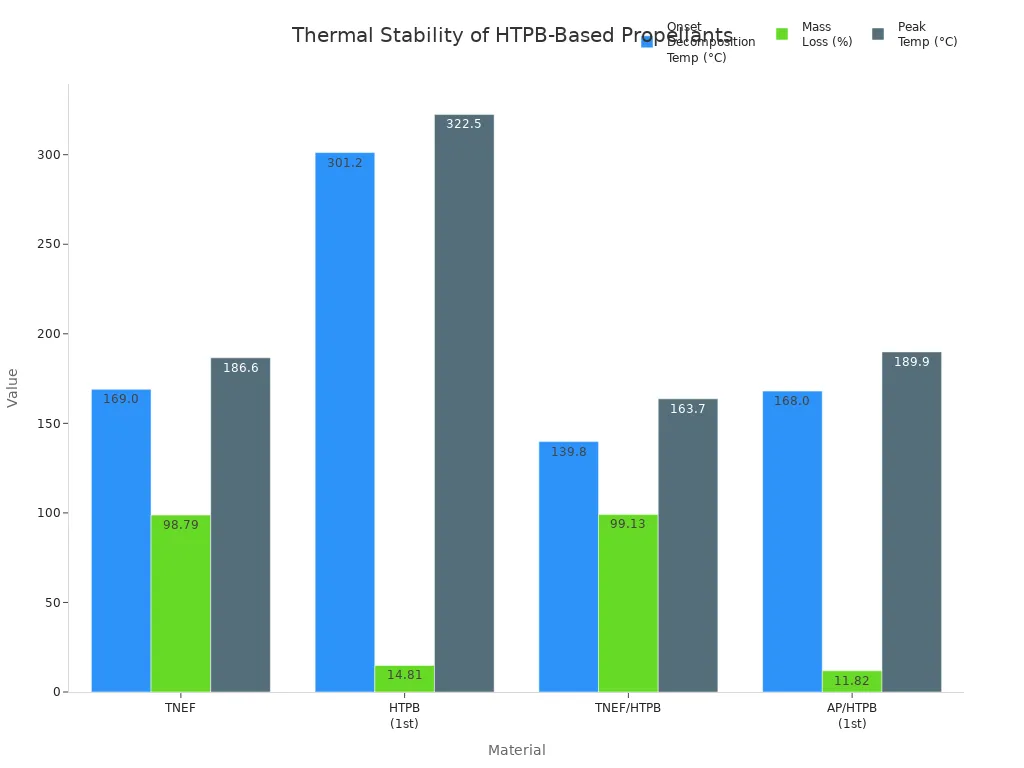
Tip: If you want your propellant to resist heat better, choose a VCH mass fraction that keeps the onset decomposition temperature high.
Processability
You also want your propellant to be easy to mix, pour, and cure. The VCH mass fraction affects how smooth and workable your mixture becomes. A higher VCH content can make the propellant softer and easier to shape. This helps you fill molds or containers without trouble. If you use less VCH, the mixture may become thicker and harder to handle.
- Higher VCH mass fraction: Easier mixing and pouring, better flow.
- Lower VCH mass fraction: Thicker, more difficult to process, but may give a stronger final product.
Note: Always balance processability with the final properties you need. Too much VCH can make handling easy but may lower thermal stability.
Influence of VCH Mass Fraction on Application Performance Metrics
Combustion Efficiency and Burn Rate
You want your propellant to burn smoothly and efficiently. The amount of VCH you add to HTPB-based propellants changes how well your fuel burns. When you increase the VCH mass fraction, you often see a faster burn rate. This happens because VCH changes the way the propellant reacts with heat and oxygen.
If you use too much VCH, the propellant might burn too quickly. This can cause problems with pressure and stability. If you use too little, the burn rate slows down. Your rocket or device may not get enough thrust.
Tip: Always test different VCH levels to find the best burn rate for your application.
Here is a simple table to show how VCH mass fraction can affect burn rate:
| VCH Mass Fraction | Burn Rate (mm/s) | Combustion Efficiency (%) |
|---|---|---|
| Low | 4.2 | 85 |
| Medium | 6.0 | 92 |
| High | 7.8 | 95 |
You can see that a medium VCH mass fraction often gives you the best balance. You get a good burn rate and high combustion efficiency. The influence of VCH mass fraction on the application performance of HTPB CAS 69102-90-5 Hydroxyl-terminated polybutadiene becomes clear when you compare these numbers.
If you want to improve combustion efficiency, you need to adjust the VCH content carefully. Too much or too little can lower performance. Always check your results and make small changes to get the best outcome.
Energy Output
You also care about how much energy your propellant releases. The energy output tells you how powerful your propellant is. The VCH mass fraction plays a big role here. When you change the VCH content, you change the chemical structure of the propellant. This affects how much energy gets released during combustion.
-
Higher VCH mass fraction:
- Can increase the total energy released
- May cause faster energy release, which can be hard to control
-
Lower VCH mass fraction:
- Can make the energy output more stable
- May lower the total energy available
You need to match the energy output to your needs. For rockets, you may want a higher energy output. For safer, slower-burning applications, you may want less energy.
Note: Always balance energy output with safety. High energy can be dangerous if not controlled.
The influence of VCH mass fraction on the application performance of HTPB CAS 69102-90-5 Hydroxyl-terminated polybutadiene shows up in both burn rate and energy output. You can tune your propellant for speed, power, or safety by adjusting the VCH content.
If you want the best results, test different VCH levels and measure the energy output. Use your data to choose the right formula for your project.
Influence of VCH Mass Fraction on Operational Reliability, Environmental, and Safety Considerations
Operational Reliability
You want your propellant to work every time you use it. The VCH mass fraction affects how reliable your HTPB-based propellant will be in real-world conditions. When you adjust the VCH content, you change how the propellant responds to stress, temperature, and pressure. A balanced VCH mass fraction helps your propellant stay stable during storage and use. If you use too much or too little VCH, you might see cracks, uneven burning, or even failure during operation. You should always test your propellant under different conditions to make sure it performs as expected.
Environmental Impact
You also need to think about the environment. The VCH mass fraction can change how your propellant breaks down after use. Propellants with higher VCH content may produce more byproducts during combustion. Some of these byproducts can affect air quality. When you choose the right VCH mass fraction, you help reduce harmful emissions. You can also look for ways to recycle or safely dispose of leftover propellant. This helps protect the environment and keeps your work responsible.
Safety Profile
Safety matters most when you handle propellants. The influence of VCH mass fraction on the application performance of HTPB CAS 69102-90-5 Hydroxyl-terminated polybutadiene includes how safe your propellant is to store, mix, and use. Studies show that changing the mass fraction of burning rate modifiers, like BH-Fe, can increase the burning rate by up to 12% without changing the pressure exponent much. This means you can adjust performance without making the propellant more dangerous under pressure. You should also know that propellants with aluminum tend to be denser than those with BH-Fe, which can affect how you handle and store them. Always follow safety guidelines and wear protective gear when working with any propellant.
Tip: Test small batches first and keep good records. This helps you spot safety issues early and keeps your team safe.
Optimal VCH Mass Fraction for HTPB-Based Propellants
Research Findings
You can find many studies that explore the best VCH mass fraction for HTPB-based propellants. Researchers test different levels of VCH to see how the propellant performs. They measure mechanical strength, burn rate, and safety. You see that most experiments use VCH mass fractions between 2% and 8%. This range gives you a balance between flexibility and strength.
Scientists often report that a VCH mass fraction around 5% works well for most applications. You get good elasticity, reliable burn rate, and stable energy output. When you use less than 2%, the propellant becomes too stiff and brittle. If you use more than 8%, the propellant may lose strength and burn too quickly.
Tip: You should start with a VCH mass fraction near 5% if you want a safe and effective propellant.
Here is a table that shows how different VCH mass fractions affect key properties:
| VCH Mass Fraction (%) | Tensile Strength (MPa) | Burn Rate (mm/s) | Elasticity (%) |
|---|---|---|---|
| 2 | 4.8 | 4.2 | 15 |
| 5 | 4.2 | 6.0 | 22 |
| 8 | 3.5 | 7.8 | 28 |
You can see that the middle value gives you the best balance. You get enough strength and flexibility. You also get a burn rate that works for most rockets and devices.
Note: Always test your own samples. Your results may change based on other ingredients and conditions.
Industry Standards
You need to follow industry standards when you make HTPB-based propellants. These standards help you stay safe and meet performance goals. Most guidelines recommend a VCH mass fraction between 4% and 6%. This range fits the results from research and gives you reliable propellants.
You find that aerospace companies and defense organizations use strict rules. They require you to test each batch and record the VCH mass fraction. You must check for consistency and quality. If you use too much VCH, you risk safety problems. If you use too little, your propellant may not work as expected.
- Standard VCH mass fraction: 4% to 6%
- Testing required: Mechanical strength, burn rate, and safety checks
- Documentation: Record every batch and keep safety logs
Safety Alert: Always follow the rules from your industry. You protect yourself and others when you use the right VCH mass fraction.
You can use these standards to guide your work. You make better propellants when you follow proven guidelines. You also help your team stay safe and meet project goals.
Practical Recommendations for Adjusting VCH Mass Fraction
Selecting the Right VCH Mass Fraction
You need to choose the VCH mass fraction that matches your project goals. Start by thinking about what you want your propellant to do. If you want more flexibility and easier processing, pick a higher VCH mass fraction. For more strength and slower burning, use a lower VCH mass fraction. Most experts suggest starting with a range between 4% and 6%. This range gives you a good balance of strength, flexibility, and safety.
Tip: Always test small batches before making large amounts. This helps you spot problems early.
You should also keep records of each batch. Write down the VCH mass fraction and the results you see. This helps you learn what works best for your needs.
Adjusting Formulations for Specific Applications
You can change your propellant’s performance by adjusting the VCH mass fraction and other ingredients. For example, adding burning rate modifiers like BH-Fe can boost the burn rate and specific impulse. The table below shows how different amounts of BH-Fe affect performance:
| Mass Fraction of BH-Fe | Effect on Burning Rate | Effect on Specific Impulse | Pressure Exponent Change |
|---|---|---|---|
| 0% | Reference | Reference | Reference |
| 3% | 12% increase | Increased | Minimal change |
| >3% | Further increase | Gradual increase | Minimal change |
If you need a faster burn or more power, try adding 3% BH-Fe. You will see a 12% increase in burning rate and a higher specific impulse, with little change in pressure behavior. Always adjust one variable at a time and test the results. This way, you can fine-tune your propellant for rockets, fireworks, or other uses.
You have seen how the influence of VCH mass fraction on the application performance of HTPB CAS 69102-90-5 Hydroxyl-terminated polybutadiene shapes your results. When you follow research-backed guidelines, you improve safety, efficiency, and reliability. Careful adjustments help you create better propellants for your needs.
FAQ
What happens if you use too much VCH in your propellant?
You may see your propellant burn too fast. It can also become weaker and less safe to handle.
How do you measure VCH mass fraction?
You measure VCH mass fraction by dividing the mass of VCH by the total mass of your propellant mixture. You usually write this as a percentage.
Can you change VCH mass fraction after mixing?
No, you cannot change the VCH mass fraction after mixing. You must decide the right amount before you start.
See Also
Key Insights About Thoriated Tungsten Electrodes for TIG Welding
Innovative Micro-Channel Technology for Hydrogen Fuel Cell Efficiency
Understanding Molybdenum Furnaces: Design and Functionality Insights
Guidelines for Choosing Materials for ASME Pressure Vessels
Future Insights on Molybdenum High-Temperature Furnaces by 2025