Exploring the Properties of Inconel 625 Bars
The Inconel 625 bar is a premier material within the family of nickel-based superalloys, which also includes specialized materials like Inconel 600 round bar. Its unique composition provides a powerful combination of properties for extreme service conditions.
Inconel 625 is a nickel-chromium-molybdenum superalloy. It delivers exceptional corrosion resistance, high strength, and remarkable stability across a wide temperature range.
These defining characteristics make the alloy indispensable for demanding applications in the aerospace, marine, and chemical processing sectors.
Key Takeaways
- Inconel 625 is a strong metal that works well in very hot places, like jet engines.
- This metal does not rust easily, even in saltwater or strong chemicals.
- It is easy to weld Inconel 625, which helps make complex parts.
- Inconel 625 is not magnetic, so it is good for sensitive electronics.
- This metal is used in many tough jobs, like in airplanes, ships, and oil rigs.
Core Mechanical and Physical Properties of sasaalloy Inconel 625 Bar
The performance of an Inconel 625 Bar in extreme environments stems directly from its robust mechanical and physical properties. These characteristics define its strength, durability, and suitability for critical industrial applications. The alloy's solid-solution-strengthened matrix, fortified by niobium and molybdenum, provides a unique combination of capabilities.
High-Temperature Strength and Stability
A primary advantage of Inconel 625 is its ability to maintain structural integrity at elevated temperatures. The alloy exhibits exceptional resistance to oxidation and scaling, allowing it to function effectively in environments ranging from cryogenic levels up to high-heat conditions. However, its practical strength limits are important for design considerations. Significant losses in tensile and yield strength begin to become evident beyond 1508°F (820°C).
When compared to other superalloys, Inconel 625 carves out a specific performance niche. For instance, age-hardened Inconel 718 typically shows higher strength and hardness at temperatures up to approximately 1200°F (650°C). Inconel 625, however, often retains its strength more effectively above this range and is frequently selected when superior corrosion resistance is a more critical factor than maximum mechanical strength.
This distinction is clear when observing creep resistance.
| Property | Inconel 625 (Solution Annealed) | Inconel 718 (Aged) |
|---|---|---|
| Creep Resistance | Good up to ~650–700°F (350–370°C) | Strong up to ~1200°F (650°C) |
This makes Inconel 625 an ideal choice for static components like exhaust systems, heat exchangers, and chemical processing ductwork where corrosion is the main challenge.
Tensile and Yield Strength
Tensile and yield strength are fundamental measures of a material's ability to withstand mechanical stress.
- Yield Strength indicates the point at which the material begins to deform permanently.
- Tensile Strength represents the maximum stress it can endure before fracturing.
Solution-annealed Inconel 625 demonstrates impressive strength values at room temperature, providing a strong foundation for its high-temperature performance. These properties ensure reliability in structural components subjected to high loads.
The typical minimum values for annealed material are outlined below:
| Property | Minimum Value (MPa) | Minimum Value (psi) |
|---|---|---|
| 0.2% Yield Strength | 414 MPa | 60,000 psi |
| Tensile Strength | 827 MPa | 120,000 psi |
These figures confirm the alloy's capacity to handle substantial mechanical forces, a key requirement for aerospace and subsea hardware.
Hardness and Ductility
Inconel 625 achieves an excellent balance between hardness and ductility. Hardness provides resistance to surface indentation and wear, while ductility allows the material to be stretched or formed without breaking. This combination results in outstanding toughness.
The alloy's inherent ductility makes it highly formable and easier to fabricate compared to more brittle materials. This property is especially beneficial for manufacturing complex components, as it allows for bending, drawing, and shaping without compromising the material's integrity. This toughness also contributes to its exceptional fatigue strength, enabling it to withstand cyclic loading in demanding service conditions.
Section Summary: Key Mechanical Takeaways 📝
- High-Temperature Service: Inconel 625 maintains excellent strength and stability, with a practical service limit around 1508°F (820°C) before significant strength loss.
- Robust Strength: It offers high minimum tensile (827 MPa) and yield (414 MPa) strength, ensuring reliability under heavy loads.
- Superior Toughness: A great balance of hardness and ductility makes the alloy resistant to wear while remaining highly formable and weldable.
Exceptional Corrosion Resistance of sasaalloy Inconel 625
The defining feature of Inconel 625 is its outstanding resistance to corrosion across a vast spectrum of aggressive media. This capability stems from its unique nickel-chromium-molybdenum composition. The high nickel content provides immunity to chloride-ion stress-corrosion cracking. Molybdenum delivers exceptional resistance to pitting and crevice corrosion. Chromium defends against oxidizing chemicals and high-temperature oxidation. Together, these elements create a robust and versatile barrier against material degradation.
Resistance to Aqueous and Seawater Corrosion
In marine and aqueous environments, Inconel 625 provides a level of performance that few other materials can match. It is particularly effective at resisting localized corrosion, such as pitting and crevice corrosion, which are common failure modes for lesser alloys in chloride-rich water. The performance of an Inconel 625 Bar in seawater is significantly better than that of common stainless steels like 316L.
Data from long-term exposure tests in natural seawater highlights this difference. Even when crevices were present, Inconel 625 showed virtually no measurable material loss, whereas 316L stainless steel suffered significant attack.
| Alloy | % of Creviced Sides Attacked (Natural Seawater) | Maximum Depth of Attack (mils) (Natural Seawater) | % of Creviced Sides Attacked (Seawater Plus 1 ppm Cl2) | Maximum Depth of Attack (mils) (Seawater Plus 1 ppm Cl2) |
|---|---|---|---|---|
| 316L | 100 | 37 | 100 | 18 |
| 625 | 50 | 0.8 | 100 | 0.8 |
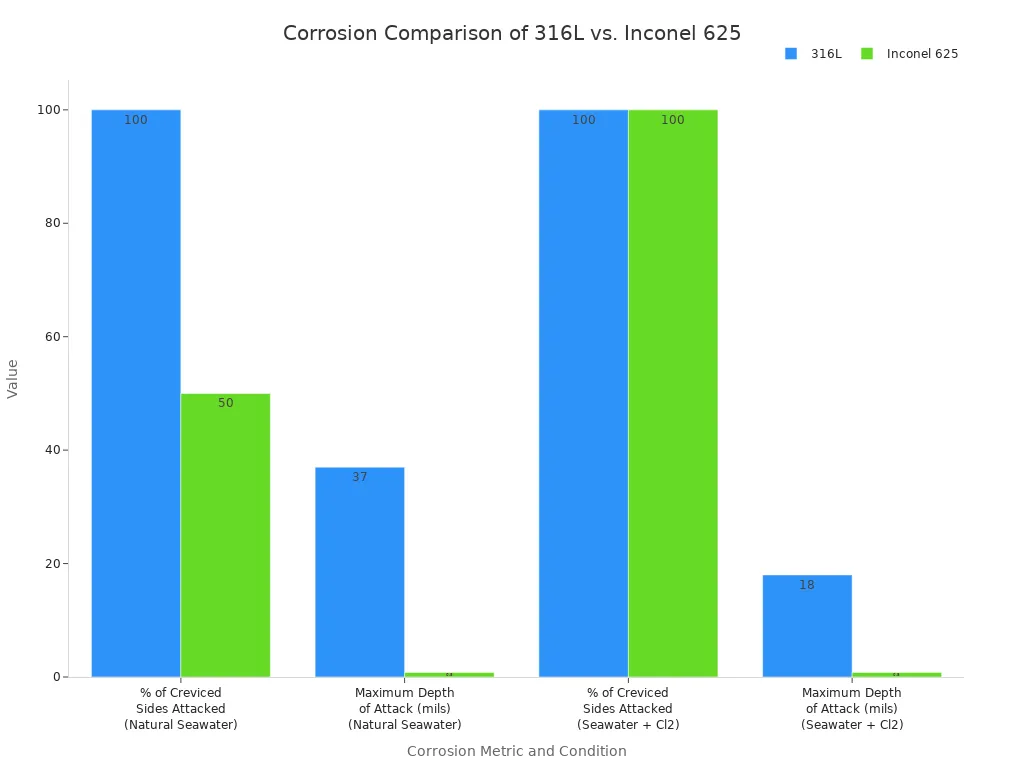
While the alloy is highly resistant, it is not entirely immune to attack under all conditions. Studies have shown that crevice corrosion can initiate on Inconel 625 after prolonged exposure (e.g., 30 days) in static, warm sodium chloride solutions. However, in practical applications involving flowing seawater, its performance remains exceptional. The velocity of the water and the presence of additives like chlorine can influence corrosion rates, but the alloy consistently outperforms others.
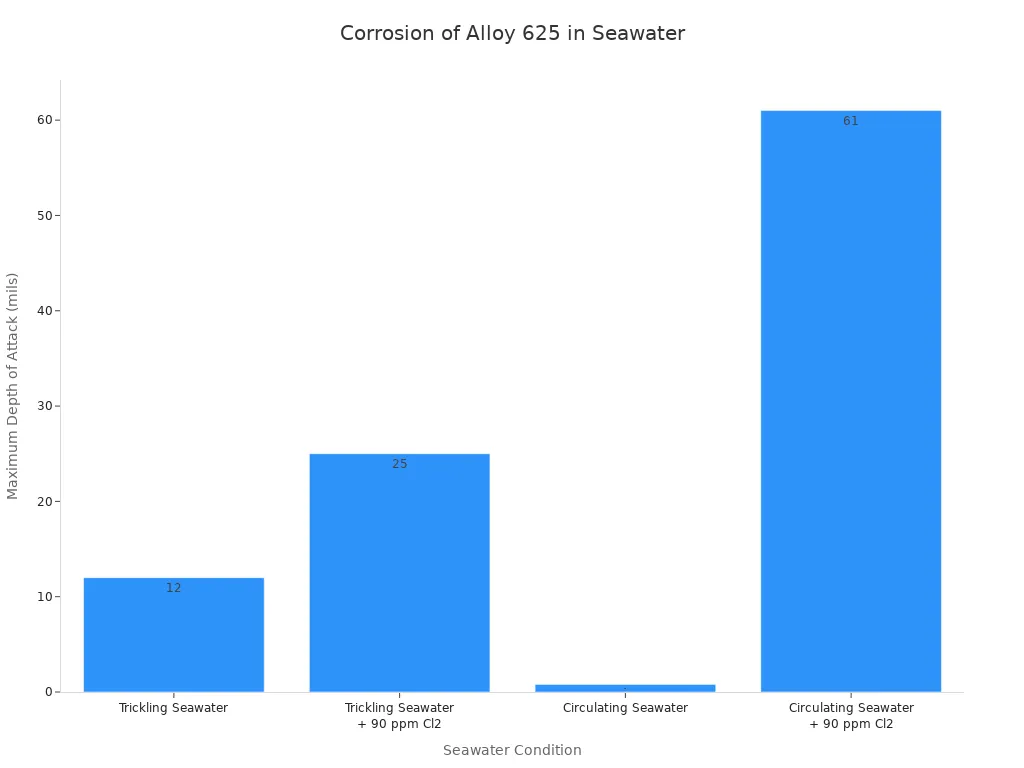
In a direct comparison of materials for marine service, Inconel 625 consistently ranks at the top. Its overall resistance places it ahead of many other common and specialized alloys.
- Carbon steel
- SS 304
- SS 316
- Cupronickel alloy 90/10
- Incoloy 825
- Inconel alloy 625 (offered the best service at all testing regions)
Chemical Compatibility with Acids and Alkalis
Inconel 625’s versatility extends to demanding chemical processing environments. Its composition provides robust defense against a wide array of both oxidizing and non-oxidizing acids.
The alloy's nickel and molybdenum content gives it excellent resistance to non-oxidizing acids. A practical example is its use in industrial pickling operations. The material is submerged in a 16% by weight sulfuric acid (hydrogen sulfideO₄) bath at 165°F (74°C) to remove surface oxides. Its ability to withstand this aggressive process demonstrates its suitability for equipment handling sulfuric, phosphoric, and hydrochloric acids.
Regarding alkaline solutions, Inconel 625 offers good resistance. However, its primary advantages are most apparent in complex chemical streams, especially those containing halides (like chlorides).
- The alloy is not typically specified for pure, high-temperature caustic soda (sodium hydroxide) applications.
- Other nickel-based alloys without molybdenum are often more cost-effective for those specific conditions.
- The true value of Inconel 625 emerges when caustic solutions are mixed with other corrosive agents, where its comprehensive resistance becomes critical.
Section Summary: Key Corrosion Resistance Takeaways 🛡️
- Seawater Dominance: Inconel 625 offers premier resistance to pitting and crevice corrosion in seawater, vastly outperforming stainless steels.
- Acid Versatility: It effectively withstands both non-oxidizing (sulfuric, phosphoric) and oxidizing acids, making it ideal for chemical processing equipment.
- Chloride Immunity: The alloy is virtually immune to chloride-ion stress-corrosion cracking, a critical benefit for marine and chemical applications.
- Specialized Performance: Its strengths are best utilized in complex, mixed-corrosive environments, particularly those containing chlorides, rather than in pure, high-temperature caustic solutions.
Key Fabrication and Material Properties from sasaalloy
Beyond its mechanical strength and corrosion resistance, Inconel 625 possesses key fabrication characteristics that make it a practical and versatile choice for manufacturing complex components. Its weldability, magnetic properties, and specific chemical composition are fundamental to its widespread use.
Excellent Weldability
Inconel 625 exhibits excellent weldability, a trait not always common in high-performance superalloys. The alloy's solid-solution strengthened matrix, fortified by niobium and molybdenum, makes it highly resistant to post-weld cracking. This forgiving nature simplifies fabrication and repair procedures. A variety of welding processes can effectively join the material.
| Category | Recommended Process | Filler Metal |
|---|---|---|
| Welding Processes | GTAW (TIG), GMAW (MIG) | ERNiCrMo-3 |
| Filler Metal Selection | ERNiCrMo-3 (UNS N06625) | Matches corrosion resistance and high-temperature strength |
Using the matching filler metal, ERNiCrMo-3, is critical. This ensures the weld deposit retains the same superior corrosion resistance and strength as the base metal.
Non-Magnetic Characteristics
A distinct advantage of Inconel 625 is that it is a non-magnetic material. This property is essential for applications where magnetic interference must be completely avoided. Such uses include specialized electronic hardware, sensitive instrumentation, and certain components in marine or subsea environments where magnetic signatures are a concern. Its lack of magnetism adds to its versatility in high-tech fields.
Chemical Composition (UNS N06625)
The exceptional performance of Inconel 625 stems directly from its carefully balanced chemical composition, designated as UNS N06625. Each primary element plays a crucial role in defining its properties.
| Element | Percentage Range |
|---|---|
| Nickel (Ni) | 58.0 min |
| Chromium (Cr) | 20.0-23.0 |
| Molybdenum (Mo) | 8.0-10.0 |
| Niobium (Nb) | 3.15-4.15 |
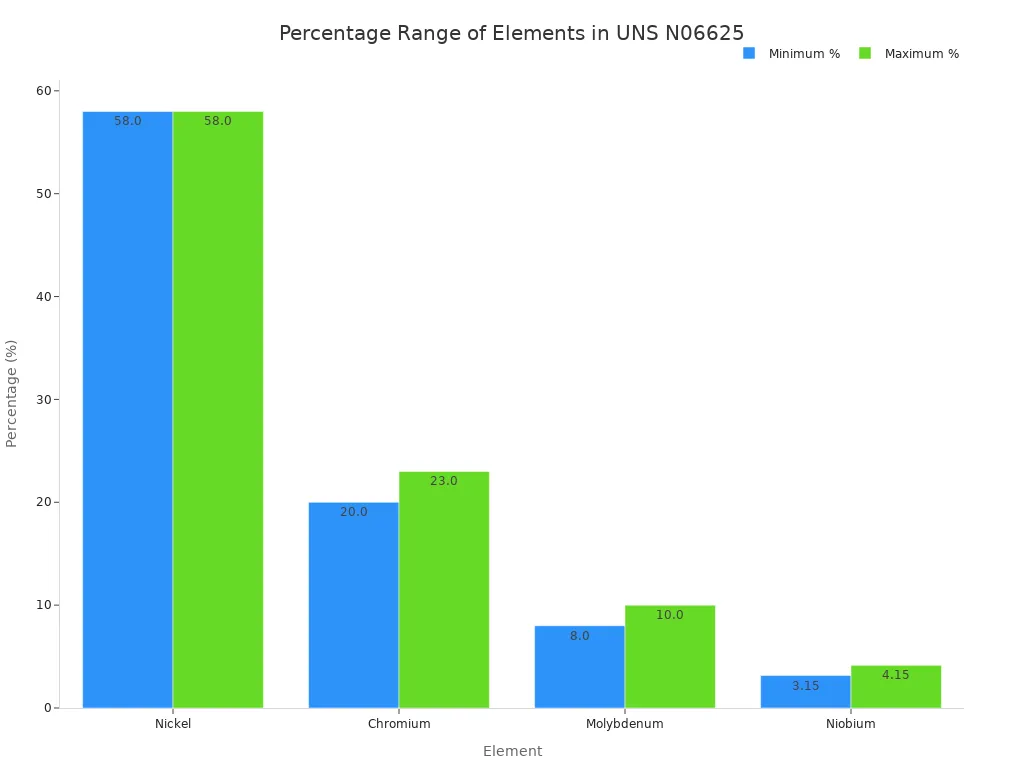
The high nickel content forms a stable austenitic matrix. Chromium provides oxidation resistance, while molybdenum and niobium work together to deliver solid-solution strength and exceptional defense against pitting and crevice corrosion.
Section Summary: Key Fabrication Takeaways ⚙️
- Excellent Weldability: The alloy is easily welded with common processes and is resistant to post-weld cracking.
- Non-Magnetic: Its non-magnetic nature makes it ideal for sensitive electronic and instrumentation applications.
- Balanced Chemistry: A precise blend of Nickel, Chromium, Molybdenum, and Niobium gives the alloy its signature combination of strength and corrosion resistance.
How sasaalloy Inconel 625 Properties Drive Applications
The unique combination of high-temperature strength, superior corrosion resistance, and excellent fabricability makes Inconel 625 a critical material for the world's most demanding industries. Its properties directly translate into reliable performance in aerospace, marine, and chemical processing environments where lesser alloys would fail.
Aerospace Engine Components
Aerospace engineers frequently select Inconel 625 for critical jet engine components. The material's ability to withstand extreme temperatures and resist oxidation is essential for parts operating in harsh combustion environments. Its high-temperature strength makes it a superior choice over many stainless steels for rocket engine exhaust nozzles. The alloy's excellent fatigue resistance also ensures durability under cyclic stress.
Specific applications within aircraft and engine systems include:
- Turbine shroud rings and seals
- Combustion system transition liners
- Aircraft ducting and engine exhaust systems
- Thrust-reverser components
- Fuel and hydraulic line tubing
For example, the United States Navy’s Prowler aircraft utilizes an Inconel 625 Bar for its tailpipe, a choice driven by the material's exceptional strength and resistance to sensitization.
Marine and Subsea Hardware
Inconel 625 provides unmatched longevity in saline environments. Its immunity to chloride-ion stress-corrosion cracking and outstanding resistance to pitting make it ideal for marine and subsea hardware. The material ensures structural integrity for components constantly exposed to corrosive seawater and high mechanical stress.
Deep-Sea Reliability 🌊 Inconel 625 is often used as a corrosion-resistant alloy (CRA) for weld overlays inside submarine pipelines. This cladding protects the carbon steel pipes that transport natural gas or petroleum from deep-sea sources.
Common marine applications include:
- Wire rope and mooring cables
- Propeller blades and propulsion motors
- Sheathing for undersea communication cables
- Submarine fixtures and fittings
- Housings for deep-sea sensors and oceanographic equipment
Chemical and Petrochemical Processing Equipment
The chemical processing industry relies on Inconel 625 for equipment that handles highly corrosive media. Its versatility against both oxidizing and non-oxidizing acids makes it a go-to material for complex chemical streams. The alloy performs exceptionally well in environments containing phosphoric acid, sulfuric acid, and other inorganic acid mixtures where pitting and crevice corrosion are significant concerns.
Key equipment manufactured from this alloy includes:
- Reaction vessels and distillation columns
- Heat exchangers and transfer piping
- Bubble caps and valves
- Pumps and pressure vessels
This robust performance allows facilities to maintain operational safety and efficiency when processing aggressive chemicals.
Oil and Gas Extraction Systems
The oil and gas industry presents some of the most corrosive environments, particularly with the presence of sour gas (hydrogen sulfide). Inconel 625 provides superior resistance to erosion and corrosion in these challenging geothermal and oilfield applications. Its robust performance ensures the long-term integrity and safety of critical extraction infrastructure, preventing failures that could have severe operational and environmental consequences.
Engineers specify the alloy for a wide range of components exposed to sour gas and high-pressure conditions. These applications include:
- Wellhead and Christmas tree equipment
- Downhole equipment, tooling, and high-strength fasteners
- Risers and tube hangers
- Valves and components for natural gas processing units
From Extreme Heat to Cryogenic Cold 🔥❄️ Inconel 625's utility spans the entire temperature spectrum of the oil and gas industry. It excels in high-temperature flare stacks and maintains its toughness for cryogenic LNG applications.
The material's versatility extends to both ends of the temperature scale. Its high-temperature strength and oxidation resistance make it an excellent choice for flare stacks, which manage the combustion of excess gas. Conversely, Inconel 625 retains exceptional toughness and ductility at very cold temperatures. This property is critical for liquefied natural gas (LNG) systems, where many carbon steels become brittle and fail. As a result, it is used for cryogenic storage tanks, transfer lines, and other key components in LNG processing and transport.
The Inconel 625 Bar delivers a premier combination of superior corrosion resistance, high-temperature strength, and excellent weldability. These defining characteristics solidify its role as a critical material for the world's most challenging industrial environments. Its importance continues to grow with expanding applications in renewable energy and adoption in advanced processes like additive manufacturing.
In Summary: A Material Defined By 🚀
- Unmatched Corrosion Defense
- Reliable High-Temperature Performance
- Excellent Fabricability and Weldability
This unique blend of properties ensures Inconel 625 remains an indispensable solution for future-facing industries.
FAQ
What makes Inconel 625 so strong at high temperatures?
The alloy's unique chemical composition provides its high-temperature strength. Molybdenum and niobium strengthen the nickel-chromium matrix through a process called solid-solution strengthening. This reinforcement allows the material to maintain its integrity and resist deformation even in extreme heat, making it ideal for jet engine components.
Is Inconel 625 magnetic?
No, Inconel 625 is a non-magnetic material. This characteristic is essential for specific applications where magnetic interference must be avoided.
Key Uses for Non-Magnetic Property: 💡
- Sensitive electronic instrumentation
- Subsea sensor housings
- Specialized measurement tools
What is the main advantage of Inconel 625 over stainless steel?
Inconel 625 offers vastly superior corrosion resistance. It excels in harsh environments like seawater, where it strongly resists pitting and crevice corrosion. The alloy is also virtually immune to chloride-ion stress-corrosion cracking, a common failure point for many stainless steels in marine applications.
Can you weld Inconel 625 easily?
Yes, the alloy exhibits excellent weldability. Its composition makes it highly resistant to cracking after welding, which simplifies fabrication and repair. For best results, fabricators must use a matching filler metal, such as ERNiCrMo-3, to ensure the weld maintains the base metal's strength and corrosion resistance.
See Also
Understanding Molybdenum High-Temperature Furnaces: Functionality and Design Insights
Effective Steel Processing for Heat Exchange: Consistent and Reliable Outcomes
Welding Pass Partition Plates: Expert Guidance for 2025 Success
Molybdenum Plugs in Seamless Steel Pipe Production: An Evaluation for 2025
WT20 Thoriated Tungsten Electrodes: Enhancing TIG Welding Performance with Facts