Solving Adhesive Toughening Problems with CTBN’s Unique Structure

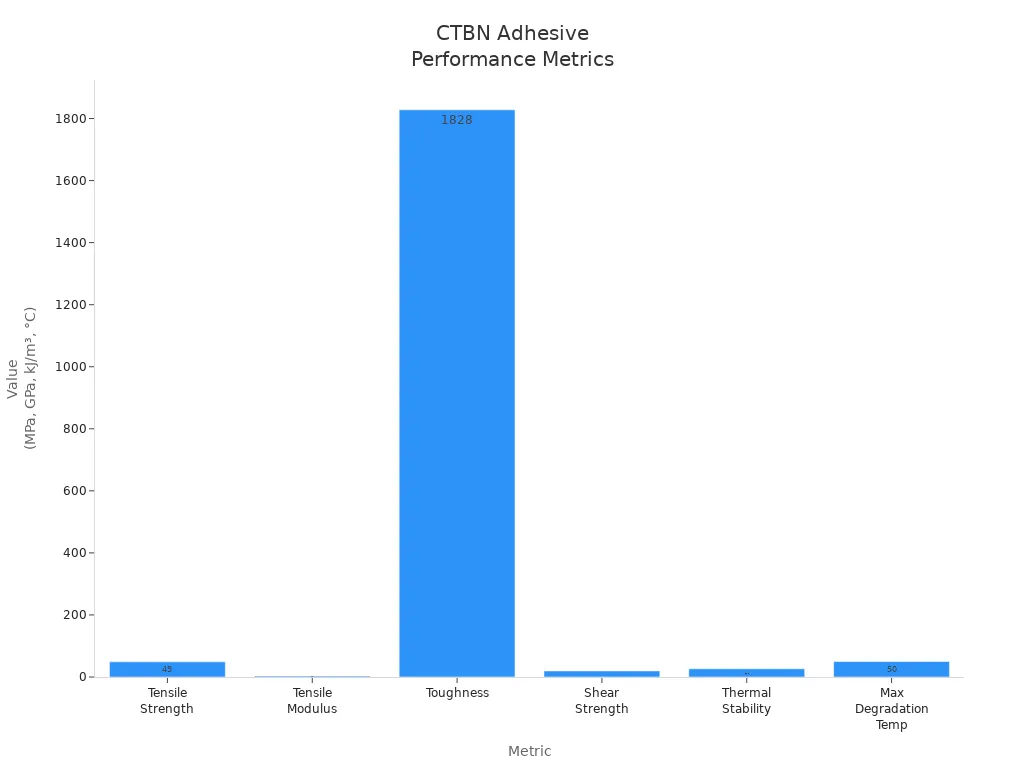
You can solve toughening problems in adhesives with CTBN’s unique structure. Its reactive carboxyl groups and customizable acrylonitrile content boost crack resistance, flexibility, and durability. The Impact of Acrylonitrile Content and Viscosity on CTBN Performance drives strong adhesion and broad compatibility. See the improvements below:
| Metric | Value | Improvement |
|---|---|---|
| Tensile Strength | 49 MPa | 60% increase |
| Shear Strength | 19.5 MPa | 127% increase |
| Impact Strength | 11.2 kJ/m² | 31% higher |
| Fracture Toughness | 70.7% | higher |
Key Takeaways
- CTBN's unique structure enhances adhesive performance by providing crack resistance, flexibility, and strong bonding capabilities.
- Adjusting the acrylonitrile content in CTBN allows you to customize adhesives for specific needs, balancing toughness and flexibility.
- CTBN's compatibility with various resins makes it suitable for multiple industries, ensuring reliable performance in demanding applications.
Why CTBN’s Structure Solves Toughening Problems

What Makes CTBN Unique
You want adhesives that last longer and perform better. CTBN, or Carboxy-Terminated Nitrile Butadiene Rubber, stands out because of its special molecular structure. The ends of each CTBN molecule have reactive carboxyl groups. These groups help CTBN bond with other materials. You also get acrylonitrile segments in the chain. These segments give CTBN high polarity and strong resistance to oil and heat.
When you use CTBN in adhesives, you see a big difference in how the adhesive handles stress and cracks. The Impact of Acrylonitrile Content and Viscosity on CTBN Performance means you can adjust the formula for your needs. If you want more flexibility, you can choose a lower acrylonitrile content. If you need higher resistance to chemicals and heat, you can pick a higher acrylonitrile content.
Tip: You can customize CTBN to match the demands of your project. This flexibility makes it a smart choice for many industries.
Researchers have studied why CTBN works so well. The table below shows what they found:
| Study Title | Findings |
|---|---|
| Influence of carboxyl-terminated butadiene-acrylonitrile random copolymers (CTBN) on the polymerization and phase separation processes | The presence of reactive carboxyl groups in CTBN enhances the compatibility with epoxy resins, leading to improved mechanical properties and toughening effects. |
| Miscibility of epoxy monomers with carboxyl-terminated butadiene-acrylonitrile random copolymers | Higher acrylonitrile levels in CTBN improve the miscibility with epoxy, which is crucial for effective toughening. |
Key Structural Features and Their Role in Adhesives
You can see the benefits of CTBN in every layer of your adhesive. The structure of CTBN gives you several advantages:
- Reactive terminal carboxyl groups let CTBN form strong bonds with other resins.
- Acrylonitrile segments add polarity, which means better oil resistance and adhesion.
- CTBN blends well with thermosetting resins, so you get improved crack resistance and durability.
Here is a summary of the main features and what they do for your adhesives:
| Structural Feature | Contribution to Adhesives |
|---|---|
| Reactive terminal carboxyl groups | Enable chain extension and crosslinking |
| Acrylonitrile segments | Provide high polarity, oil resistance, and superior adhesion |
| Blending with thermosetting resins | Enhances crack resistance and overall performance in adhesives |
When you adjust the formula, you control the Impact of Acrylonitrile Content and Viscosity on CTBN Performance. This means you can make adhesives that are tough, flexible, or resistant to chemicals—whatever your application needs. You get a product that works well in wind power, aerospace, electronics, and more.
Note: CTBN’s unique structure helps you solve toughening problems that other materials cannot handle. You get better crack resistance, stronger bonds, and longer-lasting adhesives.
Mechanisms and Benefits of CTBN in Adhesives

How CTBN Enhances Crack Resistance and Flexibility
You want your adhesives to stay strong, even when they face stress or impact. CTBN helps you achieve this by working at the molecular level. When you add CTBN to your adhesive, it reacts with the resin to form a network that combines both rigid and flexible parts. This network absorbs energy when cracks try to form, so your adhesive resists breaking.
CTBN also creates tiny rubbery zones inside the adhesive. These zones act like cushions. They spread out the force from impacts or bending, which helps prevent cracks from growing. You get an adhesive that bends and stretches without losing its strength.
Here is a table that shows how CTBN works inside your adhesive:
| Mechanism | Description |
|---|---|
| Molecular Chemical Bonding | CTBN reacts with epoxy to form block copolymers with both rigid and flexible segments. |
| Micro-Phase Separation | CTBN creates a dispersed rubber phase, improving mechanical properties. |
| Fiber-Matrix Interface Interaction | CTBN enhances bonding and load transfer between fibers and resin. |
You can see that each mechanism gives your adhesive more toughness and flexibility. The Impact of Acrylonitrile Content and Viscosity on CTBN Performance lets you fine-tune these effects. If you need more flexibility, you can adjust the acrylonitrile content or viscosity to match your requirements.
Tip: Use CTBN to make your adhesives last longer and perform better under tough conditions.
Compatibility with Various Adhesive Systems
You need adhesives that work with many types of resins. CTBN gives you this advantage. Its unique structure blends well with thermosetting resins like epoxy, polyester, and vinyl ester. You can use CTBN in different adhesive systems without worrying about poor mixing or separation.
CTBN’s reactive carboxyl groups help it bond with other resins. This means you get a smooth, even mixture every time. The Impact of Acrylonitrile Content and Viscosity on CTBN Performance also plays a role here. By adjusting these factors, you can make sure your adhesive works well with metals, plastics, composites, and more.
- You can use CTBN in:
- Epoxy adhesives for metal bonding
- Structural adhesives for composites
- Sealants for electronics and automotive parts
Note: CTBN’s compatibility helps you create adhesives for many industries, from aerospace to electronics.
Practical Benefits in Real-World Applications
You want results you can see and measure. CTBN delivers practical benefits in many real-world situations. When you use CTBN in your adhesive, you get stronger bonds and longer-lasting joints. Your products resist cracking, even after repeated impacts or temperature changes.
Many industries trust CTBN for demanding jobs. In wind power, CTBN-toughened adhesives hold turbine blades together, even in harsh weather. In aerospace, CTBN improves the durability of structural adhesives, making planes safer and more reliable. Electronics manufacturers use CTBN to protect sensitive parts from moisture and vibration.
Here are some key benefits you can expect:
- Higher impact and crack resistance
- Better performance in extreme temperatures
- Strong adhesion to metals, plastics, and composites
- Improved fatigue durability for long-term use
You can rely on CTBN to solve toughening problems and boost the quality of your adhesives. The Impact of Acrylonitrile Content and Viscosity on CTBN Performance ensures you get the right balance of strength and flexibility for your specific needs.
Impact of Acrylonitrile Content and Viscosity on CTBN Performance
How Acrylonitrile Content Affects Toughening
You can control how tough your adhesive becomes by adjusting the acrylonitrile content in CTBN. When you increase the acrylonitrile percentage, you boost the polarity of the polymer. This change helps your adhesive resist oil and heat. Higher acrylonitrile levels also make the adhesive stronger and less likely to crack. If you want more flexibility, you can choose a lower acrylonitrile content. This balance lets you match the adhesive to your project’s needs.
| Acrylonitrile Content | Toughness | Flexibility | Oil Resistance |
|---|---|---|---|
| Low (8-15%) | Medium | High | Moderate |
| Medium (16-22%) | High | Medium | High |
| High (23-28%) | Very High | Lower | Very High |
Tip: Select the acrylonitrile level based on the environment and stress your adhesive will face.
The Role of Viscosity in Adhesive Formulations
Viscosity tells you how thick or thin your CTBN is. A higher viscosity means the CTBN is thicker and can hold more fillers or additives. This property helps you control the flow and spread of your adhesive. If you need a fast-curing adhesive, you might pick a lower viscosity. For heavy-duty jobs, a higher viscosity gives you better strength and stability.
- Low viscosity: Easy to mix, good for thin layers.
- High viscosity: Better for gap filling and heavy loads.
Considerations for Optimal Use
You should always consider both acrylonitrile content and viscosity when choosing CTBN for your adhesive. The Impact of Acrylonitrile Content and Viscosity on CTBN Performance helps you get the right mix of toughness, flexibility, and chemical resistance. Test different combinations to find what works best for your application. Remember to check how your adhesive performs under real-world conditions.
Note: Careful selection leads to better results and longer-lasting bonds.
You solve toughening problems in adhesives with CTBN’s unique structure. You gain crack resistance, flexibility, and compatibility. You can customize CTBN for your project. Its proven performance makes it a top choice for high-performance adhesives.
Choose CTBN for durability and reliability in demanding applications.
FAQ

What industries use CTBN adhesives the most?
You find CTBN adhesives in aerospace, automotive, electronics, and wind power. These industries need strong, flexible, and durable bonds for their products.
How do you choose the right CTBN for your adhesive?
You look at your project’s needs. The Impact of Acrylonitrile Content and Viscosity on CTBN Performance helps you match toughness, flexibility, and resistance to your application.
Can you mix CTBN with other resins easily?
You can blend CTBN with many thermosetting resins. This makes your adhesive work well with metals, plastics, and composites.
See Also
Key Insights About Thoriated Tungsten for Enhanced TIG Welding
Professional Tips for Welding Partition Plates This Year
Unexpected Methods for Diagnosing Sulfur Recovery Catalysts
Understanding Molybdenum Furnaces: Design and Functionality Insights
Steel Processing Techniques That Ensure Effective Heat Exchange