HTPB vs CTPB: The Ultimate Showdown for Your Next Project
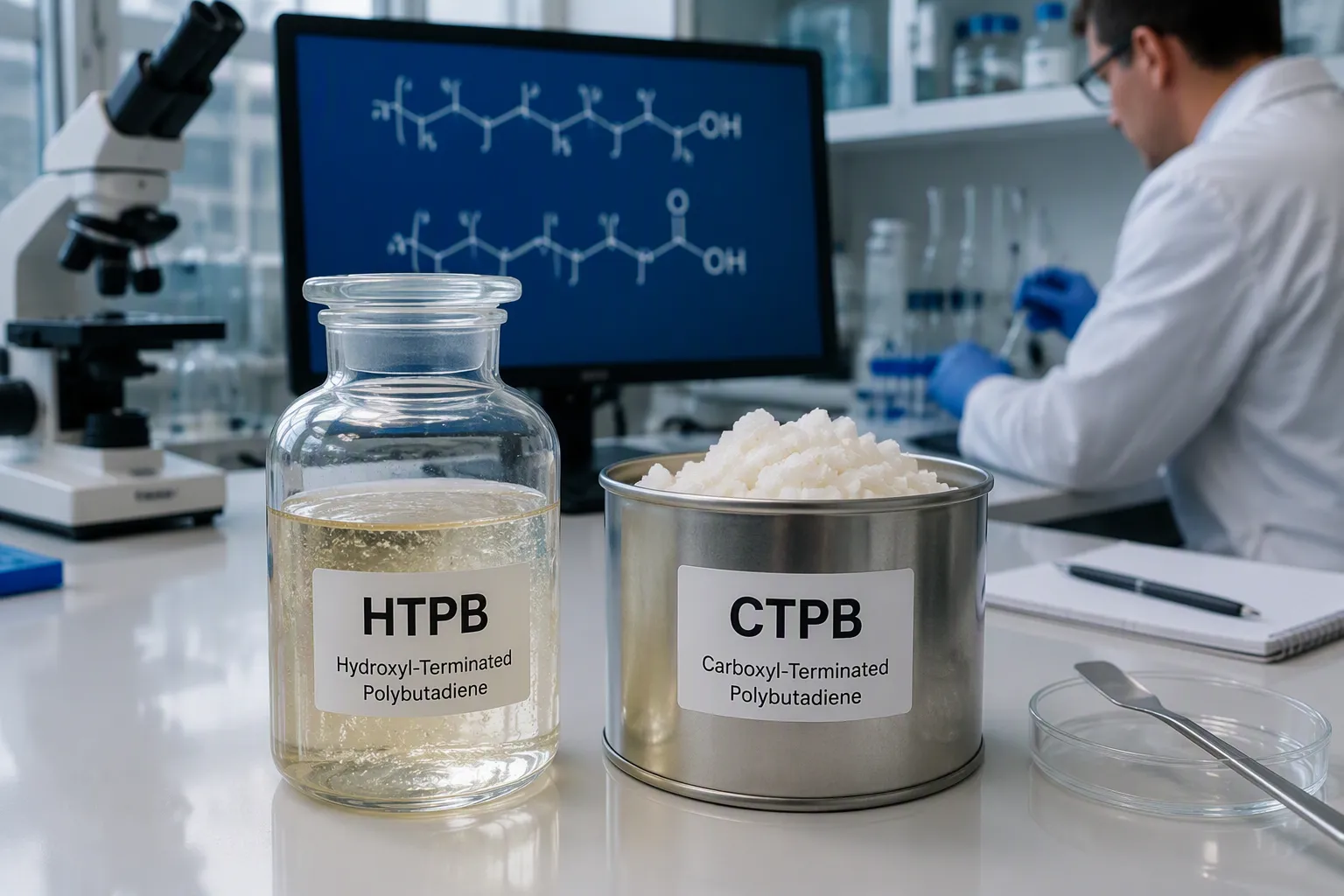
When you choose between Reactive Liquid Rubbers: HTPB and CTPB, you weigh durability against bonding power. HTPB delivers superior mechanical strength, moisture resistance, and electrical insulation. CTPB excels at adhering to polar surfaces and provides exceptional toughness for structural demands. Your project's primary need—environmental resilience or reactive bonding—determines the winner. For specialized requirements like oil resistance or fast curing, explore variants such as CTBN, HTBN, ATBN, or ATPB.
Key Takeaways
- Choose HTPB for moisture resistance, electrical insulation, and flexibility.
- Choose CTPB for strong adhesion to metal and glass, plus high toughness.
- Use CTBN, HTBN, ATBN, or ATPB for specialized needs like oil resistance or fast curing.
Understanding Reactive Liquid Rubbers: HTPB and Beyond
What Defines a Reactive Liquid Rubber?
Reactive liquid rubbers occupy a unique space between solid rubber and plasticizer. Their molecular weight stays low, typically ranging from 1,000 to 10,000 g/mol. This low molecular weight gives them fluid-like behavior at room temperature. Their viscosity remains high enough to function as a "reactive plasticizer" during mixing. You can cross-link these materials with the base rubber, so they never bleed out like process oils. This cross-linking capability makes them permanent components of your final product.
Key characteristics include:
- Low molecular weight designed to bridge solid rubber and plasticizer
- High viscosity that reduces Mooney viscosity and improves mixing
- Cross-linkable with base rubber without bleeding or migration
HTPB – Hydroxyl-Terminated Polybutadiene
HTPB carries hydroxyl (-OH) groups at both ends of its polybutadiene backbone. You cure this material with isocyanates to form polyurethane networks. The resulting polymer offers excellent mechanical strength and hydrolytic stability. For propellant applications, you will find consistent quality across commercial grades.
| Parameter | Typical Range | Unit |
|---|---|---|
| Molecular Weight (Mn) | 1,000 – 5,000 | g/mol |
| Hydroxyl Value (OH#) | 0.4 – 0.9 | meq/g |
| Hydroxyl Value (equivalent) | 22 – 50 | mg KOH/g |
CTPB – Carboxyl-Terminated Polybutadiene
CTPB features carboxyl (-COOH) end groups instead of hydroxyl groups. You cure this variant with epoxy resins or aziridine compounds. The carboxyl groups provide strong adhesion to polar substrates like metals and glass. Commercial grades typically show acid values between 40 and 60 mg KOH/g, with specific synthesis routes achieving 45–55 mg KOH/g. This reactivity makes CTPB valuable for structural adhesives.
Functionalized Variants – CTBN, HTBN, ATBN, ATPB
Beyond the base options, you can select functionalized variants for specialized needs. CTBN incorporates acrylonitrile for epoxy toughening. HTBN offers oil resistance for fuel systems. ATBN enables room-temperature curing with amine chemistry. ATPB provides fast-cure systems for rapid production cycles. Each variant modifies the polymer backbone or terminal groups to optimize specific performance attributes.
HTPB vs CTPB: A Detailed Comparison
Chemical Structure and Curing Behavior
The terminal functional groups on each polymer dictate how you cure them. HTPB carries hydroxyl (-OH) groups at both ends of its backbone. You react these groups with isocyanates to form polyurethane linkages. This curing chemistry proceeds at moderate temperatures, typically between 60°C and 80°C. The reaction produces no volatile byproducts, which simplifies your manufacturing process.
CTPB presents carboxyl (-COOH) groups at its chain ends. You cure this polymer with epoxy resins or aziridine compounds. The carboxyl groups react readily with epoxy functionalities, forming ester linkages. This curing system operates effectively at room temperature or with mild heating. The absence of moisture sensitivity during curing gives you more flexibility in production environments.
The backbone structure also influences curing behavior. Both polymers share a polybutadiene backbone with pendant vinyl groups. These unsaturated sites allow additional cross-linking through sulfur or peroxide systems. You can tailor the cross-link density by adjusting the curative ratio. Higher cross-link density produces a stiffer final product with lower elongation.
Mechanical Properties – Strength, Elongation, and Toughness
Mechanical performance separates these two polymers in practical applications. HTPB-based polyurethanes deliver tensile strengths ranging from 10 to 25 MPa. The urethane linkages create strong hydrogen bonding between polymer chains. This intermolecular attraction contributes to excellent tear resistance and cut-growth resistance. You will find elongation at break values between 200% and 600%, depending on your formulation.
CTPB systems exhibit tensile strengths in a similar range but with different characteristics. The ester linkages formed during epoxy curing provide rigidity. This rigidity translates to higher modulus values compared to HTPB systems. However, CTPB networks typically show lower elongation at break, often between 100% and 300%. The trade-off involves stiffness versus flexibility.
Toughness represents the material's ability to absorb energy before failure. CTPB excels in this property due to its ability to dissipate energy through molecular rearrangements. The carboxyl groups can form reversible hydrogen bonds that break and reform under stress. This mechanism provides exceptional impact resistance for structural applications. HTPB offers good toughness but relies more on its elastic deformation capacity.
Adhesion Performance – Polar vs. Nonpolar Substrates
Adhesion performance depends heavily on the surface energy of your substrate. CTPB demonstrates superior bonding to polar surfaces like metals, glass, and ceramics. The carboxyl groups form strong hydrogen bonds and chemical interactions with these high-energy surfaces. You achieve excellent initial adhesion without extensive surface preparation.
HTPB traditionally shows weaker adhesion to polar substrates due to its nonpolar nature. However, recent developments have expanded its capabilities. When you incorporate HTPB into a reactive acrylate network, it introduces reactive sites that engage C–H bonds on polyolefin surfaces under mild conditions. This covalent anchoring mechanism directly improves peel adhesion on nonpolar substrates like polyethylene and polypropylene. The performance reaches levels comparable to those obtained after corona treatment. Importantly, this adhesion enhancement occurs without any surface pretreatment. You need no primer, flame, or plasma treatment to achieve strong bonds on low-energy polyolefin surfaces.
For mixed-material assemblies, consider the substrate combination carefully. CTPB provides reliable bonding to painted metals and composites common in automotive applications. HTPB offers advantages when bonding to plastic components without surface modification. Your choice depends on which substrate presents the greater bonding challenge.
Moisture Resistance and Hydrolytic Stability
Environmental exposure tests reveal significant differences between these polymers. HTPB-based polyurethanes exhibit excellent hydrolytic stability. The urethane linkages resist hydrolysis even under prolonged water exposure. You can immerse HTPB systems in water for extended periods without significant property degradation. This characteristic makes HTPB suitable for marine applications and outdoor equipment.
CTPB systems show moderate moisture resistance. The ester linkages formed during epoxy curing are susceptible to hydrolysis under acidic or alkaline conditions. Water molecules can attack these ester bonds, leading to chain scission and property loss. You should protect CTPB-based products from prolonged water exposure or apply protective coatings.
Temperature accelerates hydrolytic degradation in both systems. At elevated temperatures above 60°C, the hydrolysis rate increases significantly for CTPB. HTPB maintains its integrity at higher temperatures, though prolonged exposure above 100°C may cause gradual property changes. For applications requiring long-term water immersion, HTPB provides the more reliable choice.
Electrical Insulating Properties and Dielectric Performance
Electrical insulation performance matters for encapsulation and potting applications. HTPB demonstrates outstanding electrical insulating properties. Its high volume resistivity exceeds 10¹⁴ Ω·cm, making it suitable for high-voltage insulation. The nonpolar nature of the polybutadiene backbone contributes to this excellent dielectric behavior.
Electrical Insulation: Comparable to epoxy and silicone rubber.
This direct comparison confirms that HTPB performs on par with established encapsulant materials. You can confidently specify HTPB for electrical applications where you would typically consider epoxy or silicone.
| Property | HTPB | Epoxy Resin | Silicone Rubber |
|---|---|---|---|
| Electrical Insulation (Volume Resistivity) | High (>10¹⁴ Ω·cm) | Not specified in comparison | Not specified in comparison |
| Elasticity | Excellent (>200% elongation) | Poor (brittle) | Excellent (>300%) |
| High-Temp Resistance | Moderate (100°C) | Excellent (150–200°C) | Excellent (200–250°C) |
| Cost | Moderate | Low | High |
| Process Difficulty | Moderate (humidity control) | Low | Moderate (platinum catalyst) |
CTPB also provides adequate electrical insulation for many applications. However, the carboxyl groups introduce slight polarity that increases dielectric constant compared to HTPB. For high-frequency applications or high-voltage insulation, HTPB offers superior performance. The combination of excellent insulation and mechanical flexibility makes HTPB a versatile choice for electronic encapsulation.
When you select between these Reactive Liquid Rubbers: HTPB and CTPB, consider the electrical requirements of your application. HTPB delivers insulation performance comparable to industry-standard encapsulants while offering superior elasticity. This combination proves valuable for protecting sensitive electronic components from mechanical stress and electrical failure.
Exploring Other Reactive Liquid Rubber Variants
CTBN – Carboxyl-Terminated Butadiene Acrylonitrile for Epoxy Toughening
CTBN adds acrylonitrile to the polybutadiene backbone. This modification improves compatibility with epoxy resins. You use CTBN primarily for epoxy toughening. The rubber particles phase-separate during curing. They form discrete domains throughout the epoxy matrix. These domains absorb energy and stop crack propagation. You find CTBN in structural adhesives, vinyl ester resins, and composite materials.
HTBN – Hydroxyl-Terminated Butadiene Acrylonitrile for Oil Resistance
HTBN combines hydroxyl end groups with an acrylonitrile-modified backbone. The acrylonitrile content provides excellent resistance to oils, fuels, and hydrocarbons. You use HTBN in under-hood sealants and polyurethane formulations. These applications require flexibility and oil resistance together. HTBN maintains its mechanical properties after prolonged contact with aggressive fluids.
ATBN – Amine-Terminated Butadiene Acrylonitrile for Room-Temperature Curing
ATBN carries amine (-NH₂) end groups instead of hydroxyl or carboxyl groups. You cure ATBN at room temperature without external heating. This makes it valuable for lightweight vehicle assembly. You can bond aluminum to carbon fiber composites without thermal stress. ATBN also works well for epoxy toughening and structural adhesives.
ATPB – Amine-Terminated Polybutadiene for Fast-Cure Systems
ATPB offers amine termination on a standard polybutadiene backbone. This gives you faster curing compared to HTPB or CTPB. ATPB shows moderate compatibility with epoxy and polyurethane systems. You use it in applications requiring balanced toughness and adhesion. The fast cure speed suits production environments with short cycle times.
The table below summarizes the typical applications for each variant.
| Rubber Type | Typical End-Use Applications |
|---|---|
| HTPB | Solid rocket propellant binder, rigid foam insulation, elastomeric wheels, automotive suspension bushings, electrical potting compounds, high-performance adhesives, surface coatings, sealants, synthetic fibers, carpet underlay, hard-plastic parts |
| HTBN | Under-hood sealants contacting fuel and oil, polyurethane formulations requiring oil resistance |
| CTBN | Epoxy toughening in composites, structural adhesives, vinyl ester resin toughening |
| ATBN | Structural adhesives for lightweight vehicle assembly, epoxy toughening, bonding aluminum to carbon fiber composites |
| ATPB | Moderate compatibility with epoxy and polyurethane; applications requiring balanced toughness and adhesion |
Application Scenarios and Selection Guide
Aerospace and Defense – HTPB and CTPB in Propellants and Structural Adhesives
The aerospace sector demands materials that withstand extreme conditions. HTPB dominates this field for good reason. Over 40% of HTPB usage connects directly to rocket propellants, defense-grade binders, and propulsion systems. Its oxidative stability and robust mechanical properties make it the standard choice for solid rocket motors. You can tailor the mechanical properties by adjusting cross-link density. This flexibility allows elongation at break values up to 1200% while maintaining tensile strength through hard segment incorporation. The surge in satellite launches and space exploration continues to drive demand for HTPB-based solid propellants.
CTPB finds its place in aerospace structural adhesives. The carboxyl groups bond strongly to metal substrates used in airframe construction. You benefit from exceptional toughness when bonding load-bearing components. The ability to cure at room temperature simplifies assembly of large structures where oven curing proves impractical.
- Aerospace demand driver: Over 40% of HTPB usage links to rocket propellants, defense-grade binders, and propulsion systems, driven by oxidative stability, adhesive power, and robust mechanical properties.
- Industrial manufacturing demand driver: Over 35% of producers rely on HTPB for adhesives, sealants, coatings, and elastomers, citing chemical resistance, thermal performance, and durability.
- Overall market driver: More than 55% of applications tie to sectors emphasizing mechanical strength, flexibility, and resistance to wear.
Automotive and Adhesives – CTPB for Bonding Painted Metals and Composites
Automotive manufacturing presents unique bonding challenges. You must join painted metals, plastic composites, and rubber components into a single cohesive vehicle. CTPB excels in this environment. Its carboxyl groups form strong bonds with the polar surfaces of painted metals and composite materials. You achieve reliable adhesion without extensive surface preparation, saving time and cost on the assembly line.
HTPB also contributes significantly to automotive applications. Its lightweight nature reduces vehicle weight, improving fuel efficiency and supporting sustainability goals. The material provides excellent mechanical strength, hydrolysis resistance, and cold temperature tolerance. These properties make HTPB valuable for tires, adhesives, coatings, and sealing materials.
Vibration damping represents a critical application where HTPB shines. The table below shows how automotive manufacturers implement HTPB-based formulations.
| Automotive Application | Supporting Evidence |
|---|---|
| Suspension bushings | BASF comparative research shows polybutadiene polyols provide superior low-temperature flexibility and fatigue resistance, critical for dynamic stress cycling. |
| Engine mounts | BASF research identifies engine mounts as a primary application where fatigue resistance under dynamic stress is essential. |
| Control arm bushings | Ford's testing demonstrates consistent performance from -40°C to 80°C, with extended service life exceeding 150,000 miles. |
| Subframe mounts | Ford leverages excellent fatigue resistance and low compression set characteristics under severe dynamic loading. |
Construction and Coatings – CTBN for Epoxy Modification
Construction coatings face constant abuse from impact, weathering, and structural movement. Standard epoxy formulations crack under these stresses. CTBN modification solves this problem. At a CTBN content of 15%, the elongation at break increases by 32% compared to unmodified epoxy resin. This improvement in flexibility translates directly to better crack-bridging ability in protective coatings.
The toughening mechanisms behind this performance deserve attention. Rubber bridging, cavitation of CTBN particles, and shear yielding work together to stop crack propagation. Cavitation creates voids that scatter light and dissipate energy. Rubber bridging helps resist crack growth across the coating surface. These mechanisms collectively improve the crack-bridging ability of CTBN-modified epoxy coatings.
Field performance data confirms the importance of proper phase separation. The table below compares impact resistance across different formulations.
| Formulation | Impact Resistance at 25°C | Impact Resistance at -25°C | Key Observation |
|---|---|---|---|
| Reference (unmodified epoxy) | Baseline | Baseline | Standard performance |
| CTBN-modified epoxy | Comparable to lower than reference | Comparable to lower than reference | Reduced performance due to compatibility issues causing poor phase separation |
| Polyester diacid P01-modified epoxy | Higher than reference | Higher than reference | Ability to absorb deformation due to good phase separation |
| Polyester diacid P02-modified epoxy | Higher than reference | Higher than reference | Ability to absorb deformation due to good phase separation |
| PRIPOL 1017-modified epoxy | Comparable to lower than reference | Comparable to lower than reference | Reduced performance due to compatibility issues causing poor phase separation |
Impact tests follow DIN EN ISO 6272 standards at 25°C and after 24 hours at -25°C. Good phase separation of the rubber phase within the rigid epoxy enables the coating to dissipate impact energy effectively. You must select modifiers that demonstrate compatibility with your specific epoxy system.
Electronics and Encapsulants – HTPB for Insulation and ATBN for Low-Temperature Curing
Electronic components require protection from moisture, mechanical stress, and electrical failure. HTPB provides outstanding electrical insulation with volume resistivity exceeding 10¹⁴ Ω·cm. This performance matches epoxy and silicone rubber standards. You also gain excellent elasticity with elongation exceeding 200%. This flexibility protects delicate solder joints and wire bonds from thermal cycling stress.
The combination of insulation and elasticity makes HTPB ideal for potting compounds and encapsulants. You can protect sensitive components while maintaining mechanical integrity. The moderate processing difficulty requires humidity control during curing, but the resulting protection justifies the effort.
ATBN offers an alternative for temperature-sensitive electronic assemblies. You cure ATBN at room temperature without external heating. This capability proves valuable when bonding components that cannot withstand elevated temperatures. Lightweight vehicle assembly benefits from this approach, allowing you to bond aluminum to carbon fiber composites without thermal stress.
Decision Matrix – Key Factors for Selection
Your selection between Reactive Liquid Rubbers: HTPB and CTPB depends on several critical factors. The table below summarizes the key considerations.
| Factor | Choose HTPB | Choose CTPB |
|---|---|---|
| Primary substrate | Nonpolar plastics, polyolefins | Polar metals, glass, ceramics |
| Environmental exposure | Prolonged water immersion, humidity | Dry or protected environments |
| Electrical requirements | High-voltage insulation | Standard insulation needs |
| Curing conditions | Moderate heat (60–80°C) | Room temperature or mild heat |
| Mechanical priority | Flexibility, elongation, tear resistance | Toughness, impact resistance, stiffness |
| Adhesion requirement | Bonding without surface pretreatment | Strong initial adhesion to polar surfaces |
Consider your production environment as well. HTPB requires humidity control during curing to prevent moisture interference with isocyanate reactions. CTPB offers more flexibility in manufacturing settings with variable humidity. Your curing equipment capabilities may influence the final choice.
Cost considerations also matter. HTPB generally offers moderate cost with excellent performance value. CTPB may require additional surface preparation for optimal adhesion, adding process costs. Evaluate the total system cost, not just the raw material price.
For specialized requirements, revisit the functionalized variants. CTBN provides epoxy toughening for construction and composite applications. HTBN delivers oil resistance for automotive under-hood components. ATBN enables room-temperature curing for lightweight assembly. ATPB offers fast-cure systems for high-throughput production. Each variant extends the capabilities of the base polymers to meet specific performance targets.
HTPB delivers superior mechanical strength, moisture resistance, and electrical insulation. CTPB offers exceptional adhesion to polar surfaces and high toughness for structural applications. For oil resistance or epoxy toughening, consider HTBN or CTBN. For fast curing, choose ATBN or ATPB. Align your chosen Reactive Liquid Rubbers: HTPB or CTPB with your substrate type, curing system, and environmental requirements.
FAQ
Which liquid rubber should you choose for outdoor applications?
Choose HTPB. It resists moisture and hydrolysis better than CTPB. Its urethane linkages withstand prolonged water exposure without degrading.
Can you cure CTPB at room temperature?
Yes. CTPB reacts with epoxy resins or aziridine compounds at room temperature. This flexibility simplifies manufacturing when you cannot apply heat.
What is the main cost difference between HTPB and CTPB?
HTPB generally offers moderate cost with excellent performance value. CTPB may require additional surface preparation, adding process costs to your total system.
See Also
Exploring Plate Pack Benefits and Pricing Trends in 2025
Top 8 HTN LCD Screens for Dependable High Performance
25 Inspiring Construction Website Designs Worth Following
Key Facts About WT20 Thoriated Tungsten Electrodes for Better TIG Welding