What Should an HTPB Specification Sheet Include Before You Approve a Supplier?
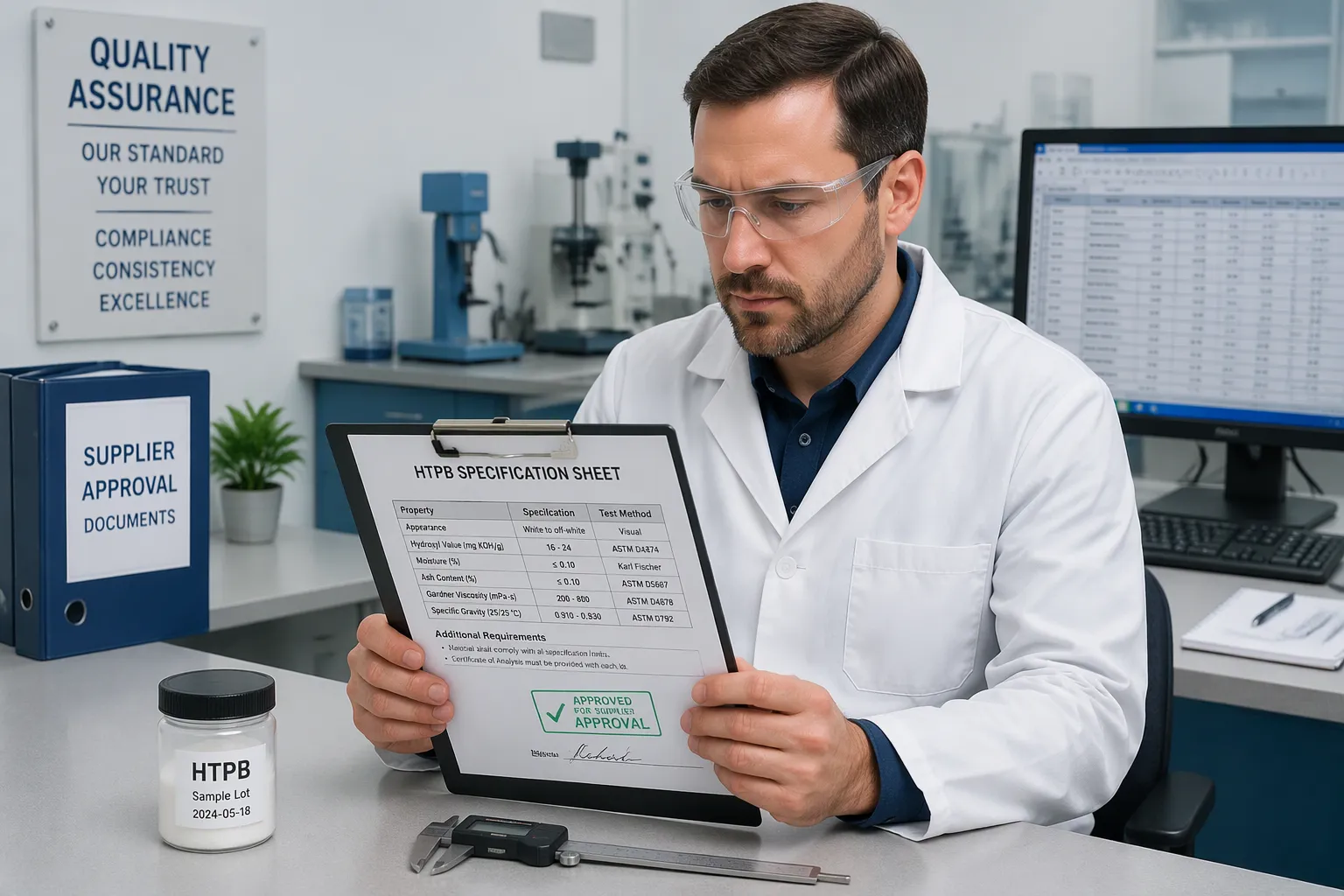
An approvable Hydroxyl-Terminated Polybutadiene(HTPB) CAS No. 69102-90-5 specification sheet must document six categories: product identification, chemical and physical properties, performance characteristics, regulatory compliance, packaging and storage, and quality assurance. A sheet missing any one category warrants pausing approval—this is not a minor paperwork gap. The spec sheet serves as the supplier's binding quality contract. What is not written cannot be enforced.
Key Takeaways
- Check that the specification sheet covers all six required categories before you approve a supplier.
- Each parameter needs a numeric limit and a named test method so you can enforce quality.
- A missing category is a serious gap that should pause approval until the supplier provides the data.
Identity and Baseline Properties of Hydroxyl-Terminated Polybutadiene (HTPB) CAS No. 69102-90-5
Hydroxyl-Terminated Polybutadiene(HTPB) CAS No. 69102-90-5 is a telechelic polybutadiene. Its flexible backbone carries hydroxyl groups at each end. Those hydroxyl groups react with isocyanates to form urethane bonds, so HTPB acts as a polyol in polyurethane products. The microstructure varies by the number of cis, trans, and vinyl units. More cis units give more elasticity, and more trans units give extra strength. Suppliers adjust molecular weight and microstructure for different uses such as adhesives or rocket propellants. Compared with CTPB, HTPB carries hydroxyl terminal groups, reacts mainly with isocyanates, offers adjustable flexibility through the cis/trans ratio, shows variable viscosity, and provides moderate cold resistance. HTPB also shows high thermal stability, better extensibility at low temperature, and superior anti-aging properties.
The baseline constants below give the reviewer a first checkpoint. Any lot that falls outside these values deserves a query before approval.
| Property | Value |
|---|---|
| Appearance | Colorless or light yellow transparent liquid |
| Density | 0.913 g/mL at 25 °C (also reported as 0.899 g/mL at 25 °C) |
| Refractive index | n20/D 1.5126 |
| Flash point | 113 °C min |
| Average Mw | 6200 |
| EPA Substance Registry System | 1,3-Butadiene, homopolymer, hydroxy-terminated (69102-90-5) |
| WGK Germany | 3 |
| TSCA | TSCA listed |
| RIDADR | NONH for all modes of transport |
Product Identification and Lot Traceability
Every lot must carry a unique identifier. The specification sheet should state the CAS number 69102-90-5, the EINECS number 614-925-3, the REACH code Y110, and the TSCA listing status. It should also list the tariff code 3902909099 and the UN number, hazard class, and packing group. For HTPB these transport fields read "None," and the sheet should say so explicitly rather than leave them blank.
| Identification Field | Value |
|---|---|
| CAS Number | 69102-90-5 |
| EINECS Number | 614-925-3 |
| REACH Code | Y110 |
| TSCA Listed | Yes |
| Tariff Code | 3902909099 |
| UN Number | None |
| Hazard Class | None |
| Packing Group | None |
Lot traceability turns identification into an auditable chain. A batch number should link to the manufacturing record, the production date, and the raw material lots used in that run. The reviewer can then pull any retained sample and confirm the lot against its certificate of analysis. A sheet that lists a CAS number but offers no lot-level link gives the buyer no way to verify what actually arrived in the drum.
Hydroxyl Value and Functionality
Hydroxyl value is the primary reactivity parameter for Hydroxyl-Terminated Polybutadiene(HTPB) CAS No. 69102-90-5. It sets the stoichiometric ratio against the isocyanate curative. Typical values run from 0.4 to 0.9 meq/g, which equals 22 to 50 mg KOH/g. The standard measurement is acetylation titration per ASTM D4274. A typical binder grade sits near 0.45 meq/g at a number-average molecular weight of about 2,800 g/mol.
Functionality describes the average number of hydroxyl groups per chain. Industrial HTPB averages roughly 2.5 hydroxyl groups per chain. That fractional value reflects a mix of difunctional and trifunctional chains, not a defect. The specification should state both the hydroxyl value range and the expected functionality, because the two together predict cure behavior.
Suppliers often quote HTPB in grades. The table below shows how hydroxyl value, viscosity, peroxide value, water, and volatile content shift across six common grades.
| Item | I | II | III | IV | V | VI |
|---|---|---|---|---|---|---|
| Hydroxyl value (mmol/g) | 0.47–0.53 | 0.54–0.64 | 0.65–0.70 | 0.71–0.80 | 0.81–1.00 | 1.00–1.40 |
| Viscosity (40 °C), Pa·s ≤ | 9.5 | 8.5 | 4.0 | 3.5 | 5.0 | 3.0 |
| Peroxide value, % ≤ | 0.04 | 0.04 | 0.05 | 0.05 | 0.10 | 0.10 |
| Water, % ≤ | 0.05 | 0.05 | 0.05 | 0.05 | 0.10 | 0.10 |
| Volatile content, % ≤ | 0.5 | 0.5 | 0.65 | 0.65 | 1.0 | 1.0 |
Molecular Weight and Distribution
Suppliers produce HTPB by free-radical polymerization. That route yields a wide distribution of chain sizes and a wide distribution of hydroxyl groups per chain. The average chain weight is 2,800 g/mol, and the average number of hydroxyl groups per chain is around 2.5. A specification sheet that quotes only an average molecular weight hides the spread that drives cure consistency.
Chain models help the reviewer interpret the distribution. A mostly cis-1,4 microstructure produces difunctional and trifunctional chain models. Used in a 1:1 ratio, those models reproduce the average molecular weight and hydroxyl functionality of commercial HTPB.
| Model | Molecular weight |
|---|---|
| Difunctional HTPB structure | 2251.77 g/mol |
| Trifunctional HTPB structure | 3349.60 g/mol |
The sheet should name the test method for molecular weight, such as gel permeation chromatography, and should report both the number-average and weight-average values. The ratio between them, the polydispersity index, tells the buyer how broad the distribution is. A narrow band supports repeatable mechanical properties. A broad band may still work, but the buyer needs to know about it before setting cure schedules.
Moisture Content and Volatiles
Water reacts with isocyanate and competes with the intended urethane reaction. It also generates carbon dioxide, which can leave voids in a cured part. The specification should cap water content at 0.05 percent for grades I through IV and 0.10 percent for grades V and VI. Volatile content follows a similar pattern, capped at 0.5 to 1.0 percent depending on grade. Peroxide value limits range from 0.04 to 0.10 percent.
The sheet should name the test methods. Karl Fischer titration is standard for water. Oven gravimetry is standard for volatile content. Peroxide value typically comes from iodometric titration. Each limit needs a method beside it, because a number without a method cannot be reproduced in a dispute.
Moisture control matters most for Hydroxyl-Terminated Polybutadiene(HTPB) CAS No. 69102-90-5 that sits in storage. HTPB picks up atmospheric moisture slowly through drum closures and transfer lines. The specification should state the maximum water content at the point of shipment and the retest interval for opened containers.
Viscosity and Color
Viscosity governs how the material pumps, mixes, and casts. Grade I carries a ceiling of 9.5 Pa·s at 40 °C, and the higher-hydroxyl grades drop to 3.0 to 5.0 Pa·s. HTPB also shows shear-thinning behavior. Viscosity falls sharply at low shear rates below about 0.2 and then levels off. At high shear rates above 0.2, the viscosity changes little and stays below 1000 Pa·s. The sheet should state the shear rate and temperature used for the quoted figure, because a bare viscosity number means little without them.
Color serves as a quick visual screen. Fresh HTPB is a translucent liquid with a color similar to wax paper and a viscosity similar to corn syrup. The specification should describe the acceptable color as colorless or light yellow transparent liquid. A dark shift toward amber signals oxidation or thermal exposure during storage. The reviewer should treat color drift as a trigger for a full retest, not as a cosmetic issue.
Performance and Compliance Data
Identity data tells the reviewer what the material is. Performance data tells the reviewer what the material does. A specification sheet for Hydroxyl-Terminated Polybutadiene(HTPB) CAS No. 69102-90-5 must carry both, because a lot can pass every identity check and still cure too fast, too slow, or too soft for the intended application. This section covers the cure behavior, the cured-stock properties, the test methods that anchor each number, and the regulatory documents that travel with the shipment.
Cure and Reactivity Behavior
HTPB cures through the reaction of its terminal hydroxyl groups with an isocyanate curative. The reaction builds urethane bonds and turns the liquid binder into a crosslinked elastomer. Cure behavior drives the entire production schedule. A batch that gels too early blocks a casting line. A batch that cures too slowly leaves voids and weak zones in the finished part.
The specification sheet should state the recommended curative system and the catalyst options. It should also give the pot life, the gel time, and the cure schedule at a named temperature. These values let the buyer plan mixing, casting, and curing without trial runs on every drum.
Research on HTPB cure systems gives the reviewer useful benchmarks. The table below summarizes key findings from published studies on HTPB reactivity.
| Study / System | Method | Key Finding on Cure and Reactivity | Effect on Processing or Performance |
|---|---|---|---|
| EHTPB-IPDI vs HTPB-IPDI | DSC, viscosity tests, universal testing machine | EHTPB-IPDI system is more reactive during curing; DBTDL catalyzes better than TECH | Cured product shows better thermal stability and mechanical properties |
| Polyurethane moisture-curing | In-situ FTIR spectroscopy, DFT calculations | Reaction initially follows one-stage kinetics; higher humidity and temperature accelerate the reaction; water molecules act as catalysts | Explains how ambient moisture affects the curing process |
| 4-(dimethylsilyl)butylferrocene-grafted HTPB | DSC, viscosity tests | Higher activation energy but faster curing rate; Fe(AA)3 catalyzes better than DBTDL | Helps optimize formulation design and cure process |
| HTPB with different isocyanates | DSC, viscosity tests, FTIR spectroscopy | FeAA catalyzes the curing reaction better; viscosity results agree with DSC analysis | Supports curing research and practical production |
| HTPB-TDI | Viscosity and torque measurements | Reaction levels differ between pre-gel and post-gel stages; rate depends on trifunctional hydroxyl fraction and small-molecule alcohol content | Critical for controlling cure and setting the application period |
| HTPB-IPDI | DSC, rheometer | Activation energy determined; master curve constructed | Basis for predicting manufacturing behavior |
| HTPB-IPDI catalysts | DSC, viscosity tests | DBTDL shows high activity but short application period; TECH shows low toxicity and long application period | Guides catalyst selection |
| HTPB-IPDI | FT-IR spectroscopy | Kinetic parameters and two-step reaction mechanism determined | Aids understanding of the polyurethane cure process |
| HTPB and HDI-trimer with varied catalyst fractions | Rheological dynamics | Relationship between application period and catalyst mass fraction obtained | Guides control of the application period |
| HTPB adhesive systems with different curing agents | Viscosity testing | Rheological rate constants and application period determined; HDI-trimer system viscosity rises fast in the late stage | Improves final product performance |
| Temperature effect (simulation) | Simulated cloud diagram, Arrhenius equation | Cure time at 333.15 K shortens from 3618 min at 323.15 K to 1243 min | Higher temperatures speed the reaction and cut cure time |
| Temperature effect at 348.15 K | Simulation and experiment | Cure completes in 473 min at 348 K; higher temperatures raise molecular mobility and reaction rates | Cure releases more heat and reaches higher temperatures faster |
| Heating rate effect | Non-isothermal DSC, Kissinger and Ozawa methods | Higher heating rates shorten reaction time but raise initial, peak, and end temperatures; fast heating disrupts chain ordering | Kinetic parameters clarify heating rate effects |
| Model validation | Thermochemical and finite element models | Three-stage cure process simulated with under 5 percent maximum error versus experimental data; sample surface runs hotter than the core | Validates model reliability for temperature and cure degree profiles |
Two practical lessons emerge from this body of work. First, catalyst choice trades speed against working time. DBTDL gives fast cure and a short application period. TECH gives a longer application period with lower toxicity. The specification sheet should name the catalyst and its allowed range, because the buyer's process depends on that choice. Second, temperature dominates cure time. A jump from 323.15 K to 333.15 K cuts cure time by roughly two-thirds in the cited simulation. The sheet should therefore state the cure schedule at a fixed temperature and warn against shop-floor temperature swings.
Mechanical Properties of Cured Stock
Cured HTPB behaves as an elastomer. Its mechanical properties depend on the crosslink density, the curative, and the cure completeness. The specification sheet should report tensile strength, elongation at break, hardness, and tear resistance for a standard cured formulation. It should also name the conditioning time and temperature before testing, because elastomers stiffen as they age.
Crosslink density ties the mechanical data back to the identity data. A higher hydroxyl value raises the number of reactive sites per gram. That change usually raises hardness and lowers elongation. The reviewer can cross-check the mechanical results against the hydroxyl value range and catch an inconsistent sheet.
The sheet should also report thermal stability of the cured stock. Published work on EHTPB-IPDI systems shows better thermal stability and mechanical properties than the baseline HTPB-IPDI system. That finding matters for applications that see heat during service. A supplier who claims high-temperature service should back the claim with cured-stock data at the service temperature, not just room-temperature numbers.
Compression set and low-temperature flexibility deserve a line each. HTPB offers good extensibility at low temperature and strong anti-aging behavior. The specification should quantify those claims with a brittleness temperature or a low-temperature elongation test. Unquantified claims give the buyer nothing to enforce.
Test Methods and Acceptance Ranges
Every performance number needs a named test method and a numeric acceptance range. A number without a method cannot be reproduced. A range without a number cannot be enforced. The specification sheet should pair each parameter with a standard method, such as ASTM or ISO, and state the lower and upper limits.
Cure and reactivity testing relies on a small set of instruments. The table below lists the methods that published HTPB studies use most often.
| Study | Test Methods Used |
|---|---|
| Ehtasimul Hoque et al. | DSC, viscosity tests |
| C. Korah Bina et al. | DSC, viscosity tests, FTIR spectroscopy |
| Jiahu Guo et al. | FT-IR spectroscopy |
| Hui Ma et al. | Rheological dynamics |
| Viscosity study | Viscosity testing method |
| Xing Zhang et al. | DSC, viscosity tests, universal testing machine |
| Jie Zhou et al. | In-situ FTIR spectroscopy, DFT calculations |
| Differential scanning calorimetry study | DSC; Kissinger and Ozawa methods |
Differential scanning calorimetry is the workhorse method for cure kinetics. It measures the heat released as the reaction proceeds. The Kissinger and Ozawa methods then extract activation energy from runs at several heating rates. Viscosity testing tracks the rise in resistance as the gel point approaches. FTIR spectroscopy follows the disappearance of the isocyanate peak and confirms the reaction path. A supplier who reports cure data should state which of these methods produced it.
The acceptance ranges should match the grade. A grade I binder with a hydroxyl value of 0.47 to 0.53 mmol/g needs a tighter cure window than a grade VI binder at 1.00 to 1.40 mmol/g. The sheet should set the gel time range, the peak exotherm temperature, and the minimum cure conversion for each grade. The reviewer can then compare the quoted range against the buyer's process window and flag any mismatch before approval.
Regulatory and Safety Documentation
Regulatory documents form the fourth pillar of the performance section. The specification sheet should confirm the TSCA listing and the REACH registration status. It should also state the transport classification. For HTPB, the UN number, hazard class, and packing group all read "None," and the sheet should say so in plain text.
The safety data sheet must accompany the specification sheet. The SDS covers handling, first aid, firefighting, and disposal. The specification sheet should reference the SDS revision date and confirm that the current version matches the shipped product. A stale SDS creates a compliance gap at the receiving site.
The sheet should also list the peroxide value limit and the flash point. HTPB carries a flash point of 113 °C minimum. That value sets the storage and transport rules for the buyer. The peroxide value limit protects against oxidation during storage. Both numbers belong in the regulatory block, because both drive safety decisions on site.
Finally, the sheet should state the shelf life and the recommended storage temperature. These items connect the regulatory data to the packaging and quality sections that follow. A supplier who documents all four performance areas gives the buyer a complete picture. A supplier who skips one area leaves a gap that no amount of identity data can fill.
Packaging, Storage, and Quality Assurance
Packaging and Shelf Life
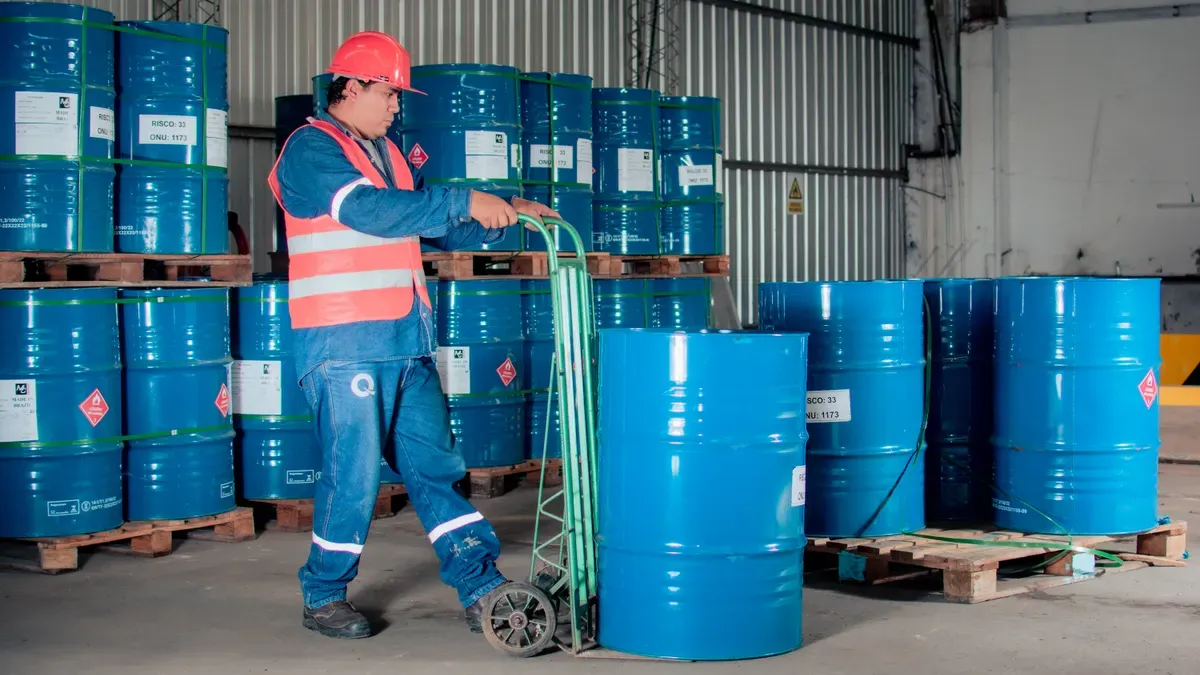
HTPB ships in sealed steel drums or intermediate bulk containers. The specification sheet should state the container size, the closure type, and the maximum fill level. Shelf life typically runs 12 to 24 months from the production date under unopened storage. The sheet should name the retest interval for opened containers, because moisture ingress degrades the material over time.
Storage and Handling Conditions
Safe storage keeps HTPB in a cool, dry, well-ventilated area. Containers must stay tightly sealed to block moisture. Workers should wear gloves and goggles and keep emergency equipment nearby. HTPB can release harmful fumes when heated, so proper ventilation is critical. The flash point sits at 113 °C minimum, and workers must identify ignition sources in the storage zone. Proper labeling on all drums and temporary containment dikes near storage areas control spill risks. Regular safety training reinforces these practices.
Certificate of Analysis and Batch Records
Every shipment needs a certificate of analysis that reports hydroxyl value, viscosity, molecular weight, moisture, and peroxide value against the specification limits. Batch records should link each lot to its raw material sources and production date. A dual validation system strengthens this record. Inter-batch sampling from multiple lots confirms consistency across production runs. Intra-batch testing at intervals tracks residual elongation and catches drift within a single batch.
Statistical Quality and Change Control
Suppliers should apply statistical process control to hydroxyl value, viscosity, molecular weight, and moisture. These four parameters define the process window for downstream formulators. Aerospace-grade suppliers should maintain long-term change-control procedures. A reformulation or a manufacturing-site change can trigger fresh qualification work for propulsion customers. The specification sheet should state the notification period for any process change and the data package that accompanies it.
Approve an HTPB supplier only when the specification sheet covers all six categories, with numeric limits and named test methods for every parameter. Identity data, performance data, and quality-system documentation must all appear. Strength in one area never offsets a gap in another. Withhold approval until every item is documented, current, and verifiable against a certificate of analysis.
FAQ
What is the minimum data set for HTPB supplier approval?
A buyer needs all six categories: identification, chemical and physical properties, performance, regulatory compliance, packaging and storage, and quality assurance. Each parameter requires a numeric limit and a named test method.
How should a buyer handle a spec sheet with a missing parameter?
The buyer should request the missing data in writing and pause approval. A verbal assurance carries no weight. Only a revised sheet with a numeric limit and a test method closes the gap.
How often should a buyer re-verify an approved HTPB specification sheet?
The buyer should re-verify the sheet at each certificate of analysis review and after any supplier process change. An annual full audit catches drift that single-lot checks miss.
See Also
Comparing EHEDG Guidelines With 3A SSI Standards For Hygienic Design
Making AHRI 400 And 401 Heat Exchanger Help Hassle Free
Selecting Pressure Vessel Materials Under ASME BPVC Section VIII Explained
Steel Processing For Heat Exchange Applications Consistently Delivers Strong Results
Key WT20 Thoriated Tungsten Electrode Facts That Improve TIG Welding