The Amazing Story of HTPB and Its Derivatives
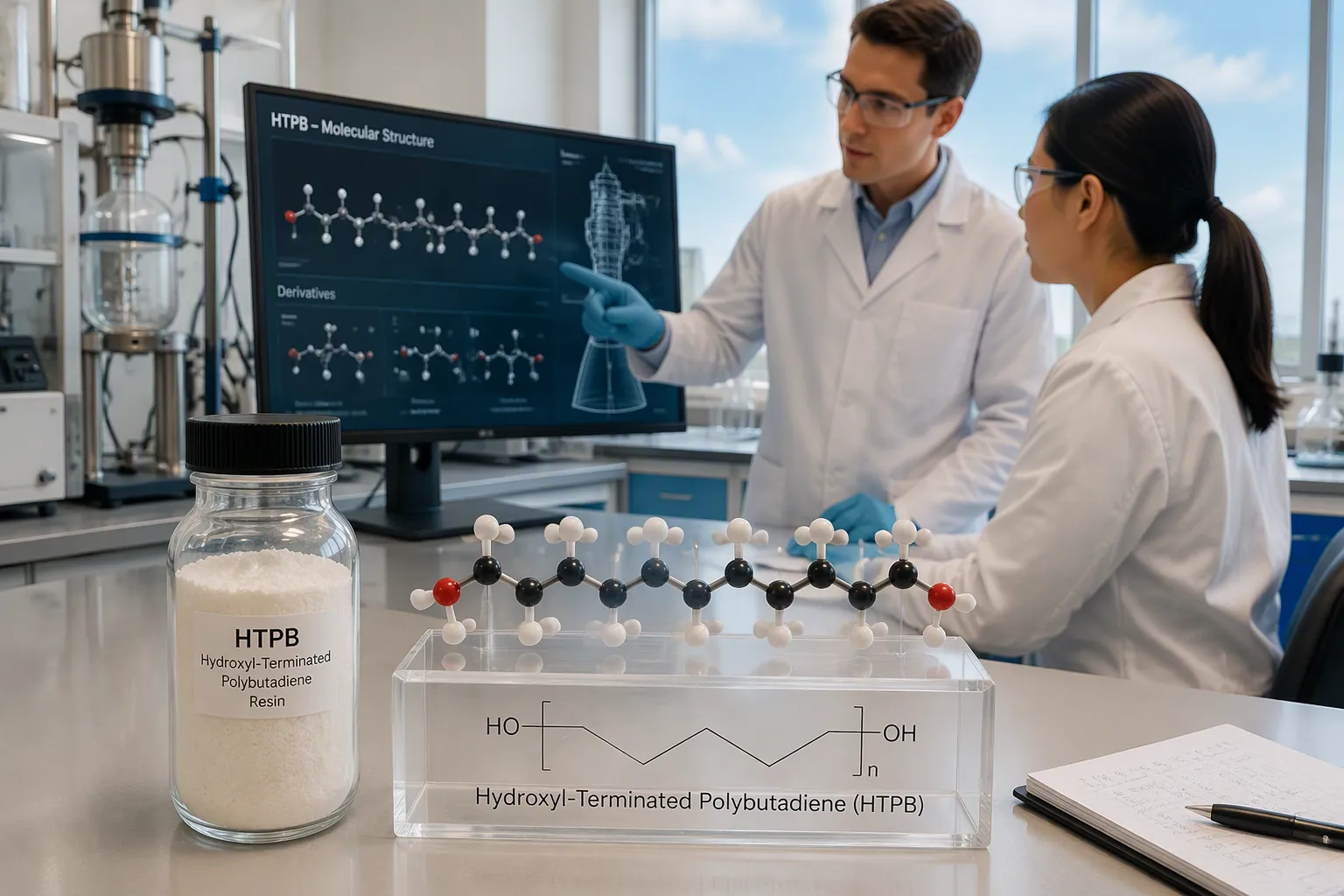
HTPB(Hydroxyl‑Terminated Polybutadiene) and its derivatives begin as liquid rubber. They cure into strong, elastic solids for rocket motors. Hydroxyl end groups act as chemical handles. They link chains into tough networks. These polymers also appear in sealants, adhesives, coatings, and artificial joints. Engineers created mono-chain HTPB, hydrogenated HTPB, and EHTPB for better performance.
The global hydroxyl terminated polybutadiene market is estimated at USD 342.5 million in 2024.
| Formulation | Elongation at Break (%) | Tensile Strength (UTS) |
|---|---|---|
| Unmodified HTPB (RHTPB) | 275 | Highest cross-link density |
| HTPB + 10 wt% T3 (RT3-10) | 600 | Minimal reduction |
| HTPB + 20 wt% T3 (RT3-20) | 1200 | ~60% decrease |
Key Takeaways
- HTPB begins as liquid rubber. Curing transforms it into a stretchy solid. Rocket motors use it to bind fuel.
- Engineers can modify HTPB to fix weak points. Mono-chain improves casting. Hydrogenated HTPB resists weather. EHTPB boosts adhesion.
- Each HTPB derivative solves a specific problem. Pick mono-chain for smooth flow. Pick hydrogenated for long life. Pick EHTPB for strong bonds.
HTPB (Hydroxyl-Terminated Polybutadiene) and Its Derivatives
HTPB(Hydroxyl‑Terminated Polybutadiene) and its derivatives provide a foundation for modern polymers. Their molecular design combines simple chemistry with powerful performance.
What Is HTPB?
HTPB is a liquid rubber polymer. It begins as a viscous liquid. Its chains carry hydroxyl (–OH) groups at both ends. Those groups act as chemical handles. A curing agent can link them together. The result is a solid, elastic network.
Manufacturers make HTPB through several synthesis routes. They choose a route based on cost, purity, and chain length. The table below shows standard methods.
| Synthesis Method | Key Features | Typical Molecular Weight Range |
|---|---|---|
| Hydrogen peroxide-mediated oxidative polymerization | Direct oxidative polymerization of 1,3-butadiene with H₂O₂ in alcohol; fast production (4–6 h) and high purity | 1,000–5,000 g/mol (PDI 1.5–2.5) |
| Anionic polymerization with hydroxyl-containing chain-transfer agents | Organolithium initiation in hydrocarbon solvent; hydroxyl termination via ethylene oxide capping; molecular weight controlled by monomer/initiator ratio | 1,000–5,000 g/mol (Mn tuned via monomer/initiator ratio) |
| UV-activated thiol-ene functionalization | UV-initiated reaction of unsaturated telechelic precursors with mercapto alcohols; rapid, quantitative, metal-free | Not explicitly stated; applies to hydroxyl-terminated telechelic polymers generally |
After synthesis, HTPB retains a polybutadiene backbone. That backbone contains many carbon–carbon double bonds. It also contains different units: cis-1,4, trans-1,4, and 1,2. The mix of those units changes the polymer’s behavior. For example, more 1,2 units make HTPB more viscous. A thicker liquid is harder to pour, mix, or cast. Thus, engineers must account for microstructure.
Curing turns liquid HTPB into a strong rubber. Isocyanates react with hydroxyl groups. The reaction forms urethane links. Those links build a three-dimensional network. The network gives the rubber its toughness and elasticity. A cured HTPB can stretch far before breaking. It also resists impact. Those traits make it a good binder for solid rocket fuel.
Why Modify HTPB?
Unmodified HTPB works well, but it has limits. Its backbone is nonpolar. This reduces adhesion. It also restricts interactions with polar ingredients. Its backbone contains double bonds. These bonds are reactive. They degrade under sunlight and oxygen. This limits long-term stability.
Modification addresses those two issues. The table below summarizes the limitations and why chemical changes help.
| Reported Limitation of Unmodified HTPB | Consequence / Performance Impact | Motivation for Chemical Modification |
|---|---|---|
| Low polarity of the backbone | Limits adhesion and restricts interactions with polar components | Introduce polar functionality, such as epoxidation, to improve compatibility and adhesion |
| Unsaturated backbone (double bonds) | Causes degradation and limits long-term stability, including UV-induced and oxidative damage | Saturate or convert double bonds, such as hydrogenation or epoxidation, to suppress degradation |
Chemists can modify HTPB in several ways. They can hydrogenate the double bonds. Hydrogenation turns them into single bonds. This reduces chemical reactivity. The product, hydrogenated HTPB, stays stable in harsh environments. They can also add polar groups, such as epoxide groups, to the backbone. Polar groups increase adhesion. They also improve compatibility with polar chemicals.
Another path changes the chain structure itself. Manufacturers can make mono-chain HTPB. This material has a narrower chain distribution. It flows more smoothly. It also gives more consistent curing. Microstructure control plays a large role here. Different contents of cis-1,4, trans-1,4, and 1,2 units produce different viscosities. A processor needs uniform viscosity for reliable casting.
The story of HTPB(Hydroxyl‑Terminated Polybutadiene) and its derivatives is one of careful molecular tuning. Each derivative solves a specific problem. Mono-chain HTPB improves process control. Hydrogenated HTPB improves stability. EHTPB creates new reaction sites for specialized uses. These changes show how small adjustments in a polymer chain produce major improvements.
The Main HTPB Derivative Families
HTPB(Hydroxyl‑Terminated Polybutadiene) and its derivatives form a family of materials. Each member starts from the same polybutadiene backbone. Each member ends with the same hydroxyl handles. The differences live in the middle of the chain. Small changes there produce large shifts in flow, stability, and reactivity. Three families dominate commercial and research use today.
| Property | Mono-Chain HTPB | Hydrogenated HTPB | EHTPB |
|---|---|---|---|
| Backbone double bonds | Present | Mostly removed | Partly converted to epoxide rings |
| Polarity | Low | Low | Higher |
| Viscosity behavior | Lower, more uniform | Similar to base HTPB | Higher |
| Main benefit | Processing control | Oxidative and UV stability | Adhesion and compatibility |
| Typical role | Binder with tight specs | Durable seals and coatings | Specialty propellants and adhesives |
Mono-Chain HTPB: Smoother Flow and Better Control
Standard HTPB contains chains of many different lengths. Some chains are short. Some are long. This spread is called the molecular weight distribution. A wide distribution creates problems during processing. Short chains act like a thin oil. Long chains act like thick syrup. Together, they make the liquid uneven.
Mono-chain HTPB solves this problem. Manufacturers tune the synthesis so that most chains reach a similar length. The result is a narrow molecular weight distribution. The liquid then behaves in a more predictable way. It pours at a steady rate. It mixes with fillers more evenly. It fills molds without leaving gaps.
Processors notice the difference on the production floor. A uniform liquid wets solid particles better. It coats each particle with the same amount of binder. The final cured product then has fewer weak spots. Its mechanical properties vary less from batch to batch. For solid rocket motors, this consistency matters a great deal. A motor with uneven binder can develop cracks. Cracks can lead to catastrophic failure.
Mono-chain HTPB also improves pot life control. Pot life is the window of time when the mixed liquid stays workable. A narrow distribution gives a sharper cure onset. Technicians know more precisely when the material will start to set. They can plan casting schedules with greater confidence.
The trade-off is cost. Mono-chain HTPB requires tighter synthesis control. It also demands more careful purification. These steps raise the price per kilogram. Engineers accept the cost when performance tolerances are tight. They choose standard HTPB when the application allows more variation.
Hydrogenated HTPB: Built for Stability
The polybutadiene backbone carries many carbon–carbon double bonds. These double bonds are the polymer's weak point. Oxygen attacks them. Ultraviolet light attacks them. Heat accelerates both processes. Over time, the bonds break. The rubber becomes brittle. It cracks. It loses its elastic properties.
Hydrogenation removes this weakness. In this process, hydrogen gas reacts with the double bonds. A catalyst speeds up the reaction. Each double bond becomes a single bond. The backbone transforms from unsaturated to saturated. A saturated backbone resists oxidation far better. It also resists UV damage.
The change in properties is dramatic. Hydrogenated HTPB survives long exposure to sunlight. It holds up in hot, oxygen-rich environments. It keeps its elasticity for years instead of months. These traits suit outdoor sealants and protective coatings. They also suit applications where the material must last the lifetime of a device.
Hydrogenation does not touch the hydroxyl end groups. Those handles remain free to react. Curing still works the same way. Isocyanates still link the chains into a network. The final rubber keeps its strength and stretch. It simply lasts longer.
One drawback deserves attention. Saturation removes reactive sites that some formulations rely on. Certain cure systems use the double bonds as cross-linking points. Hydrogenated HTPB cannot participate in those reactions. Formulators must switch to hydroxyl-based curing. They must also accept a slightly higher viscosity in some grades. These adjustments are minor compared to the stability gain.
EHTPB: What Makes It Different
EHTPB stands for epoxidized hydroxyl-terminated polybutadiene. The name describes the change. Epoxide groups are three-membered rings containing one oxygen atom and two carbon atoms. Chemists attach these rings to the backbone. They do this by reacting the double bonds with a peracid. The double bond opens. An epoxide ring takes its place.
This single change alters the polymer in several ways. First, epoxide rings are polar. They create strong interactions with other polar molecules. This raises adhesion to metal, glass, and ceramic surfaces. Second, the rings are reactive. They can open and form new chemical bonds. This opens doors to cure chemistries that standard HTPB cannot support.
The polarity shift also improves filler compatibility. Solid rocket propellants contain large amounts of crystalline oxidizer. Ammonium perchlorate is a common example. A polar binder wets these crystals better. Better wetting means stronger bonding between binder and filler. The propellant then handles mechanical stress more gracefully. It resists cracking during thermal cycling.
EHTPB offers another advantage for energetic formulations. The epoxide ring carries strain energy. This energy releases when the ring opens. The released energy contributes to the overall energy content of the material. Formulators can exploit this effect to boost performance.
The epoxide content is tunable. Manufacturers control how many double bonds they convert. A low epoxide content gives mild polarity and moderate reactivity. A high content gives strong adhesion and fast cure. This flexibility lets engineers tailor EHTPB to specific needs. They can match the binder to the filler, the cure agent, and the operating conditions.
EHTPB does carry trade-offs. Epoxide rings raise viscosity. A thicker liquid is harder to cast. The rings also react with moisture over time. Storage requires dry conditions and sealed containers. These handling requirements add cost and complexity. Engineers weigh these factors against the performance gains.
The three families together show the power of molecular design. Mono-chain HTPB refines the chain length. Hydrogenated HTPB refines the backbone chemistry. EHTPB adds new functional groups. Each path solves a distinct problem. Each path keeps the core advantages of the parent polymer.
Real-World Uses of HTPB and Its Derivatives
Solid Rocket Propellants
Solid rocket motors rely on HTPB as their primary binder. The binder holds the oxidizer and metal fuel together in a rubbery matrix. This matrix burns in a controlled way and produces thrust. HTPB offers reliable curing and good mechanical strength. These traits make it the workhorse of modern composite propellants.
Engineers compare HTPB against other binders using specific impulse. Specific impulse measures how efficiently a propellant generates thrust. The table below shows reported values.
| Binder / formulation | Context | Reported specific impulse | Notes |
|---|---|---|---|
| PBAN | Space Shuttle solid booster | 242 s sea level / 268 s vacuum | Operational PBAN solid propellant |
| HTPB | Delta II Castor 4A solid booster | 238 s sea level / 266 s vacuum | Operational HTPB solid propellant |
| HTPB + AP/Al | Theoretical optimum formulation | 277 s (theoretical maximum) | 68% AP + 18% Al + 14% HTPB; actual performance lower |
| PBAN + AP/Al | Theoretical optimum formulation | 277 s (theoretical maximum) | 70% AP + 16% Al + 12% PBAN + 2% epoxy curing agent; actual performance lower |
PBAN and HTPB are the two most common composite-propellant binders. PBAN formulations give a slightly higher specific impulse than equivalent HTPB formulations. Polyurethane appears as a possible binder in general descriptions. The source does not provide a numerical specific-impulse figure for it.
Adhesives, Sealants, and Elastomers
HTPB(Hydroxyl‑Terminated Polybutadiene) and its derivatives also serve industries far from aerospace. Their flexibility and chemical resistance suit many bonding and sealing tasks. Formulators use them in construction adhesives, automotive sealants, and industrial coatings. Hydrogenated HTPB excels in outdoor applications. Its saturated backbone resists sunlight and oxygen. EHTPB bonds strongly to metal and glass. These traits help in specialty adhesives and protective layers. Mono-chain HTPB provides consistent flow for precise casting. Together, these materials show how one polymer family covers many practical needs.
HTPB(Hydroxyl‑Terminated Polybutadiene) and its derivatives prove that simple molecules can achieve remarkable things. Mono-chain HTPB improves processing. Hydrogenated HTPB boosts stability. EHTPB enables specialized formulations. These small molecular tweaks deliver big gains across many industries. The global HTPB market reflects this value. Analysts project an 8.9% compound annual growth rate from 2024 to 2030.
FAQ
What is HTPB?
HTPB is a liquid rubber polymer. It cures into a strong, elastic solid. Hydroxyl groups at the chain ends link the molecules together.
Why do engineers modify HTPB?
Unmodified HTPB has limits. It degrades under sunlight and oxygen. It also adheres poorly to polar surfaces. Modifications fix these problems.
Where do HTPB derivatives find use?
They serve in solid rocket propellants, adhesives, sealants, and coatings. Hydrogenated HTPB suits outdoor applications. EHTPB bonds well to metal and glass.
See Also
Key CHIP Achievements Reshaping Kids' Health Insurance Coverage
How Aminoguanidine Bicarbonate Is Made And Its Major Uses
WT20 Thoriated Tungsten Electrode Facts That Boost TIG Welding
Latest Aminoguanidine Bicarbonate Synthesis Approaches And Industrial Uses
More Innovative Uses Of N,N-Dimethyl-N,N-Diphenylurea Across Diverse Industrial Sectors