Comparing AO 2246 and AO 264 (BHT) for HTPB Performance
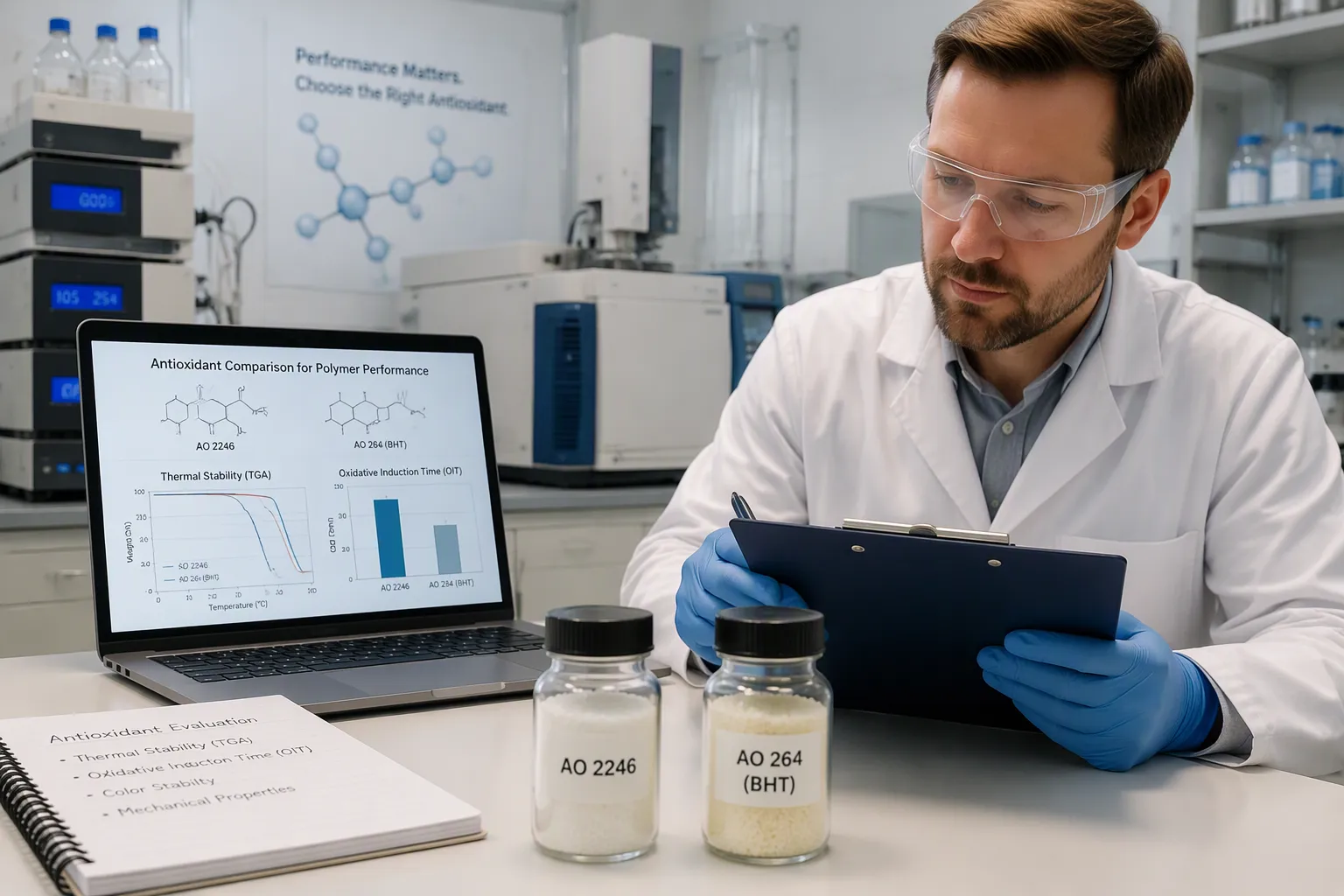
AO 2246 generally delivers better long-term thermal stability and lower volatility in HTPB. AO 264 (BHT) is the more cost-effective choice for short-term protection.
The selection of HTPB antioxidants (AO 2246 vs AO 264 (BHT)) and impact of antioxidant content on HTPB performance come down to three variables: storage duration, processing temperature, and end-use requirements.
Dosage must be tuned to balance protection against volatility, extractability, and discoloration. More antioxidant is not automatically better.
Key Takeaways
- AO 2246 provides better long-term protection for HTPB because it resists evaporation and stays in the binder.
- AO 264 (BHT) is more cost-effective for short-term needs, but it evaporates faster and offers less durable protection.
- Choose the right antioxidant and dose based on your storage time and processing heat to avoid binder failure.
Molecular Structure and Mechanism
AO 2246: High-Molecular-Weight Hindered Phenol
AO 2246 is a hindered phenol with a larger molecular structure. Its higher molecular weight gives it a physical presence that resists evaporation. The table below summarizes its key properties.
| Property | Value |
|---|---|
| Molecular Weight | 340.50 g/mol |
| Melting Point | ≥128 °C |
| Volatile Matter | ≤0.5% |
These values show a compound that stays put. The high melting point and low volatile matter support its role as a long-term stabilizer in HTPB systems.
AO 264 (BHT): Compact, Low-Molecular-Weight Phenol
AO 264, commonly known as BHT, has a smaller and more compact molecular structure. Its lower molecular weight allows it to move more freely within the binder matrix. This compact size supports rapid dispersion during mixing. The same compactness also makes BHT more prone to evaporation and migration over time.
How Structure Drives Protection in HTPB
Both antioxidants work by donating hydrogen to neutralize free radicals. This action interrupts the oxidation chain that degrades HTPB. The difference lies in how long each molecule stays active in the binder. AO 2246 remains in place longer because of its larger size. AO 264 acts quickly but leaves the system sooner. Structure therefore determines the duration and reach of protection in HTPB formulations.
Volatility and Storage Loss
Evaporation Behavior at Elevated Temperatures
Heat accelerates antioxidant loss in HTPB. AO 264 (BHT) has a low molecular weight and a low melting point. These traits let BHT evaporate readily during mixing, curing, and hot storage. AO 2246 carries a higher molecular weight and a melting point of at least 128 °C. Its volatile matter stays at or below 0.5%. AO 2246 therefore resists evaporation far better at elevated temperatures.
| Property | AO 2246 | AO 264 (BHT) |
|---|---|---|
| Molecular Weight | 340.50 g/mol | 220.35 g/mol |
| Melting Point | ≥128 °C | ~70 °C |
| Volatile Matter | ≤0.5% | Higher loss tendency |
Implications for Long-Term HTPB Storage
Storage loss changes the effective antioxidant content in HTPB over time. BHT evaporates from the binder during warm storage. The remaining protection drops, and the binder faces faster oxidation. AO 2246 stays in the binder matrix and holds its concentration steady across long storage periods. Formulators who expect months of storage or warm warehouse conditions gain more reliable protection from AO 2246. BHT still works well for short storage windows and quick consumption. The choice depends on how long the HTPB must hold its properties before use.
Extractability and Migration
Solvent and Plasticizer Contact Scenarios
HTPB binders often meet solvents and plasticizers during processing and service. These liquids can pull antioxidant molecules out of the binder. AO 264 (BHT) dissolves easily in many organic solvents because of its small, compact structure. A solvent wash or prolonged plasticizer contact therefore removes BHT from the formulation with relative ease. AO 2246 behaves differently. Its larger molecular size slows the diffusion of the molecule into surrounding liquids. The table below summarizes this contrast.
| Contact Scenario | AO 2246 | AO 264 (BHT) |
|---|---|---|
| Organic solvent wash | Slow extraction | Faster extraction |
| Plasticizer contact | Limited migration | Higher migration tendency |
| Aqueous contact | Very low loss | Low loss |
Retention in Cured Binder Systems
Curing locks the binder into a crosslinked network. Antioxidant retention after cure depends on molecular size and mobility. AO 2246 stays trapped within the network more effectively. Its higher molecular weight limits diffusion through the cured matrix. AO 264 (BHT) retains less because its small molecules move more freely. Formulators who need lasting protection in a cured grain favor AO 2246. BHT remains a practical choice when the binder sees little solvent contact and a short service life. Both antioxidants protect the binder well within their best-fit scenarios.
Discoloration and Appearance
Color Body and Staining Tendency
Antioxidants can change the color of HTPB over time. AO 2246 carries a larger phenolic structure. Its color body tends to produce a light yellow tint in the binder. The tint deepens slowly under heat and light exposure. AO 264 (BHT) starts with a lower color body. Fresh BHT shows almost no visible color in HTPB. The molecule oxidizes faster, however, and its breakdown products form yellow-brown chromophores. These chromophores stain the binder more readily during extended storage.
| Property | AO 2246 | AO 264 (BHT) |
|---|---|---|
| Initial color in HTPB | Light yellow tint | Nearly colorless |
| Color after aging | Slow, gradual shift | Faster yellow-brown staining |
| Staining tendency | Low to moderate | Moderate to high |
Impact on Visual Quality Control
Visual inspection plays a real role in HTPB production. Operators check binder batches for color consistency before release. AO 2246 gives a predictable color drift. Inspectors can set stable color standards against this baseline. AO 264 (BHT) creates a wider color spread between fresh and aged material. A dark batch may simply reflect antioxidant breakdown rather than a processing fault. This ambiguity complicates accept-or-reject decisions. Formulators who prioritize uniform appearance often select AO 2246. BHT still suits applications where color carries little weight, such as filled systems or short-life mixes. Both antioxidants remain workable options when the quality plan accounts for their color behavior.
Aging Performance in HTPB
Aging tests reveal how well each antioxidant protects HTPB over time. Heat and oxygen drive the degradation process. Both antioxidants slow this process, but they do so at different rates and for different durations. The sections below compare their performance under thermal-oxidative stress and their ability to preserve key binder properties.
Thermal-Oxidative Stability Comparison
Thermal-oxidative stability measures how long a binder resists degradation under heat and oxygen exposure. Test methods typically expose HTPB samples to elevated temperatures for set periods. Researchers then track weight change, gel formation, and oxidation induction time. These metrics show how much protection the antioxidant provides and how long that protection lasts.
AO 2246 outperforms AO 264 (BHT) in long-duration thermal-oxidative tests. Its higher molecular weight keeps the molecule in the binder matrix. The antioxidant remains available to neutralize free radicals throughout the test period. HTPB samples stabilized with AO 2246 show slower weight gain from oxidation. They also resist gel formation for longer periods. Oxidation induction times run longer with AO 2246 at equivalent loading levels.
AO 264 (BHT) provides strong protection in the early stages of aging. Its small, mobile molecules disperse quickly and reach free radicals fast. This rapid action gives BHT an edge in short-term tests. The advantage fades as the test continues. BHT evaporates and depletes, and the protection level drops. Samples stabilized with BHT show faster property loss in extended aging trials.
| Aging Metric | AO 2246 | AO 264 (BHT) |
|---|---|---|
| Oxidation induction time | Longer | Shorter |
| Weight gain under heat | Slower | Faster |
| Gel formation onset | Delayed | Earlier |
| Protection duration | Extended | Short-term |
The test temperature matters as well. At moderate temperatures, both antioxidants perform well. At higher temperatures, the gap widens. BHT loses more mass to evaporation, and its protective effect declines faster. AO 2246 holds its concentration and keeps protecting the binder. Formulators who expect high-temperature exposure during processing or storage gain a clear advantage from AO 2246.
Viscosity and Hydroxyl Value Retention
Viscosity and hydroxyl value are two key quality indicators for HTPB. Viscosity reflects the flow behavior of the binder. Hydroxyl value measures the content of reactive hydroxyl groups. Both properties change as HTPB oxidizes. Oxidation causes chain scission and crosslinking, and these reactions shift viscosity and consume hydroxyl groups. Good antioxidant protection preserves both properties over time.
AO 2246 slows the rise in viscosity during accelerated aging. HTPB samples stabilized with AO 2246 show smaller viscosity changes after heat exposure. The binder stays closer to its initial flow behavior. This stability matters for processing. A binder that thickens during storage can cause mixing and casting problems. AO 2246 keeps the viscosity window wider for longer.
Hydroxyl value retention follows a similar pattern. AO 2246 limits the loss of hydroxyl groups during aging. The binder keeps more of its reactive sites available for cure. This retention supports consistent cure kinetics and final mechanical properties. Samples with AO 2246 show higher hydroxyl value retention after aging than samples with BHT.
AO 264 (BHT) protects viscosity and hydroxyl value well in the short term. Fresh BHT-stabilized HTPB performs comparably to AO 2246-stabilized material in early tests. The difference emerges after extended aging. BHT depletion leaves the binder less protected, and viscosity and hydroxyl value drift faster. Formulators who store HTPB for long periods see more batch-to-batch variation with BHT.
| Property | AO 2246 | AO 264 (BHT) |
|---|---|---|
| Viscosity change after aging | Smaller | Larger |
| Hydroxyl value retention | Higher | Lower |
| Cure consistency after storage | More stable | Less stable |
| Long-term property drift | Slower | Faster |
The practical takeaway is straightforward. AO 2246 preserves viscosity and hydroxyl value over long storage and high-heat exposure. AO 264 (BHT) protects these properties well when the binder moves quickly through processing and use. Both antioxidants serve valid roles. The right choice depends on how much aging stress the HTPB must survive before cure.
Impact of Antioxidant Content on HTPB Performance
Antioxidant content shapes how well HTPB survives storage, processing, and cure. Too little antioxidant leaves the binder exposed. Too much creates its own problems. The selection of HTPB antioxidants (AO 2246 vs AO 264 (BHT)) and impact of antioxidant content on HTPB performance therefore move together. A formulator cannot pick a molecule and ignore the dose. The two decisions work as a pair.
Underdosing Risks and Overdosing Trade-Offs
Underdosing is the more common and more costly mistake. HTPB oxidizes through a chain reaction. Each free radical attack can trigger many more. A small amount of antioxidant breaks that chain. Remove too much of the antioxidant, and the chain runs unchecked. The binder then shows early viscosity rise, gel formation, and loss of hydroxyl value. These changes may stay hidden during incoming inspection. They appear later, after weeks in storage or after cure. A batch that looked fine on delivery can fail at the mixing stage.
The risk grows with storage time and heat exposure. A dose that protects HTPB for two weeks may fail after two months. BHT underdosing is especially risky in warm conditions. The molecule evaporates and depletes, so the effective content falls below the intended level. AO 2246 holds its concentration better, which gives the formulator more margin against underdosing.
Overdosing carries different trade-offs. Extra antioxidant does not simply add extra protection. Each molecule has a solubility limit in the binder. Beyond that limit, the excess may bloom to the surface, form visible deposits, or act as a plasticizer. High phenolic content can also shift cure behavior. Some hindered phenols interfere with urethane reactions at elevated levels. Excess antioxidant also raises cost without a matching gain in stability. In some systems, very high doses even promote color formation, because the antioxidant itself oxidizes and forms chromophores.
More antioxidant is not automatically better. The goal is the smallest dose that holds HTPB properties through the full storage and processing window.
A practical rule applies here. Match the dose to the stress the binder will face. Short storage and mild processing need less. Long storage and hot mixing need more. The selection of HTPB antioxidants (AO 2246 vs AO 264 (BHT)) and impact of antioxidant content on HTPB performance should be evaluated together, because the right dose depends on which molecule does the protecting.
Practical Dosage Ranges and Cost-per-Formulation Comparison
Typical antioxidant loadings in HTPB fall in a narrow band. Most formulations use between 0.1% and 1.0% by weight of the binder. Within that band, the choice of molecule and the exact level interact. AO 2246 usually performs well at the lower end of the range, because it stays in the binder and keeps working. BHT often needs a higher initial charge to compensate for evaporation and depletion during processing.
| Factor | AO 2246 | AO 264 (BHT) |
|---|---|---|
| Typical loading range | 0.1%–0.5% | 0.2%–1.0% |
| Effective dose after hot mixing | Close to charged dose | Lower than charged dose |
| Dose needed for long storage | Lower | Higher |
| Relative material cost per kg | Higher | Lower |
| Cost per formulation at equal protection | Often comparable | Often comparable |
| Risk at high loading | Bloom, cure interference | Bloom, color shift, volatility loss |
The cost picture deserves careful reading. BHT costs less per kilogram. That lower price does not always translate into a lower cost per formulation. BHT loses mass during hot mixing and storage, so the formulator must charge more to reach the same effective protection. AO 2246 costs more per kilogram but delivers more of its charged dose to the binder. At equal protection levels, the two often land close in total cost. The gap widens in favor of BHT for short-life, low-heat applications. The gap widens in favor of AO 2246 for long storage and hot processing.
A simple worked example makes the point. Suppose a formulator targets a given protection level in a binder that will sit in storage for six months. BHT might require a 0.6% charge to hold that level, while AO 2246 might need only 0.3%. The BHT charge is double, and part of it evaporates anyway. The per-kilogram price advantage of BHT shrinks or disappears once the formulator accounts for the higher charge. Add the cost of a failed batch from underprotection, and the economics often favor AO 2246 for long-life systems.
Dose optimization also affects the other properties covered earlier. Higher antioxidant content can raise extractables, deepen color, and increase the chance of bloom. The formulator should set the dose with all of these in mind. A dose that protects viscosity may still cause discoloration. A dose that controls color may leave the binder short on thermal protection. The selection of HTPB antioxidants (AO 2246 vs AO 264 (BHT)) and impact of antioxidant content on HTPB performance therefore calls for a balanced test plan. Run accelerated aging at two or three dose levels. Track viscosity, hydroxyl value, color, and extractables together. Pick the lowest dose that meets every requirement.
Both antioxidants remain valid choices within their best-fit use cases. AO 2246 rewards formulators who can accept a higher per-kilogram price in exchange for dose efficiency and long-term stability. BHT rewards formulators who move material quickly and want the lowest upfront cost. The dose decision should follow the application, not a default number.
| Factor | AO 2246 | AO 264 (BHT) |
|---|---|---|
| Structure | High molecular weight | Compact, low molecular weight |
| Volatility | Low | High |
| Extractability | Low migration | Higher migration |
| Discoloration | Slow, predictable | Faster staining |
| Aging performance | Strong long-term | Strong short-term |
| Cost | Higher per kg, dose-efficient | Lower per kg |
AO 2246 suits long-term storage, high-temperature processing, and low-volatility needs. AO 264 (BHT) fits short-term, cost-sensitive formulations with rapid consumption. The selection of HTPB antioxidants (AO 2246 vs AO 264 (BHT)) and impact of antioxidant content on HTPB performance depends on the application. Optimize the dose, and both options remain valid within their best-fit use cases.
FAQ
Which antioxidant should a formulator choose for HTPB?
Storage duration and processing temperature drive the choice. AO 2246 fits long storage and hot processing. AO 264 (BHT) fits short-life, cost-sensitive formulations.
What dosage do HTPB formulators typically use?
Most formulations use 0.1% to 1.0% by weight. AO 2246 works at the low end. BHT often needs a higher charge to offset evaporation losses.
Can a formulator blend AO 2246 and AO 264 (BHT)?
Blending is possible. AO 2246 provides durable background protection. BHT adds fast early action. Test the blend under accelerated aging before committing to production.
See Also
Shell Versus Plate Heat Exchanger Performance Comparison For 2025
Top Eight HTN LCD Displays For Reliable High Performance
Hassle Free Assistance With AHRI 400 And 401 Heat Exchangers
Three Methods PHE Plates Boost System Performance During 2025