How to Select the Best Capsule Checkweigher for Your Manufacturing Needs

You need a Capsule Checkweigher that matches your production goals. Accurate weighing protects product quality and keeps you compliant with regulations. See common accuracy standards below:
| Accuracy Requirement | Description |
|---|---|
| ±6g | Maximum accuracy of the dynamic checkweigher CW-60K, ensuring high repeatability. |
| Compliance with regulatory standards | Ensures that every tablet or capsule meets specific weight and quality standards set by regulatory bodies. |
| Automation features | Reduces human error and helps maintain compliance, avoiding costly recalls. |
Pharmaceutical Sample Checkweigher For Capsule Tablet Online Sampling Scale lets you check weights quickly. Capsule Checkweighe helps you maintain efficiency.
Key Takeaways
- Choose a Capsule Checkweigher that matches your production goals to ensure accurate weighing and compliance with regulations.
- Consider the machine's speed and throughput to match your production line's capacity, avoiding delays and inefficiencies.
- Ensure the checkweigher meets industry standards for accuracy and sensitivity, especially in sectors like pharmaceuticals where strict regulations apply.
Capsule Checkweigher Essential Features

How Capsule Checkweighers Work
You use a Capsule Checkweigher to measure the weight of each capsule as it moves along your production line. The machine uses advanced sensors to detect even tiny differences in weight. Modern systems can weigh up to 120,000 capsules per hour with an accuracy of ±0.5 mg. Some models, like the C3600, reach speeds of 130,000 pieces per hour for shells and 200,000 pieces per hour for filled capsules. AI-driven algorithms help the machine calibrate itself and predict when maintenance is needed. Machine vision sensors inspect capsules in real time, making sure only those with the correct weight continue through your process.
Key Functions and Technologies
A high-performance Capsule Checkweigher gives you several important benefits:
- Ensures net weight accuracy at the end of your packaging line
- Helps you comply with FSMA regulations
- Minimizes risks of underfilling or overfilling
- Offers high sensitivity to prevent out-of-specification products from moving forward
- Provides advanced connectivity for data integration
- Performs consistency checks for ongoing performance
Advanced weighing technologies deliver precise measurements within 0.1g, much better than basic models. IoT-enabled sensors and cloud platforms allow you to monitor data remotely. Digital transformation supports quality assurance and regulatory compliance.
Role in Compliance and Quality Assurance
Capsule Checkweighers help you meet strict international standards. You must follow rules from organizations like the FDA, USP, and GMPs to keep patients safe and ensure accurate dosages. These machines also support serialization and traceability, which are important for modern pharmaceutical production. The table below shows how checkweighers contribute to quality assurance:
| Feature | Description |
|---|---|
| Precision | ±0.5 mg accuracy |
| Compliance | Meets FDA 21 CFR Part 11 |
| Material | Compliant with FDA 21 CFR Part 177 |
You avoid costly recalls by ensuring accurate dosing and maintaining compliance. Real-time reporting lets you spot problems quickly and fix them before they affect your products.
Capsule Checkweigher Selection Factors
Product Type and Capsule Specifications
You need to match your Capsule Checkweigher to the types of capsules you produce. Capsule sizes and shapes can vary, so you must check if the machine can handle all the sizes you use. Some models, like the SeTAQ, let you inspect different capsule sizes without changing molds. This saves time and reduces the risk of cross-contamination. Machines like the iW-10 and iW-60 can process capsule sizes from #000 to #5, with outputs up to 60,000 capsules per hour. You should also look for machines that rotate capsules to inspect all sides for defects.
| Factor | Description |
|---|---|
| Capsule sizes and shape | Machines can inspect capsules of various sizes; minimum thickness is crucial for selection. |
| Output | Machines vary in output capacity, inspecting up to 120,000 capsules per hour depending on type. |
| Quality compliance | Ensure the machine meets standards like FDA, CE, ISO, and cGMP for safety and effectiveness. |
| Material | Durable materials like stainless steel are preferred to withstand vibrations and avoid reactions. |
| Accuracy | High accuracy is essential to prevent damages during inspection of sensitive capsules. |
| Ability to inspect all sides | Machines should rotate capsules to inspect for defects on all sides. |
| Easy to clean and maintain | Machines should allow for easy disassembly for cleaning and maintenance. |
Accuracy and Sensitivity Requirements
You must choose a Capsule Checkweigher that meets your sector’s standards for accuracy and sensitivity. Pharmaceutical companies need very high accuracy and sensitivity because strict FDA rules apply. Nutraceutical producers follow cGMP guidelines, which require moderate to high accuracy. Food manufacturers may have different requirements depending on the region. If you work in pharmaceuticals, you should look for machines with dynamic accuracy as tight as ±3mg.
| Sector | Accuracy Requirements | Sensitivity Requirements | Regulatory Compliance Needs |
|---|---|---|---|
| Pharmaceutical | High | Very High | Strict FDA regulations |
| Nutraceutical | Moderate to High | High | cGMP guidelines |
| Food Manufacturing | Moderate | Moderate | Varies by region |
Tip: Always check the regulatory standards for your sector before choosing a checkweigher.
Throughput and Speed
You need a Capsule Checkweigher that matches your production speed. High-volume environments require machines that can process thousands of capsules every hour. Some models, like the C7200, can inspect up to 432,000 capsules per hour. The chart below shows how different models compare in throughput:
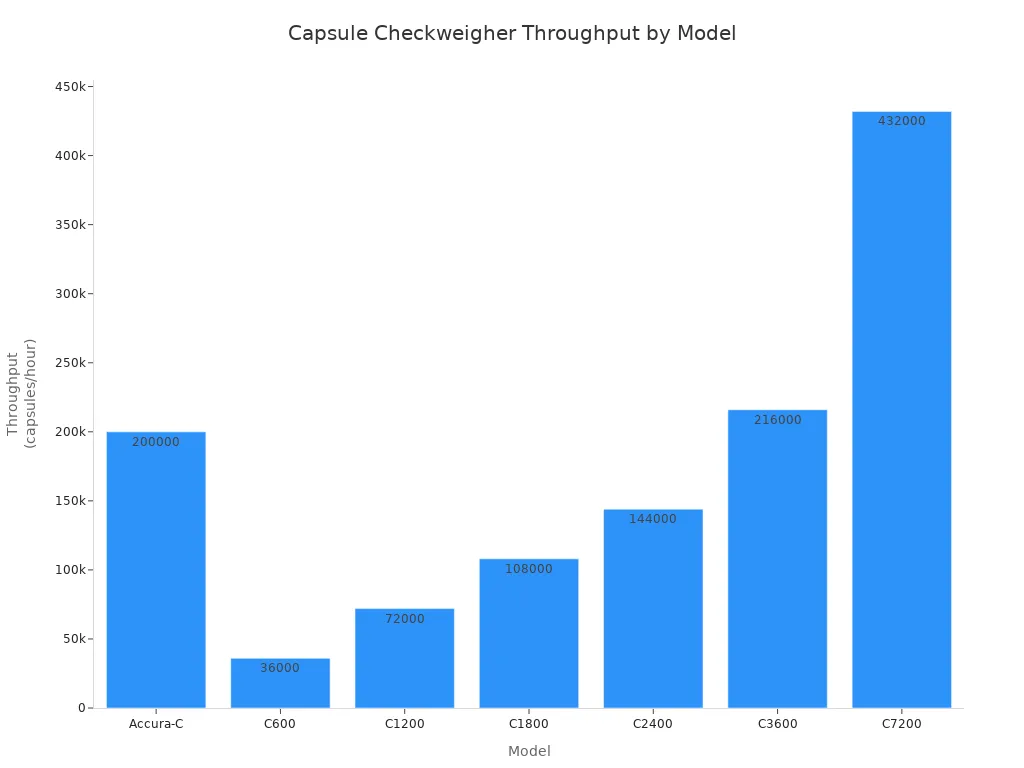
| Model | Throughput (capsules/hour) |
|---|---|
| Accura-C | 200,000 |
| C600 | 36,000 |
| C1200 | 72,000 |
| C1800 | 108,000 |
| C2400 | 144,000 |
| C3600 | 216,000 |
| C7200 | 432,000 |
If your line runs fast, you need a checkweigher that keeps up without slowing production.
Integration with Production Line
You must make sure your Capsule Checkweigher fits into your existing production line. Compatibility issues can cause delays and extra costs. Some machines need skilled technicians for installation and maintenance. You should check if your equipment works with your packaging machines and software.
| Integration Challenge | Description |
|---|---|
| Compatibility Issues | Difficulty in ensuring capsule checkweighers work with existing manufacturing and packaging equipment. |
| High Initial Capital Investment | Significant upfront costs associated with purchasing and installing the checkweigher. |
| Need for Skilled Technicians | Requirement for trained personnel for installation and ongoing maintenance of the equipment. |
Note: Plan for training and support when adding new equipment to your line.
Cost and Return on Investment
You need to consider both the price and the long-term value of your Capsule Checkweigher. The initial investment can be high, but you save money by reducing product giveaway and avoiding recalls. Automation lets you move workers to more important jobs, which increases productivity. Many companies recover the cost of their checkweigher within one or two years.
- You save money by reducing product giveaway.
- Automation increases productivity and lowers labor costs.
- You avoid fines and losses from recalls and non-compliance.
Service, Support, and Maintenance
You should choose a Capsule Checkweigher that is easy to clean and maintain. Machines that allow quick disassembly help you keep your line running smoothly. Reliable service and support from the manufacturer are important. You need access to spare parts and technical help when problems arise.
- Look for machines with simple cleaning procedures.
- Choose suppliers who offer strong technical support.
- Make sure spare parts are easy to get.
Tip: Regular maintenance keeps your checkweigher accurate and extends its life.
Capsule Checkweigher Types Compared
Manual vs. Automatic Systems
You can choose between manual and automatic systems for weighing capsules. Manual systems need you to place each capsule on the scale. You must watch the process and record the results. These systems work well for small batches or when you want to check a few samples. Automatic systems use sensors and conveyors to weigh capsules quickly. You do not need to touch each capsule. Automatic machines help you save time and reduce mistakes. They fit better in large factories where speed and accuracy matter most.
Tip: Automatic systems help you keep up with high production demands and lower the risk of human error.
Single-Channel vs. Multi-Channel Models
You need to decide if a single-channel or multi-channel model fits your production line. Single-channel systems, such as the ARTEMIS, offer speed and efficiency. They give you a simple and reliable solution. Multi-channel models can process more capsules at once. They reach two to three times the throughput of single-channel systems. Multi-channel machines add extra features that boost performance, but they may be less reliable in some cases.
| System Type | Throughput | Accuracy |
|---|---|---|
| Single-Channel | Slower, lower throughput | Reliable, simpler |
| Multi-Channel | Faster, higher throughput | Potentially less reliable |
- Multi-channel systems help you finish jobs faster.
- Single-channel systems give you steady and dependable results.
Specialized vs. General-Purpose Checkweighers
You can pick a specialized Capsule Checkweigher for capsules only. These machines focus on capsule shapes and sizes. They offer better accuracy for capsule products. General-purpose checkweighers work with many items, such as tablets, bottles, or pouches. If you make different products, a general-purpose machine gives you more flexibility. If you want the best results for capsules, a specialized model is the right choice.
Capsule Checkweigher Decision Process
Assessing Production Needs
You need to understand your production requirements before you choose a capsule checkweigher. Start by looking at the accuracy and precision you need. Check your tolerance levels and decide how often you must calibrate the machine. Match the speed of the checkweigher with your production line. Make sure the throughput rate fits your daily output. Review the range of products you process. The checkweigher should handle all the weights and types you use. Confirm that the machine meets regulatory standards and offers traceability features.
- Check accuracy and precision for your product.
- Match speed and throughput with your line.
- Ensure the machine works with your product range.
- Verify compliance and certification.
Operator training matters. You must teach your team how to select the right load cell, use the software, and perform regular maintenance.
Evaluating Vendor Reliability
You want a reliable vendor who supports your business. Use these criteria to compare suppliers:
- Check if the checkweigher meets your accuracy and calibration needs.
- Confirm the vendor follows industry regulations like FDA and HACCP.
- Review the supplier’s reputation. Look at warranty terms and service contracts.
Tip: A strong service contract helps you avoid downtime and keeps your line running.
Planning for Future Scalability
You should plan for growth when you select a capsule checkweigher. Look for machines that allow upgrades or expansion. The table below shows what to consider:
| Key Factor | Description |
|---|---|
| Expansion | Check if you can upgrade or expand the checkweigher for new needs. |
Mistakes can happen during selection. Common errors include setting the filter coefficient too small, failing to set the zero scale, picking the wrong model, using inefficient power, or calibrating with the wrong weight. Avoid these by training your operators and reviewing your choices carefully.
You can select the best capsule checkweigher by focusing on key factors. The table below shows what you should consider:
| Key Factor | Description |
|---|---|
| Accuracy and Precision | Check tolerance and calibration needs. |
| Speed and Throughput | Match machine speed with your production line. |
| Compliance and Certification | Confirm regulatory standards and traceability. |
Talk with experts and compare several options before you decide. This helps you find equipment that fits your goals and supports your success.
FAQ
What is the main benefit of using a capsule checkweigher?
You improve product quality and meet regulations. You also reduce waste and avoid costly recalls.
Tip: Accurate weighing protects your brand reputation.
How often should you calibrate your capsule checkweigher?
You should calibrate your checkweigher weekly or after any major maintenance.
- Regular calibration keeps your machine accurate.
- Follow the manufacturer's guidelines.
Can you integrate a capsule checkweigher with existing production lines?
Yes, you can integrate most models with your current equipment.
| Integration Type | Ease of Setup |
|---|---|
| Automatic | Easy |
| Manual | Moderate |
See Also
Essential Capsule Checkweighers To Evaluate For 2025
Three Must-Have Industrial Checkweighers For Food Facilities
Key Features And Definitions Of Pharmaceutical Checkweighers
Enhancing Pharma Efficiency With Modern Capsule Decapsulation Machines