How Do Liquid Packing Machines Work in Modern Industries
Liquid Packing Machine technology transforms industrial packaging by automating the filling, sealing, and packaging of liquids. Modern industries rely on these machines for several reasons:
- They operate at high speeds, meeting large-scale production needs efficiently.
- They deliver precise and consistent filling, which minimizes waste and ensures product quality.
- They adapt to different packaging formats, supporting diverse business requirements. Strict hygiene standards further enhance product safety.
Liquid Packing Machine Components
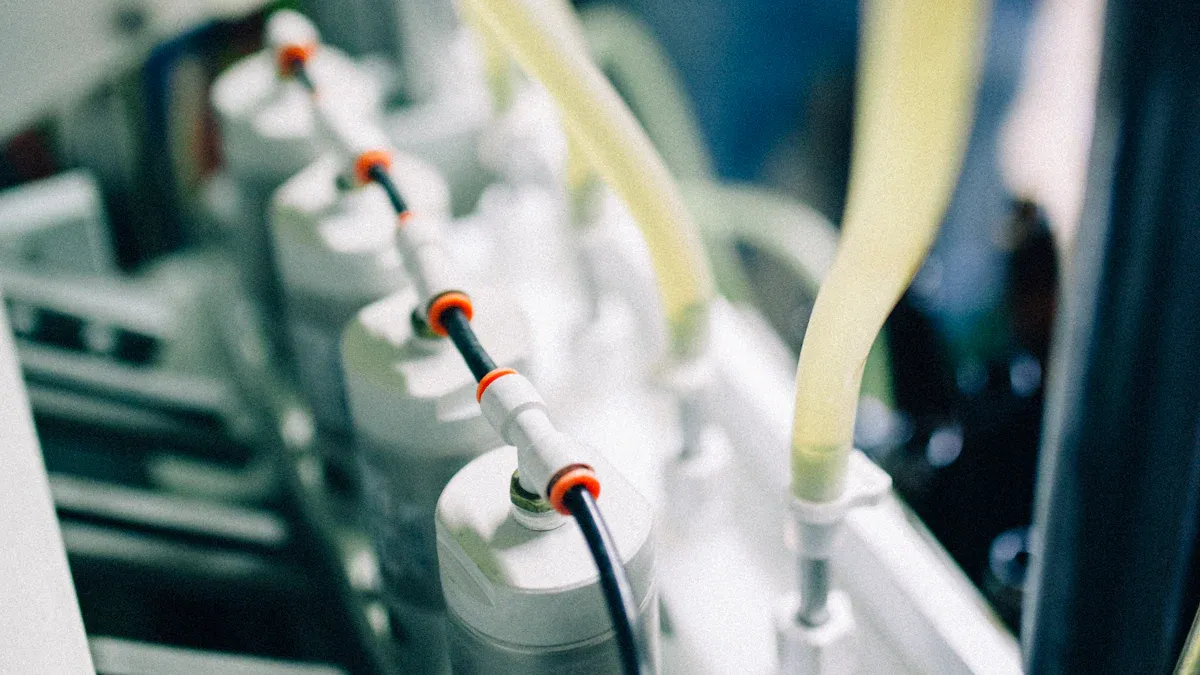
Modern industries rely on several key components to ensure the efficiency and reliability of every Liquid Packing Machine. Each part plays a unique role in the packaging process, contributing to speed, accuracy, and product safety.
| Component | Contribution |
|---|---|
| Conveyor Systems | Transport containers efficiently throughout the packaging process, ensuring smooth movement. |
| Filling Units | Measure and fill the desired quantity of liquid accurately into containers, preventing spillage. |
| Capping/Sealing Mechanisms | Ensure airtight and leak-proof packaging by applying appropriate seals or caps after filling. |
| Labelling and Coding Systems | Apply labels and codes for branding and essential information, enhancing the packaging process. |
| Control Panels and Sensors | Regulate and monitor the packaging process, ensuring optimal performance and detecting errors. |
Conveyors and Material Handling Systems
Conveyor systems form the backbone of any Liquid Packing Machine. They move containers through each stage of the process, from loading to final packaging. These systems ensure that bottles, pouches, or cartons travel smoothly and efficiently. Proper calibration of conveyors reduces the risk of spillage and maintains a steady workflow. Operators receive training to handle containers correctly, which prevents tipping and maintains product integrity.
Liquid Filling Units and Dispensing Mechanisms
Filling units determine the accuracy and consistency of the packaging process. They measure and dispense the exact amount of liquid required for each container. This precision eliminates overfilling and underfilling, which reduces waste and ensures every product meets quality standards. Automation in these units optimizes efficiency and maintains consistent filling levels. Regular calibration keeps the system performing at its best, while advanced technology minimizes spillage.
Sealing and Capping Systems
Sealing and capping systems protect the product from leaks and contamination. Recent advancements include ultrasonic, heat, and vacuum sealing methods. These technologies improve leak-proofing and enhance safety. Automated capping systems increase consistency and reduce human error. Integrated leak detection mechanisms ensure that only properly sealed containers move forward, minimizing wastage and ensuring consumer safety.
Control Systems and Automation Features
Modern industries demand high reliability and consistency from their packaging equipment. Control systems and automation features play a crucial role in meeting these expectations. Manufacturers equip machines with advanced technologies that streamline operations and reduce human error.
Programmable Logic Controllers (PLCs) serve as the central control unit. They manage all machine functions, which enhances precision and reliability. Operators interact with touchscreen Human-Machine Interfaces (HMI). These interfaces allow real-time monitoring and troubleshooting. As a result, operational consistency improves, and downtime decreases.
Integrated sensors monitor every stage of the process. They maintain fill accuracy and help reduce waste. This attention to detail ensures that each product meets strict quality standards. Data connectivity features enable real-time monitoring and predictive maintenance. Maintenance teams can address issues before they cause disruptions, which increases machine uptime.
Automation features reduce labor costs and improve traceability. Machines record every step of the process, making it easier to track production batches. This level of control supports compliance with industry regulations and customer requirements.
The following table summarizes how these features benefit modern packaging lines:
| Feature | Benefit |
|---|---|
| Programmable Logic Controllers (PLCs) | Central control unit managing all machine functions, enhancing precision and reliability. |
| Touchscreen HMI | Allows real-time monitoring and troubleshooting, improving operational consistency. |
| Integrated Sensors | Maintains fill accuracy and reduces waste, crucial for product quality. |
| Data Connectivity | Enables real-time monitoring and predictive maintenance, enhancing reliability. |
| Automation Features | Reduces labor costs and improves traceability, contributing to consistent performance. |
A Liquid Packing Machine equipped with these advanced control systems delivers consistent results. Operators benefit from intuitive controls, while manufacturers achieve higher productivity and product quality.
Liquid Packing Machine Process Steps

Loading and Preparation of Containers and Materials
Operators begin the packaging process by preparing both the machine and the materials. They follow a strict sequence to ensure efficiency and hygiene. The preparation phase includes cleaning the equipment, verifying the availability of packaging films, and aligning all conveyors and components. This attention to detail prevents contamination and mechanical errors.
| Step | Description |
|---|---|
| 1 | Ensure the machine is clean. |
| 2 | Confirm availability of necessary materials such as packaging films. |
| 3 | Properly align conveyors and other components. |
A well-prepared Liquid Packing Machine reduces downtime and maintains consistent product quality. Operators check every detail before starting the production run. This preparation supports high-speed operations and minimizes the risk of defects.
Accurate Liquid Filling Operation
The filling stage determines the accuracy and consistency of the final product. Modern machines use advanced technologies to achieve precise filling. These technologies include IoT integration, advanced sensors, and AI-driven controls. Each system monitors key parameters and adjusts the filling process in real time.
| Technology | Description | Accuracy Impact |
|---|---|---|
| IoT Integration | Uses multiple sensors to monitor key parameters and correct deviations automatically. | Maintains fill accuracy within ±0.3%. |
| Advanced Sensors | Combines ultrasonic, laser, and weight measurement systems for precise tracking. | Achieves around 0.5% accuracy even at high speeds. |
| AI and Machine Learning | Analyzes real-time variables and adjusts fill parameters dynamically. | Sustains 99.3% fill accuracy through autonomous adjustments. |
Tip: High-speed filling technologies increase production efficiency while maintaining consistent fill levels. Modern machines adapt to different liquid viscosities, which reduces the need for multiple production lines.
Operators rely on these systems to minimize waste and ensure every container receives the correct amount of liquid. Advanced quality control systems monitor each stage, reducing error rates and supporting product integrity.
Sealing, Capping, and Bag Formation
After filling, the machine moves containers to the sealing and capping stage. This phase protects the product from contamination and ensures a secure closure. The sealing system uses heat, ultrasonic, or vacuum methods to bond packaging layers. Proper sealing prevents exposure to moisture, air, and foreign particles.
- Inadequate sealing can allow contaminants such as bacteria or chemical residues to enter, making products unsafe.
- Damaged or poorly sealed packaging exposes contents to environmental factors, reducing shelf life.
- Advanced rejection systems remove any packages that do not meet quality standards, ensuring only safe products reach consumers.
Operators monitor the process closely. They rely on automated systems to detect and reject defective packaging. This approach maintains high standards and supports regulatory compliance.
The final step involves forming the bag or applying the cap, depending on the packaging format. The machine cools the seal and discharges the finished product, ready for labeling and inspection.
Labeling, Coding, and Quality Inspection
Labeling and coding represent the final steps in the packaging process. These steps provide essential information for traceability, branding, and regulatory compliance. Operators set up the machine to apply labels and print codes with high accuracy. They select the correct label rolls and ink supplies before starting production.
Modern machines use automated applicators and printers. These systems place labels at precise positions and print clear, legible codes. The codes often include batch numbers, expiration dates, and barcodes. Accurate labeling ensures that products meet legal requirements and support inventory management.
Quality inspection plays a critical role in maintaining high standards. Advanced inspection systems monitor every package as it leaves the labeling and coding stations. These systems use a combination of sensors, cameras, and software to detect errors. They check for misaligned labels, missing codes, and print defects.
Consistent quality inspection reduces the risk of recalls and customer complaints. It also protects the brand reputation.
Manufacturers integrate several inspection methods into the packaging line. Each method targets a specific aspect of quality control. The following table summarizes the main inspection technologies and their functions:
| Inspection Method | Function Description |
|---|---|
| Checkweighers | Verify fill accuracy and regulatory compliance |
| Metal detectors | Identify ferrous and non-ferrous contamination |
| X-ray systems | Detect foreign objects, verify fill levels, count pieces |
| Vision systems | Inspect seal quality, label placement, print legibility |
Operators rely on vision systems to inspect label placement and code legibility. These systems use high-resolution cameras and image processing software. They detect even minor deviations from the standard. If the system finds a defect, it triggers an automatic rejection mechanism. The defective package moves to a separate area for further inspection or rework.
Checkweighers confirm that each package contains the correct amount of liquid. Metal detectors and X-ray systems add another layer of safety. They identify foreign objects or contaminants that may have entered during the process. These technologies work together to ensure that every product leaving the Liquid Packing Machine meets strict quality and safety standards.
Tip: Regular calibration and maintenance of inspection equipment help maintain accuracy and reliability throughout the production cycle.
Labeling, coding, and quality inspection complete the packaging process. They ensure that every product is safe, compliant, and ready for distribution.
Technological Advancements in Liquid Packing Machines
Servo Control Systems and Film Pulling Options
Servo control systems have redefined precision in modern packaging. These systems deliver accuracy within ±1mm, which surpasses traditional systems that often show errors of ±3-5mm. Operators can make digital adjustments through user-friendly interfaces, reducing manual intervention. High torque at low speeds allows for stable motion control, even with challenging packaging materials. Advanced film pulling options, such as single or double servo film pulling and vacuum adsorption, support a wide range of bag formats. This flexibility enables manufacturers to switch between products quickly and maintain consistent quality.
| Feature | Servo Systems | Traditional Systems |
|---|---|---|
| Precision | Accuracy within ±1mm | Errors of ±3-5mm |
| Motion Control | High torque at low speeds | Struggles with inertia |
| Adjustment | Digital via HMI | Manual adjustments |
| Automation | Enhanced and reliable | Limited capabilities |
Integration with Multi-Head Weighers and Measuring Equipment
Integration with multi-head weighers and advanced measuring equipment has streamlined the packaging process. These systems work seamlessly with fillers and sealers, ensuring smooth transitions from one stage to the next. Proper integration minimizes downtime and maximizes throughput. Operators benefit from reduced interruptions and higher efficiency. Compatibility with various packaging systems allows for easy adaptation to different production requirements.
- Seamless integration enhances workflow efficiency.
- Reduced downtime leads to higher productivity.
- Smooth operation from filling to sealing and labeling.
Smart Controls, IoT, and Data Analytics
Smart controls and IoT technology have transformed how operators manage and monitor packaging lines. Embedded sensors track machine wear and alert operators before failures occur. Data analytics optimize fill volume accuracy, production speed, and maintenance cycles. These advancements have led to a 41% reduction in material waste, 58% faster changeovers, and 29% lower energy consumption. Operators can resolve errors quickly and schedule maintenance proactively, which keeps the Liquid Packing Machine running efficiently.
| Metric | Improvement |
|---|---|
| Material waste | 41% reduction |
| Changeover speed | 58% faster |
| Energy consumption | 29% lower |
Note: Smart systems support sustainability by reducing waste and energy use, while also improving overall reliability.
Safety, Hygiene, and Compliance with GMP and CE Standards
Modern industries demand strict safety and hygiene protocols in liquid packaging. Liquid packing machines must operate under rigorous standards to protect both consumers and products. Manufacturers design these machines to meet international requirements, ensuring every packaged item remains safe and uncontaminated.
Key standards guide the industry:
- Good Manufacturing Practice (GMP): This standard requires controlled processes, thorough documentation, and equipment designed to prevent contamination. Operators follow clear procedures to maintain cleanliness and traceability.
- Hazard Analysis and Critical Control Points (HACCP): This system identifies and controls potential hazards during packaging. Teams monitor critical points to prevent biological, chemical, or physical contamination.
- CE Certification: This mark confirms that machinery complies with European health, safety, and environmental protection standards. It assures users that the equipment meets strict regulatory requirements.
SOONTURE liquid packing machines reflect these principles. The design aligns with GMP standards, which means every surface and component supports easy cleaning and maintenance. The machines have passed CE certification, demonstrating a commitment to safety and environmental responsibility.
Note: Regular audits and staff training help maintain compliance. Teams update procedures as regulations evolve, ensuring ongoing safety.
The following table highlights essential compliance features found in advanced liquid packing machines:
| Compliance Feature | Benefit |
|---|---|
| GMP-Compliant Design | Reduces contamination risk |
| HACCP Integration | Prevents hazards at critical control points |
| CE Certification | Meets European safety and environmental standards |
| Easy-to-Clean Surfaces | Supports hygiene and quick maintenance |
| Automated Monitoring | Ensures consistent safety checks |
Operators rely on these features to deliver safe, high-quality products. Modern machines, such as those from SOONTURE, help manufacturers meet global standards and build consumer trust. Safety and hygiene remain at the core of every successful liquid packaging operation.
Industrial Applications of Liquid Packing Machines
Food and Beverage Packaging Solutions
Manufacturers in the food and beverage sector rely on advanced packaging systems to maintain product quality and safety. Liquid packing machines deliver accuracy, speed, and flexibility during the packaging process. These machines ensure hygiene, which remains critical for consumable goods. Operators use them for bottling water, juices, soft drinks, and alcoholic beverages. Food processors package condiments, soups, and ready-to-eat meals with minimal spillage and precise filling. Automated or semi-automatic systems help reduce labor costs and maintain product integrity.
Operators appreciate the ability of these machines to adapt quickly to different product types and packaging sizes.
Pharmaceutical and Chemical Industry Uses
Pharmaceutical and chemical industries require specialized solutions for liquid packaging. High-accuracy volumetric or peristaltic pump systems provide exact dosing, often within ±0.5%. Machines in these sectors support isolator and RABS compatibility for aseptic filling. Automated vision inspection systems verify fill levels and ensure compliance with strict standards, such as cGMP, FDA 21 CFR Part 11, and ISO. Chemical applications demand explosion-proof motors, sealed components, and chemical-resistant materials. Containment systems minimize vapor release and protect operators. Large-capacity formats handle drums, IBCs, and tanker loading.
| Industry | Unique Requirements |
|---|---|
| Pharmaceutical | Exact dosing, aseptic filling, automated inspection, regulatory compliance |
| Chemical | Explosion-proof design, chemical resistance, vapor containment, large-capacity handling |
Customization, Scalability, and Bag Formats
Producers often seek flexible packaging solutions to match evolving market demands. Customization options allow unique packaging designs that enhance brand identity. Scalability features support adaptation to growing production volumes. Form-fill-seal technology enables real-time shaping of pouches from flat film reels, which increases efficiency. Modular architecture facilitates future upgrades and integration into existing production lines.
| Feature | Impact on Bag Formats |
|---|---|
| Customization Options | Unique designs for brand differentiation |
| Scalability Features | Easy adaptation to increased production |
| Form-Fill-Seal Technology | Real-time pouch shaping from flat film |
| Modular Architecture | Simplifies upgrades and integration |
A Liquid Packing Machine supports a wide range of bag types, including pillow bags, gusset bags, triangle bags, and continuous bag formats. This versatility ensures manufacturers can respond to diverse industry requirements and consumer preferences.
Maintenance and Operational Best Practices
Proper maintenance and operation of liquid packing machines ensure long-term reliability and high efficiency. Operators and maintenance teams must follow structured routines to prevent unexpected breakdowns and maintain product quality. The following table outlines essential best practices for maintaining and operating these machines:
| Best Practice | Description |
|---|---|
| Regular Maintenance Schedule | Follow the manufacturer's maintenance plan, including lubrication and replacement of worn components. |
| Use of Standardized Components | Use only OEM-recommended parts to avoid compromising performance. |
| High-Quality Raw Materials | Ensure materials meet regulatory requirements for safety and durability. |
| In-Process and Final Inspections | Conduct quality checks at various stages to identify issues early. |
| Rigorous Operational Testing | Test machines under real-world conditions to verify performance and safety. |
| Guarding of Moving Parts | Enclose all moving parts to prevent accidents. |
| Emergency Stop Systems | Install easily accessible E-stop buttons to halt operations in emergencies. |
| Proper Electrical Wiring | Follow safety codes for electrical installations to prevent hazards. |
| Clutter-Free Work Environment | Maintain an organized workspace to minimize risks. |
| Regular Safety Drills and Training | Provide ongoing safety training and conduct regular drills for preparedness. |
Operators should clean the machine regularly to prevent residue build-up. Routine inspections help detect wear and potential issues before they escalate. Teams must use only high-quality raw materials that meet industry standards. This practice protects both the machine and the final product.
Tip: An organized workspace reduces the risk of accidents and improves workflow efficiency.
Safety remains a top priority. All moving parts require proper guarding to prevent injuries. Emergency stop systems must remain accessible at all times. Regular safety drills and ongoing training keep staff prepared for any situation.
By following these best practices, companies extend the lifespan of their liquid packing machines. Consistent maintenance and operational discipline support uninterrupted production and uphold product quality.
Choosing the Right Liquid Packing Machine
Evaluating Production Needs and Liquid Types
Selecting the best machine starts with a clear understanding of production requirements and the characteristics of the liquid. Companies must consider the type of liquid, such as viscosity and whether it contains particulates. They should also determine the required filling volume and accuracy. Production speed plays a major role in meeting output goals. Automation level impacts labor costs and efficiency. Regulatory compliance ensures safety and hygiene standards are met.
- Type of Liquid: Assess viscosity and compatibility with filling technology.
- Filling Volume and Accuracy: Match machine capabilities to product specifications.
- Speed and Production Rate: Align machine speed with production targets.
- Automation Level: Choose the right balance for labor and efficiency.
- Regulatory Compliance: Confirm adherence to safety and hygiene standards.
Different filling systems suit different liquids. Gravity fillers work well for thin liquids. Piston fillers handle viscous products or those with particulates. Pump systems deliver high-speed, consistent results.
Considering Automation and Efficiency Features
Modern machines offer advanced automation and efficiency features. Companies benefit from sensors that ensure accuracy and consistency in every container. Automation increases throughput, filling hundreds or thousands of units per hour. Machines provide airtight seals and contamination control, which is essential for food and pharmaceutical products. Flexibility allows for various container shapes and sizes. Smart packaging solutions use IoT for real-time diagnostics and maintenance alerts. Many machines now support environmentally friendly materials. Modular designs enable quick changes between different packaging formats.
Tip: Investing in automation reduces long-term costs and improves product quality.
Brand Recommendations: SOONTURE Product Advantages
SOONTURE stands out as a trusted choice for industrial packaging. Their machines hold CE and ISO certifications, meeting strict industry standards. Advanced automation features streamline operations and boost efficiency. The design supports easy maintenance and flexible packaging options. Customers benefit from a one-year warranty and fast technical support. SOONTURE also offers custom design services to address unique production needs.
| Factor | Description |
|---|---|
| Certifications | CE and ISO compliance |
| Automation | Advanced features for efficient operation |
| Maintenance | User-friendly design for easy upkeep |
| Support | One-year warranty and rapid technical assistance |
| Customization | Tailored solutions for specific requirements |
A SOONTURE Liquid Packing Machine delivers reliability, flexibility, and compliance for modern industries.
Liquid packing machines drive efficiency and reliability in industrial packaging. Companies achieve higher productivity, improved accuracy, and enhanced safety by adopting advanced automation. The following table highlights core benefits:
| Benefit | Description |
|---|---|
| Accuracy and Consistency | Modern sensors ensure uniform product volume in every container. |
| Rate and Efficiency | Automation fills hundreds to thousands of containers per hour. |
| Cleanliness and Safety | Airtight seals and contamination control protect sensitive products. |
| Flexibility | Machines handle diverse container shapes and sizes. |
Ongoing innovation, including AI and IoT integration, positions trusted brands like SOONTURE at the forefront of modern manufacturing.
FAQ
What types of liquids can liquid packing machines handle?
Liquid packing machines can process a wide range of liquids. These include water, juices, dairy products, sauces, chemicals, and pharmaceuticals. Operators select the appropriate filling system based on viscosity and product characteristics.
How do SOONTURE machines ensure packaging accuracy?
SOONTURE machines use advanced servo control systems and integrated sensors. These features deliver precise filling and consistent sealing. Operators benefit from digital adjustments and real-time monitoring for optimal accuracy.
Can one machine support multiple bag formats?
Yes. SOONTURE machines support various bag types, such as pillow bags, gusset bags, triangle bags, and continuous bags. This flexibility allows manufacturers to switch formats quickly and meet diverse market needs.
What maintenance practices extend machine lifespan?
Regular cleaning, scheduled inspections, and using OEM parts help maintain performance. Operators should follow the manufacturer’s maintenance plan and conduct routine safety checks to prevent unexpected downtime.
Are SOONTURE liquid packing machines compliant with industry standards?
| Standard | Description |
|---|---|
| GMP | Ensures hygiene and safety |
| CE | Meets European safety regulations |
SOONTURE machines meet GMP and CE standards, supporting safe and reliable packaging operations.
See Also
Enhancing Pharmaceutical Efficiency With Advanced Capsule Decapsulation Machines
Innovative Folder Gluer Trends for Carton Production in 2025
Essential Industrial Checkweighers Required by Food Processing Plants
Comparison of Leading Manufacturers for Ampoule Filling Lines