How an Auto Capsule Filler Solves Production Inconsistencies
Production inconsistencies like inaccurate dosing and variable capsule weights directly impact product quality, compliance, and profitability.
Manual or semi-automatic processes are often the source of this variability. They lead to wasted materials and unreliable output.
An auto capsule filler provides the definitive solution. It replaces manual variability with mechanical precision, ensuring every capsule meets exact specifications.
Achieve Pinpoint Dosing and Weight Accuracy
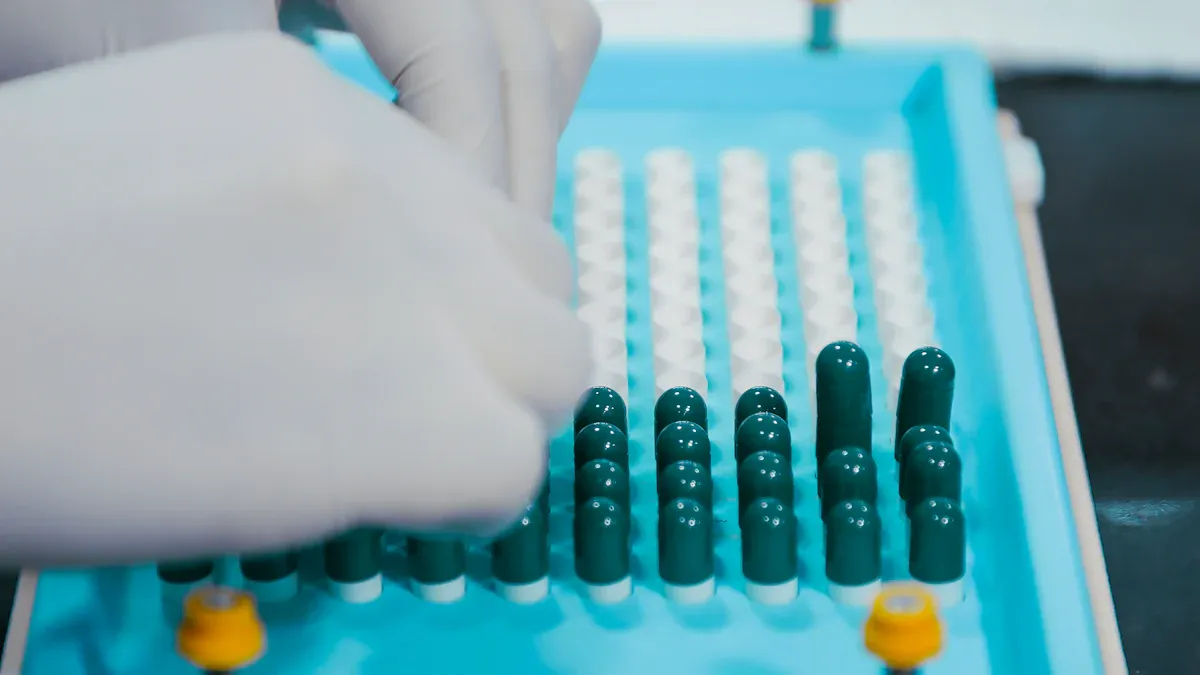
The primary advantage of an automatic capsule filler is its ability to deliver exceptional dosing and weight accuracy, a feat unattainable through manual methods. This precision is not accidental; it is the direct result of sophisticated mechanical systems designed for repeatability and control.
The Role of Precision Dosing Systems
At the heart of every automatic filler lies a precision dosing system. These mechanisms are engineered to measure and dispense an exact amount of formulation into each capsule. One of the most effective methods is the tamping pin dosing system, a technology perfected in machines like the Aligned Machinery NJP Series.
This system operates with remarkable consistency:
- A dosing disc with precision-engineered bores rotates under a powder bed.
- The bores fill with the formulation.
- A series of tamping pins repeatedly compress the powder inside the bores, forming a compact, semi-solid "slug."
- This slug is then cleanly ejected into an empty capsule body.
The accuracy of this process is exceptional. Manufacturers achieve the precise target fill weight by adjusting the dosing disc's thickness and the tamping pins' compression depth. This method is highly effective for consolidating powders and ensures an industry-leading low standard deviation in capsule weight.
Another common mechanism is the dosator nozzle system. This technology performs filling on a volumetric basis. A specialized nozzle dips into a powder bed, and a vacuum pulls the formulation into a dosing chamber of a specific size. The nozzle then retracts and ejects the powder into the capsule. The precision here depends heavily on the nozzle's diameter and the physical properties of the powder.
Guaranteeing Product and Dosage Uniformity
Precision dosing directly translates to superior product uniformity. Every capsule leaving the machine contains the correct amount of active ingredient, ensuring both safety and efficacy. This consistency is essential for meeting the strict standards set by global pharmacopoeias.
Regulatory bodies like the United States Pharmacopeia (USP) require manufacturers to perform either a Weight Variation (WV) or Content Uniformity (CU) test. The WV test is typically permitted only when the active drug substance is 25 mg or more and makes up at least 25% of the total fill weight. Otherwise, the more rigorous CU test is mandatory.
An advanced Auto Capsule Filler ensures products consistently pass these tests. The mechanical precision minimizes deviations, keeping capsule weights well within the accepted limits.
| Pharmacopoeia | Capsule Weight | Permissible Deviation |
|---|---|---|
| USP / BP / IP | Less than or equal to 300 mg | ±10% |
| USP / BP / IP | Greater than 300 mg | ±7.5% |
General acceptance criteria state that no more than two capsules from a sample can fall outside these limits, and none can deviate by more than double the percentage.
This level of control is especially critical for low-dose formulations, where even minor variations can have significant consequences. Success with low-dose products depends on factors like API particle size and the selection of excipients that prevent segregation.
A case study illustrates this perfectly. A pharmaceutical company faced a quality control issue where capsules contained too little API after a change in the drug's particle size. By using an automatic capsule filler, they conducted a study and discovered the issue. They found that adjusting machine parameters—specifically lowering the powder bed height and optimizing the machine speed—prevented API loss and restored content uniformity. This demonstrates how an automated system provides the control needed to solve complex formulation challenges.
How an Auto Capsule Filler Standardizes Operations

Beyond dosing accuracy, an automatic capsule filler brings standardization to the entire production floor. It transforms a variable, operator-dependent workflow into a consistent, measurable, and highly efficient process. This standardization is the key to unlocking continuous output and predictable growth.
Maintaining Continuous High-Speed Output
Manual and semi-automatic filling speeds are limited by operator skill and fatigue. An automatic system operates at a relentless, consistent pace, hour after hour. This mechanical endurance allows manufacturers to achieve production volumes that are simply impossible with manual intervention. High-speed machines can produce an enormous number of capsules, ensuring production targets are met consistently.
| Equipment Class | Output (capsules/hour) |
|---|---|
| High-Speed | 150,000–180,000 |
| Ultra-High-Speed | 200,000+ |
However, raw speed is only part of the equation. True operational excellence comes from continuous high-speed output, which requires minimizing downtime. Advanced machines like the Aligned Machinery NJP Series are engineered for reliability and uptime. They incorporate specific features designed to keep the production line moving.
Key Features for Minimizing Downtime ⚙️
- Robust Components: The main motor, indexing drives, and vacuum pump are built for durability and long-term performance.
- Stable Construction: A solid steel frame provides stability, allowing for smooth operation even at maximum speed and reducing mechanical wear.
- Advanced Controls: An intuitive touch screen with alarm history and remote access capabilities enables faster troubleshooting, reducing the time needed to resolve issues.
- Efficient Changeovers: Modular designs and quick-release parts facilitate rapid changeovers between different capsule sizes or product formulations.
- Simplified Maintenance: Using off-the-shelf, interchangeable components for control panels ensures that replacement parts are readily available, preventing extended shutdowns.
These design elements work together to maximize machine availability. The sealed workstation turntable on the NJP Series, for example, prevents powder contamination that could otherwise cause operational stops for cleaning. This focus on robust engineering ensures the machine’s high-speed potential translates directly into real-world, continuous output.
Enabling Predictable and Scalable Production
Standardized, high-speed operation makes manufacturing schedules predictable. When a machine reliably produces a set number of capsules per hour, production managers can forecast output with confidence. This stability is essential for meeting deadlines, managing inventory, and planning resource allocation. An Auto Capsule Filler provides the process control needed for this level of predictability, moving operations away from the variability of operator-dependent methods.
Understanding what makes production truly predictable involves looking beyond peak mechanical speed.
| Parameter | What It Means for Production | Why It Matters for Predictability |
|---|---|---|
| Machine Capacity | The number of saleable capsules produced over time. | This figure accounts for rejects and stops, giving a realistic measure of stable output for accurate scheduling. |
| Dosing Accuracy | How consistently the fill weight remains within specification. | Consistent accuracy prevents batch failures and rework, which are major sources of unpredictability. |
| Changeover Time | The time required to switch products or capsule sizes. | Fast, repeatable changeovers are crucial for maintaining a predictable schedule in multi-product facilities. |
This predictability also lays the foundation for scalability. As a business grows, its production needs increase. Automation provides a clear path to scale capacity without a proportional increase in labor or facility space. A company can transition from a semi-automatic process to a fully automatic one to meet rising demand.
| Feature | Semi-Automatic Machine | Fully Automatic Machine |
|---|---|---|
| Production Capacity | 5,000–20,000 capsules/hour | 30,000–200,000+ capsules/hour |
| Labor Requirements | 1–2 operators | Minimal human intervention |
This scalability allows businesses to invest according to their growth. A startup might begin with a smaller model like the NJP-200, capable of 12,000 capsules per hour. As demand surges, they can upgrade to a high-capacity model like the NJP-3500, which produces up to 210,000 capsules per hour. This ability to scale with a proven technology platform empowers companies to respond to market opportunities effectively, transforming production from a bottleneck into a driver of growth.
Eliminate Inconsistencies Caused by Human Error
Manual and semi-automatic filling processes depend heavily on operator skill and attention. This human element introduces significant variability. Common errors include misaligned capsules, powder leakage from improper handling, and inconsistent tamping. Such issues directly compromise product quality. Automation systematically removes these operator-dependent variables, replacing human intervention with mechanical precision and creating a more reliable production environment.
Leveraging Automated Quality Control
Modern automatic fillers integrate sophisticated quality control systems that operate in real-time. These machines go beyond simple filling to actively inspect and validate each capsule. An online sample weight checker, for instance, provides immediate feedback on dosing accuracy. Advanced systems feature integrated checkweighers that perform 100% weight verification.
How Automated Checkweighers Work ⚖️
- Capsules are fed onto a high-precision weighing conveyor.
- A load cell captures each capsule's weight in milliseconds.
- The system compares the weight against preset tolerances.
- An air-blast or mechanical pusher automatically ejects any non-compliant capsule.
This process guarantees that only capsules meeting strict weight specifications continue down the line. Furthermore, machines like the Aligned Machinery NJP Series include a capsule kicking device to remove defective units. Many systems also incorporate advanced vision inspection, using high-resolution cameras and AI to detect cosmetic flaws such as cracks, breakage, or surface imperfections.
Boosting Yield and Minimizing Material Waste
Eliminating human error directly translates to higher production yields and significant material savings. Manual filling is slow, producing only a few hundred capsules per hour, while automated systems can produce over 200,000. This massive increase in output means more saleable products are made in less time.
Precision also drastically reduces material waste. The tamping-pin dosing method and sealed turntables prevent powder spillage and ensure every microgram of formulation ends up inside a capsule. This efficiency delivers a powerful return on investment. Case studies show the financial impact is substantial:
- One manufacturer saved $9,700 per million capsules.
- Another company reduced its annual material costs by $330,000.
By maximizing the number of accepted capsules and minimizing the loss of expensive active ingredients, an automatic capsule filler boosts both productivity and profitability.
Ensure Consistent Handling of Formulations
A machine's ability to consistently handle different formulations is crucial for reliable production. The physical properties of a powder—such as its flowability, particle size, and compressibility—can vary significantly. An automatic capsule filler is engineered to manage this variability, ensuring consistent performance regardless of the material.
Optimizing Powder Flow and Density
Accurate dosing depends on maintaining a uniform powder bed density. Good powder flow properties are essential for achieving this. Advanced machines control flowability and compressibility through precise, repeatable mechanical actions. The Aligned Machinery NJP Series, for example, uses a sophisticated powder filling device to ensure consistency.
Key components work together to manage the powder bed:
- A hopper and stirrer maintain a steady supply.
- A powder level sensing device ensures the powder tub remains at an optimal height.
- A three-dimensional chassis adjustment system minimizes powder leakage and maintains uniform gaps for consistent dosing.
These mechanisms create a stable environment where the formulation is handled predictably. This control prevents segregation and ensures that each dosing station receives material with uniform density, which is fundamental for achieving accurate fill weights.
Delivering Reliable Performance Across Materials
Modern manufacturing requires versatility. Automatic capsule fillers are intricately designed machines capable of filling capsules with powders, pellets, liquids, or microtablets. The machine meticulously controls the filling stage to ensure each capsule receives the exact amount of the desired substance. This precision is vital for maintaining product integrity.
The NJP Series demonstrates this adaptability. It can be configured with different filling systems to handle a wide range of materials.
- Tamping Pin Filling: This method is ideal for most powders, compacting the material into a slug for precise dosing.
- Pellet Filling: Specialized stations can be integrated to dose pellets or micro-tablets accurately.
- Liquid Filling: The machine can also be equipped with liquid filling pumps and nozzles for oil-based or other liquid formulations.
This ability to switch between different filling techniques allows manufacturers to produce a diverse portfolio of products on a single platform. It guarantees reliable performance and consistent quality across all material types.
An automatic capsule filler is the key to overcoming production inconsistencies. It solves issues at the source by automating dosing, standardizing operational speed, and removing the variable of human error. This equipment ensures consistent material handling and implements automated quality checks, guaranteeing a reliable, high-quality output. Integrating an Auto Capsule Filler transforms a production line from variable to predictable. The resulting cost savings and increased capacity deliver a strong return on investment, making an Auto Capsule Filler a consistent, efficient, and profitable asset for any manufacturer.
FAQ
How does an auto filler handle different capsule sizes?
Automatic capsule fillers provide excellent versatility. Machines like the Aligned Machinery NJP Series use modular, quick-release parts. This design allows operators to rapidly change tooling. A single machine can efficiently fill a wide range of capsule sizes, from 00# down to 5#, to meet diverse product requirements.
What makes the NJP Series reliable for continuous operation?
The NJP Series achieves reliability through superior engineering. Its sealed workstation turntable prevents powder contamination, a common cause of downtime. A robust frame and durable components ensure stable, high-speed performance, maximizing machine availability and maintaining a continuous, predictable output for manufacturers.
Can these machines handle materials other than powders?
Yes, they are highly adaptable. An automatic capsule filler can be configured to handle various formulations. With specialized stations, the machine precisely fills capsules with pellets, micro-tablets, or even liquids. This versatility allows manufacturers to produce a diverse product portfolio on a single, efficient platform.
How does automation improve product yield?
Automation directly boosts yield by minimizing waste and rejects. Precision dosing systems prevent material spillage. Integrated quality control, such as automated checkweighers, removes defective capsules in real-time. This ensures a higher percentage of saleable products and a greater return on investment.
See Also
Capsule Sorters: Essential Tools for Flawless Pharmaceutical Product Quality
Ampoule Filling Lines: Comparing Top Manufacturers for Optimal Production
Boosting Pharma Efficiency with Advanced Capsule Decapsulation Technology
Top Capsule Checkweighers for Smart Pharmaceutical Investment in 2025
Versatile Nozzle Solutions: A Guide for Diverse Industrial Applications