What Is the Magic Behind a Planetary Gearbox's Power?

The remarkable power of a planetary gearbox stems from its unique internal architecture. You can understand its strength by examining how its components work together. This design allows for an elegant and effective distribution of force, which is the key to its high torque capacity.
The Core Components: Sun, Planets, and Ring Gear
Imagine a miniature solar system. At the center, you have the sun gear. Orbiting it are several smaller planet gears. An outer ring gear (or annulus) with internal teeth meshes with these planet gears, enclosing the entire system. A carrier holds the planet gears in place, ensuring they maintain their orbit.
Fun Fact: ⚙️ The name "planetary" comes from this celestial arrangement. The sun gear is the star, and the planet gears orbit it, just like planets in our solar system!
The Power of Multiple Contact Points
Here is where the real magic happens. In a simple gear pair, the load is transferred through a single contact point. A planetary gearbox, however, divides the input load among multiple planet gears. For instance, a system with three planet gears splits the load across three distinct contact points on the sun gear and three on the ring gear.
This load-sharing principle means no single gear tooth bears the entire burden. This distribution dramatically increases the system's torque capacity and shock resistance without needing larger, heavier gears.
Key Takeaways
- Planetary gearboxes use a special design with sun, planet, and ring gears. This design shares the work among many gears.
- Sharing the work lets planetary gearboxes handle a lot of power in a small space. This makes them strong and long-lasting.
- These gearboxes are very good at saving energy and moving things exactly where they need to go. This is important for robots and machines.
How Load Sharing Creates Immense Power
The secret to the immense power of a planetary gearbox lies in its clever engineering. You can unlock this secret by understanding how its components share the workload, turning a compact device into a torque powerhouse.
The Core Components: Sun, Planets, and Ring Gear
When you look inside a planetary gearbox, you see a design that mimics a solar system. At the heart of it all is the sun gear. Several smaller planet gears orbit this central gear. These planets mesh with both the sun gear and an outer ring gear (or annulus) that has internal teeth. A planet carrier connects the planet gears, holding them in a stable orbit as they rotate.
The durability of this system depends on using the right materials for each part. Engineers select materials based on the specific stresses each gear will face.
Materials at a Glance ⚙️
Gear Component Common Material Types Purpose Sun Gear Hardened Steel, Special Alloys Withstands high rotational speeds and central load. Planet Gears High-Strength Hardened Steel Endures constant meshing and load distribution. Ring Gear Tough, Long-Lasting Steel Provides a strong, stationary outer boundary. Planet Carrier Cast Iron, Aluminum Alloys Offers a rigid frame to hold planets in alignment.
The Power of Multiple Contact Points
Here is where the design truly shines. In a standard spur gear system, only one or two teeth make contact at any given moment, bearing the entire load. A planetary system, however, is fundamentally different. It distributes the input torque across multiple planet gears simultaneously.
This load-sharing principle has profound effects on performance:
- Massive Torque Increase: A system with three planet gears can transfer three times the torque of a similarly sized spur gear setup. Adding more planets further increases this capacity.
- Reduced Stress: Because the load is shared, each individual gear tooth experiences far less stress. This distribution prevents premature wear and fatigue, significantly extending the gearbox's service life.
- Higher Stiffness: The multiple contact points increase the gearbox's torsional stiffness. This results in more precise and responsive motion control with less "play" or backlash.
The shape of the gear teeth also plays a critical role. Most modern systems use an involute tooth profile. This shape ensures smooth, rolling contact between gears, which minimizes friction and noise while maximizing efficiency.
Pro Tip: Calculating Gear Ratios You can determine the gear ratio of a simple planetary setup with a fixed ring gear using a straightforward formula. The ratio (
i) is calculated by dividing the number of teeth on the ring gear (Zr) by the number of teeth on the sun gear (Zs) and adding one.
i = 1 + (Zr / Zs)For applications needing very high reduction, designers connect multiple planetary stages in a series. A single-stage planetary gearbox might offer a 10:1 ratio, but a three-stage system can easily achieve ratios of 100:1 or more.
Ultimately, the combination of multiple contact points, robust materials, and precise geometry allows the planetary gearbox to deliver exceptional power density and reliability.
Key Benefits of a Planetary Gearbox Design

The clever engineering behind load sharing gives you several distinct advantages. These benefits make planetary gearboxes the top choice for demanding applications in robotics, automation, and advanced machinery.
High Power Density in a Compact Size
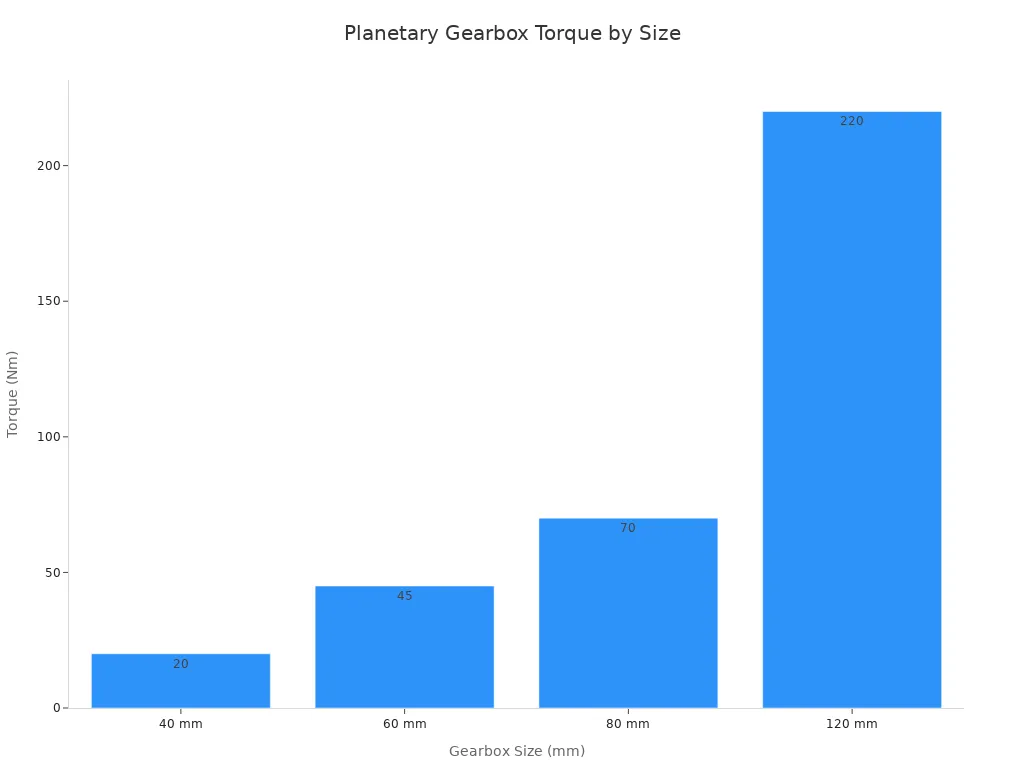
You gain a massive advantage with high power density. This means you can pack immense torque into a surprisingly small and lightweight unit. A planetary system can handle three to five times more torque than a traditional spur gear system of the same physical size. This makes it perfect for modern applications where space is a premium, such as in robotic arms or electric vehicle transmissions. As you can see below, even a small increase in gearbox size yields a significant boost in torque capacity.
Superior Efficiency and Stability
These systems are incredibly efficient. A single-stage planetary gearbox can achieve an efficiency of 95% to 98%, wasting very little energy as heat. This design also provides exceptional stability because the input and output shafts share the same centerline. This coaxial layout naturally balances the forces among the planet gears, reducing stress on bearings and extending the gearbox's operational life.
Note on Maintenance 💡 To maintain this high efficiency, proper lubrication is essential. Using the correct lubricant reduces friction, prevents wear, and helps dissipate heat, ensuring your gearbox runs smoothly for years.
High Rigidity for Precise Motion
High torsional rigidity is another key benefit. This stiffness prevents the gearbox from twisting under load, which is crucial for accurate positioning. This rigidity results in minimal backlash—the tiny gap between gear teeth. For you, this means more precise and repeatable movements. This feature is critical in applications where accuracy is everything.
- Robotic Arms: Can move to the exact same spot every time.
- CNC Machining: Ensures parts are cut to tight tolerances with a smooth finish.
- Medical Devices: Allows for steady, reliable motion during delicate procedures.
You now see the power of a planetary gearbox is not magic, but a result of clever engineering. Its design distributes force across multiple gears in a compact, coaxial layout. This delivers unmatched power density and high torque, making it a fundamental component in modern robotics, industrial automation, and advanced machinery.
FAQ
Why are planetary gearboxes more expensive?
You pay for precision engineering and more components. Their complex design requires tight manufacturing tolerances to ensure reliability and high performance, which increases the overall cost.
What happens if one planet gear fails?
The remaining planets can briefly carry the load. You get a warning before total system failure. You should inspect the unit immediately to prevent further damage. ⚙️