What are the techniques of wastewater management in hotels?
Hotels face high water usage from laundry, kitchens, and guest rooms. Effective hotel wastewater treatment methods include activated sludge, membrane bioreactors, and advanced decentralized solutions. Choosing the right system ensures compliance, efficiency, and sustainability. Innovative options, such as the Mejec Scavenger STP, offer smart, eco-friendly operation for modern hospitality needs.
Key Takeaways
Hotels can use various wastewater treatment methods like activated sludge and membrane bioreactors to improve efficiency and sustainability.
Choosing the right system helps hotels save water, reduce costs, and meet environmental regulations.
Innovative solutions like the Mejec Scavenger STP offer eco-friendly options for decentralized wastewater management.
Hotel Wastewater Treatment Techniques
Hotels generate large volumes of wastewater from guest rooms, kitchens, laundry, and public areas. Effective hotel wastewater treatment is essential for compliance, sustainability, and operational efficiency. The following techniques represent both traditional and advanced wastewater treatment solutions used globally in hotels.
Conventional Activated Sludge
The activated sludge process is a widely used biological method for hotel wastewater treatment. It uses microorganisms to break down organic matter in aeration tanks. This method is effective for removing pollutants and is suitable for medium to large hotels. The process achieves high removal rates for organic contaminants.
Technology | BOD Removal | COD Removal | TSS Removal |
|---|---|---|---|
ASP | 90-95%+ | 90-95%+ | Good |
Activated sludge systems help hotels meet strict discharge standards. They require regular monitoring and skilled operation. These systems are reliable for consistent wastewater flows.
Membrane Bioreactors
Membrane bioreactors (MBRs) combine biological treatment with membrane filtration. This advanced technology produces high-quality effluent suitable for reuse in non-potable applications. MBRs are compact and ideal for hotels with limited space.
Advantages | Disadvantages |
|---|---|
Superior Effluent Quality | Membrane Fouling |
Compact Footprint | Energy Consumption |
Reduced Sludge Production | Cost |
Water Reuse Potential |
MBRs offer nearly complete removal of suspended solids and pathogens. Hotels benefit from water reuse opportunities, which support sustainability goals.
Sequencing Batch Reactors
Sequencing batch reactors (SBRs) treat hotel wastewater in timed cycles. The process includes filling, aeration, settling, decanting, and idle phases. SBRs are flexible and adapt to changing wastewater volumes, making them suitable for hotels with fluctuating occupancy.
SBRs produce high-quality effluent.
They have a compact footprint and are energy-efficient.
These systems generate less sludge, reducing disposal costs.
Technology | BOD Removal | COD Removal | TSS Removal |
|---|---|---|---|
SBR | 90-98% | 95-99% | Excellent |
A study in a luxury hotel showed that optimizing SBR configuration can handle seasonal changes in wastewater flow. SBRs are a reliable choice for hotels seeking efficient and adaptable wastewater treatment systems.
Constructed Wetlands
Constructed wetlands use natural processes involving plants, soil, and microorganisms to treat hotel wastewater. These systems are cost-effective and environmentally friendly.
Simple construction and low operational costs.
No excess sludge removal required.
High pathogen removal efficiency.
Aesthetic appeal and support for biodiversity.
Parameter | Average Removal Rate |
|---|---|
BOD5 | 80% |
COD | 66% |
TSS | 72% |
Constructed wetlands are suitable for hotels in rural or scenic locations. They provide long-term savings and enhance the landscape.
Advanced Oxidation
Advanced oxidation processes (AOPs) use powerful oxidants like ozone to break down organic pollutants in hotel wastewater. These methods are effective for removing surfactants and other contaminants from laundry and kitchen operations. Hydroxyl radicals produced during AOPs decompose pollutants into harmless byproducts such as carbon dioxide and water. This process also eliminates pathogens without transferring pollution to another phase.
On-site Package Plants
On-site package plants are compact, modular wastewater treatment solutions designed for hotels, resorts, and villas. These systems are prefabricated and require minimal land and civil work.
Feature | Description |
|---|---|
Compact Design | Minimal land area needed |
Low Civil Work | Off-site fabrication reduces construction time and cost |
Modular and Expandable | Capacity can be increased by adding modules |
Energy Efficiency | Low-energy systems minimize power consumption |
Ease of Operation | Automated systems need minimal intervention |
Mobility | Portable versions for temporary projects |
Reuse Opportunities | Treated water can be reused for irrigation |
On-site package plants are ideal for decentralized hotel wastewater treatment, especially in remote or eco-sensitive areas. The Mejec Scavenger Household Sewage Treatment Plant is a leading example. It treats both black and grey water, including kitchen and toilet waste, using the MHAT+ contact oxidation process. The system operates with low energy consumption and integrates solar power, making it suitable for villas, hostels, and scenic spots. Treated water can be reused for irrigation or toilet flushing, supporting sustainable hotel operations.
Filtration and Disinfection
Filtration and disinfection are critical steps in hotel wastewater treatment. Filtration removes suspended solids, while disinfection eliminates harmful microorganisms. Common methods include ultrafiltration, UV disinfection, and chemical disinfection.
Ultrafiltration removes fine particles and microbiological contaminants.
UV disinfection uses light to destroy pathogens without chemicals.
Chemical disinfection maintains residual protection in treated water.
Pathogen | Log Reduction |
|---|---|
Escherichia coli | >7.1 |
Salmonella enterica | >8.0 |
Pseudomonas aeruginosa | >7.4 |
MS2 bacteriophage | 3.8 |
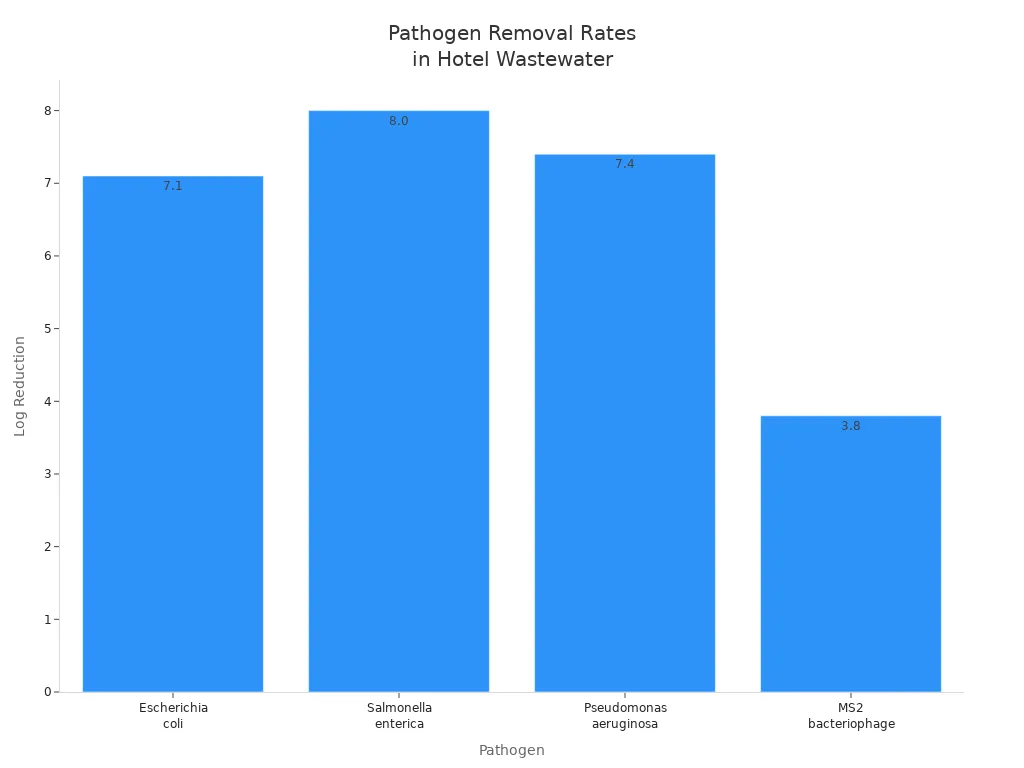
These methods ensure that treated water is safe for reuse in landscaping or toilet flushing.
Greywater Recycling
Greywater recycling captures water from showers, baths, and sinks for reuse in non-potable applications. This practice can save up to 40% of hotel water usage and reduce reliance on freshwater resources.
Greywater recycling captures the water used for showering or bathing and, after treatment, is reused for non-potable purposes such as flushing toilets and irrigation. This can save as much as 40% in water usage.
Benefit | Percentage Savings |
|---|---|
Mains water consumption reduction | Up to 30% |
Greywater recycling savings | Up to 40% |
Hotels that implement greywater recycling lower their water bills and enhance their reputation for sustainability. Advanced treatment technologies ensure that recycled water meets safety standards.
Effluent Treatment Plants (ETPs)
Effluent treatment plants (ETPs) are comprehensive systems that treat all types of hotel wastewater. ETPs use a series of processes to remove solids, organic matter, and pathogens.
Stage | Description |
|---|---|
Preliminary Treatment | Removal of large particles like plastics and stones to prevent equipment damage in later stages. |
Primary Treatment | Settling of wastewater in tanks to reduce suspended solids by forming sludge and floating substances. |
Secondary Treatment | Biological treatment using microorganisms to break down organic matter, reducing BOD and COD levels. |
Tertiary Treatment | Advanced processes to remove remaining impurities, enhancing water quality for reuse or safe discharge. |
Sludge Treatment | Further treatment of collected sludge to reduce volume and toxicity for easier disposal. |
ETPs help hotels comply with local discharge standards and support water reuse initiatives. These systems are suitable for large hotels with high wastewater volumes.
Summary Table: Main Hotel Wastewater Treatment Stages
Treatment Type | Description |
|---|---|
Primary Treatment | Removal of large solids through screening and sedimentation to prevent blockages. |
Secondary Treatment | Biological degradation of organic matter using methods like activated sludge processes. |
Tertiary Treatment | Advanced filtration techniques to remove remaining contaminants for safe reuse in non-potable applications. |
Disinfection | Eliminates harmful microorganisms using methods like chlorination, UV disinfection, and ozone treatment. |
Modern hotel wastewater treatment solutions, such as the Mejec Scavenger Household Sewage Treatment Plant, offer smart operation, low energy use, and solar integration. These features make them ideal for decentralized locations and eco-conscious hotels. By selecting the right wastewater management solutions, hotels can achieve compliance, efficiency, and sustainability.
Choosing Wastewater Management Solutions for Hotels
Assessing Hotel Size and Wastewater Volume
Hotel size and daily wastewater volume play a major role in selecting the right wastewater management approach. Larger hotels, especially those in remote areas, often need their own treatment systems to handle the high volume of wastewater they generate. Smaller hotels usually connect to municipal wastewater facilities, but they must still meet pre-treatment standards before discharge. Managers should monitor daily average wastewater volume and track changes during peak and off-peak seasons. This helps ensure that the chosen system can handle fluctuations and maintain effective wastewater management throughout the year.
Local Regulations and Compliance
Every hotel must comply with local and national environmental regulations. These rules set standards for how wastewater is treated and discharged. Non-compliance can lead to fines and damage a hotel’s reputation. Meeting strict environmental protection regulations also appeals to guests who value sustainability. Hotel managers should check local laws and ensure their wastewater management systems meet all requirements, especially during busy tourist seasons when water use and wastewater production increase.
Space and Location Constraints
Space and location often limit the types of wastewater management systems a hotel can use. Urban hotels face limited physical space, so they need compact treatment solutions. For example:
Hotels in cities may need to install treatment plants in basements or small service areas.
The Leela Palace Hotel installed its sewage treatment plant underground due to space constraints, which made it impossible to use large traditional systems.
Odor issues from basement plants can affect guest experience, showing the importance of choosing the right technology for the available space.
Decentralized systems like the Mejec Scavenger STP are ideal for hotels with limited space or those located in villas, hostels, and scenic spots. The compact design allows installation in small areas, and the system operates quietly with low energy use.
Environmental Impact
Hotels must consider the environmental impact of their wastewater management choices. Integrating circular economy principles into wastewater management supports sustainable practices. Many regions, such as the Caribbean, face serious pollution problems because 70-80% of wastewater is discharged untreated or only partially treated. This pollutes groundwater, freshwater, and oceans, causing harm to the environment and local communities.
Treating wastewater for reuse on-site reduces overall water consumption and supports sustainability. Decentralized systems can recover resources, such as water for irrigation, and help manage water scarcity. Advanced wastewater treatment technologies, like the Mejec Scavenger STP, allow hotels to reclaim water for gardens and toilets, reducing their environmental footprint and supporting efficient water resource management.
Step-by-Step Selection Guide
Choosing the best wastewater management solution for your hotel involves several key steps:
Assess your hotel’s water consumption and calculate the daily average wastewater volume.
Monitor how wastewater discharge changes during peak and off-peak seasons.
Understand all local and national environmental regulations that apply to your hotel.
Make sure the treatment system can meet required effluent standards, even during busy periods.
Install a grease trap to prevent oil and grease from clogging the treatment plant.
Compare different technologies based on cost, compliance, and efficiency.
Consult with wastewater management experts to find the most suitable solution.
Consider decentralized systems like the Mejec Scavenger STP for small, remote, or eco-conscious hotels. This system treats both kitchen and toilet wastewater, operates with solar energy, and produces water safe for irrigation or toilet flushing.
Train staff to operate and maintain the system properly.
Include greywater recycling as part of your overall strategy to save water and reduce costs.
Tip: Combining effective wastewater management with greywater recycling can help hotels lower water bills, improve efficiency, and enhance their reputation for sustainability.
Step | Action | Benefit |
|---|---|---|
1 | Assess water use and wastewater volume | Right-size your system |
2 | Monitor seasonal fluctuations | Ensure year-round performance |
3 | Check regulations | Avoid fines and protect reputation |
4 | Meet effluent standards | Protect environment and comply with law |
5 | Install grease trap | Prevent system blockages |
6 | Compare technologies | Find best fit for your hotel |
7 | Consult experts | Get professional advice |
8 | Consider decentralized solutions | Ideal for small or remote hotels |
9 | Train staff | Maintain system efficiency |
10 | Add greywater recycling | Save water and reduce costs |
Hotels that follow these steps can achieve effective wastewater management, meet all legal requirements, and support long-term sustainability.
Mejec Household Sewage Treatment Plant
suitable for decentralised wastewater treatment scenarios
The Mejec Scavenger Household Sewage Treatment Plant offers a modern solution for hotels in remote or eco-sensitive areas. This system handles both kitchen and toilet waste, also known as black and ash water. It uses advanced MHAT+ contact oxidation technology for effective treatment. Hotels in villas, hostels, and scenic spots benefit from its compact design and quiet operation.
Key features include:
Dual Waste Handling: The plant treats all wastewater from kitchens, bathrooms, and cleaning areas. This ensures complete treatment and safe discharge.
Decentralized Suitability: Its small size fits locations with limited space. Hotels in rural or scenic areas can install the system without major construction.
Solar Energy Integration: The plant uses solar power for low energy consumption. This feature supports reliable operation even in areas with unstable electricity.
Water Reuse: Treated water meets local standards for irrigation and toilet flushing. Hotels can reduce freshwater use and support sustainability goals.
Feature | Benefit |
|---|---|
Treats all hotel waste | Complete and safe wastewater treatment |
Compact and quiet | Fits small or remote hotel locations |
Solar energy powered | Low energy costs and eco-friendly |
Water reuse capability | Supports irrigation and toilet flushing |
Note: Choosing the Mejec system helps hotels meet environmental standards and improve resource efficiency.
The Mejec Scavenger Household Sewage Treatment Plant stands out as an innovative and practical choice for decentralized hotel wastewater management.
Hotels can choose from many wastewater management solutions to improve efficiency and sustainability.
Matching the right system supports water conservation, guest experience, and sustainable hotel operations.
Innovative options like Mejec help with water conservation, efficiency, and sustainability.
Evaluate your needs and consult experts to support water conservation and sustainability.
FAQ
Can hotels use greywater recycling to reduce water consumption?
Hotels can use greywater recycling to treat water from showers and sinks. This process saves water, lowers costs, and supports sustainable wastewater management.
How does solar energy integration improve wastewater management systems in hotels?
Solar energy integration allows wastewater management systems to operate with low energy use. Hotels benefit from reduced electricity costs and reliable operation, especially in remote areas.
Is the Mejec Scavenger suitable for decentralized wastewater management in hotels?
The Mejec Scavenger treats kitchen and toilet wastewater together. Its compact design fits villas, hostels, and scenic spots, making it ideal for decentralized wastewater management.