Corrosion Protection in 2025 Why Hot-Dip Galvanizing Still Leads
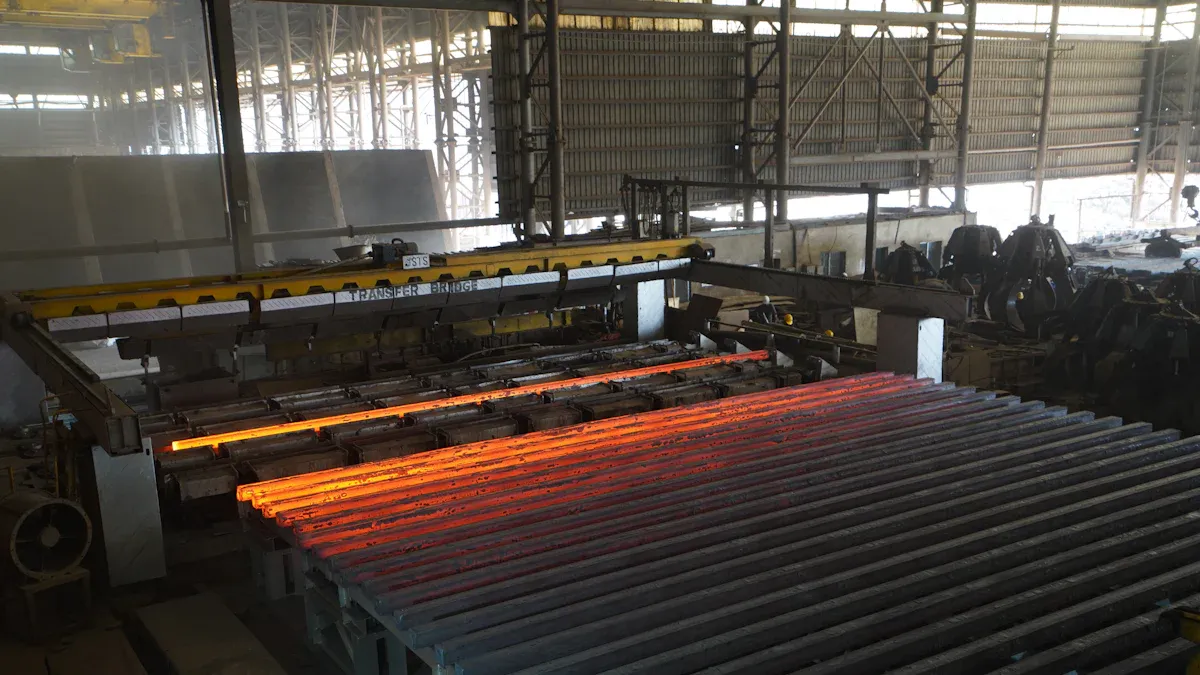
Hot-Dip Galvanizing (HDG) delivers superior long-term value for steel projects. Its unique metallurgical bond provides unmatched durability against damage. The immersion process ensures complete, uniform coverage that spray-on methods cannot replicate. This dual protection significantly lowers lifecycle maintenance costs.
The global galvanizing market is projected to reach $68.89 billion in 2025. A galvanizing equipment manufacturer builds advanced galvanizing lines to meet this growing demand.
Key Takeaways
- Hot-dip galvanizing makes steel very strong. It creates a special bond that protects steel better than paint.
- Galvanizing covers all parts of the steel. This stops rust from starting in hidden spots.
- Galvanized steel saves money over time. It lasts a long time and needs less repair than other coatings.
What Makes Hot-Dip Galvanizing the Superior Choice?
Hot-Dip Galvanizing (HDG) stands apart from other corrosion protection methods. Its superiority comes from three core strengths: a fused metallurgical bond, complete immersion coverage, and a dual-action protective system. These features work together to deliver unmatched performance and long-term value.
Unmatched Durability Through a Metallurgical Bond
Paint and other coatings simply stick to the surface of steel. Hot-dip galvanizing creates a finish that becomes part of the steel itself. The process involves immersing a steel part in molten zinc heated to approximately 450°C (842°F). This high temperature triggers a diffusion reaction, fusing the zinc and iron together.
This process forms a series of distinct zinc-iron alloy layers. These layers are metallurgically bonded to the steel substrate.
- Gamma Layer: Closest to the steel, with about 75% zinc.
- Delta Layer: The next layer out, with about 90% zinc.
- Zeta Layer: A thick layer containing approximately 94% zinc.
- Eta Layer: The pure zinc outer layer that gives the coating its initial bright finish.
These interlocked layers are actually harder than the base steel, providing exceptional resistance to abrasion and damage. The tough inner layers resist scratches, while the more ductile pure zinc outer layer can absorb impacts. This metallurgical bond is significantly stronger than the mechanical bonds of other coatings.
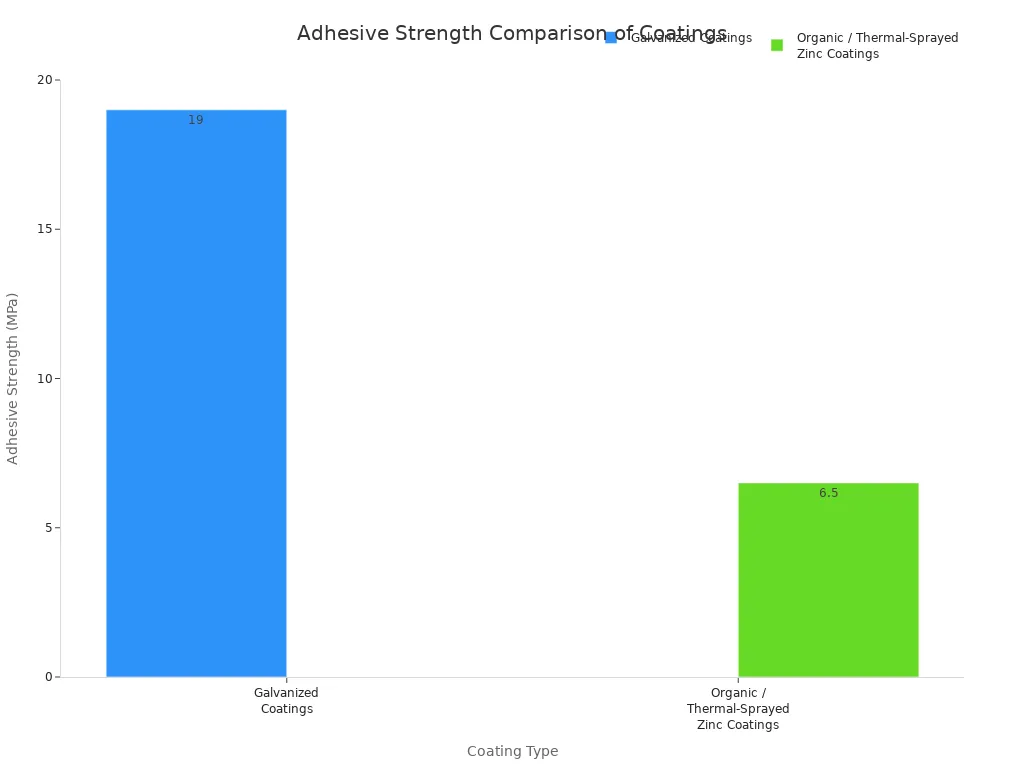
| Coating Type | Bond Strength (psi) |
|---|---|
| Hot-Dip Galvanized | ~3,600 |
| Other Coatings | 300-600 |
This immense bond strength means the galvanized coating is extremely difficult to peel or chip. It reliably withstands the rigors of transportation, handling, and on-site construction.
Complete Coverage for Total Protection
Corrosion finds the weakest point. Spray-on paints, primers, and other coatings are vulnerable to application errors like drips, runs, or missed spots. These small imperfections become initiation points for rust.
Hot-dip galvanizing eliminates this risk through total immersion. Dipping the entire steel fabrication into molten zinc guarantees complete coverage. The liquid zinc flows into, over, and around all surfaces.
Every corner, edge, seam, and internal hollow section receives a uniform layer of protection. This "edge-to-edge" coverage ensures there are no unshielded areas left exposed to the environment.
This comprehensive protection is not just a best practice; it is a requirement. Global standards mandate this level of quality to ensure performance.
- ASTM A123 requires the galvanized finish to be continuous, smooth, and uniform, with no uncoated areas.
- ASTM A153 sets similar rules for hardware, demanding a complete and adherent finish.
- ISO 1461 is the international standard ensuring fabricated steel articles receive full, uniform coverage.
This process guarantees a consistent protective barrier across the entire structure, a feat that manual spray or brush applications cannot replicate.
Dual Action: Barrier and Sacrificial Protection
A galvanized coating protects steel in two powerful ways.
First, it acts as a barrier coating. The zinc layers seal the steel from contact with moisture and oxygen. Zinc itself is highly resilient. In most atmospheric environments, zinc corrodes at a rate 10 to 30 times slower than steel. This slow corrosion rate provides a long-lasting physical shield.
Second, it provides sacrificial protection. Zinc is more electrochemically active than steel. If the coating is damaged by a deep scratch or drill hole, the zinc will corrode first, "sacrificing" itself to protect the exposed steel. This cathodic protection prevents rust from creeping under the coating and can protect bare spots up to ¼ inch in diameter. The zinc essentially acts as a bodyguard for the steel, ensuring that even if the barrier is breached, the structure remains safe from corrosion. This self-healing property is a unique advantage of galvanizing.
The HDG Process: A Mark of Quality
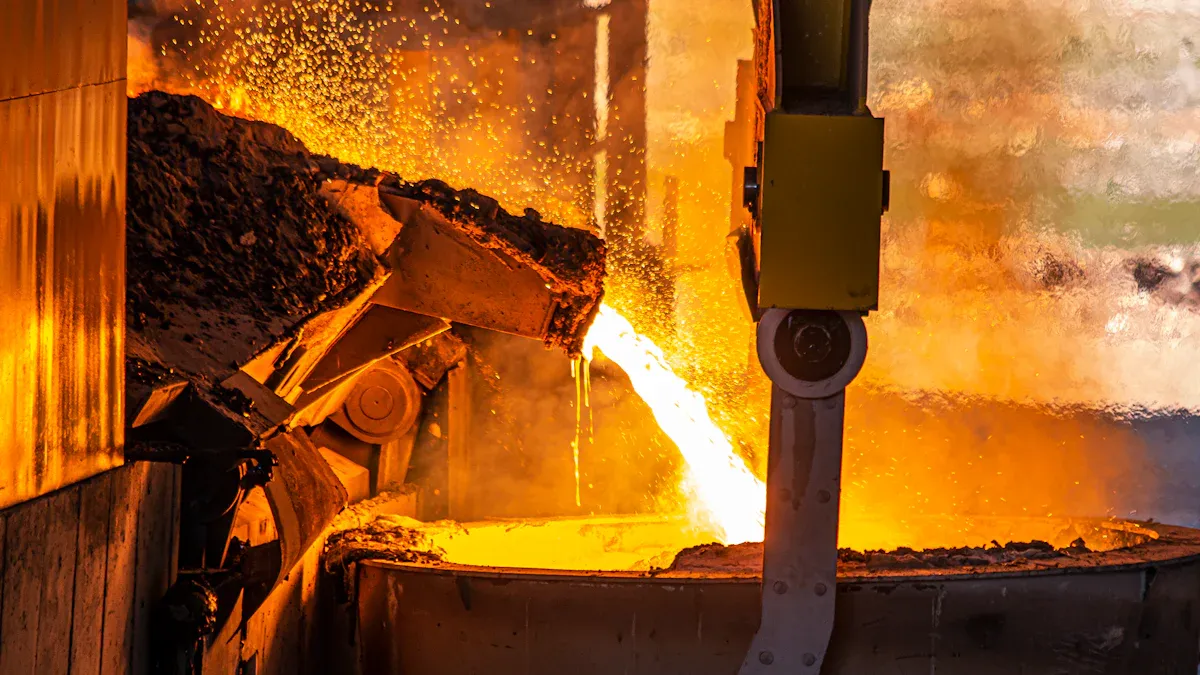
The exceptional quality of a hot-dip galvanized coating is not an accident. It results from a precise, multi-stage process that guarantees a superior finish. This process begins long before the steel ever touches molten zinc.
From Surface Preparation to Molten Zinc Dip
Proper surface preparation is the most critical factor for a successful coating. The steel must be perfectly clean for the metallurgical reaction to occur. The process involves three key steps:
- Degreasing: A hot alkali solution removes organic contaminants like dirt, grease, and oil from the steel.
- Pickling: The steel is dipped into a dilute acid bath to remove mill scale and rust.
- Fluxing: A final dip in a zinc ammonium chloride solution removes any last oxides and applies a protective layer to prevent new rust from forming before galvanizing.
Only after this rigorous cleaning is the steel immersed in a molten zinc bath, typically heated to around 450°C (842°F).
The Role of a Galvanizing Equipment Manufacturer
The quality of the entire process depends on the machinery. A professional galvanizing equipment manufacturer designs and builds the advanced lines that make modern HDG possible. Today, a leading galvanizing equipment manufacturer incorporates automation and real-time sensors for precise control. This ensures every step, from chemical cleaning to temperature management, is optimized. Furthermore, a responsible galvanizing equipment manufacturer engineers systems that meet strict environmental and safety standards, often including closed-loop systems to handle waste. The expertise of the galvanizing equipment manufacturer is essential for consistent, high-quality results.
How Coating Thickness Ensures Longevity
The controlled process, managed by systems from a top-tier galvanizing equipment manufacturer, directly impacts the final coating thickness. This thickness is a key predictor of the steel's service life. A thicker, more uniform zinc coating provides a longer period of both barrier and sacrificial protection. Industry standards specify minimum coating thicknesses based on the steel's type and size, ensuring it can withstand its intended environment for decades with minimal maintenance.
HDG vs. Alternatives: A 2025 Performance Comparison
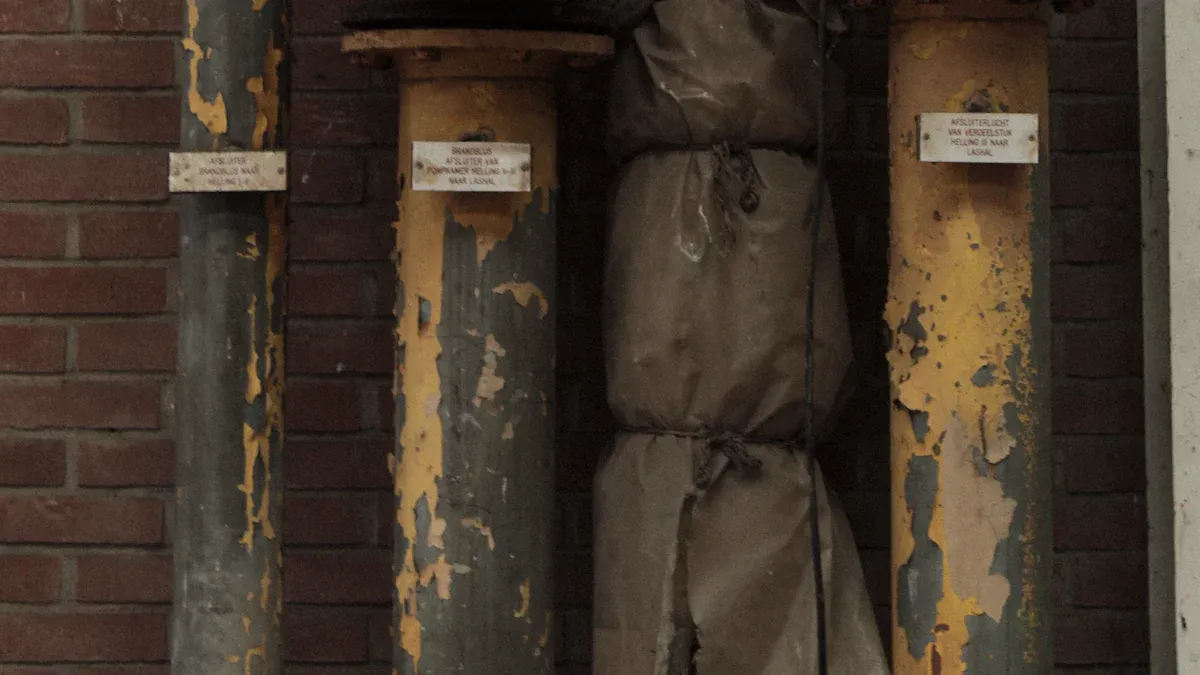
Choosing a corrosion protection system requires a careful look at performance, durability, and long-term cost. While many alternatives exist, hot-dip galvanizing consistently proves its superiority when compared directly against paints, epoxies, and primers.
Against Paint and Epoxy Coatings
Paint and epoxy coatings are surface films. They create a protective layer but do not chemically bond with the steel. This fundamental difference leads to major performance gaps.
Epoxy coatings are especially prone to failure. They can crack and peel, exposing the steel underneath. Once the barrier is broken, corrosion can spread rapidly. The New York State Thruway Authority learned this firsthand. They initially used epoxy-coated rebar for road repairs, but the coatings cracked quickly. This led to fast deterioration of the roads. After switching to galvanized rebar for a bridge repair, the results were so impressive that they now use galvanized materials for their projects.
The limitations of epoxy coatings become clear when comparing them to HDG.
| Feature | Epoxy Coatings | Hot-Dip Galvanizing |
|---|---|---|
| Bonding | Forms a film on the surface; no chemical bond. | Creates a chemical, metallurgical bond with the steel. |
| Failure Mechanism | Prone to cracking and peeling, which allows rust to spread. | Self-healing properties protect scratches and prevent rust creep. |
| Durability | Can crack easily during transport and installation. | Extremely durable alloy layers resist abrasion and impact. |
| Repair | No self-repair ability. Damaged areas must be manually fixed. | Automatically protects small damaged areas through sacrificial action. |
Application and storage also present significant challenges for epoxy coatings.
- Damage Risk: Epoxy is fragile. Scratches during transport or installation can create weak points for corrosion.
- UV Sensitivity: Epoxy-coated steel requires special tarps for outdoor storage. It must stay covered to prevent damage from sunlight.
- Adhesion Loss: The coating's bond to the steel can weaken over time, even in storage.
- Marine Environments: In coastal areas, epoxy coatings can perform worse than bare steel. Salt and moisture easily exploit any small defect in the coating.
In coastal environments, HDG shows its resilience. Even in areas with direct salty winds, galvanized steel can last 5-7 years before needing first maintenance. Sheltered areas on the same structure can remain protected for an additional 15-25 years.
Against Zinc-Rich Primers
Zinc-rich primers are often presented as a liquid alternative to galvanizing. These primers contain a high percentage of zinc dust mixed into a paint binder. The zinc particles provide sacrificial protection, but the system relies on a mechanical bond, much like regular paint.
Hot-dip galvanizing, in contrast, creates its protective layers through a diffusion reaction at high temperatures. This forms true zinc-iron alloys that are fused to the steel. A zinc-rich primer simply sticks to the surface. This difference in bonding is the key to HDG's superior performance.
| Feature | Hot-Dip Galvanizing | Zinc-Rich Primer |
|---|---|---|
| Mechanism | Metallurgical bond creates durable zinc-iron alloy layers. | Zinc dust in a binder provides sacrificial protection. |
| Adhesion | Fused to the steel with a bond strength of ~3,600 psi. | Mechanical bond relies on surface cleanliness; much weaker. |
| Durability | Extremely hard alloy layers resist abrasion and impact. | Softer paint-like coating can be easily scratched or chipped. |
| Suitability | Ideal for structural steel in harsh, long-life applications. | Best for touch-ups or when HDG is not possible. |
While zinc-rich primers offer good protection, they cannot match the toughness and longevity of a true galvanized coating. The primer's effectiveness depends entirely on perfect surface preparation and application, and it remains vulnerable to scratches and physical damage.
Addressing Common Criticisms of HDG
A common misconception about hot-dip galvanizing is its initial cost. In the past, HDG was sometimes seen as a more expensive option upfront. However, that is no longer the case in 2025.
Due to stable zinc prices and more efficient processes, HDG is now highly competitive on initial cost. When considering the total lifecycle cost, HDG is almost always the most economical choice. Other systems require frequent maintenance and reapplication, adding significant expense over the project's life.
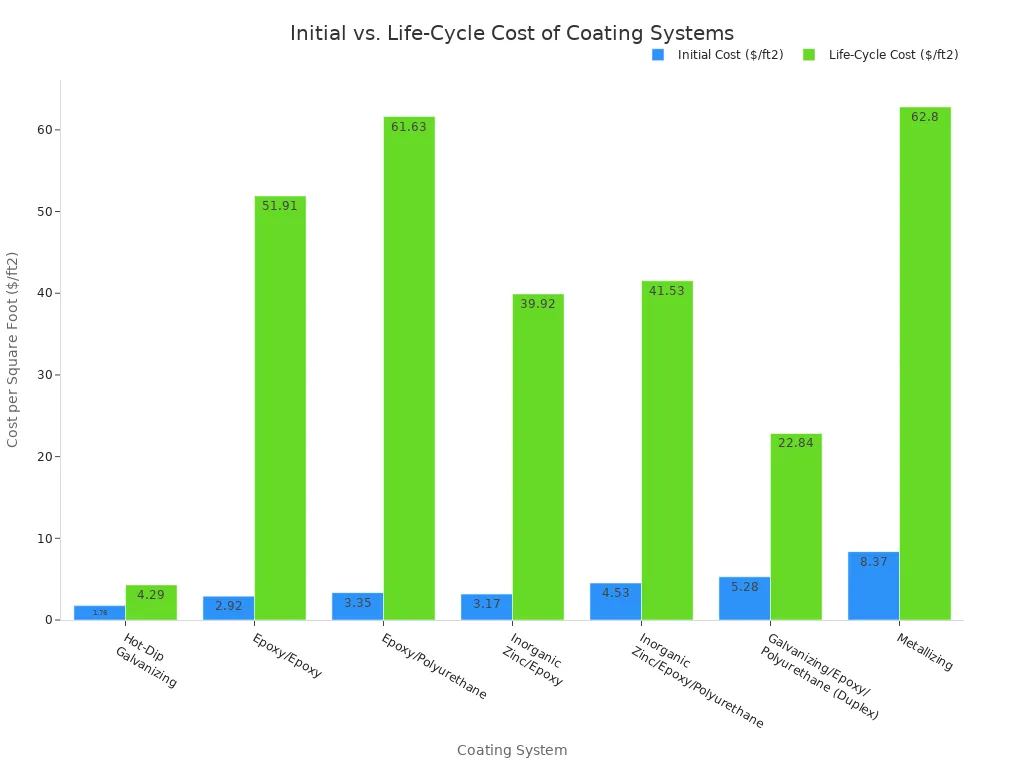
The American Galvanizers Association provides a Life-Cycle Cost Calculator (LCCC) that compares HDG to over 30 other systems. The data consistently shows that HDG saves money. For example, in one study of a bridge with a 75-year design life:
- Hot-Dip Galvanizing had a lifecycle cost of $4.29 per square foot.
- An Epoxy/Polyurethane system had a lifecycle cost of $61.63 per square foot.
This massive difference comes from HDG's maintenance-free performance. A galvanized structure can often last 75 years or more without needing any major work. This makes it the smartest financial investment for long-term projects. 💡
The Long-Term Value: Why HDG is the Smartest Investment
Smart project planning looks beyond the initial price tag. It focuses on the total lifecycle cost. Hot-dip galvanizing provides exceptional long-term value by minimizing future expenses and delivering reliable performance for decades.
A Lower Lifecycle Cost Analysis
The total lifecycle cost includes the initial price, maintenance costs, and the coating's service life. While some systems have a lower initial cost, they require frequent and expensive upkeep. Inflation also makes future maintenance much more costly. A $10 repair today could cost nearly $13 in just five years with 5% inflation.
HDG's durability dramatically reduces these long-term expenses. It requires far less maintenance than alternatives like paint. This comparison shows the clear financial advantage over a project's lifespan.
| Feature | Hot-Dip Galvanizing | Painting |
|---|---|---|
| Initial Cost | Higher | Lower |
| Maintenance Cycle | 20-50+ years | 5-10 years |
| Long-term Cost | 1.5x initial cost | 6x initial cost |
| Overall Value | Higher long-term value | Lower long-term value |
This data proves that choosing HDG is a wise financial decision for any long-term asset. 💰
Proven Performance in Harsh Environments
HDG's value extends to its reliable performance in tough conditions. In high-humidity areas, galvanized steel forms a stable, protective layer called a zinc patina. This natural shield is crucial for its longevity.
HDG's performance data comes from decades of real-world field exposure. Accelerated lab tests, like the salt spray test, cannot replicate the patina formation and do not accurately predict HDG's lifespan.
Its durability also applies to soil applications. Experts can estimate the service life of buried galvanized steel. They analyze factors like soil moisture and chloride levels to predict performance. This predictability makes HDG a trusted choice for infrastructure projects in any environment, from coastal bridges to underground pipelines.
In 2025, the choice for superior steel protection remains clear. Hot-Dip Galvanizing’s metallurgically bonded, complete, and sacrificial coating offers unmatched durability and reliability. When evaluating total lifecycle costs, HDG proves to be the most cost-effective and intelligent investment. For projects demanding minimal maintenance and maximum lifespan, HDG is the undisputed leading choice.
FAQ
Why does galvanized steel change color?
The zinc coating reacts with the atmosphere. This reaction forms a strong, matte gray layer called a patina. The patina provides additional, long-lasting protection for the underlying steel.
Can you paint over galvanized steel?
Yes, painting galvanized steel is possible. The surface requires proper cleaning and a special primer. This preparation ensures the paint adheres correctly for a durable, long-lasting finish.
How long does the galvanizing process take?
The entire process is very fast. A typical steel part can be fully cleaned, galvanized, and cooled in just a few hours, making it ready for immediate use. ⏱️
Tip: Always consult with a galvanizing professional to ensure proper procedures are followed when painting or specifying a project.
See Also
Mastering Pass Partition Plate Welding: Expert Strategies for 2025 Success
Optimizing Heat Exchange: The Proven Efficacy of Steel Processing Solutions
Molybdenum High-Temperature Furnaces: A Comprehensive Guide for 2025
Unlocking Efficiency: Key Advantages of Commercial Heat Exchangers in 2025
Industrial Applications: A 2025 Guide to Semi-Welded Plate Heat Exchangers