Top Features to Look for When Choosing a Dental Teaching Simulator
Selecting a High quality Dental Teaching Simulator for dental training practice requires attention to realism, advanced feedback, and reliable performance tracking. Simulators with lifelike anatomy, immediate feedback, and strong manufacturer support help students gain skills faster and perform better in assessments. The table below highlights how simulator features enhance learning outcomes:
| Evidence Type | Findings |
|---|---|
| Student Feedback | Simodont priority group performed better overall in post-training assessments (p < 0.05). |
| Immediate Feedback | VR simulation provides immediate feedback, helping students identify and reduce errors. |
| Skill Acquisition | VR offers unlimited practice hours with objective feedback, enhancing skill acquisition. |
| Performance Comparison | VR outperformed traditional methods in comprehension and anatomy detection (p < 0.001). |
For best results, educators should consider options like High quality Dental Teaching Simulator for dental training practice JPS-FT-III that combine durability, cost-effectiveness, and proven educational value.
Realism and Simulation Quality in a High Quality Dental Teaching Simulator for Dental Training Practice
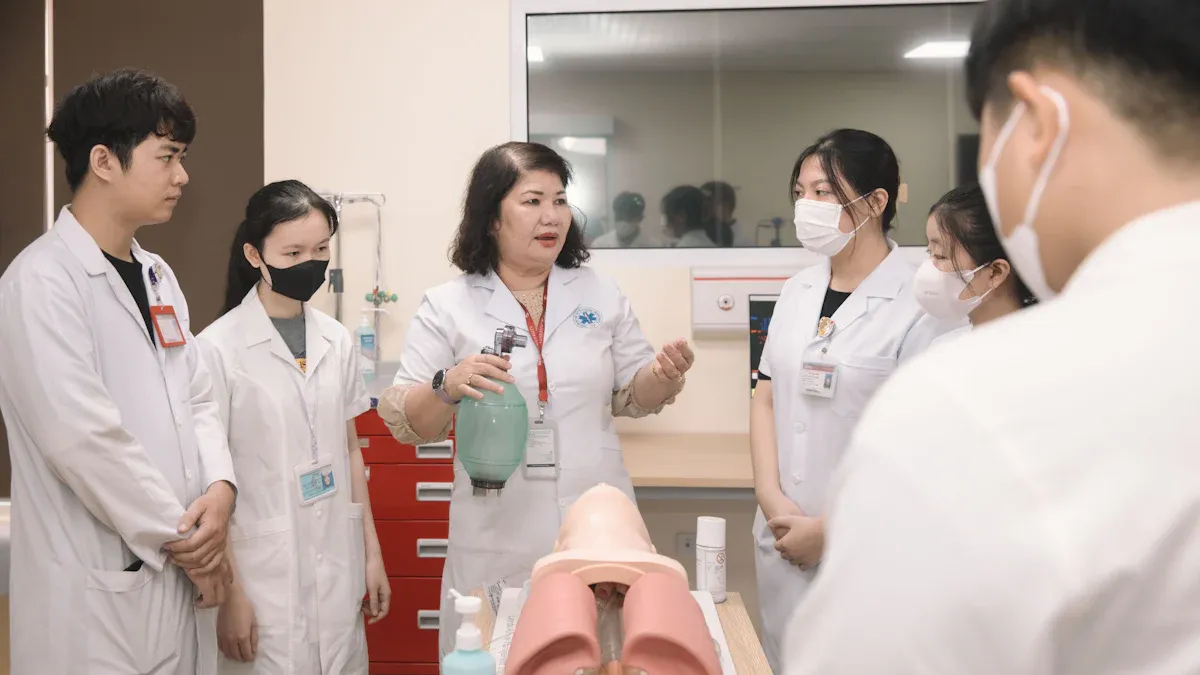
Lifelike Anatomy and Tactile (Haptic) Feedback
A High quality Dental Teaching Simulator for dental training practice must deliver lifelike anatomy and tactile feedback to create an authentic learning environment. High-fidelity simulators, such as the Simodont® Dental Trainer, surpass traditional low-fidelity models by offering advanced tactile sensations and immersive experiences. These simulators replicate real clinical scenarios, allowing students to refine their skills in a dynamic setting. The ability to feel resistance and texture during procedures helps learners develop essential psychomotor skills.
Tip: Simulators with force feedback technology provide realistic tactile sensations, which are crucial for mastering dental procedures.
| Evidence Description | Key Findings |
|---|---|
| Haptic VR dental simulator with force feedback | Enhanced training experience by simulating realistic tactile sensations, crucial for skill development in dental procedures. |
| High fidelity haptic feedback in virtual orthodontic training | Improved performance scores in bracket bonding procedure training, indicating effective skill transfer and training personalization. |
Replication of Soft and Hard Oral Tissues
The replication of soft and hard oral tissues plays a vital role in simulation quality. Modern simulators use advanced materials and 3D printing to mimic the appearance and feel of oral structures. Expert reviews highlight several strengths and limitations:
- The 3D-printed simulator shows strengths in visual realism and educational value compared to traditional models.
- Expert reviews indicate that while the simulator is effective for visual and educational purposes, it struggles with accurately replicating tactile feedback.
- Senior surgeons noted limitations in the tactile aspects, suggesting a need for material innovation to better mimic human tissue properties.
- The simulator's design achieves a higher fidelity than previous models, approximating clinical reality during suturing, though it is not fully biomimetic.
Advanced Feedback and Assessment Tools
Real-Time Performance Feedback and Guidance
Dental education benefits greatly from real-time feedback. Technologies such as DenTeach and PrepScanner deliver immediate guidance, helping students correct mistakes as they work. These systems reduce errors and improve efficiency. Students who use real-time feedback tools show a 50% reduction in range of motion errors during shadowing exercises. Task completion times improve by 25% after several practice trials. The PrepScanner app highlights errors instantly, allowing learners to reinforce best practices and build confidence.
Note: Real-time feedback increases student engagement and interest in learning. Digital assessment systems create realistic teaching environments that support skill development.
- Virtual simulation teaching systems enhance operational skills.
- Immediate feedback helps students identify and reduce errors.
- Realistic environments boost motivation and learning outcomes.
Objective Assessment Metrics and Self-Evaluation
A High quality Dental Teaching Simulator for dental training practice uses objective metrics to evaluate student performance. These metrics provide clear standards for assessment and self-evaluation. Simulators often use hidden Markov models (HMMs) to measure the quality of procedures. Students receive feedback at each stage, which helps them understand their strengths and areas for improvement.
| Metric Type | Description |
|---|---|
| Objective Skill Assessment | The simulator uses hidden Markov models (HMMs) to objectively assess the quality of procedures. |
| Feedback on Performance | Provides objective feedback on the user's performance at each stage of the procedure. |
Levels of supervision also guide self-evaluation:
- Level 1: Student works with supervisor.
- Level 2: Supervisor steps in if needed.
- Level 3: Supervisor available within minutes.
- Level 4: Supervisor available from a distance.
- Level 5: Remote monitoring.
Customizable Evaluation Criteria
Customizable evaluation criteria allow educators to tailor assessments to individual needs. VR-based training improves technical performance in simulated oral surgery tasks. AR simulation systems let instructors set specific criteria for each subject, addressing unique learning goals. Technology-enhanced tools provide immersive scenarios and instant feedback, supporting personalized skill development.
- Educators set criteria for each student.
- Simulations offer immediate feedback and immersive cases.
- Customization enhances individual learning experiences.
Performance Tracking and Analytics for Dental Training Practice

Progress Monitoring and Detailed Reporting
Dental educators rely on progress monitoring and detailed reporting to track student development. These features provide a feedback loop that supports instruction and intervention. Real-time progress data helps instructors assess the effectiveness of efforts to close learning gaps. Immediate feedback prevents the need for more intensive educational supports. Online statistics allow educators to monitor and evaluate both individual and class performances. Quizzes graded by the program deliver instant results to students and instructors.
- Provides a feedback loop for instruction or intervention.
- Shows real-time progress data to assess learning gaps.
- Enables monitoring and evaluation of individual and class performances.
- Utilizes quizzes graded by the program, providing immediate feedback.
Tracking staff productivity also helps optimize appointment scheduling and align team members with goals. Improved productivity reduces average treatment times, enhancing patient experiences. Analytics identify bottlenecks, streamlining operations and boosting practice performance.
| Aspect | Evidence |
|---|---|
| Staff Productivity | Tracking staff productivity helps optimize appointment scheduling and align team members with goals. |
| Treatment Times | Improved productivity reduces average treatment times, enhancing patient experiences. |
| Operational Performance | Identifying bottlenecks through analytics streamlines operations and enhances practice performance. |
Integration with Learning Management Systems
Integration with learning management systems (LMS) enhances skill acquisition and creates immersive learning environments. Dental teaching simulators that connect with LMS bridge the gap between theoretical knowledge and clinical practice. These systems support competency-based education, ensuring safer patient care and accelerating learning curves for dental professionals. By utilizing data analytics, practitioners gain a comprehensive understanding of patients' oral health histories and specific needs. This enables the creation of personalized treatment plans and optimized preventive care strategies, leading to improved patient outcomes.
GPS-Based Tracking and 3D Visualization
GPS-based tracking and 3D visualization improve the accuracy of dental training assessments. Advanced technologies such as 3D imaging, virtual simulations, and dynamic navigation systems enhance precision and reliability in dental procedures. These tools allow for accurate preoperative planning and customization of treatment plans. Real-time tracking capabilities deliver superior accuracy.
| Study | Findings |
|---|---|
| Casap et al. | VR navigation system improved accuracy of implant placement among final-year dental students. |
| Vincent et al. | VR training reduced angle deviation and risk of perforation, demonstrating a learning curve. |
| Schneider et al. | AR training significantly improved implant angulation accuracy. |
| Technology | Impact |
|---|---|
| 3D imaging (CBCT, CAD/CAM) | Enhances precision and reliability of dental implant placement. |
| Virtual simulations | Allows for accurate preoperative planning and customization of treatment plans. |
| Dynamic navigation systems | Superior accuracy due to real-time tracking capabilities. |
A High quality Dental Teaching Simulator for dental training practice that incorporates these features supports both educators and students in achieving optimal training outcomes.
User Experience and Accessibility
Ergonomic and Adjustable Design
A High quality Dental Teaching Simulator for dental training practice must support ergonomic and adjustable design to ensure comfort and safety during extended sessions. Simulators with adjustable height and angle settings allow students to work in realistic positions, reducing fatigue and promoting proper posture. The following table highlights key specifications that enhance usability:
| Feature | Specification |
|---|---|
| Lowest height to incisal edge | 700 mm |
| Maximum height to incisal edge | 950 mm |
| Angle adjustment | -10° to +90° |
Simulators often feature modular configurations and flexible instrumentation. Stable construction and high-quality materials withstand repeated student use. As one expert noted, ergonomics during treatment improve with thoughtful patient simulator position settings. These features create a supportive environment for learning and skill development.
Ease of Use and Intuitive Interface
Dental students and instructors value simulators that offer intuitive interfaces and easy operation. When users find controls straightforward, they can focus on clinical tasks rather than navigating complex menus. Cognitive load theory suggests that intuitive design reduces unnecessary mental effort, allowing learners to concentrate on essential skills. Both gamer and nongamer groups report high satisfaction with user-friendly simulators. Usability evaluations show that clear interfaces lead to better training outcomes and faster skill acquisition.
- Users rate ease of use highly for platforms like OrthoVirt.
- Simple controls help students and instructors stay engaged.
- Reduced cognitive load supports more effective learning.
Adaptability for Different Skill Levels
A High quality Dental Teaching Simulator for dental training practice adapts to the needs of beginners and advanced users alike. Simulation-based education tailors experiences to each learner’s background. Adult learning theory supports self-directed learning, letting users progress at their own pace. Guided reflections and active experimentation help students identify knowledge gaps and refine their skills. Simulators also provide differentiated training in communication and clinical techniques, ensuring that every user receives appropriate challenges and support.
- Simulators adjust to various experience levels.
- Learners benefit from self-directed and guided activities.
- Training adapts to individual backgrounds and needs.
Durability, Maintenance, and Practicality
Build Quality and Longevity
Dental teaching simulators must withstand frequent use in busy educational environments. Manufacturers select robust materials and advanced construction methods to ensure long-term reliability. High-quality PVC and other durable materials resist wear and tear, supporting repeated practice sessions. Simulators built with these materials maintain their structural integrity and performance over time.
| Material | Description |
|---|---|
| High-quality PVC | Ensures durability and longevity during dental training practices. |
| Durable Materials | Constructed from high-quality, durable materials to ensure longevity and resistance to wear and tear. |
Educators value simulators that deliver consistent results year after year. Strong build quality reduces the risk of breakdowns and minimizes interruptions in training schedules.
Ease of Cleaning and Upkeep
Routine maintenance and cleaning play a vital role in the practicality of dental teaching simulators. The JPS-FT-III Dental Simulation System features an independent suction system and quick-detach waste water bottles. These design elements simplify cleaning and maintenance tasks, allowing staff to keep equipment hygienic with minimal effort. Easy upkeep ensures that simulators remain ready for use, supporting efficient training sessions.
Tip: Simulators with streamlined maintenance features save time and reduce operational costs for dental schools.
Educators appreciate systems that minimize downtime and require fewer specialized cleaning procedures. Practical design choices help maintain a safe and sanitary learning environment.
Availability of Replacement Parts and Tools
Access to affordable replacement parts and tools ensures that simulators remain functional and cost-effective. Leading manufacturers offer a wide range of compatible components, including typodonts, teeth models, and phantom heads. The following table lists several options available for popular brands:
| Product Description | Price |
|---|---|
| Dental Typodont With Mounting Pole with 28PcsTeeth Model Compatible with Kilgore Nissin 200 | $126.99 |
| Dental Manual Manikin Simulator Phantom Head Model for Dentist Training Practice Compatible with Nissin Kilgore | $287.99 |
| Dental Replacement Typodont Teeth 32 pcs with Screws Compatible with Kilgore Nissin 200 | $28.99 |
| Dental Typodont Restorative Standard Simulation Model with 32PCS Removable Teeth Compatible Frasaco AG3 | $28.99 |
| Dental Practice Model Typodont Compatible with Columbia NISSIN Kilgore Frasaco 28 /32 Teeth | $51.99 |
| Jingle JG-A11 Mobile Dental Student Training Teaching Electrical Control Dental Simulation Unit Working Station | $3471.99 |
| Jingle A4 Dental Double Teaching Manual Control Phantom Dental Simulation Unit | $3727.99 |
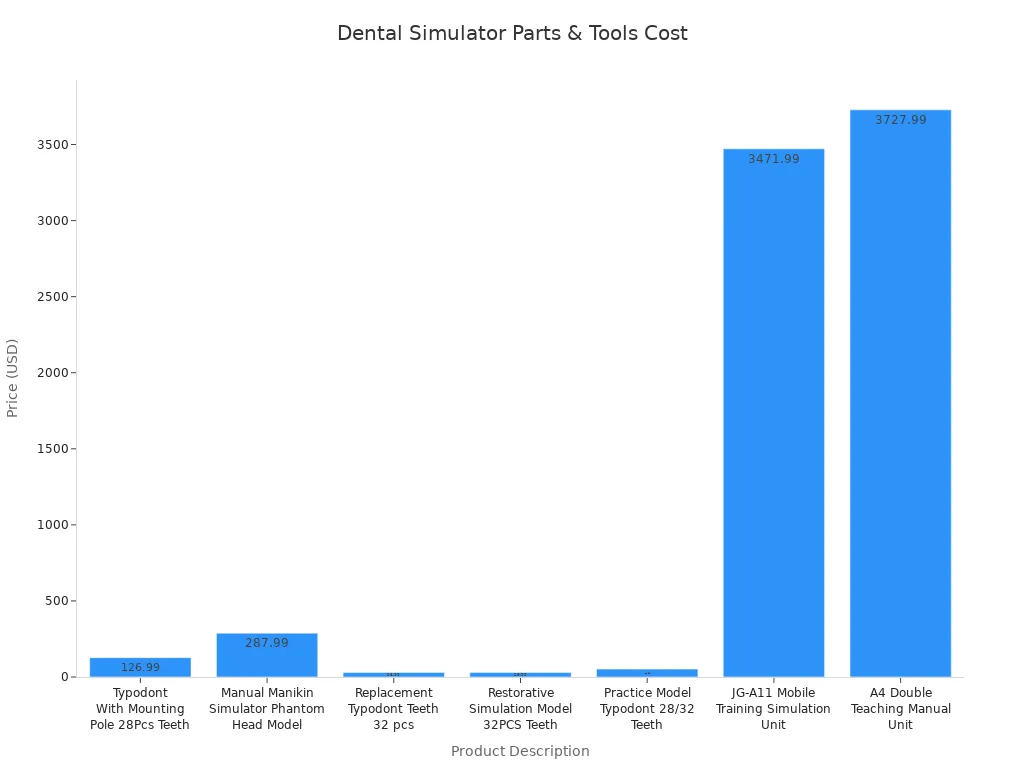
Schools benefit from reliable access to replacement parts, which helps extend the lifespan of their investment. Quick availability of tools and components keeps training programs running smoothly and supports uninterrupted learning experiences.
Manufacturer Reputation and Support for High Quality Dental Teaching Simulators
Track Record in Dental Education
Manufacturers with a strong history in dental education earn trust from institutions and instructors. They invest in research and development to improve simulator technology. Companies with proven expertise often collaborate with universities and dental schools. Their products reflect years of feedback from educators and students. Reliable brands update their simulators to match current teaching standards. Schools prefer manufacturers who demonstrate commitment to advancing dental training.
Customer Support and Training Resources
Top manufacturers provide robust customer support and training resources. These services help users maximize the value of their simulators. JPS Dental stands out by offering comprehensive technical support for all their models. Training resources guide instructors and students through setup and operation. Users benefit from quick troubleshooting and ongoing assistance.
- Comprehensive technical support for all simulators
- Training resources included for a smooth experience
Customer support ensures that educators resolve issues quickly. Training materials help new users adapt to advanced features. These resources contribute to successful implementation of a High quality Dental Teaching Simulator for dental training practice.
Warranty and Service Agreements
Warranty and service agreements protect investments in dental teaching simulators. Leading brands offer clear terms for repairs and technical support. The table below compares warranty coverage and after-sale service among popular manufacturers.
| Brand | Warranty | After-Sale Service |
|---|---|---|
| Adelson | 1 Year | Online Technical Support |
| Lingchen Dental | N/A | N/A |
Adelson provides a one-year warranty and online technical support. Lingchen Dental does not offer warranty or after-sale service. Schools should review these agreements before purchasing. Strong warranty coverage reduces downtime and ensures long-term reliability.
Cost-Effectiveness and Value in Dental Training Practice
Upfront Investment vs. Long-Term Benefits
Dental schools often face budget constraints when selecting training equipment. A High quality Dental Teaching Simulator for dental training practice may require a significant upfront investment. However, durable construction and advanced features can reduce replacement costs over time. Institutions benefit from simulators that maintain performance after repeated use. Long-term benefits include improved student outcomes and reduced need for remedial instruction. Schools that invest in reliable simulators see fewer interruptions in training schedules.
Tip: Choosing a simulator with proven longevity and low maintenance needs helps maximize the value of initial spending.
Scalability for Group and Individual Training
Modern dental teaching simulators support both group and individual learning environments. Flexible systems allow instructors to create custom cases for different training scenarios. Simulators with adaptable user roles accommodate students and tutors, making them suitable for various class sizes. Some platforms face limitations, such as supporting only a single patient case or lacking haptic feedback, which may affect scalability. The following table highlights features that influence scalability:
| Feature | Description |
|---|---|
| Custom Case Creation | Enhances scalability for both group and individual training scenarios. |
| User Roles | Supports two main roles: Students and Tutors, indicating adaptability. |
| Current Limitations | Only a single patient case and lack of haptic feedback may affect scalability. |
Institutions should evaluate these factors when planning for future growth or curriculum changes.
Return on Investment Considerations
Dental teaching simulators deliver measurable improvements in student confidence and clinical skills. After simulation-based training, participants report higher levels of knowledge and proficiency. Studies show a 10% increase in clinical procedure performance, such as laceration repairs, following training. These gains translate into better patient care and reduced errors in real-world settings. Improved outcomes contribute to a positive return on investment for educational institutions. Administrators should consider both direct and indirect benefits when assessing simulator value.
Practical Tips for Evaluating Dental Teaching Simulators
Hands-On Demonstrations and Trials
Dental educators and decision-makers benefit from hands-on demonstrations before making a purchase. These trials allow users to test the simulator’s features in real time. They can evaluate the realism of the anatomy, the quality of haptic feedback, and the ease of use. Many manufacturers offer on-site or virtual demonstrations. During these sessions, instructors can perform common procedures and assess how the simulator supports skill development.
Tip: Bring a checklist to the demonstration. Include items such as tactile feedback, software interface, and adjustability. This helps ensure a thorough evaluation.
Gathering Feedback from Current Users
Feedback from current users provides valuable insights into daily performance and reliability. Educators and students who use a High quality Dental Teaching Simulator for dental training practice can share their experiences with maintenance, technical support, and learning outcomes. Their opinions often highlight strengths and weaknesses that may not appear in product brochures.
- Ask users about the simulator’s durability.
- Inquire about the quality of customer support.
- Request examples of how the simulator improved student skills.
Comparing Product Reviews and Testimonials
Product reviews and testimonials help buyers compare different simulators. Independent reviews often discuss ease of use, software updates, and cost-effectiveness. Testimonials from dental schools or training centers can reveal long-term satisfaction. A simple table can help organize this information:
| Source | Positive Aspects | Areas for Improvement |
|---|---|---|
| Online Reviews | Realistic feedback, easy setup | Occasional software bugs |
| School Testimonials | Improved student confidence | Limited replacement parts |
Note: Look for patterns in reviews. Consistent praise or criticism can guide your decision.
Future Trends in High Quality Dental Teaching Simulators for Dental Training Practice
Advances in Virtual and Augmented Reality
Dental education continues to evolve with the rapid development of virtual reality (VR) and augmented reality (AR) technologies. Simulators now create immersive environments that replicate clinical scenarios with high precision. Students interact with 3D models of oral anatomy, practicing procedures in a safe and controlled setting. VR platforms allow learners to visualize complex cases, while AR overlays digital information onto physical models. These innovations help students build confidence and improve their technical skills before treating real patients.
VR and AR integration supports individualized learning and enhances engagement during training sessions.
Artificial Intelligence and Adaptive Learning
Artificial intelligence (AI) transforms the capabilities of dental teaching simulators. AI-powered systems analyze student performance and deliver real-time feedback. Adaptive learning pathways adjust the difficulty of tasks based on individual progress. These simulators identify skill gaps and recommend targeted exercises, ensuring efficient skill development. Digital assessment tools provide analytics dashboards that track readiness and clinical competence. Educators use these insights to tailor instruction and meet regulatory standards.
| Trend | Description |
|---|---|
| Integration of AI | Real-time feedback and adaptive learning personalize education and identify skill gaps. |
| Digital Assessment Tools | Analytics dashboards improve curriculum effectiveness and align with regulatory expectations. |
Remote and Collaborative Training Capabilities
Cloud-enabled platforms expand access to dental training by supporting remote learning. Students participate in simulations from different locations, collaborating with peers and instructors online. These systems track progress and store performance data securely. Remote capabilities increase inclusivity, allowing more learners to benefit from advanced training tools. Sustainability efforts also shape future designs, with manufacturers using durable, reusable materials to reduce waste.
- Remote learning platforms enhance accessibility.
- Collaborative features support teamwork and peer feedback.
- Eco-friendly materials promote environmental responsibility.
A High quality Dental Teaching Simulator for dental training practice will continue to incorporate these trends, preparing students for the demands of modern dentistry.
Dental educators should prioritize realism, advanced feedback, and robust analytics when selecting a simulator. Institutions must align simulator features with specific training goals and student needs. A High quality Dental Teaching Simulator for dental training practice supports skill development and improves learning outcomes.
Tip: Review product demonstrations and user testimonials before making a final decision.
FAQ
What makes a dental teaching simulator realistic?
High-quality simulators use advanced materials and haptic feedback to mimic real oral anatomy. They provide lifelike resistance and texture, helping students practice procedures with accuracy and confidence.
How does performance tracking benefit dental students?
Performance tracking allows students to monitor progress and identify skill gaps. Detailed analytics help instructors tailor feedback, improving learning outcomes and supporting continuous improvement.
Are replacement parts for simulators easy to find?
Most reputable manufacturers offer a wide range of compatible replacement parts. Schools can quickly order typodonts, teeth models, and phantom heads to keep training equipment functional.
Can simulators adapt to different skill levels?
Modern simulators feature customizable settings for beginners and advanced users. Educators adjust scenarios and evaluation criteria, ensuring every student receives appropriate challenges and support.
What support do manufacturers provide after purchase?
Manufacturers often include technical support, training resources, and warranty coverage. Reliable customer service ensures educators resolve issues quickly and maximize simulator value.
See Also
A Comprehensive Guide to Choosing Tablet Sampling Machines
Comparing Leading Hospital Bed Elevators for Safety and Efficiency
Where to Find Quality X-Ray Inspection Machines in China
3-A SSI Summit: Industry Experts Discuss Hygienic Design Trends
25 Exceptional Construction Website Designs You Should Explore