The Food Manufacturer's Guide to AI and Automation
Artificial intelligence and automation directly boost profitability for food manufacturers. These technologies enhance operational efficiency. Key applications include improving quality control, optimizing supply chains, and enabling predictive maintenance. The market for AI in food manufacturing reflects this growing importance. Projections show the global AI in food and beverages market growing from USD 15.36 billion in 2025 to USD 263.80 billion by 2034. Implementing these tools builds a more competitive and resilient operation.
High-ROI Applications of AI in Food Manufacturing
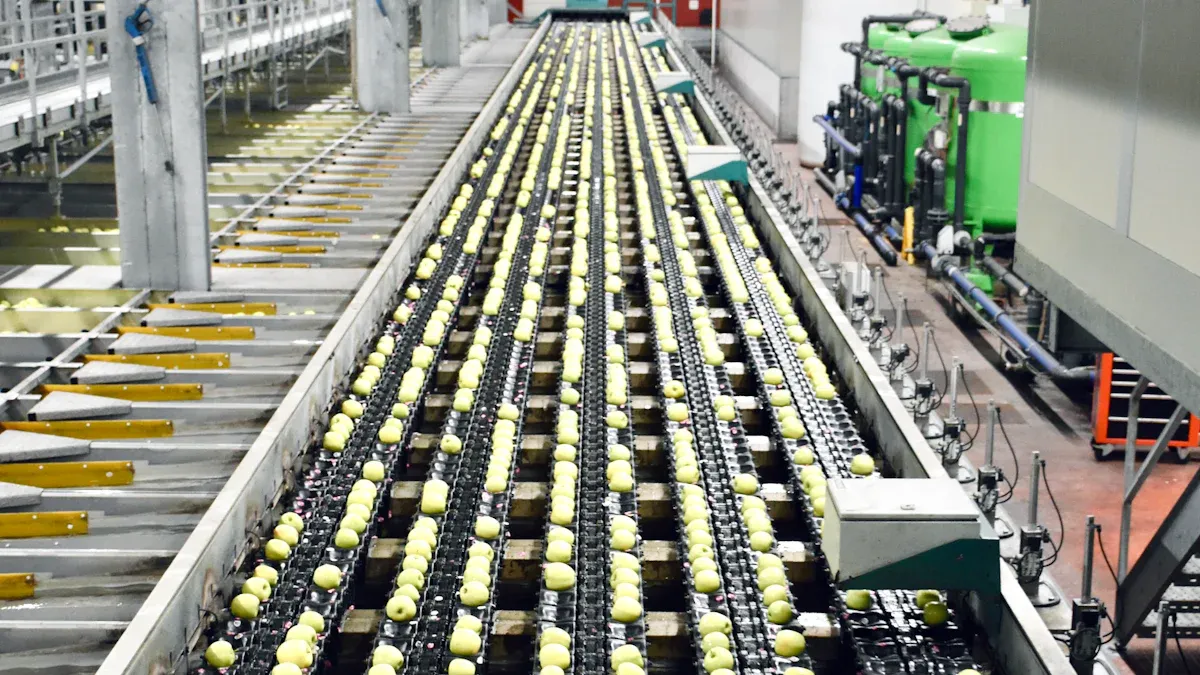
Manufacturers can target several high-impact areas to generate a significant return on investment from artificial intelligence. These applications solve persistent industry challenges. They range from enhancing product quality to eliminating costly operational downtime. Focusing on these proven solutions provides a clear path to a more efficient and profitable future.
Automated Quality Control with Computer Vision
Manual quality inspection is slow, inconsistent, and prone to human error. Computer vision systems offer a superior alternative. These AI-powered solutions use high-resolution cameras and machine learning algorithms to analyze products on the production line in real time. They identify issues with a precision and speed that humans cannot match. Advanced models like Faster R-CNN can achieve over 99% accuracy in identifying defects.
Key applications of computer vision include:
- Defect and Contamination Detection: Systems automatically spot product flaws like discoloration, improper shape, or surface blemishes. Advanced hyperspectral imaging can even detect foreign objects, microbial growth, or chemical residues invisible to the naked eye. Tyson Foods, for example, has tested vision systems to find foreign materials on its production lines.
- Portion and Packaging Integrity: AI ensures consistent product portions and verifies packaging quality. It checks for improper seals, misaligned labels, and damaged containers, reducing waste and minimizing recall risks.
- Sorting and Grading: The technology rapidly sorts and grades items based on size, color, and texture. This automates the classification of products like fruits and grains, ensuring uniform quality standards.
The return on these systems is compelling. The investment often pays for itself through labor savings, brand protection, and waste reduction. Preventing a single product recall can save millions of dollars.
One cookie producer reduced scrap waste by 8.7% after implementing a real-time monitoring system. This saved nearly $47,000 in just six months from reduced material waste alone, projecting to an annual savings of $94,600.
Predictive Maintenance to Eliminate Downtime
Equipment failure is a primary cause of lost revenue in food manufacturing. Predictive maintenance shifts the paradigm from reactive repairs to proactive intervention. This approach uses AI algorithms to analyze data from equipment sensors, monitoring variables like temperature, vibration, and energy consumption. The system predicts when a machine part is likely to fail, allowing maintenance teams to schedule repairs before a breakdown occurs. This use of ai in food manufacturing directly prevents costly unplanned downtime.
Several major companies have already achieved significant results.
| Company | Predictive Maintenance Solution | Outcome |
|---|---|---|
| Swire Coca-Cola | Siemens' Manufacturing Information System (MIS) | Reduced fault diagnosis time and improved operational transparency across 100 production lines. |
| A snack manufacturer | ATS's customized predictive diagnostics | Reduced unplanned downtime by an impressive 63%. |
Implementing predictive maintenance also delivers direct financial benefits. It eliminates unnecessary servicing and prevents severe equipment damage, extending machinery lifespan. Food manufacturers using this technology report a 5-10% reduction in overall maintenance costs.
Supply Chain Optimization and Demand Forecasting
Volatile consumer demand and perishable inventory make supply chain management a major challenge. AI-driven demand forecasting helps manufacturers navigate this complexity with incredible accuracy. These systems analyze vast datasets, including historical sales, weather patterns, and market trends, to predict future demand. Large manufacturers using these tools can achieve forecast accuracies between 85% and 95%.
This precision delivers several key advantages:
- Improved Inventory Management: AI helps maintain optimal stock levels. It automates restocking, reduces carrying costs, and aligns inventory with route-level demand to minimize out-of-stocks.
- Enhanced Accuracy: AI models improve the precision of demand predictions. This helps businesses avoid overstocking perishable goods or running out of popular items.
- Reduced Food Waste: Accurate forecasting is one of the most effective tools for fighting food waste. By aligning production and stock orders with precise demand, companies dramatically reduce spoilage.
The impact on waste is substantial. AI-driven approaches can reduce food waste by up to 30% in the supply chain. Companies like Ikea have even cut their food waste in half by using AI-enabled waste tracking solutions. The application of ai in food manufacturing creates a more sustainable and cost-effective operation.
Robotic Process Automation for Packaging
The packaging stage of production is often labor-intensive and repetitive. Robotic process automation (RPA) addresses this bottleneck by deploying robots to handle tasks with speed and consistency. This technology boosts throughput while reallocating human workers to more valuable, less strenuous roles.
Robots drive efficiency in two primary ways: increasing throughput and reducing labor costs.
Increased Throughput
- Speed and Consistency: Robots work without fatigue. Delta robots, for instance, can perform up to 100 actions per minute, easily keeping pace with high-speed production lines.
- Precision Handling: Equipped with 3D vision, robots can handle and place irregularly shaped items with consistent accuracy, reducing product damage and waste.
- Automating Repetitive Tasks: Robots excel at arranging, transferring, and placing food into packaging, freeing human operators for supervisory roles.
Reduced Labor Costs
- Lower Turnover: Automating monotonous jobs reduces employee turnover, saving significant money on recruitment and training.
- Fewer Workplace Injuries: Robots take over physically demanding tasks, leading to fewer workers' compensation claims and lower insurance premiums.
- Efficient Labor Use: A single operator can often supervise multiple robotic systems, making the entire operation more efficient.
By automating the end of the line, the strategic use of ai in food manufacturing strengthens the entire production process, delivering consistent quality and a healthier bottom line.
Your Step-by-Step Implementation Roadmap

Adopting AI and automation is a strategic journey, not a one-time purchase. A phased roadmap helps manufacturers manage complexity, mitigate risks, and build momentum. This structured approach ensures that each investment is validated and aligned with long-term business goals, paving the way for a successful, enterprise-wide transformation.
Phase 1: Assess Readiness and Identify a Pilot Project
The first phase is foundational. It involves a thorough evaluation of operational readiness and the strategic selection of a high-impact pilot project. This initial step sets the direction for the entire AI initiative.
A successful assessment begins with an ROI-focused evaluation. Manufacturers should identify workflows with significant challenges, such as high waste generation, frequent forecasting errors, or labor-intensive manual checks. This process highlights the areas where AI can deliver the most immediate value. Key steps in this phase include:
- Define Clear Objectives: Outline the specific goals for the pilot. Limit the project's scope to ensure it remains manageable. Define quantitative KPIs and qualitative benefits to measure success accurately.
- Build the Business Case: The proposal should extend beyond simple ROI. It must align with broader strategic goals like improving operational efficiency or fostering innovation. Position the pilot as a critical learning opportunity for future scaling.
- Audit Data Infrastructure: AI systems depend on high-quality data. A thorough audit of existing data systems—like ERP and MES platforms—is essential. This review ensures data is clean, integrated, and ready to support AI initiatives.
- Ensure Cross-Functional Collaboration: Involve stakeholders from IT, operations, quality control, and finance from the beginning. An agile, collaborative approach ensures the project aligns with diverse business needs and gains widespread support.
Tip: Choosing Your Pilot 🎯 Select a project with a manageable scope and a clear path to value. Consider starting with a single product line that has either excellent data availability or known data challenges. This helps test the impact of data quality on AI performance and provides valuable lessons for future projects.
Phase 2: Execute the Pilot and Measure ROI
With a pilot project selected, the next phase focuses on execution and measurement. This is where the theoretical business case meets real-world application. Success hinges on meticulous project management and a robust framework for tracking performance.
During execution, the project team deploys the AI solution in a controlled environment. The primary goal is to test the technology, validate its effectiveness, and gather data on its performance. A critical component of this phase is measuring the return on investment (ROI) to justify further expansion.
The standard formula for ROI is straightforward:
ROI = (Net Return / Investment Cost) × 100
To apply this formula effectively, manufacturers must account for all costs and returns.
- Investment Costs: These include hardware, software licenses, implementation services, and employee training.
- Net Returns: These are the financial gains from the project. They can be "hard" returns, like labor savings and waste reduction, or "soft" returns, like improved brand reputation and employee satisfaction.
A comprehensive ROI calculation must also factor in ongoing operational expenses. These include electricity, system maintenance, and potential productivity dips during the initial ramp-up period. Overlooking these costs can lead to unrealistic projections.
To measure success accurately, it is vital to establish baseline metrics before the pilot begins. Key Performance Indicators (KPIs) provide the data needed to quantify improvements.
| KPI Category | Key Metrics to Track |
|---|---|
| Operational Efficiency | Overall Equipment Effectiveness (OEE), Yield Stability, Throughput, Cycle Time |
| Model Performance | Accuracy, Precision, Recall, Mean Squared Error (MSE), Latency |
| Financial Impact | Labor Cost per Unit, Waste Reduction Percentage, Energy Cost Savings |
| Data & System Health | Data Quality Score, Uptime of Data Pipelines, Computational Resource Usage |
Tracking these KPIs provides concrete evidence of the pilot's impact, building a data-driven case for scaling the solution.
Phase 3: Scale Proven Solutions Across Operations
A successful pilot provides the proof-of-concept and business case needed for broader implementation. Scaling involves rolling out the validated AI solution across other production lines, departments, or facilities. This phase requires careful planning to replicate success while adapting to new environments.
Best practices for scaling AI initiatives include:
- Establish Scalable Infrastructure: Move from a pilot-specific setup to an enterprise-grade platform. This involves implementing MLOps (Machine Learning Operations) practices to ensure consistency and reliability as the solution expands.
- Strengthen Data Governance: As data volume grows, robust governance becomes critical. Use tools like Master Data Management (MDM) systems and data catalogs to ensure AI models operate on consistent, trusted data.
- Develop Human Capabilities: Scaling AI is as much about people as it is about technology. Companies must invest in upskilling existing staff and hiring for key roles like ML engineers. Creating a "hub and spoke" organizational model, with a central AI team supporting local units, can facilitate knowledge sharing and adoption.
- Secure Executive Sponsorship: Continued support from leadership is crucial. A compelling business narrative, backed by pilot data, helps maintain momentum and secure the resources needed for a full-scale rollout.
Companies that successfully scale AI often follow a phased "lighthouse" approach. They identify a few high-potential facilities to act as models for the rest of the organization. For example, an automotive manufacturer scaled a predictive maintenance system by first deploying it in a few key factories, using their success to build confidence and a repeatable blueprint for global implementation.
Phase 4: Integrate AI into Your Core Strategy
The final phase transcends individual projects. It involves embedding AI into the company's DNA, making it a core component of its competitive strategy and long-term vision. At this stage, AI is no longer just a tool for optimization; it becomes a driver of innovation and growth.
Integrating AI into the core strategy means using its insights to inform high-level business decisions. This can manifest in several ways:
- Driving Product Innovation: Companies like Mondelez International use AI to accelerate R&D, developing new snack formulations and product variants at a much faster pace. Nestlé also deployed an AI tool that reduced its product ideation timeline from six months to just six weeks.
- Optimizing the Entire Value Chain: Kraft Heinz built an "AI Lighthouse" platform that provides insights to logistics, manufacturing, and supply chain teams. This system added $30 million to sales by helping the company meet demand and prevent service interruptions.
- Creating New Customer Experiences: Global brands like Coca-Cola and Unilever use AI to analyze market trends, personalize marketing, and even optimize in-store customer engagement. This strategic use of ai in food manufacturing helps them stay ahead of consumer preferences.
To reach this level of maturity, organizations must foster a data-driven culture. This involves continuous employee training to ensure teams trust and act on AI-driven recommendations. By making AI a central pillar of strategy, food manufacturers can build a resilient, agile, and forward-thinking operation prepared for future market challenges.
Overcoming Common Implementation Challenges
Adopting AI presents significant opportunities, but manufacturers must navigate several common hurdles. Addressing challenges related to investment, data, and workforce skills is critical for a smooth transition and successful implementation.
Justifying the Initial Investment
Securing funding for AI projects is often the first major obstacle. A strong business case is essential. A proven method is the "3-Layer Approach," which presents the investment logic to stakeholders. It starts with a concise executive summary, followed by a core business case, and is supported by detailed technical and financial appendices. This structured proposal answers key board-level questions about financial returns and cost categories. Furthermore, a company’s commitment to technology enhances its appeal to grant committees and investors, including those offering USDA grants for food safety.
Ensuring Data Quality and Security
AI systems are only as good as the data they use. Manufacturers must establish strong data governance to ensure operational data is accurate, traceable, and secure. This involves creating clear rules for data handling and ownership. However, connected AI systems also introduce new cybersecurity risks. They expand the potential points of entry for cyberattacks, making legacy operational technology (OT) systems vulnerable. Companies must also comply with data privacy regulations like GDPR to protect sensitive consumer data and avoid significant fines.
Upskilling Your Workforce
Automation transforms job roles, requiring new employee capabilities. The modern workforce needs skills in data analysis, problem-solving with AI assistance, and collaborating with robotic systems. Successful companies align upskilling programs with clear business goals. They prioritize experiential learning, allowing employees to practice new skills on real projects. Leading organizations like Schneider Electric use internal talent marketplaces to provide equal access to growth opportunities, unlocking productivity and saving millions in hiring costs.
Starting with small, strategic projects is key to long-term success. Manufacturers should focus on a single pilot project with clear ROI to build momentum. Adopting ai in food manufacturing is essential for future-proofing operations, as nearly 60% of companies plan to increase their AI investments to remain competitive.
FAQ
What is the best first AI project for a food manufacturer?
Companies should target a high-impact area with clear ROI. Automated quality control and predictive maintenance are excellent starting points. They offer measurable results and build momentum for future projects.
Do we need to hire data scientists to start with AI?
Not always. Many modern AI platforms are user-friendly. Manufacturers can begin with vendor-supported solutions. They can then upskill existing teams for long-term success and greater self-sufficiency.
How can small manufacturers afford AI and automation?
Small manufacturers can start with a targeted pilot project. They should focus on solutions with a fast ROI. Government grants and flexible vendor pricing also help reduce initial costs.
See Also
Essential Industrial Checkweighers: A Must-Have for Every Food Processing Plant
2025 Guide: Top Capsule Checkweighers for Smart Buyers to Consider
Nozzle Solutions Demystified: Insights for Gardeners, Bioprinters, and Lubrication Professionals
Hygienic Design Innovations: Industry Leaders Convene at the 3-A SSI Summit
Hygienic Design Standards: Comparing EHEDG Guidelines and 3A SSI for Best Practices