Gelatin vs Pectin, Agar and Carrageenan: A Formulator's Guide to Choosing the Right Hydrocolloid
You're developing a new product—a plant-based gummy, a stable yogurt, or a firm jelly—and the texture isn't right. Which hydrocolloid do you reach for? This post demystifies the four most common hydrocolloids—gelatin, pectin, agar, and carrageenan—by comparing their origins, functionalities, and ideal use cases. By the end, you'll have a clear, criteria-based framework for selection, moving beyond guesswork to informed formulation. We'll skip lengthy histories and focus on the practical 'what,' 'why,' and 'when' for each ingredient. Understanding the gelatin vs pectin agar carrageenan landscape empowers you to make confident choices that match your product's specific needs.
Hydrocolloids: The Basics of Texture and Stability
Defining Their Functional Role in Food Systems
A hydrocolloid is a water-soluble polymer that changes how a food feels and behaves. These molecules interact with water to increase viscosity or form a gel. Viscosity measures a fluid's resistance to flow. Gelation creates a three-dimensional network that traps water, producing a solid-like structure. This dual ability makes hydrocolloids essential tools for formulators.
The concentration needed depends on the application. Vegetable-based inks for 3D printing require less than 2% w/w hydrocolloid. Meat-based formulations typically use 0.5% or 1%. These small amounts produce dramatic textural changes. The choice of a specific hydrocolloid depends on the final product's desired sensory attributes and processing conditions.
Different hydrocolloids respond to different triggers. Many gel when cooled, including gelatin and pectin. Methylcellulose forms a gel when heated instead. Some gels are thermo-reversible, meaning they melt and re-set with temperature changes. Others show temperature hysteresis. Agar sets at approximately 35°C but melts near 90°C, a wide gap that provides heat stability.
Ionic conditions also trigger gelation. Alginates and kappa carrageenan form gels in the presence of positively charged ions. The positive ion fits into negatively charged areas of the hydrocolloid, allowing two molecules to stick together in an 'egg-crate' structure. This mechanism explains how calcium or potassium can initiate gel formation.
Key Selection Criteria: Texture, Thermal Stability, and Dietary Needs
Formulators evaluate several factors when choosing a hydrocolloid. Hydration conditions matter first. Temperature, shear, time, and order of addition determine whether the polymer develops properly. The flow profile affects suspension, pumping, and eating experience. Low-shear viscosity, yield, shear thinning, and recovery all play roles.
pH and ions can alter hydration, gelation, and protein interactions. Heat history changes performance; some systems need heat, while others lose function through cooking. Particle distribution affects suspension stability. Sensory texture—slimy, elastic, brittle, creamy, or short—cannot be predicted from viscosity alone.
Source category influences selection too. Plant-derived options like guar and pectin align with clean-label preferences. Microbial sources such as xanthan offer consistent quality but may require consumer education. Marine-derived agar and carrageenan provide unique properties, with sustainable sourcing increasingly critical. Modified hydrocolloids enhance performance but may not meet clean-label criteria.
The evidence package must match the functional claim. If a hydrocolloid claims emulsion stability, results must include stability measurements under relevant conditions. Texture improvement requires texture profile analysis or sensory measurements. Gelation advantages need rheology figures interpreted against food-function needs. This systematic approach moves formulation beyond guesswork.
Gelatin: The Classic Protein-Based Gelling Agent
Source, Gelling Mechanism, and Unique Texture Profile
Gelatin comes from animal collagen. Commercial sources include pig skin, fish, beef hides, and beef bones. Each source produces Type A or Type B gelatin with Bloom strengths from 50 to 325. Low Bloom gelatin creates soft gels. Medium Bloom works for desserts and dairy. High Bloom delivers firm textures. Source and Bloom strength affect firmness.
Bloom Strength | Gel Firmness | Typical Applications |
|---|---|---|
200 | Moderate | Desserts, dairy, general food |
225 | Moderate to high | Confectionery, desserts, nutritional products |
250 | High | Gummies, confectionery, specialty foods |
275 | Very high | High-strength gummies, precision texture |
gelatin's defining characteristic is its thermoreversible gelation. When a solution cools below about 35°C, polypeptide chains aggregate and form triple-helix structures. These zones create a network that traps water. The trapped water prevents rigidity. This structure gives the product its jiggly yet solid form. When temperature rises above the transition point, the network breaks down and the gel liquefies. This melting releases trapped flavor molecules.
Gelatin melts at around 97°F (36°C), just below body temperature. This low melting point ensures gelatin-based products soften and release flavors smoothly on the palate.
This explains gelatin's melt-in-mouth quality. Products dissolve on the tongue. This differs from thermoirreversible gels like agar.
Beyond Collagen offers pharmaceutical gelatin with customizable Bloom strengths. It comes from bovine and porcine sources for softgels, hard capsules, and tablets. The anti-cross-linking gelatin provides superior seam strength for aldehyde-sensitive fills. Low-endotoxin options suit biomedical applications.
Gelatin in Gummies: Why It's the Industry Standard
Gelatin dominates the gummy market. Formulators use it at 6–9% of the recipe. This creates a chewy, elastic texture. Consumers find this soft chew satisfying. Pectin versions offer a firmer bite.
Gelatin is the most utilized gelling agent in supplement gummies because of its ease of use, easy supply and consistency. It allows flexibility in depositing pH, temperature and solids ranges, standing time before depositing, thermal reversibility for reworking, and compatibility with most active ingredients.
This flexibility extends to other candies. marshmallows rely on this protein for their light, airy structure. marshmallows would not achieve the same texture with pectin or agar. marshmallows demonstrate its unique ability to stabilize foam.
Thermal reversibility offers a practical advantage. Manufacturers can rework base material. This reduces waste. For gummy production, gelatin remains the standard choice.
Pectin: The Fruit-Derived Star for Jams and Jellies
Pectin comes from fruit cell walls. Commercial pectin is extracted mainly from citrus peels and apple pomace. Citrus fruits yield high-methoxyl types. Apples provide low-ester types. These two types of pectin behave differently. The formulator must understand these differences to choose the right type for the product.
The Role of Sugar and pH in Pectin Gelation
High-methoxyl pectin requires two conditions to form a gel: high sugar concentration and low pH. The sugar must be above 60% soluble solids. The pH must fall within a narrow range. Different HM pectin types have different optimal pH ranges.
HM Pectin Type | Optimal pH Range | Sugar Requirement |
|---|---|---|
Ultra Rapid Set | 3.1 – 3.4 | Above 60% |
Rapid Set | 3.0 – 3.3 | Above 60% |
Medium Set | 2.8 – 3.1 | Above 60% |
Slow Set | 2.6 – 2.9 | Above 60% |
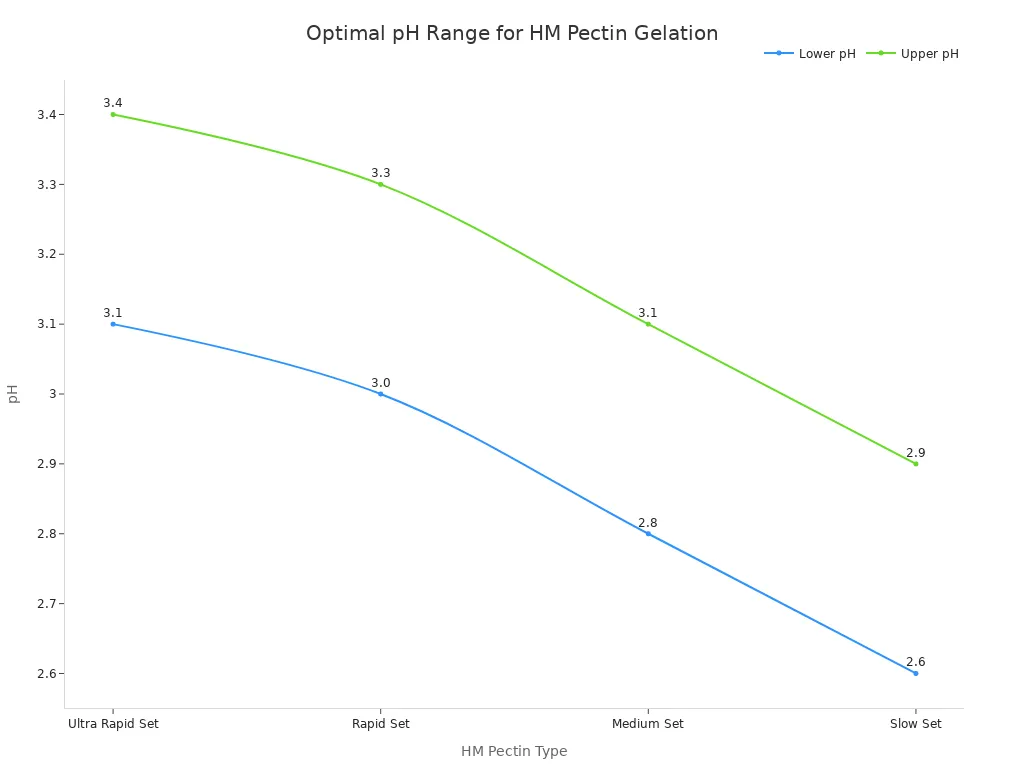
High-methoxyl (HM) pectins are ideal for products with sugar content above 60%, requiring precise sugar levels and pH control to perform optimally.
The gelation mechanism involves hydrophobic interactions and hydrogen bonding. The low pH neutralizes negative charges on the pectin molecules. The high sugar reduces water activity. These conditions allow the chains to associate and form a network. The resulting gel is thermally reversible and soft.
HM vs. LM Pectin: Choosing the Right Type
Low methoxyl type works differently. Its gelation relies on calcium ions. The carboxyl groups of two molecule chains connect through a calcium bridge. This is the "egg-box" model. Hydrogen bonding also contributes. This type does not need high sugar or low pH. It gels at pH 2-6 and soluble solids 10-80%.
Attribute | LM | HM |
|---|---|---|
< 50% | ≥ 50% | |
Primary Gel Driver | Ca²⁺ crosslinking | High sugar + low pH |
Working pH | 2–6 | 2.8–3.5 |
Sugar Requirement | Low to none | 55–75% soluble solids |
This table shows the key differences. LM type works for products with reduced sugar. HM type works for traditional jams and jellies with high sugar content. The choice between them depends on the product. Both produce softer, more elastic gels than agar. This mouthfeel suits fruit spreads and confectionery.
Agar: The Firm, Vegan-Friendly Seaweed Extract
Agar comes from red seaweed. This plant-based hydrocolloid has served as a gelling agent for centuries in Asian cuisines. Today, formulators value it for unique properties that other gelling agents cannot match. Agar stands apart from gelatin because it requires no animal sources. This makes it a cornerstone among plant-based hydrocolloids for modern food development.
Understanding Its High Gel Strength and Hysteresis
Agar forms gels through a cooling process. When dissolved in hot water and cooled, the molecules arrange into a firm network. Commercial agar products display impressive strength. Standard agar powder measures between 500 and 1200 g/cm². Agar strips typically range from 500 to 700 g/cm². This gel strength surpasses most other gelling agents.
The most distinctive feature of agar involves hysteresis. This term describes the gap between solidification and melting temperatures. Agar solidifies between 32°C and 43°C. It melts only above 85°C. This wide gap creates practical advantages.
Property | Agar | Gelatin |
|---|---|---|
Gel point | 32–42°C | Melts at ~37°C |
Melting point | Above 85°C | Near body temperature |
Hysteresis gap | ~43–53°C difference | Minimal |
Agar remains solid at 37°C. Gelatin melts at that same temperature. This difference matters for products that must withstand warm conditions. A gelatin dessert loses structure in a warm room. An agar-based product holds its shape. This thermal stability makes agar valuable for incubation studies and heat-exposed applications.
Ideal Applications for Heat-Stable, Brittle Gels
Agar produces a firm, brittle gel texture. This texture differs from the elastic chew of gelatin or the soft spread of pectin. The brittleness suits specific applications where clean breakage matters. Bakery glazes benefit from this quality. The glaze sets firmly and does not run or sag.
Plant-based desserts represent another key application. Vegan panna cotta, flans, and jelly confections rely on agar for structure. These products deliver the firm bite consumers expect without animal-derived ingredients. The heat stability ensures desserts survive transport and storage without melting.
Agar also works well in canned products. The high melting point prevents gel breakdown during retort processing. This property extends to pet foods, bakery fillings, and fruit preparations. Each application leverages agar's unique combination of strength and thermal resistance.
Formulators should note that agar sets quickly. This rapid setting requires careful timing during production. The gel forms at relatively high temperatures compared to other plant-based hydrocolloids. This characteristic demands attention during filling and molding operations. Proper temperature control ensures consistent results across production batches.
Carrageenan: The Versatile Milk-Reactive Thickener
Carrageenan comes from red seaweed. Manufacturers extract this hydrocolloid from species like Chondrus crispus, Eucheuma cottonii, and Kappaphycus alvarezii. The extraction process uses hot alkaline water at temperatures up to 150°C for several hours. Some methods employ enzymes like cellulase to break down seaweed cell walls. This approach offers a more environmentally friendly alternative. The resulting carrageenan powder delivers remarkable functionality in small quantities.
The Three Main Types: Kappa, Iota, and Lambda
Carrageenan exists in three primary forms. Each type responds to different ionic conditions and produces distinct textures.
Attribute | Kappa | Iota | Lambda |
|---|---|---|---|
Gelation ability | Strong gelling | Moderate gelling | Non-gelling |
Gel texture | Hard, brittle | Soft, elastic | Not applicable |
Key ion required | Potassium | Calcium | None |
Protein interaction | Strong with casein | Weak | No specific interaction |
Kappa carrageenan forms firm, brittle gels with potassium ions. This type provides high gel strength and clean-cut sliceability. Iota carrageenan creates elastic, cohesive gels with calcium ions. It offers better freeze-thaw stability than kappa. Lambda carrageenan does not gel at all. It acts purely as a thickener and stabilizer. This type dissolves in cold water and remains insensitive to ions.
The sulfate ester content differs among the three types. Kappa contains about 25%, iota around 30%, and lambda near 35%. Higher sulfate content reduces gelation ability. This explains why lambda cannot form gels.
The Crucial Interaction with Proteins in Dairy Systems
Carrageenan shows unique reactivity with milk proteins. This property makes it indispensable in dairy products. The mechanism involves electrostatic attraction. Kappa carrageenan carries a high negative charge density. It interacts with the positively charged κ-casein surface on casein micelles. This interaction occurs at native milk pH between 6.5 and 6.7.
The concentration determines the functional outcome. At 0.01–0.02% in whole milk, carrageenan suspends cocoa particles without detectable gel texture. Chocolate milk relies on this effect. At 0.03–0.05%, it modifies mouthfeel in flavored milks. At 0.1–0.2%, it contributes structural support in dairy desserts.
This interaction forms a weak thixotropic network. The network suspends particles like cocoa and breaks down under shear. When the shear stops, the network rebuilds. This property creates stable suspensions without noticeable thickness. The mechanism works specifically with dairy casein. It does not transfer to plant-based systems. Formulators must consider this limitation when developing alternatives.
Gelatin vs Pectin Agar Carrageenan: A Decision Matrix
With distinct properties for gelatin, pectin, agar, and carrageenan, the selection process requires a systematic approach. A direct comparison of their core functional attributes provides the foundation for an informed choice. This decision matrix moves beyond ingredient lists to focus on performance outcomes.
Comparing Texture, Clarity, and Setting Temperature
The sensory and physical properties of a gel define the consumer experience. Texture, clarity, and thermal behavior are primary differentiators. These attributes stem directly from each hydrocolloid's molecular structure and gelling mechanism.
A side-by-side comparison highlights the critical differences formulators must consider.
Hydrocolloid | Gelling/Melting Behavior | Texture | Clarity |
|---|---|---|---|
Gelatin | Melts ~30–35°C; fully thermoreversible | Soft, elastic, melt-in-mouth | Excellent, glass-clear |
Agar | Sets ~35–45°C; stable to ~80–85°C | Firm, brittle, clean-cutting | Good, slightly opaque |
Carrageenan (kappa/iota) | Sets <40°C; melts >65°C, ion-dependent | Firm to elastic, depending on type | Good |
Pectin (HM/LM) | Sugar- or calcium-dependent gelling | Spreadable (HM) to brittle (LM) | Good |
This table reveals clear patterns. Gelatin provides a unique combination of supreme clarity and a low-melting, elastic texture. Agar offers the highest heat stability with a firm, brittle gel. The texture for carrageenan varies between the firm brittleness of kappa-type and the soft elasticity of iota-type. Pectin textures range from the spreadable consistency of high-sugar jams to the shorter, more brittle gels of low-methoxyl types.
The thermal behavior is perhaps the most decisive factor. Gelatin's defining characteristic is its melt-in-mouth quality, a direct result of its low melting point.
Gelatin's gel-melting temperature (<35°C) is below body temperature, providing a unique 'melt-in-mouth' quality. While some plant hydrocolloids like carrageenan and agar form thermally reversible gels, their melting points are significantly higher.
In contrast, agar solutions must be boiled to hydrate, then cooled to about 38°C (110°F) to set. They remain solid until heated past 85°C (185°F). This large hysteresis gap makes agar ideal for products requiring ambient or warm-temperature stability. Carrageenan also requires simmering to hydrate and set, with melting points well above 65°C, ensuring stability in hot applications.
Clarity is another key differentiator, especially for premium confections or transparent supplements. Gelatin and high-acyl gellan gum produce glass-clear gels. Agar and kappa-carrageenan introduce some turbidity or cloudiness. This optical property can influence the perceived quality and visual appeal of the final product.
Matching Hydrocolloid Properties to Your Product's Needs
The correct hydrocolloid choice aligns specific ingredient properties with defined product goals. Formulators should start by listing non-negotiable requirements. These requirements include dietary claims, processing conditions, target texture, and shelf-life stability.
For a melt-in-the-mouth gummy or marshmallow, gelatin is the unequivocal standard. Its thermoreversibility allows for easy production rework. Its elastic chew and flavor release are difficult to replicate. In pharmaceutical applications, the consistency and purity of the source material are paramount. Premium suppliers like Beyond Collagen provide pharmaceutical-grade gelatin with customizable Bloom strengths. This ensures batch-to-batch reliability for sensitive applications like softgel capsules and tablet binding.
The development of a plant-based dessert creates different needs. A vegan panna cotta requires a firm set that holds its shape without animal derivatives. Agar is the logical first choice. Its high gel strength and thermal stability prevent melting at room temperature. The resulting texture will be firmer and more brittle than a traditional gelatin dessert. This is an acceptable and often expected trade-off for the dietary benefit.
Creating a fruit spread or reduced-sugar jelly centers on pectin. A traditional high-sugar jam needs high-methoxyl pectin and precise control of pH and soluble solids. A low-sugar or sugar-free fruit product needs low-methoxyl pectin and the addition of calcium ions. The formulator must select the pectin type based on the recipe's sugar content and desired setting profile.
A dairy-based application like chocolate milk or cream cheese demands carrageenan. Its unique reactivity with milk casein proteins stabilizes suspensions and modifies mouthfeel at very low usage levels. A small addition of kappa-carrageenan prevents cocoa sedimentation without making the milk noticeably thick. This specific protein interaction does not occur in plant-based milks, limiting carrageenan's direct substitution in vegan dairy analogs.
Cost and sourcing form the final layer of the decision matrix. While commodity-grade hydrocolloids are widely available, performance-critical applications justify investment in premium ingredients. For pharmaceutical or nutraceutical products, the assurance of consistent quality, regulatory compliance, and technical support from a supplier like Beyond Collagen becomes a critical part of the selection process, directly impacting the final product's performance and market acceptance.
Practical Formulation Advice and Common Pitfalls
Navigating Substitutions and Synergistic Blends
Direct 1:1 substitutions between hydrocolloids rarely succeed. Each gelling agent responds to different triggers and produces a distinct texture. A formulator who swaps gelatin for pectin without adjusting the recipe faces immediate failure. High Methoxyl pectin demands soluble solids above 55% and a pH between 2.8 and 3.5 to form a gel. Traditional gummy recipes run around 80 brix, which exceeds the threshold, but the acidity must still fall within the narrow window. Without precise control of sugar content and acid levels, the pectin will not set. Low Methoxyl pectin introduces another complication. It gels through calcium ions, and calcium creates unpredictable gel strength variability in high-sugar systems. Gelatin's simple melt-and-set process avoids these complexities entirely.
The table below summarizes the key differences a formulator faces when considering pectin as a gelatin substitute.
Pitfall Category | Gelatin (Baseline) | Pectin (Substitution Risk) |
|---|---|---|
Gelling speed control | Moderate, easy to control | Extremely fast, prone to pre-gelation |
Processing conditions | Dissolves in warm water, forgiving | Requires >80°C, strict pH control |
Texture outcome | Chewy, elastic, melts in mouth | Short bite, brittle, zero elasticity |
Thermal stability | Melts at ~35°C | Heat-resistant, won't melt |
Agar presents a different substitution challenge. Agar sets much firmer than gelatin. One teaspoon of agar powder equals roughly one tablespoon of gelatin powder. To achieve a softer, gelatin-like set, reduce the agar amount by 25–50%. A formulator aiming for a soft texture should start with 3/4 teaspoon of agar per cup of liquid. If the result remains too firm, reduce the agar by another 25% on the next attempt. These adjustments require iterative testing rather than a single calculation.
Synergistic blends offer another path to custom textures. Combining hydrocolloids can produce properties neither ingredient achieves alone. Kappa carrageenan reacts synergistically with locust bean gum. The blend produces a stronger, more elastic gel than kappa carrageenan alone, with lower syneresis or weeping. Rheological analysis confirms that increasing locust bean gum content strengthens both the elastic and loss moduli of the gel system. The stress at break increases while the breaking strain remains roughly unchanged. This means a firmer gel without added brittleness. Xanthan gum also pairs well with locust bean gum to create strong, elastic gels. These combinations let formulators fine-tune mouthfeel beyond what a single hydrocolloid can deliver.
Cost, Sourcing, and Labeling Considerations
Sourcing quality directly affects batch consistency. Commodity-grade hydrocolloids vary in gel strength and purity between lots. This variability forces constant recipe adjustments. Premium suppliers offer standardized products with documented specifications. For pharmaceutical and nutraceutical applications, this consistency becomes critical. Beyond Collagen provides pharmaceutical gelatin with customizable Bloom strengths and batch-to-batch reliability. Their manufacturing processes comply with strict pharmaceutical standards.
Certification requirements add another layer of consideration. Kosher and Halal certifications depend on the source animal and slaughter method. Pork-derived gelatin is strictly prohibited in Halal products. Beef gelatin must come from halal-slaughtered cattle. Kosher rules permit pork gelatin under certain rabbinical opinions, but beef must come from kosher-slaughtered cattle. Fish gelatin is permissible under both systems. Plant-based alternatives like agar and pectin avoid these concerns entirely. A formulator targeting global markets should verify certifications early in development. Beyond Collagen offers HALAL, KOSHER, and ISO certifications, simplifying regulatory approval across multiple regions.
Labeling claims also influence hydrocolloid selection. Clean-label trends push formulators toward recognizable ingredients. Pectin and agar carry consumer-friendly perceptions. Gelatin faces scrutiny from vegan and vegetarian consumers. Carrageenan has attracted negative attention despite regulatory approval. Each choice carries labeling implications that affect market positioning. The formulator must weigh functional performance against consumer perception and regulatory requirements. A systematic approach that considers texture, thermal stability, dietary needs, cost, and certification ensures the final product meets both performance and market expectations.
Each hydrocolloid serves a distinct purpose. Gelatin delivers melt-in-the-mouth textures for gummies and confections. Pectin excels in acidic fruit systems. Agar provides firm, heat-stable vegan gels. Carrageenan handles dairy interactions effectively.
The best choice depends on your product's performance and label requirements. Use the decision matrix as your starting point. Test variations systematically.
For pharmaceutical or nutraceutical applications, sourcing matters. Beyond Collagen offers premium gelatin with ISO 9001, HACCP, GMP, and HALAL certifications. Their FDA-registered facility ensures regulatory compliance. This quality guarantees consistent results batch after batch. Choose gelatin from a trusted supplier to protect your formulation's integrity.
FAQ
Can I substitute gelatin with agar in any recipe?
Direct substitution rarely works. Agar sets firmer and melts at higher temperatures than gelatin. Use roughly one teaspoon of agar powder for each tablespoon of gelatin. Expect a more brittle texture. Test small batches first to adjust concentration and achieve the desired mouthfeel.
Why does my pectin gummy stay soft?
Pectin requires specific conditions to gel. High-methoxyl pectin needs sugar above 60% and pH between 2.8 and 3.5. Low-methoxyl pectin needs calcium ions. Check your recipe's sugar content and acidity. Adjust these parameters before increasing pectin concentration.
What makes carrageenan essential for dairy products?
Kappa carrageenan interacts with casein proteins in milk. This electrostatic attraction creates a weak network that suspends particles like cocoa. The effect works at very low concentrations, around 0.01-0.02%. This protein interaction does not transfer to plant-based milk alternatives.
How do I choose between kappa and iota carrageenan?
Kappa carrageenan forms firm, brittle gels with potassium ions. Iota carrageenan creates soft, elastic gels with calcium ions. Choose kappa for sliceable desserts and firm textures. Select iota for products needing freeze-thaw stability or a more cohesive gel structure.
Does gelatin work for vegan formulations?
No. Gelatin derives from animal collagen, typically bovine or porcine sources. For vegan products, consider agar, pectin, or carrageenan instead. Each offers different textures and setting behaviors. Agar provides firm, heat-stable gels. Pectin suits fruit-based systems. Carrageenan works well in dairy applications.