What Makes Fullerene C60 Unique

When you look at Fullerene C60, you see a molecule shaped like a soccer ball. Sixty carbon atoms join together in a pattern of pentagons and hexagons. This special shape gives the molecule great strength, balance, and stability. Scientists and engineers use it in many areas because of these qualities.
Key Takeaways
- Fullerene C60 has a unique soccer ball shape made of 60 carbon atoms, providing strength and stability.
- Its high symmetry allows for various applications in medicine, electronics, and materials science, making it a valuable molecule.
- Fullerene C60's ability to absorb light and act as an electron acceptor enhances its use in solar cells and advanced technologies.
Fullerene C60 Molecular Structure
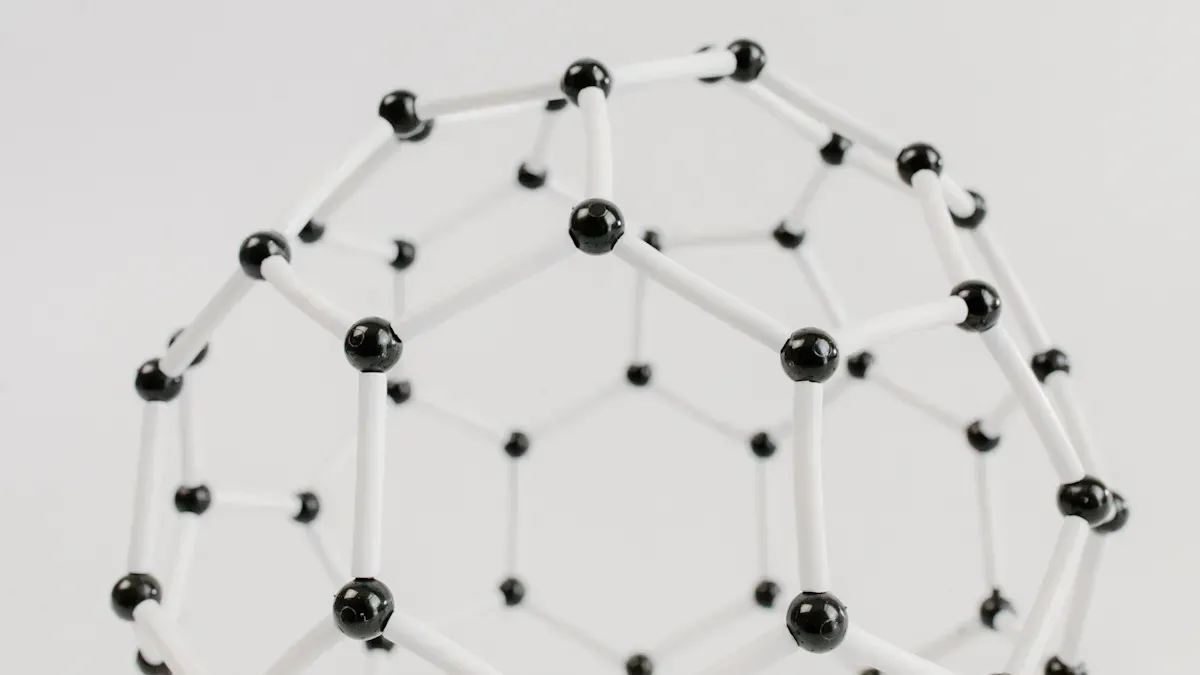
Buckyball Shape and Atom Arrangement
When you look at Fullerene C60, you see a molecule that looks like a soccer ball. This shape is called a "buckyball." Sixty carbon atoms connect together to form a closed cage. The pattern includes 12 pentagons and 20 hexagons. Each carbon atom bonds with three neighbors. Two of these bonds are single bonds with pentagons, and one is a double bond with a hexagon. The bond angles measure about 120° and 108°, which makes the structure different from graphite or diamond.
You can compare Fullerene C60 to other forms of carbon by looking at their structures:
| Carbon Allotrope | Structure Description |
|---|---|
| Fullerene C60 | Closed-cage structure with 12 pentagons and 20 hexagons, exhibiting high symmetry. |
| Graphite | Two-dimensional planar structure with layers of hexagonal arrangements. |
| Diamond | Three-dimensional structure with each carbon atom bonded to four others in a rigid lattice. |
| Graphene | Single layer of carbon atoms in a hexagonal arrangement, similar to a sheet of graphite. |
The bond lengths in Fullerene C60 range from 1.40 to 1.45 Å. This range helps the molecule keep its round shape. The spherical design causes the carbon atoms to bend slightly, which scientists call "pyramidalization." This bending changes how the electrons move in the molecule. As a result, Fullerene C60 can attract and hold electrons well. This property makes it useful in electronics and other advanced technologies.
Tip: The unique arrangement of pentagons and hexagons gives Fullerene C60 both strength and flexibility, making it stand out among carbon materials.
Stability and Icosahedral Symmetry
Fullerene C60 shows a high level of symmetry called icosahedral symmetry. This means the molecule looks the same from many different angles. Scientists use the term "C60-Ih" to describe this symmetry group. The even shape spreads out any strain in the molecule, which helps it stay stable.
You can see how different parts of the structure add to its stability:
| Structural Feature | Contribution to Stability |
|---|---|
| Isolated Pentagons | Avoid strain, enhancing stability |
| Hexagons | Provide resonance stabilization |
| Symmetry of C60 | Uniform distribution of strain, increasing overall stability |
- The isolated pentagons prevent too much strain from building up.
- The hexagons allow electrons to move freely, which adds extra stability.
- The symmetry makes sure that no part of the molecule is weaker than another.
The icosahedral symmetry also affects how Fullerene C60 reacts with other chemicals. This symmetry lets you attach different atoms or groups to the molecule, which is helpful in medicine and materials science. The shape even looks like some natural molecules, so scientists study it as a possible drug carrier. However, the double bonds in the structure can make it reactive, so you need to handle it with care.
Note: The balance between stability and reactivity makes Fullerene C60 a fascinating subject for research and new inventions.
Fullerene C60 Properties and Applications

Physical and Chemical Properties
You can discover many interesting physical and chemical properties when you study Fullerene C60. This molecule melts at about 280ºC. It stays stable up to around 400ºC if you keep it in an inert atmosphere. If you heat it in air above 600ºC, it will break down.
- Melting point: about 280ºC
- Stable up to ~400ºC in an inert atmosphere
- Decomposes above 600ºC in air
Fullerene C60 does not dissolve well in water, but it dissolves much better in some organic solvents. You can see how its solubility changes in different liquids:
| Solvent | Solubility (mg/L) |
|---|---|
| Pure Toluene | 3000 |
| Tetrahydrofuran | 11 |
| Ethanol | 1.4 |
| Acetonitrile | 0.04 |
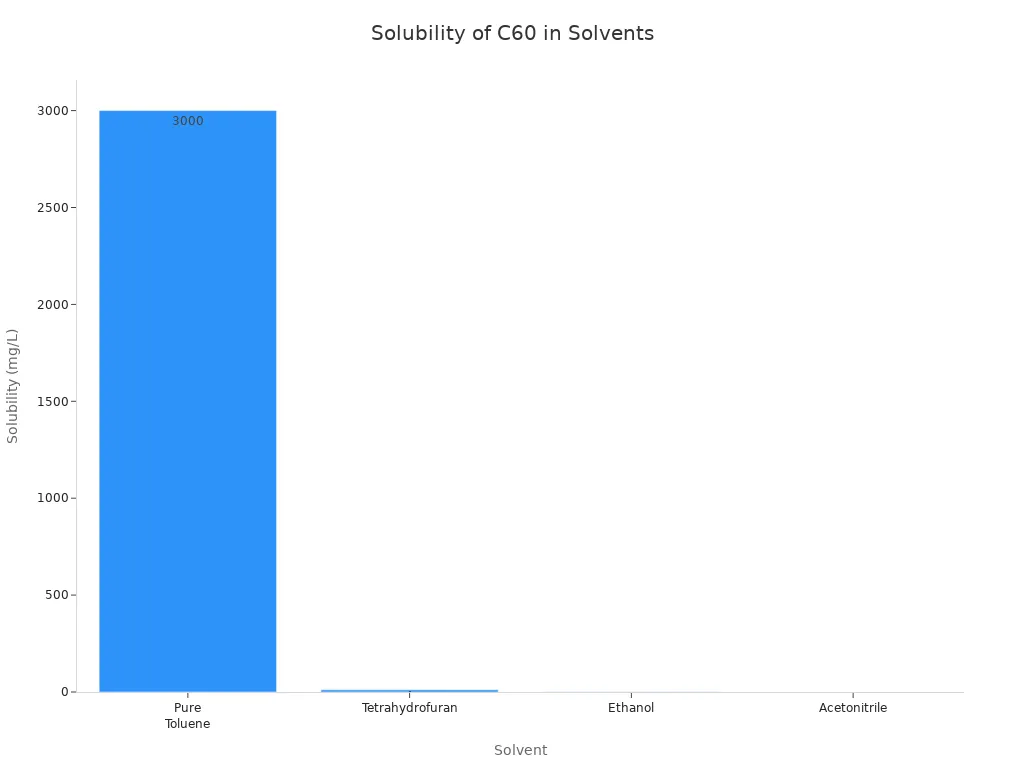
You will notice that Fullerene C60 dissolves best in pure toluene. This property helps scientists use it in different chemical reactions and applications.
You can also see that Fullerene C60 absorbs light strongly in the UV-visible spectrum. This means it can interact with light in ways that other forms of carbon cannot. It also acts as an excellent electron acceptor, which makes it useful in solar cells and other electronic devices.
Tip: The strong absorption of light and high electron affinity make Fullerene C60 a favorite in research on new energy sources.
Uses in Medicine, Electronics, and Materials Science
You can find Fullerene C60 in many advanced fields. In medicine, scientists use it for several important purposes:
| Application Type | Description |
|---|---|
| Drug and Gene Delivery | Fullerenes can cross cell membranes, allowing for targeted delivery of therapies directly to cells. |
| Antiviral Applications | C60 can inhibit virus replication when combined with certain molecules, enhancing water solubility. |
| Diagnostics | Fullerenes can carry and slowly metabolize elements in the body, aiding in the diagnosis of conditions. |
| Anti-aging | C60 has antioxidant properties that may help reduce wrinkles and improve skin moisture retention. |
| Musculoskeletal Issues | Studies show C60 may reduce muscle fatigue and inflammation in conditions like arthritis. |
| Cognitive Function | Research indicates C60 may prevent cognitive decline by inhibiting harmful peptides in the brain. |
| Tumor Research | C60 is being explored for its potential to target cancer cells and induce cell death through light activation. |
You can see that the pharmaceutical industry values Fullerene C60. The market for this molecule is growing quickly, especially for drug delivery and anti-aging products. Experts expect the global market to grow at about 15% each year from 2022 to 2028. The use of nanomaterials in healthcare could reach over $200 billion by 2026.
In electronics, you can find Fullerene C60 in devices like organic solar cells and field-effect transistors. It acts as an electron acceptor in organic photovoltaics, which helps solar cells work better and last longer. It also serves as an n-type semiconductor in organic field-effect transistors.
- Used in organic photovoltaics (OPVs) as a classic electron acceptor
- Used in organic field-effect transistors (OFETs) as an n-type semiconductor
In materials science, you can use Fullerene C60 to make materials stronger and more durable. It improves conductivity and helps create lighter, stronger composites. These features make it valuable for energy-efficient products and advanced engineering.
- Enhances strength and durability of materials
- Improves conductivity
- Enables lighter and stronger composites
- Promotes energy efficiency
Note: You can find Fullerene C60 in many products, from medical treatments to solar panels and advanced materials.
Comparison with Graphite, Graphene, and Diamond
You may wonder how Fullerene C60 compares to other forms of carbon. Each form has its own special properties. The table below shows some key differences:
| Material | Conductivity | Notes |
|---|---|---|
| Fullerene C60 | Low | Curved structure limits electron movement between molecules. |
| Diamond | Non-conductor | All valence electrons are used in bonding, preventing conductivity. |
| Graphite | Good conductor | Delocalized electrons allow for conductivity; layers can slide easily. |
| Graphene | Excellent conductor | Highly conductive due to its two-dimensional structure and delocalized electrons. |
You can see that graphite and graphene conduct electricity much better than Fullerene C60 or diamond. Fullerene C60 has a curved structure, which makes it harder for electrons to move between molecules. Diamond does not conduct electricity at all because its electrons are locked in strong bonds.
If you compare hardness, both Fullerene C60 and diamond show remarkable strength:
| Material | Hardness Comparison |
|---|---|
| Fullerene C60 | Exhibits remarkable hardness, potentially comparable to diamond |
| Diamond | Known for its exceptional hardness, the hardest natural material |
You can also compare their optical properties. Fullerene C60 absorbs light strongly in the UV-visible range, while graphite and graphene do not show this feature as clearly. This makes Fullerene C60 useful in devices that need to interact with light, such as solar cells.
Tip: Each form of carbon has its own strengths. Fullerene C60 stands out for its unique combination of stability, strength, and special electronic and optical properties.
You see Fullerene C60 as a molecule that changes science and technology. You find it in nanotechnology, medicine, and energy. You notice its market grows quickly. You may use it for drug delivery, new materials, or even batteries. Research continues to reveal new uses and benefits.
- Nanotechnology foundation
- Medical breakthroughs
- Fast-growing market
FAQ
What makes Fullerene C60 different from other carbon molecules?
You see Fullerene C60 as a soccer ball shape. This structure gives it unique strength and stability.
| Feature | Fullerene C60 | Graphite | Diamond |
|---|---|---|---|
| Shape | Spherical | Layered | Lattice |
| Stability | High | Medium | High |
Can you use Fullerene C60 in everyday products?
You find Fullerene C60 in cosmetics, solar panels, and medical research.
Tip: Scientists study it for new uses in batteries and drug delivery.
Is Fullerene C60 safe for you to handle?
You must wear gloves and use proper safety equipment.
- Avoid breathing dust.
- Store it in a cool, dry place.